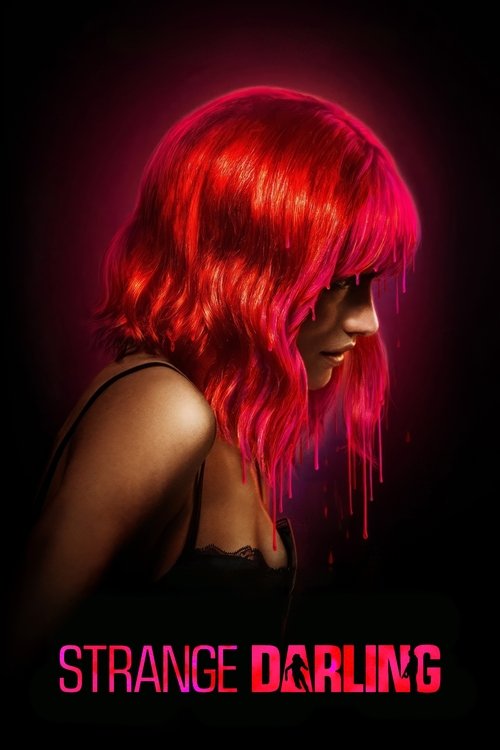
Strange Darling
2024 · JT Mollner
For when you're craving something dangerous — a wild, twisty midnight movie that plays rough and rewards you for paying close attention. Fair warning: it goes to genuinely dark places around sex and violence, so it's a challenge, not a cozy scare.
What it's about
A man and a woman meet for a one-night stand in rural Oregon, and within a day it has spiraled into a savage game of hunter and hunted, with a serial killer's spree at its center. The story is dealt out in six numbered chapters shuffled out of order, so every new scene forces you to rethink what you thought you knew about these two people — who they are to each other, and who you should be afraid of.
The experience
A nasty, nervy rush — lurid, violent, and constructed like a trap, with each chapter jolt rearranging your sympathies. It's the kind of thriller you watch leaning forward, half-thrilled and half-queasy, and the structure makes it hugely fun to argue about afterward.
Performances
Willa Fitzgerald is ferocious in a role that demands she shift registers scene to scene, and Kyle Gallner matches her with live-wire unpredictability — the whole film rests on the two of them and they carry it.
The craft
Shot on 35mm anamorphic film — by actor Giovanni Ribisi, in a striking turn behind the camera — it has a saturated, grainy, 1970s-thriller texture that digital rarely matches. The out-of-order chapter structure isn't a gimmick; it's the engine of the suspense, and the editing wrings maximum menace from every cut. Looks gorgeous projected big.
Why it matters
A word-of-mouth hit that became one of the most talked-about indie thrillers of 2024, sparking real debate about its provocations and announcing JT Mollner as a filmmaker to watch.
Snapshot
Strange Darling is a two-hander thriller that disguises a fairly simple chase as a formal puzzle. Across roughly twenty-four hours in rural Oregon, a man and a woman who meet for a one-night stand turn on each other, and what begins as the apparent stalking of a vulnerable woman by a predatory stranger is gradually revealed to be the reverse. Writer-director JT Mollner shoots the story in six numbered "chapters" presented out of chronological order, so the audience is repeatedly forced to revise its assumptions about who is the hunter and who is the prey. Willa Fitzgerald plays "The Lady" and Kyle Gallner "The Demon," the film withholding proper names as part of its game. The picture's most discussed attribute is extra-textual as much as textual: it was photographed on 35mm anamorphic film by the actor Giovanni Ribisi in his debut as a cinematographer, a fact the film foregrounds in an opening title card. Strange Darling is a minor but genuinely clever entry in the 2020s wave of trope-aware American genre filmmaking — a movie whose chief pleasure is the controlled detonation of a single twist, engineered through structure rather than spectacle.
Industry & production
Strange Darling is an independent American genre production, modest in scale and built around two lead performances and a handful of locations. It is the second narrative feature directed by JT Mollner, following the period Western Outlaws and Angels (2016); the long gap between features situates it as the work of a filmmaker outside the studio system who returned with a tighter, more commercial conceit. The film premiered on the festival circuit — at Fantastic Fest in Austin in 2023 — before a theatrical release in 2024 handled in the United States by Magnolia Pictures' Magenta Light Studios. Beyond these broad facts the granular production record (budget, exact shooting schedule, full financing structure) is not something I can state with confidence, and I will not invent figures.
What is clear is the production's bet on a single distinctive asset: shooting on celluloid at a moment when independent thrillers almost universally originate digitally, and recruiting a name actor as first-time director of photography. That choice is both an aesthetic decision and a marketing one, giving a small film a talking point and a texture that distinguishes it from the flat digital look of much streaming-era horror. The casting follows the same logic of leveraging recognizable faces in a contained story: Fitzgerald and Gallner are both seasoned genre performers, and the supporting cast includes veteran character actors — Barbara Hershey and Ed Begley Jr. among them — whose presence lends gravity to brief roles. The economics of the film are those of the elevated-genre indie: keep the cast and locations few, invest in craft and concept, and rely on a hook (here, the structural gimmick and the celluloid pedigree) to cut through.
Technology
The defining technological choice is the use of photochemical film. Strange Darling was shot on 35mm in an anamorphic format, and it announces this in an early title card, effectively making its capture medium part of its identity. In the 2020s this is a deliberate counter-current. The grain, halation, and gentle highlight roll-off of film stock give the image an organic, slightly nostalgic quality that digital sensors render differently; anamorphic lenses add their characteristic shallow, oval-bokeh fields and horizontal flares. For a thriller built on landscape, blood, and faces in close-up, these properties matter: skin tones, the saturated reds of violence, and the Pacific Northwest's greens read with a richness the film clearly wants.
The decision also has narrative consequences. By committing to celluloid, the production accepted the discipline of film — finite takes, considered lighting, a slower setup — which tends to push a small crew toward precision rather than coverage-heavy improvisation. The result is an image that feels composed rather than captured. Beyond the stock and lenses, Strange Darling is not a technologically experimental film; it deploys no novel visual-effects pipeline or virtual production. Its innovation is regressive on purpose, using an older tool to achieve a tactile look that separates it from its digital peers.
Technique
Cinematography
Giovanni Ribisi's photography is the film's calling card. Working in anamorphic 35mm, he favors strong, saturated color and a painterly use of light, and the film's palette leans into bold blocks of red that both foreshadow and depict its bloodshed. The Oregon exteriors — forest, road, an isolated property — are shot with an eye for the menace of open space, while interior scenes exploit the format's shallow focus to isolate faces. For a first-time cinematographer, the work is notably assured, though it is worth saying plainly that Ribisi arrived with decades on set as an actor, an apprenticeship of observation that informs the confidence of the framing. The camera is an active participant in the film's deception: by controlling what we see and the order in which we see it, the cinematography helps sustain the misdirection about who threatens whom, presenting images that are literally accurate but contextually misleading until the structure reorders them.
Editing
Editing is arguably the film's true authorial instrument, because Strange Darling's entire effect depends on sequence. The story is divided into six chapters screened out of order, and the assembly is engineered so that each new chapter recontextualizes what came before. The non-chronological structure is not decorative; it is the mechanism by which a conventional predator-and-prey scenario is inverted, withholding the information that would collapse the suspense if presented linearly. The cutting therefore carries an unusual burden — it must keep the audience oriented enough to follow the action while disoriented enough to mistake the killer for the victim. I am not able to confirm the editor's name with certainty and will not guess; what can be said is that the film belongs to a lineage of puzzle-structured thrillers in which the edit, more than any single shot, is the locus of meaning.
Mise-en-scène / staging
The staging is spare and functional, organized around bodies in pursuit and confrontation. Costuming does quiet narrative work — the visual coding of the two leads is arranged to support, then subvert, the audience's instinct about which is dangerous. Locations are few and elemental: road, woods, house, motel-like interiors, the iconography of the American backroads thriller. Within these spaces Mollner stages violence and intimacy with the same matter-of-factness, refusing to telegraph the inversion through the blocking until the script wants it revealed. The production design is naturalistic rather than stylized; the film's expressiveness lives in light and color more than in elaborate sets.
Sound
The soundtrack mixes score with curated needle drops, and the film uses music pointedly — both to set period-flavored mood and, at moments, to ironize the on-screen action. The sound design emphasizes the quiet of rural isolation punctured by sudden violence, the contrast between near-silence and abrupt aggression doing a good deal of the suspense work. I am not confident of the composer's identity and decline to attribute the score to a specific artist; what is observable is that the music is deployed as commentary as much as atmosphere, a knowing tonal layer consistent with the film's broader self-awareness.
Performance
Strange Darling lives or dies on two performances, and both are pitched to serve the structural reversal. Willa Fitzgerald, as The Lady, must read first as terrorized victim and later as something far colder, and the role demands a performance that retroactively reveals a second self without ever having cheated in the first register — a difficult two-faced assignment she carries. Kyle Gallner, a familiar genre presence, plays The Demon against the audience's initial reading of him, and his work anchors the film's central misdirection. The supporting players — including the veterans noted above — provide texture in compact appearances. The acting is the human counterweight to the film's mechanical cleverness, keeping a high-concept structure emotionally legible.
Narrative & dramatic mode
The film's dramatic mode is the suspense thriller refracted through nonlinear, chaptered storytelling. Its governing device is dramatic irony inverted: rather than granting the audience knowledge the characters lack, Strange Darling deliberately gives the audience false knowledge, letting genre conditioning — the assumption that a man chasing a fleeing woman is the aggressor — supply a wrong reading that the structure then dismantles. The six-chapter, out-of-order design is a riddle whose solution reframes the genre itself. This places the film in the tradition of the twist narrative, where the value proposition is the reveal and the rewatch, and where the pleasure is partly retrospective — recognizing, after the fact, how fairly the deception was played. The risk of such a mode is that once solved, the puzzle loses charge; Strange Darling mitigates this by grounding the gimmick in performance and craft so that the images retain interest beyond the trick.
Genre & cycle
Strange Darling belongs to the contemporary cycle of self-aware American horror-thrillers that interrogate, rather than simply deploy, their inherited tropes — particularly the gendered conventions of the slasher and the home-invasion / lovers-on-the-run thriller. It converses directly with the "final girl" framework codified in scholarship on the slasher film: the movie sets up the expectation of a woman fleeing a male killer and then weaponizes that expectation. In doing so it sits alongside a broader 2010s–2020s tendency, sometimes labeled "elevated horror," in which genre mechanics are turned to commentary on perception, gender, and violence. It also draws on the grindhouse and exploitation lineage — the rural pursuit thriller, the saturated palette, the title-card framing — but filters that pulp through a puzzle-box architecture. The film is thus a hybrid: pulpy in content, formally ambitious in delivery.
Authorship & method
The film is most legibly the work of JT Mollner as writer-director: the concept, the chaptered structure, and the trope-inversion are authorial signatures, and Strange Darling reads as a screenwriter's film in which structure is the central idea. Mollner's method here is conceptual — to build a thriller whose form is inseparable from its twist — and to execute it with a small, craft-forward team. The decisive collaboration is with Giovanni Ribisi, whose 35mm cinematography supplies the film's sensory identity and whose debut behind the camera became part of the film's story. The lead performers, Fitzgerald and Gallner, function almost as co-authors of the deception, since their calibrated performances are what make the reversal land. Regarding the composer and editor, I cannot reliably name them and will not fabricate attributions; the honest statement is that the film's effect is distributed across writing, structure, photography, and acting, with Mollner and Ribisi the two collaborators whose contributions are firmly established in the public record.
Movement / national cinema
This is American independent genre cinema, rooted in the regional landscape of the Pacific Northwest and in the long American tradition of the backroads thriller. It is not affiliated with a formal movement, but it is fluent in the language of a loose contemporary tendency: the trope-conscious, festival-launched genre film (associated in distribution terms with companies like Magnolia and in spirit with the broader "elevated genre" conversation). Its use of celluloid also aligns it with a small cohort of contemporary American filmmakers consciously resisting the digital default. The national-cinema frame is therefore the United States' indie-genre ecosystem — festivals, specialty distribution, recognizable genre performers — rather than any national school or stylistic manifesto.
Era / period
Strange Darling is very much a film of the mid-2020s, and self-consciously so. Its trope-awareness presumes an audience saturated in slasher and thriller conventions, the kind of literate viewership that decades of genre cinema and a decade of "elevated horror" discourse have produced. Its formal play with chronology participates in a long post-Pulp Fiction normalization of nonlinear storytelling. And its insistence on 35mm is legible only against the digital baseline of its moment — the celluloid gesture means something precisely because nearly everything around it is shot digitally. The film's content, structured around a one-night-stand-gone-wrong and questions of who is permitted to be read as victim, also reflects a contemporary cultural preoccupation with the politics of perceived threat and gendered violence.
Themes
The film's central thematic gambit is the politics of assumption — specifically, how genre and gender condition us to assign the roles of victim and aggressor on sight. By inverting the expected dynamic, Strange Darling turns its thriller plot into a meditation on misperception: the audience's wrong reading is the point, and the film implicates the viewer's reflexes rather than merely surprising them. Secondary threads include the violence latent in intimacy and the thin membrane between desire and danger, since the story springs from a sexual encounter that curdles. There is also a meta-theme about storytelling itself — about how the order of information manufactures truth, and how a "true" sequence of images can be assembled into a lie. The film is less interested in psychological depth than in this epistemological game, which is both its distinction and its limitation.
Reception, canon & influence
Strange Darling was received as a smart, stylish genre exercise whose structural conceit and celluloid look drew particular praise, with the Fitzgerald and Gallner performances and Ribisi's cinematography singled out; the most common reservation in such reception is the familiar one for twist-driven films — that the cleverness of the structure can outweigh emotional investment. I'll flag honestly that I cannot cite specific review verdicts, critical aggregator scores, or box-office figures with confidence, and I will not invent them.
Looking backward, the film's influences are well-marked. It draws on the slasher tradition and its scholarship on the final girl; on the nonlinear, chaptered storytelling normalized by 1990s American independent cinema; on the grindhouse / exploitation thriller's iconography and title-card framing; and on a recent run of trope-deconstructing genre films that taught audiences to expect their expectations to be subverted. Its commitment to anamorphic 35mm places it in dialogue with filmmakers championing photochemical capture in the digital era.
Looking forward, Strange Darling is too recent for its legacy to be assessed responsibly, and any claim of broad influence would be premature. What can be said is that it functions as a calling card on two fronts: it advanced JT Mollner's profile as a structure-minded genre director, and it launched Giovanni Ribisi as a cinematographer, a debut notable enough that it may shape his subsequent career. Within the ongoing cycle of self-aware American horror-thrillers, it stands as a well-engineered example of how structure alone can refresh a familiar premise — a small film whose afterlife will likely rest on rewatchability and on its place in the conversation about trope subversion rather than on box-office or franchise impact.
A Deleuzian reading
A woman runs through Oregon woods.
The full Deleuzian reading of Strange Darling →
Reception
Premiered at Fantastic Fest 2023, then sat on the shelf for nearly a year before its August 2024 release — where word of mouth (and a Stephen King rave calling it 'a clever masterpiece') turned it into the sleeper thriller of the summer. Critics were near-unanimous; audiences have been arguing about it ever since.
How Strange Darling was received, from release to now →
Influences: the films it descends from and the films it influenced
- Psycho (1960) — Establishes the structural betrayal Strange Darling runs on — killing off the apparent protagonist and revealing a two-faced killer behind unassuming against-type casting, weaponizing the audience's misplaced identification.
- Pulp Fiction (1994) — Models the out-of-sequence chaptered structure with on-screen title cards that reorder cause and effect so each scene is ironically recontextualized by what we learn later — the exact device of Strange Darling's numbered chapters.
- Reservoir Dogs (1992) — Pioneers color-coded character identity and a withhold-then-reveal architecture, the costume-coding and information-rationing grammar Strange Darling uses to disguise predator and prey.
- Memento (2000) — Engineers chronology so the audience is locked into the protagonist's misinformation — the inverted dramatic irony where reordering, not new events, is what produces the twist.
- Irréversible (2002) — Demonstrates reverse-chronology as a craft engine, letting effect precede cause so dread and recontextualization accrue from sequence alone.
- The Texas Chain Saw Massacre (1974) — Founds the backroads-predation iconography and grindhouse celluloid texture — isolated rural pursuit shot on grain — that Strange Darling cites and stylizes.
- Halloween (1978) — Codifies the final-girl template and killer-POV stalking grammar whose expectations Strange Darling deliberately inverts.
- Audition (1999) — Pioneers the demure-woman-revealed-as-torturer reversal, the gendered against-type flip of victim and aggressor that Strange Darling's lead performance descends from.
- Death Proof (2007) — Pairs grindhouse 35mm aesthetics and ironic needle drops with women flipping the predator-prey dynamic on a backroads — the tonal and formal package Strange Darling refines.
- The Hateful Eight (2015) — Combines explicit chapter-title structure with militant photochemical (70mm) capture in the digital era, the chaptered-plus-celluloid commitment Strange Darling adopts on anamorphic 35mm.
- Funny Games (1997) — Builds a thriller whose entire purpose is deconstructing genre expectation and audience complicity, the trope-subversion lineage Strange Darling extends.
- Gone Girl (2014) — Stages a controlled two-faced reversal in which a woman's calibrated performance retroactively rewrites who is hunter and who is hunted — the same inverted dramatic irony driven by a deceiving lead.
- Promising Young Woman (2020) — Weaponizes a candy-saturated palette and against-type casting inside a chaptered revenge structure to subvert victim/predator coding, the bright-genre-as-trap approach Strange Darling shares.
- Revenge (2017) — Shoots hyper-saturated anamorphic backroads rape-revenge that converts the final girl into aggressor — matching Strange Darling's color-charged photography and inverted slasher dynamics.
- X (2022) — Revives the slasher as elevated horror with celluloid-conscious cinematography and a dual-faced lead performance (Mia Goth), the same craft-forward retro-genre register.
- Barbarian (2022) — Re-sequences and withholds information to repeatedly upend who the real threat is, the structural rug-pull built on misdirected audience assumption that Strange Darling also executes.
- Longlegs (2024) — Runs the same contemporary photochemical elevated-horror playbook — anamorphic dread and against-type star casting deployed for unease — as a 2024 peer of Strange Darling.
Similar films
- Barbarian (2022) — influence & lineage · same viewing thread
- Longlegs (2024) — influence & lineage · often watched together
- Gone Girl (2014) — influence & lineage
- Memento (2000) — influence & lineage
- Promising Young Woman (2020) — influence & lineage
- Fresh (2022) — same viewing thread
- Trap (2024) — same viewing thread
- Leviticus (2026) — same viewing thread
All the films related to Strange Darling →
Watch it with: curated runs of related films
- Whatever's Wearing That Face — A run of horror-thrillers where the real terror is that you can't trust what a person appears to be — a double, a shapeshifter, a smiling stranger, the one you desire.