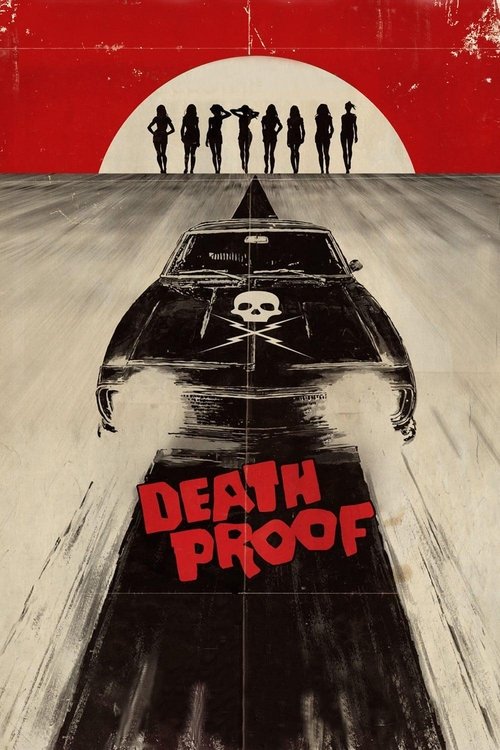
Death Proof
2007 · Quentin Tarantino
For a late night when you want something trashy, talky, and adrenalized — grindhouse nostalgia with a slow fuse and a huge payoff. It asks patience with the hangout stretches and rewards it with a finale that has you yelling at the screen.
What it's about
In Austin, DJ Jungle Julia and her friends head out for a night of bars and banter, unaware they've caught the eye of Stuntman Mike — a scarred ex-Hollywood stunt driver whose matte-black muscle car is 'death proof,' but only for the man in the driver's seat. Tarantino's half of the Grindhouse double bill is a slasher where the weapon is a car, split between two groups of women and the predator circling them.
The experience
Long, loose hangout scenes — women talking, drinking, flirting — detonated by some of the most violent car action ever filmed. The rhythm is deliberately lopsided: languid, chatty stretches that make the vehicular mayhem hit like a slap, building to a final stretch of pure white-knuckle exhilaration.
Performances
Kurt Russell is magnetic and skin-crawling as Stuntman Mike, flipping between good-ol'-boy charm and something far uglier. Real-life stuntwoman Zoë Bell plays herself and performs her own jaw-dropping car work, which gives the final act a danger no digital effect can fake.
The craft
Tarantino shoots his homage complete with scratched-print damage, a 'missing reel,' and a jukebox-perfect soundtrack, then stages the car chases almost entirely with practical stunts — real metal, real speed, a real woman on a real hood. Loud speakers are practically mandatory; the engine roar is half the film.
Why it matters
The Grindhouse experiment flopped in theaters but grew a devoted cult, and Death Proof's practical-stunt finale became a rallying point for analog car action in a CGI era — and made Zoë Bell a name in her own right.
Snapshot
Death Proof is Quentin Tarantino's contribution to Grindhouse, the 2007 double-bill he mounted with Robert Rodriguez as a feature-length homage to the worn, disreputable exploitation programming of 1970s American drive-ins and 42nd Street theaters. It is a carsploitation slasher built on a hard structural bisection: Stuntman Mike (Kurt Russell), a scarred former Hollywood stunt driver, stalks and murders one group of young women with his reinforced "death proof" muscle car, then, in the film's second movement, targets a second group who turn the hunt back on him. The picture is at once Tarantino's most formally restricted work — long, dialogue-saturated scenes of women talking, punctuated by sudden vehicular violence — and a piece of loving pastiche, replete with simulated print damage, a missing reel, and needle-drop scoring. It is widely read as his most divisive film, and Tarantino himself has spoken of it self-deprecatingly as the closest he expects to come to a lesser work; that framing has shadowed its reputation even as its car stunts and its feminist revenge reversal have earned durable admiration.
Industry & production
Death Proof was conceived not as a standalone feature but as one half of Grindhouse, a collaboration between Tarantino and Rodriguez released in the United States through Dimension Films (the Weinstein-controlled genre label) in April 2007. The pair's premise was archival and affectionate: to recreate the experience of a 1970s exploitation double feature, complete with fake trailers between the two films (contributions came from Rob Zombie, Edgar Wright, and Rodriguez, whose Machete trailer later spawned an actual feature). Rodriguez's Planet Terror, a zombie picture, played alongside Tarantino's Death Proof.
The US theatrical run is generally described as a commercial disappointment relative to its cost and the directors' profiles; audiences reportedly found the three-plus-hour double-feature format and the deliberately damaged aesthetic difficult to parse. In response, the Weinsteins split the two films apart for many international markets and home video, releasing them as separate, longer standalone features. Tarantino's extended cut of Death Proof premiered in competition at the Cannes Film Festival in May 2007 and runs substantially longer than the Grindhouse version — most notably restoring a black-and-white lap-dance sequence that the double-feature edition elided with a "missing reel" gag. I would flag that precise budget and box-office figures for the standalone versus the combined release are reported inconsistently across sources, so I avoid citing specific numbers here.
Production was comparatively lean by Tarantino's standards, shot largely in Austin, Texas, and Lebanon, Tennessee — locations that double for the film's two geographic acts. The practical, stunt-driven climax was the production's centerpiece and its chief logistical commitment.
Technology
The film was photographed on 35mm and then deliberately degraded to imitate the physical decay of over-circulated exploitation prints: added scratches, dust, hairs in the gate, blown-out reel-change cues, abrupt splices, and color that lurches or drops to black-and-white. This distressing was applied through a mix of photochemical and digital processing after the fact, so that a contemporary production masquerades as a beaten 1970s artifact. The "missing reel" — where a scene appears to jump because a projectionist's reel has been lost — is the most conspicuous technological joke, converting the material fragility of celluloid distribution into a narrative device. The choice sits against the grain of the mid-2000s industry drift toward pristine digital intermediates; Death Proof uses the era's finishing tools to manufacture imperfection rather than erase it.
Technique
Cinematography
Tarantino served as his own cinematographer on Death Proof, an unusual step for a director who had worked repeatedly with major DPs (notably Robert Richardson). Operating the camera himself suited the film's conceit: the imagery favors the vernacular grammar of exploitation cinema — zooms, hand-held immediacy, saturated then abruptly desaturated stock, and compositions that linger on legs, feet, dashboards, and diner tables. The talk scenes are shot with patient, rotating coverage that lets performances breathe; the vehicular sequences shift to a rawer, more kinetic register. The famous foot fetishism of Tarantino's authorship is here foregrounded as a compositional principle, not a stray motif.
Editing
Sally Menke, Tarantino's editor on every one of his features until her death, cut Death Proof, and the film is in many ways an editing statement. The two halves are built as mirror structures; the escalation from stillness to catastrophe depends entirely on rhythm. The head-on collision that ends the first movement is presented in a bravura repeated-angle montage, replaying the moment of impact from several vantage points to itemize each woman's death — a passage that weaponizes editing's capacity to hold and dissect an instant. Menke also engineers the faux-degradation's rhythmic hiccups, integrating the "missing reel" and jump-splices so they read as accidents of the print rather than authorial cuts.
Mise-en-scène / staging
The film's material world is fetishistically specific: the muscle cars are characters. Stuntman Mike drives a 1970 Chevy Nova and later a 1969 Dodge Charger; the second group's climactic vehicle is a white 1970 Dodge Challenger, explicitly invoked as the car from Vanishing Point (1971). Bars, diners, and roadside Americana furnish the staging, and Tarantino stages his long conversations with a theatrical confidence in the actors — bodies arranged around tables, the camera circling. The "death proof" car itself, reinforced for the driver and lethal to everyone else, is the film's central object and its cruelest metaphor for one-sided invulnerability.
Sound
There is no original score. Tarantino builds the soundtrack from compiled recordings, his signature method: Jack Nitzsche's brooding instrumental "The Last Race" recurs as Stuntman Mike's leitmotif, and April March's "Chick Habit" — a bouncy, kiss-off pop song — closes the film over the women's triumph, its lyric turning ironic vengeance sweet. The sound design otherwise leans on engine noise, tire shriek, and the diegetic textures of jukeboxes and radios, with the manufactured pops and dropouts of the "damaged print" bleeding into the audio track as well.
Performance
Kurt Russell anchors the film, and his casting is itself a citation — a performer with a deep action and car-movie lineage, deployed first as a charming raconteur and then as a whimpering coward once the prey fights back. Russell modulates from menace to abject terror in a way that supplies the film's second-half comic release. The ensemble is largely young women: Sydney Tamiia Poitier as the DJ Jungle Julia, Vanessa Ferlito, Jordan Ladd, and Rose McGowan in the first group; Rosario Dawson, Tracie Thoms, Mary Elizabeth Winstead, and the New Zealand stuntwoman Zoë Bell — playing a version of herself — in the second. Bell's presence is the film's key performance gambit: as an actual stuntwoman doing her own work, she collapses the distinction between performer and stunt double that Stuntman Mike embodies as villain.
Narrative & dramatic mode
Death Proof runs on a diptych structure that withholds conventional momentum. The first half is nearly all conversation — women drinking, flirting, gossiping, moving between bar and car — before erupting into sudden slaughter. The second half repeats the shape but inverts the outcome: another set of women talk at length, then, when Stuntman Mike attacks, they refuse the victim role and hunt him to a beating death. The dramatic mode is thus one of deferral and reversal. The talk is not filler but the point: it establishes the women as specific, sovereign people, so that the first group's deaths land as loss and the second group's survival as earned. The film flouts the thriller contract — that tension should build steadily — in favor of a rhythm of long plateaus and vertical drops, a structure closer to the shaggy patience of 1970s cinema than to contemporary action pacing.
Genre & cycle
The film braids two exploitation cycles. It is a slasher — a predatory man kills women with a phallic, weaponized machine — and it is a carsploitation road picture in the lineage of Vanishing Point, Dirty Mary, Crazy Larry (1974), and Gone in 60 Seconds (1974), with the muscle-car chase as its ecstatic center. Stuntman Mike literalizes the slasher's implement as an automobile, and the film's climax converts the passive terror of the woman-in-peril chase into an active pursuit. By staging its practical car work without CGI — most famously Bell riding the hood of a speeding Challenger in the "Ship's Mast" sequence — Death Proof also functions as a tribute to the vanishing craft of the physical stunt driver, the very trade its villain has corrupted.
Authorship & method
Death Proof is a concentrated expression of Tarantino's method: genre pastiche as a mode of authorship, compiled music in place of an original score, dialogue as spectacle, and a dense weave of cinephile citation (the Vanishing Point Challenger; the recurring Texas Ranger Earl McGraw, played by Michael Parks, who threads through Tarantino and Rodriguez's shared universe). Tarantino wrote and directed, and on this project also photographed the film himself. His collaboration with editor Sally Menke is central to the film's mirror architecture and its manipulation of the "damaged" print. The absence of a composer is itself an authorial signature — Tarantino curates rather than commissions his music. His own on-screen cameo (as the bartender Warren) and casting choices rich in extra-textual meaning — Russell's action past, Bell's real stunt career — are characteristic of a director who treats casting as commentary. Tarantino has publicly ranked the film among his least favorite of his own works, a self-assessment that is unusual candor and that has colored, perhaps unfairly, its critical afterlife.
Movement / national cinema
The film belongs to American independent-descended commercial cinema, but its true "movement" is a retrospective one: the postmodern revival and homage tradition through which Tarantino, since the early 1990s, has metabolized global exploitation and genre film. Death Proof is a museum of a specifically American disreputable cinema — the drive-in, the grindhouse theater, the regional carsploitation quickie — reanimated for a 21st-century audience largely unfamiliar with it. In that sense it is less a national cinema statement than an act of cinephile archaeology directed at a lost mode of exhibition.
Era / period
Made and set in the present of the mid-2000s, the film nonetheless lives in a temporal double exposure. Cell phones and contemporary slang mark it as of 2007, while its texture, cars, music, and print damage evoke the 1970s. This anachronism is deliberate: the film argues that the pleasures of exploitation cinema — physical stunts, muscle cars, unhurried talk — are recoverable but endangered. Its release also coincides with a broader mid-decade wave of genre nostalgia and a growing tension between celluloid and digital, which Death Proof thematizes through its manufactured decay.
Themes
The film's governing theme is invulnerability and its puncture. Stuntman Mike's car is "death proof" only for him; his power depends on an asymmetry — he can inflict what he cannot suffer. The second half exists to destroy that asymmetry, subjecting him to genuine risk and, finally, terror and death. Around this sits a sustained meditation on gender and predation: the film has been read, and has invited reading, as a feminist revenge structure in which women initially objectified by camera and killer become agents who reclaim the road and the machine. That reading is contested — some critics find the film's fetishism and violence toward the first group too complicit to redeem — and the debate is part of the work's meaning rather than a settled verdict. Craft and authenticity form a third strand: through Zoë Bell's real stunts, the film valorizes bodily, non-digital labor against a corrupt professional (Mike) who turns the stuntman's skills to murder.
Reception, canon & influence
Critical reception was sharply divided and remains so. Within Grindhouse, Death Proof was frequently judged the more demanding, talkier half, and the US double-feature's commercial underperformance framed early coverage; the standalone extended cut's Cannes premiere drew warmer, more considered notice for its craft and its climactic chase. The car sequences, and Bell's performance and stunt work, are near-universally praised; the languid first acts remain the flashpoint between admirers who see structural daring and detractors who see indulgence.
Its influences run backward into 1970s exploitation and carsploitation — Vanishing Point above all, cited by name via the white Challenger, alongside the broader muscle-car chase tradition (Bullitt, Dirty Mary, Crazy Larry, Gone in 60 Seconds) and the slasher's stalking grammar. Forward, its most concrete legacy is the elevation of Zoë Bell, whom the film transformed from stunt double to on-screen presence and whom Tarantino continued to feature in later work. More broadly, Grindhouse and Death Proof helped legitimize the fake-trailer/homage mode — the Machete trailer became a real franchise — and stand as a landmark in the ongoing cultural rehabilitation of exploitation cinema. Within Tarantino's own canon the film occupies a peculiar niche: routinely named among his minor efforts, including by the director, yet cherished by a substantial contingent for its practical stunt work, its dialogue, and its blunt, cathartic reversal of the woman-in-jeopardy tradition.
A Deleuzian reading
A camera goes around a table in an Austin bar.
The full Deleuzian reading of Death Proof →
Reception
Released as half of the Grindhouse double bill, it bombed at the 2007 US box office and was quickly filed under 'lesser Tarantino' — but its extended cut played in competition at Cannes, and it's since become the pet cause of fans who insist the 'worst QT movie' is secretly one of his most interesting.
How Death Proof was received, from release to now →
How to watch Death Proof: what to notice on a first viewing
- Watch how long the camera circles the bar-table conversation. This circling coverage returns for every group of women who talk before Stuntman Mike appears, holding ordinary time until the story seems to stop moving. Deleuze calls this dead time: suspended story time that makes the women real as people.
- Notice the camera lingering on feet, legs, and dashboards. Tarantino, shooting his own film, repeats this framing across talk scenes and drives alike. It isn't a stray habit; it's how the camera composes. The camera's appetite for parts of bodies mirrors Stuntman Mike's own gaze.
- Listen for Jack Nitzsche's brooding instrumental returning around Stuntman Mike. "The Last Race" recurs as his leitmotif across both halves, tying otherwise unconnected scenes to his lurking presence. The recurring cue lets you track the threat in scenes where he says nothing at all.
- Look at the specific muscle cars: Nova, Charger. Stuntman Mike drives the Nova, then the Charger, and the film wears its debt to 1970s car movies openly. The cars carry genre history with them, turning the chase into a conversation with 1970s carsploitation films.
The whole guide to watching Death Proof, with the keys for a rewatch →
Influences: the films it descends from and the films it influenced
- Vanishing Point (1971) — Death Proof directly quotes it via the identical white 1970 Dodge Challenger R/T, inheriting its car-as-fetish-object and its existential-driver mythos as a diegetic citation.
- Bullitt (1968) — Established the bumper- and interior-mounted, real-speed practical car chase with no process shots, the grammar Death Proof's climactic pursuit deliberately revives without CGI.
- Dirty Mary, Crazy Larry (1974) — Supplies the carsploitation road-duel template — Dodge muscle car, rural two-lane geography, cop-and-civilian pursuit — that structures the film's final chase.
- Gone in 60 Seconds (1974) — Its ethos of really wrecking real cars with driver-performed stunts is the practical-destruction creed Death Proof honors by putting Zoë Bell on the actual hood.
- Halloween (1978) — Provides the slasher's stalking/menace grammar — a predator patiently sizing up a group of women — which Death Proof transplants onto Stuntman Mike before inverting the woman-in-jeopardy convention.
- Faster, Pussycat! Kill Kill! (1965) — Fuses lethal women, fast cars, and exploitation iconography, seeding the deadly-women-behind-the-wheel imagery Death Proof weaponizes for its revenge reversal.
- Two-Lane Blacktop (1971) — Its languid, talk-heavy car-culture hangout structure — engines and idle chatter as the movie's real subject — models Death Proof's controversial slow first acts and cars-as-characters.
- Duel (1971) — Renders an automobile itself as a faceless predatory killing-machine stalking a highway victim, the exact conceit behind Stuntman Mike's 'death proof' car.
- Psycho (1960) — Its mid-film slaughter of the apparent protagonist is the structural rug-pull Death Proof scales up into a full diptych, killing off its entire first female ensemble.
- Escape from New York (1981) — Codified the Kurt Russell action-icon persona that Death Proof casts as commentary, exploiting audience memory of Russell-as-badass to stage his humiliating collapse.
- Beyond the Valley of the Dolls (1970) — Tarantino's homage to Meyer's low-angle female framing and aggressive splice-cutting, with the Meyer canon as openly acknowledged touchstone for its body-fetishizing camera and percussive violence.
- Mad Max 2 (1981) — Extends the practical, CGI-free stunt-driving ethic — real cars at real speed with the stunt performer on the hood — as a deliberate corrective to digital action, the same physical-truth doctrine.
- Machete (2010) — Proves the fake-trailer/homage mode Grindhouse legitimized by expanding its bogus interstitial into a real feature franchise.
- Once Upon a Time in Hollywood (2019) — Extends the real-stunt-performer-as-star gambit — re-casting Zoë Bell and building the film around a stuntman — turning Death Proof's casting-as-commentary into subject matter.
- Mad Max: Fury Road (2015) — Carries forward the practical vehicular-stunt tribute, privileging real rigs and human stunt performers over digital effects in the same anti-CGI chase creed.
- Baby Driver (2017) — Choreographs practically-shot car stunts to a wall-to-wall compiled pop soundtrack, adopting Tarantino's curated-music-as-score method as the engine of its action editing.
- Hobo with a Shotgun (2011) — A Grindhouse-contest fake trailer grown into a feature, continuing the faux-print exploitation-homage mode Death Proof helped rehabilitate.
- Strange Darling (2024) — Pairs grindhouse 35mm aesthetics and ironic needle drops with women flipping the predator-prey dynamic on a backroads — the tonal and formal package Strange Darling refines.
- Promising Young Woman (2020) — Models the genre-literate reclamation of exploitation cinema by a female collective, scored with cool pop cues and authorial irony rather than leering — the reflexive-revenge posture Fennell inherits.
- Planet Terror (2007) — Its Grindhouse other half shares the faux-damaged-print technology, missing-reel gag, and the recurring Earl McGraw character threading the two films into one exploitation universe.
- Kill Bill: Vol. 1 (2003) — The same authorial toolkit — feminist-revenge genre pastiche propelled by a compiled needle-drop soundtrack and dense cinephile citation in place of an original score.
Similar films
- Kill Bill: Vol. 1 (2003) — influence & lineage
- Mad Max: Fury Road (2015) — influence & lineage
- Once Upon a Time... in Hollywood (2019) — influence & lineage
- Two-Lane Blacktop (1971) — influence & lineage
- Duel (1971) — influence & lineage
- Titane (2021) — shared sensibility
- Kill Bill: Vol. 2 (2004) — shared sensibility
- Reservoir Dogs (1992) — shared sensibility