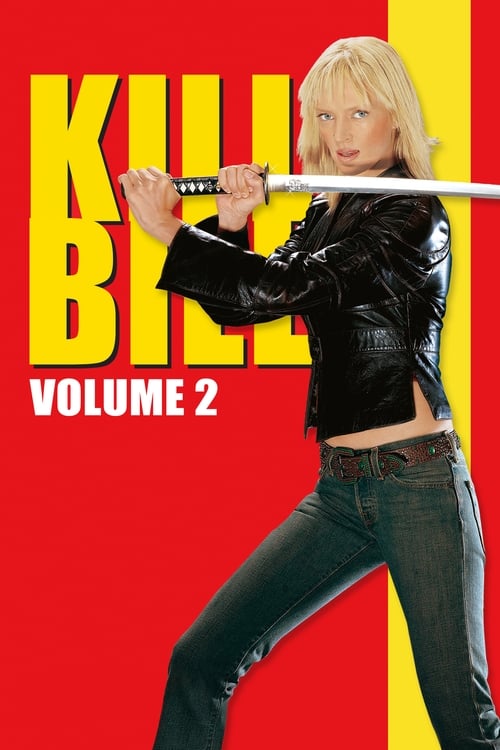
Kill Bill: Vol. 2
2004 · Quentin Tarantino
For when you want your pulp with soul — a revenge western to sink into on a night you have time for long scenes and big payoffs. Watch it soon after Volume 1 if you can; it's the answer to that film's question.
What it's about
The Bride is still working through her Death List Five — the former assassin colleagues who gunned down her wedding party and left her for dead. Volume 2 takes her into the Texas desert and the memory of a brutal kung fu apprenticeship as she closes in on the last names: Budd, Elle Driver, and finally Bill himself, the lover and mentor at the top of the list. The revenge saga's second half trades body count for reckoning.
The experience
Slower, talkier, and stranger than Volume 1 — long fuses of dialogue that detonate into sudden violence, one genuinely claustrophobic sequence that will test you, and an ending that lands on emotion instead of spectacle. It's the half of the story that makes the whole thing mean something.
Performances
Uma Thurman carries the saga from action figure to full tragic heroine, and David Carradine's Bill is the great late-career surprise — soft-spoken, courtly, and quietly menacing, delivering monologues you'll be quoting for years.
The craft
Tarantino swaps Volume 1's anime-and-katana kinetics for spaghetti-western vistas, wuxia training-flashback grammar, and some of the best written confrontations of his career. The dialogue is the action here, and it rewards a viewer who leans in — though the desert widescreen and needle-drop score still earn the biggest screen you've got.
Why it matters
Completed one of the defining pop-cinema events of the 2000s and cemented the two-volume revenge epic as a modern myth — proof that a grindhouse pastiche could end in genuine heartbreak.
Snapshot
Kill Bill: Vol. 2 is the second half of Quentin Tarantino's revenge epic, the slower, more verbal, more elegiac counterweight to Vol. 1's kinetic bloodletting. Where the first film front-loaded spectacle — the anime interlude, the black-and-white House of Blue Leaves massacre, the O-Ren Ishii duel in the snow — the second retreats into the desert Southwest, the wuxia training hall, and the intimate living room where the whole saga finally resolves in conversation rather than combat. The Bride (Uma Thurman) completes her Death List Five: Budd (Michael Madsen), Elle Driver (Daryl Hannah), and at last Bill (David Carradine). Structurally it is the film's dénouement stretched to feature length, and it deliberately trades kill-count for character, revelation, and myth. It is best understood not as a sequel but as the back half of a single 247-ish-minute work cleaved in two for commercial release — a fact that shapes everything about how it plays.
Industry & production
Kill Bill was conceived and shot as one film. Tarantino and his producing home, Lawrence Bender and Miramax under Harvey and Bob Weinstein, arrived at a rough cut running well over three hours, and the decision was made to release it in two volumes several months apart — Vol. 1 in October 2003, Vol. 2 in April 2004. This was a distribution and exhibition solution as much as an artistic one: a single ticket could not contain the running time, and two releases doubled the theatrical windows. Tarantino has spoken of an intended unified cut ("The Whole Bloody Affair"), which has screened only rarely and has never received a wide home-video release; the standard viewing experience remains the two separate volumes.
The film was Tarantino's return to directing after a six-year gap following Jackie Brown (1997), and it reunited his core production family. Because both volumes were shot in a single continuous production, Vol. 2 shares its below-the-line personnel and much of its budget accounting with Vol. 1; the combined production drew on locations in the United States (the California and desert exteriors, the El Paso wedding chapel) and in China, where the Beijing studio work and the Pai Mei sequences were mounted. Exact budget and box-office figures for the individual volumes are reported inconsistently across sources, and I won't assign a specific number I can't verify; what is secure is that both films were solid commercial successes and cemented Tarantino's post-Jackie Brown commercial standing.
Technology
Kill Bill: Vol. 2 is a film shot photochemically on 35mm and finished, for its era, largely by traditional means. Its notable "technology" is less about new tools than about Tarantino's magpie use of old formats and processing as expressive devices. Across the two volumes the production shifts film stocks, aspect ratios, and color treatments to evoke the cinemas it quotes — a strategy that in Vol. 2 leans toward the warm, grainy, sun-blasted look of the spaghetti Western and the flat, saturated palette of 1970s martial-arts programmers. This is deliberate archaism: the "special effect" is the deployment of formats audiences associate with a specific vintage of genre filmmaking. Digital intervention exists (wire removal, the sword-fight enhancements) but is subordinated to a handmade, analog aesthetic. The film predates the industry's full digital-intermediate normalization, and its texture reflects that transitional moment.
Technique
Cinematography
Robert Richardson, Tarantino's cinematographer from this point forward, shot both volumes. Richardson's signature is legible throughout: the hot, blown-out top light — his trademark halo of overhead illumination — and a bold command of chiaroscuro. In Vol. 2 he modulates his palette by genre register. The Pai Mei training passages are staged in the flatter, frontal, zoom-happy grammar of Shaw Brothers kung fu, complete with crash zooms and iris-like framings. The desert and trailer-park material carries the parched Panavision widescreen grandeur of the Leone Western. Most celebrated is the "buried alive" sequence, in which The Bride is nailed into a coffin and lowered into the ground: Richardson cuts to total black and holds it, the frame lit only by the beam of a flashlight, converting the widescreen image into a claustrophobic sliver of illumination. It is one of the film's purest fusions of technique and dread.
Editing
Sally Menke, Tarantino's editor on every film from Reservoir Dogs until her death in 2010, cut both volumes, and Vol. 2's editorial personality is defined by restraint relative to Vol. 1. Where the first film's set pieces were montage showcases, Vol. 2 holds shots, lets dialogue breathe, and trusts long takes — the extended talk between The Bride and Bill in the finale is edited for performance rhythm rather than propulsion. Menke and Tarantino still deploy chapter cards, flashback insertions (the massacre at Two Pines, finally shown from the inside), and the franchise's non-linear architecture, but the tempo is patient, almost novelistic. The training flashback, by contrast, is cut in the punchy, elliptical style of the genre it honors.
Mise-en-scène / staging
The film is a catalog of carefully coded environments: Budd's squalid trailer and the strip club where he has fallen to working; the dojo-like training hall of Pai Mei perched in mountain mist; Esteban Vihaio's pastel Mexican courtyard; and Bill's serene hacienda living room, the domestic space where violence has been suspended in favor of family. Tarantino stages the climactic confrontation as a chamber piece — a mother, a father, and their daughter around a television and a sofa — precisely because the audience arrives primed for a duel. The withholding of spectacle is the staging. Recurring props (the Hattori Hanzō sword, Bill's flute, the goldfish, the sandwich Bill makes for B.B.) do quiet thematic work.
Sound
Kill Bill has no through-composed original orchestral score in the conventional sense; it is scored, like most Tarantino films, as a curated compilation. Vol. 2 draws heavily on Ennio Morricone cues and spaghetti-Western source music, alongside additional original music by Robert Rodriguez (Tarantino's frequent collaborator), plus needle-drops spanning surf, country, and world music. The soundscape reinforces the genre migration from Japan-inflected Vol. 1 to the Western/wuxia hybridity of Vol. 2. Sound design earns particular weight in the coffin sequence, where breath, the scrape of wood, and buried silence carry the terror, and in the finale, where the click of the "Five Point Palm Exploding Heart Technique" landing is answered by near-total quiet.
Performance
The volume is, above all, an actors' film. Uma Thurman — credited as co-creator of the character of The Bride, an authorship note that reflects her genuine collaborative role in the conception — anchors it with a performance that turns from ferocity to grief, culminating in the emotional collapse when she discovers her daughter alive. David Carradine gives Bill a courtly, dangerous serenity; his monologues (notably the "Superman" speech on Clark Kent as a critique of Beatrix's true nature) are the film's centerpiece, and the casting deliberately activated Carradine's own iconography from television's Kung Fu. Michael Madsen plays Budd as a study in fatalistic decline; Daryl Hannah's one-eyed Elle Driver is venomous comedy and menace; and Gordon Liu — himself a Shaw Brothers legend, and a different role than his Vol. 1 appearance — plays Pai Mei with imperious, whiskered relish. Michael Parks appears as the aged pimp Esteban Vihaio.
Narrative & dramatic mode
Vol. 2 operates as the resolution movement of a five-act revenge structure, and it inverts the dramatic mode of its predecessor: exposition and confession replace action. It supplies the answers Vol. 1 withheld — how The Bride survived, what happened at the wedding-chapel rehearsal, the origin of her training, and the truth about her child. The film is built on delayed revelation and reframing, a Tarantino hallmark: scenes we thought we understood are re-narrated from new vantage points. Its dramatic engine shifts from "can she win?" to "what has her vengeance cost, and what is she returning to?" The famous anticlimax — Bill dies not in a swordfight but from a technique administered almost tenderly, after a long conversation — is a deliberate subversion of genre expectation, converting the revenge saga into a story about parenthood and the possibility of stopping.
Genre & cycle
The two volumes together constitute one of cinema's most ostentatious exercises in genre pastiche, and Vol. 2 foregrounds a different set of source cycles than Vol. 1. Where the first drew on Japanese chanbara, yakuza film, and anime, the second is dominated by the Italian spaghetti Western (Leone above all, carried by Morricone's music and the widescreen desert vistas) and the Hong Kong / Shaw Brothers kung-fu film (the Pai Mei training, the crash zooms, the master-student conventions, the coffin-punch payoff). It also touches the American grindhouse and exploitation traditions Tarantino would formalize later. The film belongs to the early-2000s wave of postmodern, quotation-driven genre cinema, and it sits at the head of Tarantino's own late-career cycle of stylized historical and genre revisions.
Authorship & method
Kill Bill: Vol. 2 is a near-total expression of Tarantino's authorial method: the cinephile-as-director, assembling a personal film out of the DNA of the genres he loves, and writing dialogue that functions as both character revelation and standalone aria. His key collaborators here are the pillars of his mature style. Robert Richardson (cinematographer) brought a painterly, top-lit classicism that would define Tarantino's subsequent work. Sally Menke (editor) shaped the rhythm and the non-linear architecture across both volumes; their partnership was among the most important director-editor collaborations of the era. There is no single credited composer in the traditional sense — the score is a compilation curated by Tarantino, with Robert Rodriguez contributing original music and Ennio Morricone's catalog supplying much of the emotional texture. On the writing, Tarantino holds sole screenplay credit, with the character of The Bride credited as created by "Q & U" — Tarantino and Uma Thurman — a rare and telling acknowledgment of an actor's co-authorship of the role.
Movement / national cinema
Kill Bill is an American studio-adjacent independent production, but its identity is transnational by design. It is less an artifact of a national cinema than a deliberate synthesis of several: Hong Kong martial arts, Japanese genre film, and Italian Western. In this sense it belongs to the loose international movement of postmodern pastiche that flourished around the turn of the millennium, in which filmmakers treated the global archive of genre cinema as a common vocabulary. Within American film history it stands as a defining work of the 1990s-born independent auteur sensibility (Tarantino, alongside peers like Rodriguez) reaching full-blown maturity and scale.
Era / period
Released in 2004, Vol. 2 is a document of a specific moment: the last years of predominantly photochemical filmmaking, before digital intermediates and digital capture became standard; the height of the Miramax era before the company's dissolution and the later collapse of the Weinstein brothers' empire; and the crest of a mainstream appetite for stylized, reference-dense genre cinema. Its handmade textures and its two-part theatrical rollout would be harder to replicate in the streaming era. It also marks the mid-point of Tarantino's own career — the film that reestablished him after a gap and set the template for the ambitious, genre-revising projects that followed.
Themes
The dominant theme is the cost and completion of vengeance — and, unusually for the genre, its possible cessation. The Bride's rampage is reframed in Vol. 2 as inseparable from motherhood: her original flight from Bill, the wedding, the pregnancy, and finally the discovery that her daughter lives all recast revenge as a fight to reclaim a family and a self. Bill's Superman monologue crystallizes a second theme: identity and role — the idea that Beatrix Kiddo's assassin nature is her true self and the loving mother a costume, a claim the film's ending both entertains and refuses. Mastery and discipline (the Pai Mei training, the internalized technique that ultimately kills Bill) form a third thread, as does mortality and fatalism, embodied in Budd's resigned decline. Beneath it all runs the cinephilic theme of inheritance — of styles, genres, and iconographies passed down like the Hanzō sword.
Reception, canon & influence
Kill Bill: Vol. 2 was received warmly by critics, many of whom found it the more mature and emotionally resonant of the two volumes precisely for trading action for character and dialogue; a competing critical strand preferred Vol. 1's pure kinetic audacity. The critical consensus tends to treat the two as inseparable halves whose full value emerges only in combination. Both volumes have entered the canon of early-21st-century American genre cinema and are routinely cited in discussions of Tarantino's oeuvre and of postmodern pastiche.
Influences on the film (backward): the spaghetti Westerns of Sergio Leone and the scores of Ennio Morricone; the Shaw Brothers kung-fu tradition and its master-disciple narratives (with Gordon Liu as a living link); Japanese samurai and revenge cinema; and the broader grindhouse and exploitation traditions Tarantino has long championed. David Carradine's casting explicitly summons his Kung Fu television persona.
Legacy (forward): the film reinforced the viability and prestige of overt genre-homage filmmaking and deepened Tarantino's influence on a generation of directors who treat film history as raw material. It solidified the creative partnerships — with Richardson and, until her death, Menke — that defined his subsequent films. Uma Thurman's Bride became an enduring icon of the female action protagonist, frequently invoked in later discussions of women-led action cinema. The "Five Point Palm Exploding Heart Technique," the Pai Mei training montage, and Bill's Superman speech have all passed into wider pop-cultural circulation. The persistent, largely unfulfilled demand for "The Whole Bloody Affair" — and recurring talk over the years of a possible Vol. 3 — testifies to the saga's continued hold on audiences; on the latter, the record is speculative and I won't state as fact anything beyond that it has been discussed publicly by Tarantino without materializing.
A Deleuzian reading
The screen goes black and stays black.
The full Deleuzian reading of Kill Bill: Vol. 2 →
Reception
In 2004 it landed as the 'talky half' after Vol. 1's bloodbath, with critics largely calling it the richer film; today the two volumes are inseparable in fans' minds, endlessly rewatched as one four-hour revenge epic Tarantino always insisted was a single movie.
How Kill Bill: Vol. 2 was received, from release to now →
How to watch Kill Bill: Vol. 2: what to notice on a first viewing
- Look for the hot overhead light blowing out the tops of faces. Robert Richardson lights interiors from above, a burning halo that flares hair and foreheads while the surrounding room falls into deep shadow. It happens in trailers, bars and mountain halls alike. One cinematographer's signature holds four different genres together, so the film feels like a single world despite its borrowings.
- Count the cuts during the first long conversation. Sally Menke cuts far less here than in Vol. 1. Shots are held, pauses are left in, and the rhythm follows how actors talk rather than pushing you forward. The patience is the engine. Dread builds in the waiting, not in the montage.
- Listen for whistles, ocarina and twanging guitar under the desert scenes. There is no orchestral score. Tarantino drops in Morricone cues and spaghetti-western source music, then switches idiom when the film moves to the mountain training hall. The music tells you which genre you are inside at any moment, before the images do.
- Watch for sudden crash zooms in the mountain training hall. The camera goes flat and frontal, then snaps in hard on a face or a hand. Gordon Liu's white-browed master is shot in the exact grammar of the Shaw Brothers films he starred in. The style changes with the story's source, so the film shows you what tradition it is borrowing from.
- Look at Budd's squalid trailer and the strip club he works. Every character gets a coded environment: Madsen's junk-filled trailer, a pastel Mexican courtyard, a mountain dojo in mist, a serene hacienda. The rooms rank the people in them. You can read where each assassin has ended up without anyone saying it out loud.
The whole guide to watching Kill Bill: Vol. 2, with the keys for a rewatch →
Influences: the films it descends from and the films it influenced
- Once Upon a Time in the West (1968) — The Bill confrontation lifts Leone's grammar of holding faces in extreme close-up through long tense dialogue before violence, resolved by a late flashback that retroactively reframes the antagonist's motive.
- The Good, the Bad and the Ugly (1966) — Establishes the Morricone-scored Mexican-standoff idiom and the whistle/ocarina emotional cues Tarantino drops verbatim into his compilation score.
- Death Rides a Horse (1967) — Tarantino recycles Morricone's actual cues from this film, and its flashback-driven list-of-targets revenge plot is a direct structural template for the Bride's arc.
- The 36th Chamber of Shaolin (1978) — The Pai Mei training sequence imitates the Shaw Brothers master-disciple ordeal montage, and Gordon Liu — this film's star — is cast as the living link between the traditions.
- Executioners from Shaolin (1977) — Source of the cruel white-browed Pai Mei archetype and the train-in-secret-to-defeat-the-master structure that governs the Bride's flashback.
- Kung Fu (1972) — David Carradine's slow, aphoristic Kwai Chang Caine persona is deliberately summoned so Bill can speak as a philosopher-warrior, culminating in the Superman monologue's TV-Western cadence.
- Lady Snowblood (1973) — The female-avenger-with-a-list, delivered in discrete titled chapters and stylized bloodletting, is the revenge template the Bride's saga extends.
- The Premature Burial (1962) — The buried-alive coffin sequence descends from Corman's Poe cycle — sustained pitch-black interior shot from inside the box, staging terror through total darkness and sound rather than image.
- Kill Bill: Vol. 1 (2003) — Its inseparable other half, built by Menke as one non-linear cross-volume architecture and shot on the same photochemical 35mm genre-pastiche palette.
- A Fistful of Dollars (1964) — Tarantino inserted Morricone's pre-recorded cues directly into his own diegesis as scored punctuation—treating the Spaghetti Western score as auditory quotation rather than pastiche—and constructed the final showdown through Leone's ECU-to-wide oscillation, making the formal inheritance explicit as both homage and compositional argument.
- Lone Wolf and Cub: Baby Cart at the River Styx (1972) — B.B. watches Shogun Assassin onscreen, an explicit citation that also imports River Styx's theme/fatherhood-and-death into the film's mother-child assassin frame.
- Inglourious Basterds (2009) — Extends the chamber-piece dialogue-as-suspense standoff (the tavern, the farmhouse) and the delayed-revelation chapter structure into feature-length set pieces.
- Django Unchained (2012) — Deepens the Leone/Morricone spaghetti-Western homage while formalizing Richardson's top-lit, high-key classicism as the house style.
- The Hateful Eight (2015) — The full realization of the single-room chamber-piece climax, paired with a commissioned original Morricone score and 70mm/35mm photochemical capture.
- Once Upon a Time in Hollywood (2019) — Carries forward the hangout-paced anticlimax and TV-Western nostalgia (Rick Dalton) that Carradine's casting first channeled here.
- Promising Young Woman (2020) — Extends the female-avenger-with-a-list into a candy-colored genre remix, inheriting the Bride's chaptered targeting structure and its bait-and-swerve anticlimax.
- Atomic Blonde (2017) — Advances the Bride as female-action icon into stylized long-take combat, treating the woman-fronted martial-arts set piece as a prestige formal showcase.
- Sukiyaki Western Django (2007) — A pastiche-of-pastiche that folds Leone and samurai cinema together in the same cinephile-remix method, with a Tarantino cameo acknowledging the shared genre-DNA approach.
Similar films
- Kill Bill: Vol. 1 (2003) — influence & lineage · same viewing thread · often watched together
- Lady Snowblood (1973) — influence & lineage
- Django Unchained (2012) — influence & lineage
- Inglourious Basterds (2009) — influence & lineage
- Crouching Tiger, Hidden Dragon (2000) — same viewing thread
- Hero (2002) — same viewing thread
- Dragon Inn (1967) — same viewing thread
- Kung Fu Hustle (2004) — same viewing thread
All the films related to Kill Bill: Vol. 2 →
Watch it with: curated runs of related films
- Wuxia and Its Heirs — Watch these as a bloodline — King Hu's weightless swordplay flowering into Zhang Yimou's painted epics and finally Tarantino's homage, all built on choreography as dance.