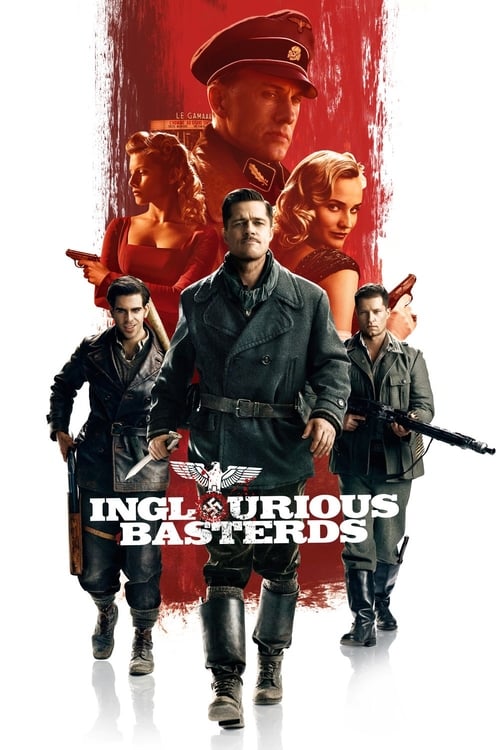
Inglourious Basterds
2009 · Quentin Tarantino
Generates discourse without releasing anything: the abandoned Movie Critic "final film," podcast hot takes (dunking on Marvel actors as "not movie stars," snubbing Toy Story 3), and the eternal "what will the tenth film be" watch. The industry's loudest opinion-haver.
For when you want to be entertained within an inch of your life — big swings, big catharsis, dialogue you'll quote for weeks. Bring your appetite; it's a feast, not a snack.
What it's about
In Nazi-occupied France, two separate plots against the Third Reich take shape: a squad of Jewish-American soldiers waging a terror campaign behind enemy lines, and a young Jewish woman who runs a Paris cinema and finds history walking through her front door. Both threads converge on a single glittering movie premiere attended by the Nazi high command.
The experience
Tarantino builds suspense out of conversation — long, multilingual scenes where politeness is a loaded gun — then detonates them with sudden, gleeful violence. It's funny, nerve-shredding, and audacious, often in the same scene.
Performances
Christoph Waltz's SS colonel — charming, polyglot, terrifying — is one of the great screen villains and made him an international star overnight; Brad Pitt is a hoot as the drawling Basterd-in-chief, and Mélanie Laurent gives the film its steel and its heart.
The craft
The script structures itself as chapters, each essentially a self-contained suspense play, and the multilingual writing turns language itself into a survival skill. Gorgeous 35mm photography and needle-drops that shouldn't work but do; the theatrical finale demands the biggest screen you can find.
Why it matters
It launched Christoph Waltz, became one of Tarantino's biggest hits, and opened his late-career project of rewriting history's atrocities as cinematic revenge — a move endlessly debated and imitated since.
Snapshot
A counterfactual wartime revenge fantasy set in Nazi-occupied France, Inglourious Basterds follows two converging assassination plots against Adolf Hitler: one mounted by a Jewish-American commando unit led by Lt. Aldo Raine (Brad Pitt), another conceived independently by Shosanna Dreyfus (Mélanie Laurent), a French-Jewish cinema owner who survives the massacre of her family in the film's devastating opening chapter. The film funnels these parallel threads into a single Paris movie house, where a Nazi propaganda premiere becomes the site of history's violent, cathartic, and entirely fictional rewriting. Neither a war film in the conventional sense nor a straightforward revenge thriller, Inglourious Basterds is above all a film about cinema — about the power of the image to kill, to mythologize, and to reshape memory. It is arguably Tarantino's most formally disciplined and thematically rich work.
Industry & production
Tarantino had been developing the screenplay for approximately a decade before production began, working through multiple drafts and at one point publicly acknowledging that the script had grown unwieldy — a sprawling war epic he could not fully tame. The solution, eventually, was to radically compress and restructure the material into a chapter-based architecture, treating the film almost as a novel-in-chapters rather than a conventionally plotted feature. The finished film retains traces of that extended gestation in its density of world-building and its leisurely, almost theatrical pacing within individual sequences.
The film was produced by Lawrence Bender, Tarantino's longtime producing partner since Reservoir Dogs (1992), under the banner of the A Band Apart / Zehnte Babelsberg Film production arrangement, with distribution through The Weinstein Company and Universal Pictures internationally. Principal photography took place largely in Germany — primarily at Studio Babelsberg in Potsdam, one of the oldest film studios in the world, which lent the production a pointed historical resonance — and on location in France. The budget is widely reported at approximately $70 million, and the film went on to gross over $320 million worldwide, making it by far the largest commercial success of Tarantino's career to that point. Casting was notably pan-European: Christoph Waltz, then largely unknown outside Austrian and German television, anchored the film in what became one of the most celebrated debut performances of the decade, while Mélanie Laurent, Diane Kruger, and Michael Fassbender brought French, German, and Irish-British registers respectively. Brad Pitt's cartoonishly exaggerated American drawl was a deliberate genre gesture — the "ugly American" of 1960s international co-productions made literal.
Technology
Inglourious Basterds was shot on 35mm film, a deliberate choice that placed it in dialogue with the celluloid cinema it was simultaneously celebrating and eulogizing. Cinematographer Robert Richardson worked with anamorphic lenses and a widescreen 2.39:1 aspect ratio, an homage to the scope epics and spaghetti westerns that populate Tarantino's imaginative world. The film makes no significant use of digital visual effects for its WWII backdrop — production design rather than post-production compositing creates the period. One prominent exception is the climactic fire sequence inside the Parisian cinema, which required careful practical and digital integration; the spectacle of a theater consuming itself with film stock-fed flame was both practically achieved and augmented in post.
The film's use of genuine nitrate film as a plot device — Shosanna plans to feed the highly flammable nitrate prints from her archive into the conflagration — is historically accurate in its chemistry. Nitrate film stock, used broadly through the early 1950s, was legendarily combustible and responsible for numerous cinema fires. Tarantino deploys this as both historical fact and meta-cinematic metaphor: cinema itself, in its most literal material form, becomes the instrument of destruction and liberation.
Technique
Cinematography
Robert Richardson's work in Inglourious Basterds is measured and precise in a way that distinguishes it from the more frantic energy of Kill Bill. His approach privileges sustained wide and medium shots that allow actors to occupy space and time without being hurried by cutting — the long-lens close-up is deployed as punctuation, not as a baseline mode. The film's most celebrated sequence cinematographically is Chapter 1: the interior of the dairy farmer Perrier LaPadite's house, where a conversation between Col. Hans Landa and the farmer unfolds across a single extended take before Richardson's camera slowly descends below floor level to reveal the Dreyfus family hiding beneath the floorboards. The movement is unhurried, inevitable, and morally devastating. Richardson also modulates his palette chapter by chapter: warm, pastoral light for the French countryside opening; cool, shadow-heavy interiors for the tavern; a golden, almost silent-era glamour for the Paris sequences.
Editing
Sally Menke, who had edited every Tarantino feature since Reservoir Dogs and died in September 2010, here achieved perhaps her most disciplined work. Where Pulp Fiction had celebrated cutting as performance — nonlinear bravura for its own sake — Inglourious Basterds uses editing to sustain and modulate tension across very long scenes. The underground tavern sequence in Chapter 4, running nearly twenty minutes, is a masterclass in how editing rhythm can accelerate an audience's heart rate without a single cut that breaks the scene's spatial logic. Menke holds on reactions, cuts away from violence before it fully arrives, and finds the precise moment at which a lingering shot tips from comfort to dread. Her restraint is the film's most underappreciated formal achievement.
Mise-en-scène / staging
Tarantino's staging throughout prioritizes the theatrical over the kinetic. Characters are positioned across tables, across rooms, across cultural and linguistic chasms, and his blocking makes those distances felt. The recurring motif of the contained space under pressure — a farmhouse, a tavern, a projection booth, a cinema auditorium — places Inglourious Basterds in a tradition of chamber drama that owes as much to stage naturalism as to cinema. The tavern scene is set almost entirely at a table; it is a game of cards played with identities. Crucially, Tarantino stages violence so that it ruptures these periods of stasis with jarring force, making the contrast between civilized conversation and sudden brutality the film's primary structural rhythm. Production designer David Wasco's meticulous recreation of occupied-Paris interiors and German military dress lends the staging a coherent material world that Tarantino's camera then treats almost lushly — a world made beautiful and repellent simultaneously.
Sound
Inglourious Basterds adheres to Tarantino's established practice of assembling a soundtrack from pre-existing recordings rather than commissioning an original score, and nowhere in his filmography is this approach more artistically purposeful. The film draws heavily from Ennio Morricone's spaghetti western and giallo scores — particularly cues from The Good, the Bad and the Ugly (Sergio Leone, 1966) and from Morricone's own Il grande silenzio (Corbucci, 1968) — as well as from Charles Bernstein, Lalo Schifrin, and the Alamo's Dimitri Tiomkin. The most spectacular sonic gesture is the deployment of David Bowie's "Cat People (Putting Out Fire)" over Shosanna's preparation sequence: an anachronistic choice (the song is from 1982) that superimposes a contemporary gaze onto a historical moment, collapsing time and making the scene feel mythological rather than documentary. Sound design throughout amplifies the spatial claustrophobia of interior settings, and the multilingual dialogue — German, French, English, Italian — creates an acoustic texture that itself becomes thematically meaningful, since language and accent are the film's primary instruments of identity, suspense, and death.
Performance
Christoph Waltz's Hans Landa is one of the great screen villains precisely because Waltz refuses villainy as a mode. Landa is charming, intellectually curious, self-aware, and possessed of an almost playful command of social power. Waltz won both the Cannes Film Festival Best Actor prize and the Academy Award for Best Supporting Actor for the role, and the performance deserves both: it operates simultaneously as genre pleasure and as something more disturbing, a portrait of evil that wears the face of civilization's best manners. Mélanie Laurent is the film's moral center, and her performance — contained, furious, strategic — grounds the film's more baroque excesses in genuine grief. Brad Pitt's Aldo Raine is openly comic, a deliberate caricature of American movie-hero masculinity, and Pitt plays the joke with complete conviction. Diane Kruger and Michael Fassbender bring precise register work to roles that demand the ability to perform performing — both characters are, within the film's fiction, actors playing roles under lethal stakes.
Narrative & dramatic mode
Inglourious Basterds is structured in five titled chapters — a novelistic device that Tarantino borrowed in part from Sergio Leone's operatic sequencing and from the chapter-titles of the hardboiled novel tradition. The chapter structure allows each section to function as a near-autonomous dramatic unit with its own tonal register, pace, and generic DNA: Chapter 1 is a Loach-esque rural tragedy; Chapter 2 introduces the war-movie adventure mode; Chapter 3 moves into continental glamour and intrigue; Chapter 4 is a confined thriller; Chapter 5 is apocalyptic spectacle. The film does not resolve these tonal tensions so much as explode them in the final conflagration.
The narrative's central conceit — that history can be rewritten, that cinema has the power to do so — is rendered not as whimsy but as a formal argument. The film concludes with Hitler shot to pieces in a movie theater and the building burned to the ground by cinema itself (Shosanna's nitrate prints). The counterfactual is not a gimmick; it is the thesis. Tarantino asks whether myth-making — which is what cinema does — is morally distinguishable from the myth-making that enabled fascism, and he offers no comfortable answer.
Genre & cycle
The film operates at the intersection of several genre traditions without belonging fully to any. Most immediately, it appropriates the World War II ensemble action film — the Dirty Dozen (Aldrich, 1967) lineage — and the spaghetti western, blending their iconographic vocabularies (the commando unit, the desert-southwest-via-Italy moral universe, the stylized violence) with the European spy thriller and the occupation drama. The title itself references Enzo Castellari's 1978 Italian genre film Quel maledetto treno blindato (released internationally as Inglorious Bastards), and while Tarantino's film shares almost nothing with Castellari's plot, the title is a tribute to a tradition of low-budget Italian exploitation cinema that Tarantino has consistently championed.
Inglourious Basterds belongs to a broader cycle of 2000s revisionist genre work — films that self-consciously anatomize genre conventions while deploying them — but it also initiated a more specific Tarantino sub-cycle of historical revenge fantasies, continued in Django Unchained (2012) and The Hateful Eight (2015), in which traumatized or oppressed peoples enact cathartic, historically impossible violence on their oppressors. This cycle constitutes a coherent authorial project, not merely a stylistic tic.
Authorship & method
Tarantino functions as writer-director with virtually absolute creative control, a position established from Pulp Fiction onward and maintained through his relationship with The Weinstein Company. His method is shaped by an autodidactic film education rooted in exploitation cinema, video store immersion, and a magpie relationship with world film history. Inglourious Basterds reflects this most explicitly: the film is simultaneously a tribute to and a critical engagement with the cinema it loves.
Robert Richardson is perhaps the most formally accomplished cinematographer Tarantino has worked with. Richardson's career encompasses the fluid, often handheld expressionism of his Oliver Stone period (JFK, Natural Born Killers, Nixon) and the more controlled classical compositions of his Scorsese collaborations (The Aviator). With Tarantino across Kill Bill and Inglourious Basterds, he found a middle register: precise and wide, with the compositional confidence of classical Hollywood and the stylistic boldness of European arthouse.
Sally Menke's contribution cannot be overstated. She was Tarantino's sole feature editor across his entire career, and her understanding of his rhythmic instincts allowed the long-form dramatic sequences that are Inglourious Basterds' signature to work at all. The film is her finest credit and a fitting final work. Tarantino has spoken publicly about the impossibility of replacing her and the difficulty of working with subsequent editors.
Movement / national cinema
Inglourious Basterds is nominally an American film — American studio money, an American director, an American lead — but it is more productively understood as a work of deliberate transnational cinema. It was shot in Germany and France, cast almost entirely with European actors, and is spoken in three languages more than it is in English. Its most formally accomplished sequences owe more to European genre filmmakers — Leone, Godard, Melville — than to Hollywood. The film engages directly with French and German national memory of the Occupation, and its counterfactual ending is as much an intervention into European historical consciousness as into American pop mythology.
This transnationalism is characteristic of Tarantino's practice but reaches its fullest articulation here: he is an American filmmaker whose imaginative world is substantially European, and Inglourious Basterds is the film where that tension becomes the explicit subject.
Era / period
The film appeared at the end of a decade defined by the aftermath of September 11, 2001, and the "War on Terror," a context that inflected its reception profoundly. Its fantasy of cathartic, extra-judicial violence enacted by a small commando unit against a monstrous enemy found an obvious contemporary resonance; its moral ambiguities about that violence — the Basterds are themselves brutal and scalp their enemies — complicated any simple reading. The film also appeared at a moment when Hollywood cinema was negotiating its transition from celluloid to digital production and distribution, and Tarantino's conspicuous embrace of 35mm was a position-taking in that debate. The meta-cinematic climax, in which nitrate film burns a cinema to the ground, reads retrospectively as an elegy for the analog medium.
Themes
Cinema's power — as myth-maker, as weapon, as historical force — is the film's dominant preoccupation. Shosanna's plan depends on cinema's material properties (nitrate's flammability) and its social architecture (a captive audience in a darkened room). The Nazis' own cinema (the propaganda premiere of Nation's Pride) is shown to be effective precisely because it follows the same principles of spectacle and collective emotion that make Shosanna's counter-operation possible. Tarantino implies that cinema is morally neutral — a technology of power that can serve fascism or resist it.
Language and identity run through every scene. Hans Landa shifts fluently among French, English, German, and Italian not as a skill but as a form of domination; his linguistic mastery is how he reads and controls others. The tavern scene turns on a British officer's inability to sustain a German accent; the slip costs lives. Language is survival.
Revenge and its limits constitute the moral undertow. The film offers its audience the pleasure of historical revenge fantasy while staging that revenge as spectacle that also kills innocents in the auditorium. The fire does not discriminate. Tarantino offers catharsis and then withholds the clean conscience that catharsis usually grants.
Reception, canon & influence
Critical reception. The film premiered at Cannes in May 2009 to strong notices, with particular attention to Waltz's performance and the sustained tension of the set pieces. Most serious critics recognized it as a significant formal achievement, though some found the revisionist historical conceit glib or its pleasures ethically uncomfortable. A. O. Scott in the New York Times and Manohla Dargis were largely admiring; Jonathan Rosenbaum and others in the serious cinephile press were more skeptical about what the film was doing morally. Over subsequent years, critical consensus has moved decisively toward the view that Inglourious Basterds is Tarantino's mature masterwork — the film in which his style finally became fully coextensive with his themes.
Influences on the film (backward). The debts are extensive and openly acknowledged. Jean-Luc Godard's Bande à part (1964) and his broader distillation of American genre into European self-consciousness; Jean-Pierre Melville's occupation thriller Army of Shadows (1969); Sergio Leone's patient, theatrical tension-building and his use of the close-up as punctuation; Henri-Georges Clouzot's The Wages of Fear (1953) and its chamber-drama suspense. The WWII ensemble tradition — The Dirty Dozen, The Great Escape (Sturges, 1963) — provides genre scaffolding. Italian exploitation cinema of the 1970s provides the title and the spirit of gleeful transgression. Ennio Morricone's scores, deployed directly, constitute a dialogue with their original contexts.
Legacy and forward influence. The most immediate legacy was Tarantino's own: Django Unchained (2012) applied the revisionist-historical-revenge structure to American slavery, and The Hateful Eight (2015) extended the chamber-drama mode. More broadly, Inglourious Basterds accelerated a trend of "alt-history" prestige genre filmmaking — films willing to rewrite historical atrocity for emotional and moral purposes. Christoph Waltz's casting redirected European arthouse talent toward Hollywood genre production. The tavern sequence entered film-school curricula as a paradigm case of tension construction through dialogue and behavioral performance rather than action. The film's meta-cinematic argument — that cinema is not a passive record of history but an active participant in shaping it — has become a touchstone in film theory pedagogy. As digital production has become universal, Inglourious Basterds has taken on added resonance as a late monument to 35mm's particular grain, warmth, and combustibility.
A Deleuzian reading
A farmer pours a glass of milk.
The full Deleuzian reading of Inglourious Basterds →
Reception
Divisive at Cannes 2009 — some critics balked at its audacity and Tarantino's rewriting of history — but it became his biggest box-office hit to that point and has since climbed to 'maybe his best film' status in fan rankings.
How Inglourious Basterds was received, from release to now →
Influences: the films it descends from and the films it influenced
- The Wages of Fear (1953) — Clouzot's method of generating suspense through extended scenes where behavioral micro-performance — a pause, a misdirection, a concealed lie — carries mortal weight in a confined space is the direct formal model for IB's Dreyfus prologue and tavern sequence.
- Bande à part (1964) — Godard's technique of constructing scenes as genre performances — dialogue and behavior that cite American genre conventions as love-letter quotation rather than naturalistic action — is the model for IB's chapter structure in which each set piece functions as tribute to a specific cinematic tradition.
- The Great Escape (1963) — Sturges's multi-strand ensemble plotting — parallel storylines following specialist characters whose individual competencies converge in a single behind-enemy-lines operation — provides the narrative architecture that IB borrows and then subverts for the Basterds storyline.
- The Good, the Bad and the Ugly (1966) — Leone's technique of expanding moments of peak tension to operatic length through alternating close-ups and environmental reaction shots — treating time itself as dramatic material — is the governing grammar of IB's standoff logic and the direct source of the Morricone cues deployed intact.
- The Dirty Dozen (1967) — Aldrich's ensemble-of-specialists structure — assembling individually introduced characters with distinct military competencies for a single suicide mission — provides the genre skeleton Tarantino consciously inhabits for the Basterds' storyline before pivoting away from its conventions.
- Once Upon a Time in the West (1968) — Leone's deployment of Morricone's scores as the temporal and emotional architecture of scenes — cues that arrive early and dominate the dramatic logic rather than illustratively responding to the image — is the precise model for how IB uses pre-existing Morricone recordings as scene structure rather than accompaniment.
- Army of Shadows (1969) — Melville's occupation-thriller chamber suspense — loading behavioral signs (a mispronunciation, an averted glance, a hesitation) with mortal stakes in enclosed spaces under Nazi surveillance — is the direct formal ancestor of Landa's interrogation of the Dreyfus family and the entire logic of the tavern scene.
- Inglorious Bastards (1978) — Castellari's Italian war-exploitation cycle established the template of transgressive irreverence toward Allied WWII iconography — grindhouse spectacle combined with anti-heroic revisionism — which IB cites in its title and deploys in its unsentimental treatment of the Basterds' sadistic methodology.
- Pulp Fiction (1994) — The final Tarantino-Menke editing collaboration extends the Pulp Fiction formal system in full: chapter-title structure, theatrical long-take dialogue scenes building unbearable tension before explosive release, and compilation soundtrack counterpoint — the completest realization of the grammar they developed together.
- Europa Europa (1990) — Turns multilingual jeopardy into its central suspense engine — accent and language betraying identity — with agents and Jews passing among Nazis amid deliberate Nazi-iconography irony.
- To Be or Not to Be (1942) — Turns a theater into the trap and deploys actors and performance-within-performance as an espionage weapon against the Nazi high command—Lubitsch's playhouse-as-battlefield taken to its literal end.
- The Guns of Navarone (1961) — A self-conscious revival of the Navarone/Dirty Dozen commando-mission film, restaging the behind-the-lines demolition as a literal cinema-burning cross-cut climax.
- Django Unchained (2012) — Tarantino directly transplants IB's revisionist-historical-revenge formula — chapter structure, chamber-drama set pieces (the Candie plantation dinner as tavern-scene analog), anachronistic score, and the moral logic of spectacular genre violence against historical perpetrators — from Nazi-occupied France to antebellum America.
- Fury (2014) — The extended farmhouse dinner sequence — a multi-character confined scene in which power dynamics and mortal tension unfold entirely through behavioral performance over an elongated duration without action — directly applies IB's chamber-drama grammar to a WWII ensemble context.
- The Hateful Eight (2015) — Tarantino extends IB's chamber-drama mode into a full feature and commissions an original Morricone score, building a single-location film driven entirely by the extended-scene behavioral performance logic first fully realized in IB's tavern sequence, now shot in Ultra Panavision 70mm.
- JoJo Rabbit (2019) — Waititi adopts IB's chapter-structured WWII revisionism in which theatrical, self-conscious performance modes reframe historical atrocity, using the same tonal instability — comedy and horror occupying the same scene without resolution — as the governing structural and ethical device.
- Once Upon a Time in Hollywood (2019) — Tarantino applies IB's counterfactual-history structure — meticulous period authenticity built only to rewrite a historical trauma through fictional agency — to the Manson murders, preserving IB's meta-cinematic argument that cinema actively constructs rather than records historical memory.
- Mayday (2026) — Makes language competence itself the suspense-and-comedy mechanism — an accent, a wrong idiom, a hand signal held wrong — which is the only way a language-barrier gag can pay off dramatically instead of decoratively.
- No Country for Old Men (2007) — The Coens' motel-room and gas-station confrontations — scenes of mortal danger built entirely through behavioral performance and dialogue over extended durations with almost no action — constitute a parallel contemporary development of the chamber-drama suspense grammar IB employs in exactly the same years.
- There Will Be Blood (2007) — Anderson's sustained 35mm anamorphic wide-shot compositions in the church and oil-field sequences — frames where character power dynamics are inscribed in the physical arrangement of bodies in space rather than through cutting — parallel IB's use of the wide frame as a theatrical stage for behavioral performance.
- Operation Mincemeat (2022) — Pushes fiction-as-weapon to its limit: a staged fabrication deployed to kill the enemy, a metafiction about deception and performance winning the war.
- Devils on the Doorstep (2001) — Builds extended set-pieces where language competence and mistranslation generate suspense and comedy before erupting into violence, with the same farce-to-horror whiplash.
- Black Book (2006) — Sibling counter-model that also dramatizes WWII as pulpy suspense entertainment, staging tension through masquerade and language among Nazis and running the cabaret/cinema-as-battleground device with relish over reverence.
- Deliver Us from Evil (2020) — Translation as suspense engine — scenes whose life-or-death stakes turn on who understands which of several languages, with an interpreter figure holding real narrative power because only they can move between them, exactly Yui's structural function in the Bangkok half.
Similar films
- Django Unchained (2012) — influence & lineage
- The Hateful Eight (2015) — influence & lineage
- Jojo Rabbit (2019) — influence & lineage
- Once Upon a Time... in Hollywood (2019) — influence & lineage
- The Dirty Dozen (1967) — influence & lineage
- Casablanca (1943) — same viewing thread
- Schindler's List (1993) — same viewing thread
- A Hidden Life (2019) — same viewing thread
All the films related to Inglourious Basterds →
Watch it with: curated runs of related films
- In the Shadow of the Reich — A run of films about ordinary people inside the Nazi era — surviving it, resisting it, or trying to reckon with how it happened — that rhyme on conscience, complicity, and who chooses to act.