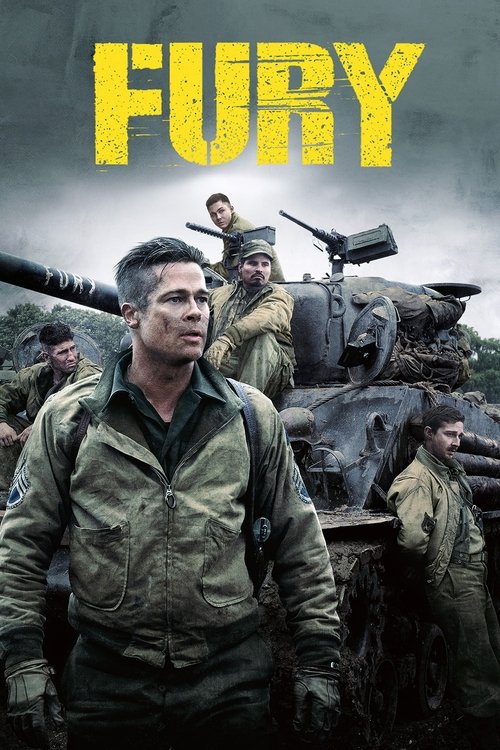
Fury
2014 · David Ayer
For when you want a heavy, intense war film that puts you through it — mud, steel, and moral weight, not clean heroics. Definitely a challenge watch; save it for a night when you have the stomach for it.
What it's about
April 1945, the last weeks of the war in Europe. A battle-hardened sergeant nicknamed Wardaddy commands a Sherman tank called Fury and its five-man crew as they push into Nazi Germany, outnumbered and running on fumes. Into this sealed, traumatized little family drops a rookie clerk-typist who has never fired a shot — and the film watches what the war, and the crew, make of him.
The experience
Grinding, visceral, and claustrophobic — you spend much of it inside forty-seven tons of steel with five frayed men, and the tank battles hit with real mechanical terror. It's brutal and unsentimental for long stretches, then swings for something bigger and more mythic.
Performances
Brad Pitt gives Wardaddy a cracked authority — hard shell, visible damage — and Logan Lerman is the film's raw nerve as the rookie forced to become one of them; Shia LaBeouf does striking, haunted work in the margins.
The craft
Ayer built it on physical authenticity: real period machinery, veterans consulting, a cast put through genuine ordeal, and it shows in every mud-caked frame. The tank combat — tracer fire cutting through fields, armor clanging like a bell — is some of the most tactile ever filmed, and it demands a big screen and loud speakers.
Why it matters
It reset the bar for how tank warfare looks and sounds on screen, and stands as the most ambitious entry in Ayer's run of films about violent brotherhoods under pressure.
Snapshot
A Sherman tank crew in the final weeks of the Second World War in Europe — five men sharing forty-seven tons of steel, shared trauma, and a dying war. Fury is David Ayer's most formally ambitious film: a study of what prolonged killing does to the men who survive it, structured as a descent from routine atrocity into a last-stand siege that tips toward myth. It belongs to the long tradition of the small-unit war film — crew drama as existential pressure cooker — but distinguishes itself through an unusual commitment to material and experiential authenticity: real machinery, real veterans as consultants, and a production ethos of physical ordeal. The result is a film caught between the unsentimental and the operatic, more interested in the texture of moral damage than in the mechanics of heroism, yet willing, in its final reel, to embrace a kind of doomed grandeur.
Industry & production
Fury was produced by Columbia Pictures in association with QED International and Le Grisbi Productions, with principal photography taking place primarily in the United Kingdom in autumn 2013. The rural Oxfordshire countryside doubled for the bombed-out landscape of central Germany in the war's terminal phase. The Tank Museum at Bovington, Dorset, was central to the production's logistical planning, supplying multiple Sherman variants as well as what became the film's most publicized asset: the only fully operational Tiger I tank in the world, chassis number 250122, restored by the museum's engineers. Securing the Tiger for active filming required months of coordination and represented a production achievement with no direct precedent in large-scale filmmaking of the sound era.
Ayer wrote the screenplay himself, drawing on research with veterans, military historians, and period accounts of U.S. Army armored operations in the ETO during the Siegfried Campaign and the final Allied push through Germany. The script was developed with input from surviving tankers and technical advisors who had direct knowledge of Sherman crew procedures and the psychological realities of armored combat. The film's reported production budget was in the range of sixty-five to seventy million dollars — substantial for a period war film with no franchise attachment, and a sign of the industry's continued appetite for prestige war pictures in the 2010s, particularly in the year marking the seventieth anniversary of D-Day and the European campaign's conclusion.
Brad Pitt's producer-level involvement and star gravity were essential to financing and distribution on this scale, reprising a dynamic from his earlier role in the similarly myth-inflected Inglourious Basterds (2009). The film was released in October 2014, positioning it within the awards-season calendar, and performed strongly at the global box office, though specific figures should be verified against studio records rather than cited from secondary sources.
Technology
The centerpiece technology was the Bovington Tiger — a machine whose presence on screen carries immediate indexical weight. Unlike the Soviet T-34s, wooden mock-ups, and American vehicles modified to resemble German armor that have stood in for Tigers in virtually every prior war film, this is the actual object: a 57-ton, 700-horsepower Maybach-engined predator, with all the mechanical idiosyncrasy and fragility that operational Tiger ownership entails. Ayer and his team filmed it moving, firing, and engaging Sherman replicas. The visual difference is not merely documentary; it changes the film's dramatic logic. The Tiger sequence in Fury lands with a weight — physical, tonal — that composite or substituted machines cannot replicate.
The Sherman tanks used in the film were sourced from collectors and the Bovington collection, dressed to period accuracy. The tracer rounds visible in the tank combat sequences were, according to widely reported production accounts, live rounds fired on set under controlled conditions — a decision that shaped the visual grammar of the battle scenes in ways that digital compositing struggles to match. The colored tracer tracks moving across the screen at night carry a quality of actual physical event rather than simulation, contributing materially to the film's visceral credibility.
Principal photography was captured on the ARRI ALEXA digital cinema camera, a dominant platform of its period. Cinematographer Roman Vasyanov's approach — discussed in more detail below — exploited the camera's low-light sensitivity in ways that complemented the film's palette of mud, fire, and failing dusk.
Technique
Cinematography
Roman Vasyanov, who had previously shot Ayer's End of Watch (2012), brought to Fury a grammar rooted in the documentary tradition: close focal lengths, proximity to face and body, a camera that seems to share the crew's confinement. Inside the tank, the visual field is radically compressed — the camera pressed into corners, shooting around bodies, approximating the ergonomic reality of five men in a space designed for machinery, not habitation. The interior shots convey claustrophobia not through conventional signifiers (tight framing alone) but through physical implication: the lens seems to breathe the same recycled air.
Exterior combat was photographed with a tonal register calibrated toward the overcast grays and burnt oranges of the German countryside in late April — a palette that suppresses heroic saturation and insists on the dreariness of the operational environment. Night sequences, including the climactic engagement with the SS column, use tracer fire and tank muzzle flash as the primary light sources, a decision that required the camera to work in light conditions that celluloid of prior decades could not have managed. The result is a battle lit from within itself, the instruments of death also illuminating the dying.
Editing
The editing — handled with a rhythm attentive to the alternation between compression and release — structures the film's escalating violence. The tempo of the early sections is deliberately slow by genre standards, allowing the crew's internal hierarchies and behavioral codes to establish themselves before the violence that will test them arrives in full. The final siege sequence is cut with increasing urgency but never abandons geographic legibility; the spatial logic of the crossroads position and the waves of SS infantry are maintained with unusual clarity, preserving the tactical logic that gives the heroics their context.
Mise-en-scène / staging
Ayer is a director who prioritizes behavioral authenticity over pictorial composition. His staging tends toward the improvisatory: blocking that emerges from character logic rather than from visual pattern. The dinner scene in the German apartment — structurally the film's most unsettling passage — is staged with a theatricality that cuts against the surrounding texture of the film. Two German women, a veteran sergeant, a rookie, and the looming threat of the rest of the crew create a pressure-cooker domestic space in which the war's violence is temporarily and uncomfortably domesticated. The staging is deliberate and almost Pinteresque: silence, eye contact, the politics of who sits where and who speaks.
The crossroads where the film ends is used as a classical siege space — elevated, isolated, defensible only in the sense of being inescapable. Ayer stages the final engagement in clear waves, using the geometry of the position to let the viewer track attrition and shrinking resources across the length of the sequence.
Sound
The sound design is one of Fury's most sustained achievements. The acoustic signature of Sherman tank operations — the ignition sequence, the turret traverse, the distinctive crack of the 75mm gun, the mechanical protest of the drivetrain over broken ground — was recorded from operational vehicles and constructed into a layered sonic environment that gives the machines their physical presence. The contrast between interior and exterior acoustics is used throughout: inside the tank, gunfire is a compression event, a hammerblow that arrives through the hull; outside, the same shot is a crack and a plume of exhaust in an open landscape.
The score by Steven Price — who had won an Academy Award for his work on Alfonso Cuarón's Gravity (2013) — works in opposition to heroic precedent. Price's approach favors drone, dissonance, and restraint over martial convention, supporting the film's emotional ambiguity rather than resolving it. The absence of triumphalism in the score is a principled formal choice.
Performance
Brad Pitt's Wardaddy is a performance organized around withholding. He conveys competence, menace, and an interior that the camera is never quite allowed to see — a deliberate opacity that distinguishes the character from the articulate traumatized veterans of more therapeutic war narratives. Shia LaBeouf, who underwent widely reported intense preparation for the role — including extended isolation and, according to press accounts at the time, self-inflicted physical ordeal on set — brings an unlikely spiritual intensity to Boyd "Bible" Swan that functions as the film's moral register without sentimentalizing it.
Logan Lerman carries the film's pedagogical burden as Norman, the typist-turned-gunner through whose induction the audience is educated into the crew's world. His performance navigates the risk of the naive witness function — the character who exists to be shocked by what the experienced characters have normalized — by grounding Norman's responses in a specific physical and moral vulnerability that reads as genuinely earned rather than schematic. Jon Bernthal and Michael Peña complete a crew whose collective dynamics Ayer manages with the assurance of his earlier ensemble work.
Narrative & dramatic mode
Fury is structured as a moral initiation narrative embedded within an episodic operational progression. Norman's arc — from reluctant clerk to functional killer — is the film's organizing throughline, but Ayer consistently refuses to frame this transformation as growth or achievement. The sequence in which Wardaddy forces Norman to execute a prisoner is one of the film's most significant formal moves: the initiation into violence is staged not as dramatic climax but as ugly administrative fact, and the film does not permit the audience to process it as resolution.
The episodic structure — a series of missions and engagements, culminating in the crossroads siege — follows the conventions of the operational war film while progressively stripping away the momentum that genre convention usually provides. By the final act, the film is operating in a register closer to existential drama than action-adventure: five men with no realistic prospect of survival choosing to fight not because they believe they can win but because the alternative is a form of self-erasure the film treats as worse than death.
Genre & cycle
Fury belongs to the tradition of the American combat film — specifically the armored or vehicular variant of the small-unit subgenre — but its immediate antecedents are European as much as Hollywood. Wolfgang Petersen's Das Boot (1981) is the most cited precursor for the crew-in-confined-vehicle structure: the tank crew's interdependence, the rituals and antagonisms of shared confinement, the alternation between boredom and mortal terror. Samuel Fuller's armored infantry films — particularly The Big Red One (1980) — provide the model of the weathered veteran leading the initiate through a landscape of mechanized slaughter.
The film's ambient cynicism and its interest in atrocity — the bodies encountered on the road, the village reprisals, the normalization of murder among men we are asked to care about — place it in dialogue with the revisionist war film cycle that runs from Michael Cimino's The Deer Hunter (1978) and Oliver Stone's Platoon (1986) through to Terrence Malick's The Thin Red Line (1998). Fury does not achieve the formal radicalism of Malick, but it shares the refusal to aestheticize violence as catharsis.
Authorship & method
David Ayer established himself as a writer-director preoccupied with men under institutional and moral pressure: his screenplay for Training Day (2001) and his directorial work on End of Watch and Sabotage (2014) form a body of work organized around codes of loyalty, violence, and masculine belonging within hierarchical systems. Fury extends this preoccupation into a historical frame, treating the tank crew as a version of the police unit or street gang that recurs in his work — a primary loyalty group constituted through shared exposure to violence, with the larger institutional mission (the war, the law) serving as context rather than meaning.
Ayer's method on set reportedly emphasized physical immersion: actors were put through abbreviated military training, discouraged from breaking character between takes, and exposed to conditions designed to build the crew's mutual familiarity. Whether this constitutes a formal methodological system or a director's intuition toward authenticity is a matter of record interpretation, but the behavioral coherence of the ensemble is among the film's most remarked-upon qualities.
Roman Vasyanov (cinematographer) and Steven Price (composer) are the primary creative collaborators whose signatures are most audible; the editing and production design complete a team oriented toward a coherent aesthetic of material specificity and tonal austerity.
Movement / national cinema
Fury is a product of mainstream American studio filmmaking with aspirations toward European art-cinema sobriety. It carries none of the national-mythological triumphalism of the classical Hollywood war film — there is no flag-raising, no final communiqué — and its German opponents, while not individuated at length, are not cartoon antagonists. The film's national cinema context is the American prestige war picture of the post-Saving Private Ryan era, a cycle that treats WWII as a site for moral seriousness rather than simple commemoration.
Era / period
Released in the year of the D-Day seventieth anniversary and the broader commemoration cycle of the Second World War's final year, Fury participates in a 2014 moment of heightened public attention to WWII history. It sits alongside The Monuments Men (2014, George Clooney) and anticipates Hacksaw Ridge (2016, Mel Gibson) and Dunkirk (2017, Christopher Nolan) in a sustained run of major WWII productions in the 2010s that collectively moved away from the Greatest Generation mythology toward a more complicated and visceral accounting of what the war cost its participants.
Themes
The film's central preoccupation is the moral cost of survival — specifically, the question of what a person must become in order to endure extended exposure to organized killing. Wardaddy's command is organized around a pedagogical cruelty: he teaches survival by forcing the new man to kill, to harden, to suppress the responses that would get him killed. The film does not celebrate this pedagogy; it presents it as tragedy — the transmission of damage from one generation of soldiers to the next.
Brotherhood under duress, the dehumanization of the enemy as psychological necessity, the irreducibility of violence to justification — these are the film's animating tensions. The apartment sequence introduces a brief pastoral interlude that the film then destroys: domesticity, however fragile and compromised, is shown to be precisely what the war annihilates. The final siege literalizes the logic of the whole: survival is impossible; the choice is only how one meets the end.
Reception, canon & influence
Critical reception was generally favorable, with consistent praise for the technical accomplishment — the tank combat, the sound design, the use of the Tiger — and for the ensemble performances, particularly LaBeouf's and Lerman's. Some critics noted a tonal inconsistency between the film's first two acts, with their commitment to unglamorous moral complexity, and the final siege's embrace of genre convention and near-mythological scale. The transition from corrosive realism to operatic last stand struck a portion of the critical audience as a capitulation to the demands of the Hollywood war film's formal obligations.
In terms of backward influence, the film draws most explicitly on Das Boot, The Big Red One, Sam Peckinpah's Cross of Iron (1977) — another European-theater WWII film organized around the disillusionment of veteran soldiers and the cost of survival — and the broader tradition of the revisionist American combat film. Coppola's Apocalypse Now (1979) is legible in the film's interest in the horror that competent men can become.
Fury's forward legacy is harder to assess at the distance of a decade. Its influence on subsequent WWII cinema is real but diffuse — the film raised the production standard for armored combat sequences, and its use of authentic equipment set a marker for period authenticity that subsequent productions have referenced. Among war-gaming and military-enthusiast communities, the film's tank sequences acquired a documentary authority that continues to circulate. Whether it achieves canonical status within the war film genre proper remains a question of longer duration; it is a film that was taken seriously at the time of its release and has not receded into mere spectacle, but neither has it accumulated the critical mass of retrospective reassessment that would install it firmly in the first tier of the genre.
A Deleuzian reading
Start with the tracer rounds.
The full Deleuzian reading of Fury →
Reception
Landed in 2014 to solid-but-unspectacular reviews — praised for visceral tank combat, knocked for war-movie clichés — but it's since climbed into 'dad movie canon' and is now routinely called David Ayer's best film, a claim Ayer's post-Suicide-Squad career only strengthened.
How Fury was received, from release to now →
Influences: the films it descends from and the films it influenced
- Cross of Iron (1977) — Peckinpah's multi-camera fragmented combat editing — real-time action intercutting with slow-motion to distend moments of maximum violence — is the prototype for Ayer's compression/release rhythm in the Tiger engagement, while the film's German-soldier revisionism establishes the moral framework of unglamorous veteran-guilt Fury inherits.
- Apocalypse Now (1979) — The PBR patrol boat as a sealed moral world — a primary loyalty group constituted through shared violence, insulated from the institutional mission's meaning — establishes the convention of the war vehicle as a closed community with its own code that Fury's tank crew inherits as its central dramatic premise.
- The Big Red One (1980) — Fuller's episodic operational structure — narrative advancing through discrete tactical actions rather than dramatic arc — and the explicit veteran-as-initiator / green-soldier dynamic organizing the moral drama provide the structural spine Fury directly inherits.
- Das Boot (1981) — Jost Vacano's handheld camera threading through the U-boat's mechanical corridors, and the diegetic sound design of hull pressure, engines, and weapons systems as primary expressive register, establishes the grammar of claustrophobic vessel-interior cinematography and machine-acoustics that Vasyanov directly replicates inside the Sherman's hull.
- Come and See (1985) — Klimov's production methodology of extreme environmental immersion — live fire around actors, conditions designed to produce genuine physiological responses — is the ethical precursor to Ayer's ensemble-training approach, in which behavioral authenticity is pursued through physical exposure rather than performed affect.
- Platoon (1986) — Stone's autobiographical method — drawing on personal combat experience to choreograph the specific behavioral rhythms of men under fire — and the moral initiation structure in which a green soldier is inducted by competing veteran figures representing irreconcilable ethical responses, are direct templates for Fury's Wardaddy dynamic.
- Full Metal Jacket (1987) — The two-part moral initiation structure — green soldier absorbed into institutional violence by a mentor whose competence and brutality are inseparable — and Kubrick's extended off-camera rehearsal process generating genuine ensemble behavioral coherence before filming, are both structural and methodological templates for Fury.
- Stalingrad (1993) — The European-theater WWII film's material specificity — period-accurate equipment staging, physical soldier exhaustion as expressive register, no-glory revisionism organized around the German enlisted perspective — establishes the production standard for small-unit revisionist authenticity that Fury's design approach directly extends.
- Saving Private Ryan (1998) — Janusz Kaminski's technique of removing the polarizing filter and overdriving highlights to degrade the image toward documentary grain in combat sequences is the direct precursor to Vasyanov's low-light digital approach, establishing the desaturated immersive aesthetic Fury refines for digital acquisition.
- Inglourious Basterds (2009) — The extended farmhouse dinner sequence — a multi-character confined scene in which power dynamics and mortal tension unfold entirely through behavioral performance over an elongated duration without action — directly applies IB's chamber-drama grammar to a WWII ensemble context.
- Enemy at the Gates (2001) — Carries forward the cold desaturated palette and mud-and-rubble tactile physicality of late-war Eastern-style combat, treating the soldier's body and machine as grimy material fact.
- Hacksaw Ridge (2016) — Simon Duggan's compression/release combat editing rhythm and close-in handheld coverage of chaotic infantry action — along with the production's commitment to practical prosthetics-based gore and period-accurate equipment staging — extend the WWII combat authenticity standard that Fury established as the benchmark for 2010s studio war films.
- 1917 (2019) — Roger Deakins' immersive oner-aesthetic cinematography and the operational proceduralism of a small-unit mission — tactical survival mechanics driving the narrative in place of dramatic arc — build on the grammar of experiential WWII cinema that Fury codified, in which production-level material authenticity is the primary condition of meaning.
- Greyhound (2020) — Directly inherits Fury's template of a WWII vessel as a sealed operational world, with procedural diegetic sound design of machine systems — sonar, engines, depth charges — as primary expressive register, and command-under-pressure dramaturgy substituting technical decision-making for psychological interiority, extending the Das Boot / Fury vessel-film tradition.
- Jarhead (2005) — Roger Deakins' bleached, overexposed photography as a visual register of the soldier's psychological dissociation — color grading deployed as moral damage rather than period nostalgia — runs formally parallel to Vasyanov's low-light digital palette, both films using photographic texture to externalize institutional deformation.
- The Hurt Locker (2008) — Barry Ackroyd's handheld cinematography embedded at operator-height rather than observational distance, and the episodic operational structure organized around discrete tactical tasks with no score anchoring emotional response, are formal siblings to Fury's approach to small-unit procedural drama.
- Zero Dark Thirty (2012) — Ackroyd's source-light-only, action-height cinematography in the Abbottabad raid — tight framing, no coverage wider than the action requires, camera at eye-level of the operators — codifies the documentary-proximity grammar that Fury employs for its night combat and tank interior sequences.
- Lone Survivor (2013) — The production methodology of extended pre-shoot military training for the ensemble — real special operations personnel with on-set authority over behavioral authenticity — and Tobias Schliessler's close-in handheld combat coverage run directly parallel to Ayer's method, producing a comparable quality of operational behavioral coherence in the small-unit ensemble.
- The Forgotten Battle (2021) — Geographic honesty in small-unit European theater combat staging with multilingual dialogue authenticity—German soldiers speaking German without subtitles in key sequences—and practical location-based construction that refuses back-lot substitution.
- The Outpost (2020) — Builds its climax as a last-stand defense of a fixed position by a tight ensemble crew, with grimy diegetic-over-score sound and replica-set fidelity to armored combat.
Similar films
- Lone Survivor (2013) — influence & lineage · same viewing thread
- Saving Private Ryan (1998) — influence & lineage · often watched together
- Platoon (1986) — influence & lineage
- Cross of Iron (1977) — influence & lineage
- The Hurt Locker (2008) — influence & lineage
- 1917 (2019) — influence & lineage
- Apocalypse Now (1979) — influence & lineage · often watched together
- Come and See (1985) — influence & lineage · often watched together
All the films related to Fury →
Watch it with: curated runs of related films
- Against Overwhelming Force — A run for when you want scale and physical punishment — men set against armies, tanks, and the frozen wild, holding a line that by rights should have broken them.