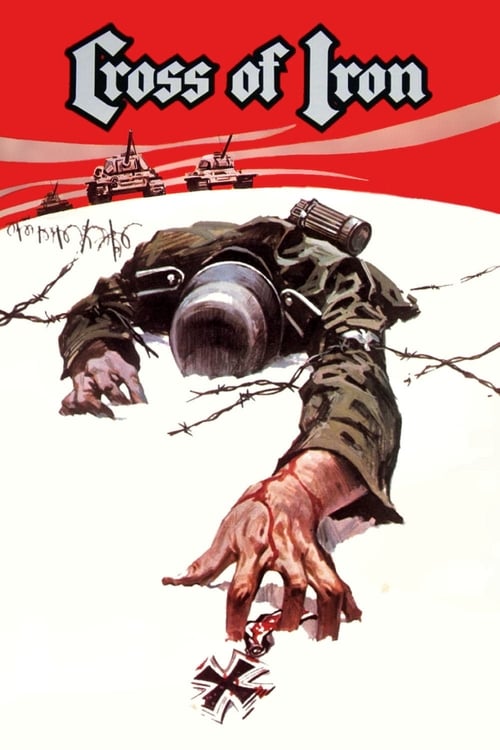
Cross of Iron
1977 · Sam Peckinpah
When you want a war film with teeth — not heroics but rage — and you're ready for something grim and confrontational rather than comforting.
What it's about
On the Eastern Front in 1943, the German army is falling apart and retreating from Russia. Corporal Steiner, a hardened soldier who despises rank and cares only about keeping his platoon alive, collides with Captain Stransky, a Prussian aristocrat who has come to the front for one reason: to win an Iron Cross and go home decorated. It's a class war fought inside a shooting war, while the actual war grinds everyone into the mud.
The experience
Brutal, muddy, and nerve-shredding — the combat comes in slow-motion eruptions of chaos that feel less like action than like being caught in machinery. Between battles it's bitter and sardonic, a film that hates war and the men who profit from it in equal measure.
Performances
James Coburn gives one of his best performances as Steiner, all coiled contempt and exhausted decency; Maximilian Schell makes Stransky's vanity genuinely chilling, and James Mason and David Warner add weary intelligence as officers watching the collapse.
The craft
Peckinpah brings his signature slow-motion montage editing to the Eastern Front, cutting explosions, bodies, and faces into hallucinatory bursts that influenced how screen combat has looked ever since. The production design is caked in grime and smoke — this is war as filth, not spectacle — and it rewards a big screen and loud speakers even as it refuses to make any of it glamorous.
Why it matters
Peckinpah's only war film and one of the very few major English-language pictures told from the German side of World War II, it flopped in America but became revered in Europe and among later war-film directors as a benchmark for unromantic combat cinema.
Snapshot
Cross of Iron is Sam Peckinpah's only war film and one of the few major English-language pictures to render the Second World War entirely from the vantage of the German army — specifically the exhausted, retreating Wehrmacht on the Eastern Front in 1943. Adapted from Willi Heinrich's novel Das geduldige Fleisch (published in English as The Willing Flesh), it stages a class war inside a shooting war: James Coburn's Corporal (Sergeant) Steiner, a battle-hardened, insubordinate professional who cares only for the survival of his platoon, against Maximilian Schell's Captain Stransky, a Prussian aristocrat who has transferred to the front for the sole purpose of winning the Iron Cross and returning to Berlin decorated. Around them, James Mason's weary Colonel Brandt and David Warner's sardonic Captain Kiesel watch the collapse of the front and of any illusion that the war can be redeemed by honor. The film's reputation has inverted over time — a commercial disappointment in the United States on release, it has since been received as one of the genre's most unsparing and formally aggressive works, and as the clearest late statement of Peckinpah's obsessions with violence, masculine codes, and institutional rot.
Industry & production
The film was a European co-production of the mid-1970s runaway-production economy, financed largely through West German and British sources — producer Wolf C. Hartwig (a figure previously associated with commercial and exploitation fare) working with EMI Films and Rapid Film — and shot on location in Yugoslavia, whose landscapes and low costs made it a standing substitute for the Russian front. The production is legendary for its difficulty. Financing was chronically unstable, and by most accounts the money ran out before Peckinpah could complete the picture as planned, a shortfall widely credited with the film's famously abrupt, near-fragmentary final movement. Peckinpah's own condition compounded the strain: by 1977 his long-documented alcoholism and drug use had eroded his health and reliability, and Cross of Iron was made in the difficult late phase of a career that had already produced The Wild Bunch, Straw Dogs, and Pat Garrett and Billy the Kid. The result of these pressures is visible in the film itself — a work of enormous power that is also structurally uneven, its ending arriving less as resolution than as collapse. A sequel, Breakthrough (also released as Sergeant Steiner, 1979), continued the Steiner character with Richard Burton in the role and without Peckinpah's involvement; it is generally regarded as a lesser, unrelated venture.
Technology
Cross of Iron was shot in color and in widescreen, and its technical ambition lies less in novel equipment than in the sheer physical staging of combat — trench networks, tank advances, artillery barrages, and infantry actions realized practically with pyrotechnics, squibs, and large-scale mechanical effects. The film belongs to the era just before Das Boot (1981) and the video-assisted, increasingly controlled war spectacle of the following decades; its battle sequences depend on in-camera destruction and on the coordination of extras, vehicles, and explosives across real terrain. (I would not want to assert a precise aspect ratio or film stock beyond this without the technical record in front of me.) The most distinctive "technology" is arguably editorial and photographic rather than mechanical: the marriage of Peckinpah's established multi-camera, variable-speed shooting method to the demands of modern combat, which required capturing chaotic, fast-moving action from several angles simultaneously so that it could be recombined in the cutting room.
Technique
Cinematography
The images are the work of John Coquillon, Peckinpah's trusted cinematographer from Straw Dogs and Pat Garrett and Billy the Kid. Coquillon renders the front in a palette of mud, smoke, and cold light — a demoralized, overcast world drained of glory. His handheld and mobile camerawork stays low and close inside the fighting, privileging the soldier's disoriented sightline over the commander's map-view. The photography is markedly unromantic: where much prior war cinema found grandeur in landscape and formation, Coquillon finds obscuring smoke, churned earth, and bodies, so that the geography of battle is deliberately hard to read — an aesthetic that mirrors the men's own confusion.
Editing
Editing is the film's signature register and the fullest late flowering of Peckinpah's montage style. The combat is cut with the director's characteristic intercutting of multiple speeds — slow motion detonating against normal-speed action — to stretch and fracture moments of violence and death. The technique, pioneered in The Wild Bunch, is turned here toward a war of attrition, making killing simultaneously balletic and grotesque. Equally important are Steiner's subjective sequences: after he is wounded, the film moves into fevered, hallucinatory montage that dissolves the boundary between memory, delirium, and present action. The editing credits are shared among several hands (including Tony Lawson and Michael Ellis), consistent with a production finished under duress.
Mise-en-scène / staging
Peckinpah organizes space around hierarchy and its inversion. Command posts, headquarters, and the officers' quarters are staged as arenas of manners, class ritual, and self-deception; the trenches and forward positions are staged as a democracy of mud where competence, not rank, decides who lives. The film repeatedly frames Stransky's fastidious uniform and bearing against the filthy, improvised appearance of Steiner's men, making costume and setting carry the argument. The opening-credits montage — archival and photographic imagery of the Nazi era set against a German children's song ("Hänschen klein") — establishes the strategy at once, juxtaposing innocence and machinery of state; the film returns to comparable material at its close, bracketing the drama within a larger historical indictment.
Sound
The sound design leans into the overwhelming, disorienting texture of modern combat — layered ordnance, engines, and cries that submerge speech — while Ernest Gold's score (Gold best known for Exodus and It's a Mad, Mad, Mad, Mad World) supplies motifs that resist triumphalism. The recurring children's song is the film's most pointed sonic gesture, an ironic thread that binds the horror to the notion of a nation's inheritance and complicity.
Performance
The performances are unusually strong for a film made under such strain. James Coburn gives what many consider one of his finest performances as Steiner — laconic, physically weathered, contemptuous of authority yet bound to his men by something deeper than duty. Maximilian Schell makes Stransky a study in aristocratic cowardice curdled into malice, a man whose vanity becomes lethal. James Mason and David Warner lend the officer-class scenes gravity and irony respectively, functioning as the film's disillusioned conscience. Coburn had a prior working relationship with Peckinpah (from Major Dundee and Pat Garrett and Billy the Kid), and that trust registers in the ease and authority of his presence.
Narrative & dramatic mode
The film operates in a mode of ironic, anti-heroic realism structured around a moral duel. Its engine is not the campaign but the private war between Steiner and Stransky over the Iron Cross — a decoration Stransky covets fraudulently and Steiner regards as worthless. This personal antagonism becomes the vehicle for a broader argument about institutions: Stransky attempts to secure a false valor claim, and the plot turns on the coercion and betrayal he deploys to protect himself, including his exploitation of a subordinate officer's vulnerability. The narrative is episodic and increasingly centrifugal, especially after Steiner's wounding, when the subjective delirium sequences loosen linear storytelling. The ending is deliberately anti-climactic and chaotic — famously so, partly by design and partly by circumstance — refusing the catharsis of a decisive victory or a clean death, and closing instead on a note of grim, near-hysterical futility, sealed by a citation from Bertolt Brecht warning that the source of such horror is not yet exhausted.
Genre & cycle
Cross of Iron sits within the war film but pointedly against its patriotic, victory-oriented mainstream. It belongs to the anti-war lineage that runs from All Quiet on the Western Front (1930) — itself a German-perspective account of futility — and shares affinities with Jean Renoir's La Grande Illusion in its focus on the class fault lines cutting across national ones. By centering sympathetic ordinary German soldiers, it participates in a small cycle of works willing to separate the Wehrmacht foot soldier from the Nazi state, complicating the Allied-heroic framework that dominated Anglo-American war cinema. Within Peckinpah's own filmography it functions as a transposition of the Western's dying-code themes onto a twentieth-century battlefield: the professional man of violence, obsolete and betrayed by the institution he serves.
Authorship & method
The film is unmistakably Peckinpah's — in its montage of violence, its elegiac attention to men bound by a fraternal code, and its contempt for the powerful who send others to die. His method here, as elsewhere, combined meticulous action choreography with a volatile, improvisatory set culture, all conducted amid the personal deterioration that shadowed his late career. He is served by a familiar and formidable set of collaborators: cinematographer John Coquillon, a repeat partner whose grimy naturalism defined Peckinpah's 1970s look; composer Ernest Gold; and an editorial team (including Tony Lawson) executing the director's demanding cutting scheme. The screenplay derives from Willi Heinrich's novel; the writing credits are shared and have been the subject of some dispute, with the veteran screenwriter Julius J. Epstein (of Casablanca) among the names associated with the script — a point worth flagging as one where the precise division of credit is contested in the record rather than settled.
Movement / national cinema
Though directed by an American and shot in Yugoslavia with an international cast, Cross of Iron is culturally a hybrid — an Anglo-German co-production narrating German experience. It does not belong to a formal movement so much as to the transnational, runaway-production filmmaking of 1970s Europe and to the broader New Hollywood sensibility that Peckinpah helped shape: disillusioned, violent, institutionally skeptical. Its German subject matter and its West German financing also connect it, tangentially, to the period's German reckoning with the war on film, though it stands apart from the contemporaneous New German Cinema in style and origin.
Era / period
The film is doubly a period piece: it depicts 1943 and the German retreat, and it is itself a product of 1977, a post-Vietnam moment in which the futility, brutality, and institutional betrayal of war were dominant themes in international cinema. Its refusal of heroism, its foregrounding of a professional soldier abandoned by his own command, and its unromantic violence are legible as much through the lens of the mid-1970s as through that of the Eastern Front. It arrives at the tail end of the New Hollywood auteur era and near the end of Peckinpah's viable directing career.
Themes
The governing theme is the hollowness of honor: the Iron Cross functions throughout as an empty signifier, coveted by the coward Stransky and disdained by the brave Steiner, so that the film systematically severs valor from its official emblems. Beneath it runs a thoroughgoing class critique — the aristocratic officer corps set against the working-class enlisted men who actually fight — and an anti-authoritarianism directed at the institution of the army itself. The film explores the professional soldier's code and the fierce, apolitical loyalty of men to one another as the only value that survives the collapse of larger justifications. It meditates on the machinery and futility of war, on courage and cowardice as facts of character rather than rank, and, in its bracketing use of children's imagery and the closing Brecht epigraph, on national complicity and the recurrence of the conditions that breed such catastrophe.
Reception, canon & influence
On release Cross of Iron met a divided response and underperformed commercially in the United States, while reportedly faring far better with European and especially West German audiences. Its critical standing has risen substantially since. A frequently repeated piece of the film's lore is that Orson Welles admired it, calling it the finest anti-war film he had seen since All Quiet on the Western Front — an endorsement widely cited, though it is worth treating such attributed praise with the caution any oft-repeated anecdote deserves. Over the decades it has been reassessed as one of the strongest entries in the war genre and as essential late Peckinpah, its combat sequences and its German-eye-view narration singled out for particular respect.
Looking backward, the film draws on the anti-war tradition of All Quiet on the Western Front and the class-conscious war drama of La Grande Illusion, and it transposes the doomed-professional ethos and slow-motion violence of Peckinpah's own Westerns — above all The Wild Bunch — onto the Eastern Front. Looking forward, its influence is most often located in the "grunt's-eye" realism and de-glamorized violence that later war cinema pursued, and in the wider filmmaking of admirers of Peckinpah's montage. Its most direct progeny was the unofficial 1979 sequel Breakthrough, made without him. Beyond that immediate legacy, the film's precise line of influence on specific later works is harder to document with confidence than its enduring cult reputation, and I would rather note that reputation plainly than overstate causal claims the record does not firmly support.
A Deleuzian reading
A children's song plays first.
The full Deleuzian reading of Cross of Iron →
Reception
A troubled production that flopped in the US in 1977, it was a genuine blockbuster in Germany and has since climbed into the anti-war canon — now regularly ranked alongside Peckinpah's best work rather than as his late-career oddity.
How Cross of Iron was received, from release to now →
How to watch Cross of Iron: what to notice on a first viewing
- Listen for a children's song playing over the opening images. The film opens with archival photographs of the Nazi era set against the German children's song 'Hanschen klein,' the two elements running together without comment or explanation. You are handed two things that refuse to explain each other, right from the first frame.
- Watch the camera stay low and close inside combat. John Coquillon keeps the handheld camera at the soldier's own disoriented height rather than a commander's map view, filling the frame with smoke and churned earth. You are never given a clearer view of the battlefield than the men actually have.
- Watch combat cut between slow motion and normal speed. Peckinpah intercuts multiple camera speeds within a single burst of violence, stretching a fall or a death against the ordinary tempo happening around it. A single moment of killing gets held long enough to look both grotesque and beautiful.
- Compare Stransky's immaculate uniform to his men's filthy gear. Peckinpah stages command posts as arenas of manners and composed framing, and forward positions as a handheld democracy of mud, where competence rather than rank decides who lives. Costume and camera style are arguing about class before a single line of dialogue does.
- Watch how little Steiner reacts to talk of medals. Coburn plays Steiner laconic and weathered, contemptuous of the honors his superiors keep offering, while Schell's Stransky visibly covets the same decoration Steiner treats as worthless. One man wants the medal desperately. The other cannot be bothered to want it at all.
The whole guide to watching Cross of Iron, with the keys for a rewatch →
Influences: the films it descends from and the films it influenced
- The Wild Bunch (1969) — Supplies the signature multi-camera slow-motion montage that intercuts varying frame rates to elongate and abstract death — the exact violence grammar Peckinpah transplants from the doomed-gunfighter West onto Steiner's Eastern-Front combat.
- Seven Samurai (1954) — Kurosawa's slow-motion death spasm (the bandit crumpling in the rain) is the technique Peckinpah reverse-engineered into his squib-and-slow-mo kills, and its weary warrior-caste code prefigures the film's professional-soldier fraternity.
- All Quiet on the Western Front (1930) — Milestone's laterally tracking camera dollying across trench assaults and its enemy-POV humanism are the anti-war template Cross of Iron extends by narrating WWII from the German grunt's eye.
- La Grande Illusion (1937) — Renoir's aristocratic officer clinging to medals and caste honor is the direct model for Stransky's obsession with the Iron Cross, structuring the film's officer-versus-enlisted class-hierarchy staging.
- Paths of Glory (1957) — Establishes the staging of comfortable commanders sending men to die for personal vanity and the tribunal-of-honor irony, the institutional-rot contempt Peckinpah channels through Stransky's cowardice.
- Battleship Potemkin (1925) — Eisenstein's collision montage — fragmenting an action into colliding shards of movement — is the editing foundation beneath Peckinpah's disorienting cross-cut cutting rhythm in the assault sequences.
- Major Dundee (1965) — Peckinpah's own earlier study of a doomed, class-riven military column across hostile terrain rehearses the commander-vs-men friction and elegiac march-to-annihilation he reprises on the Eastern Front.
- The Bridge (1959) — Takes the war from the German enlisted man's viewpoint and refuses heroism entirely, continuing Wicki's inside-the-Wehrmacht, defeat-facing perspective on ordinary soldiers.
- 49th Parallel (1941) — Peckinpah takes the enemy unit as protagonist and fractures it along the same fault: Stransky's ideological officer against Steiner's professional humanist is Hirth against Vogel, the internal dissent within the German group doing the dramatic work the pursuers can't.
- Come and See (1985) — Extends the concussed subjective-delirium POV — sound dropping to a ringing whine, blurred vision, direct-to-camera stares — into a total sensory grammar, still viewed from the Eastern Front.
- Das Boot (1981) — Continues the German-perspective WWII drama with a restless handheld camera racing through cramped interiors and a de-glamorized doomed crew bound by professional duty rather than ideology.
- Stalingrad (1993) — Lifts the premise wholesale — ordinary German soldiers ground up on the Eastern Front — rendered in mud-and-frost naturalism directly downstream of Cross of Iron's enemy-eye realism.
- Platoon (1986) — Pushes the grunt's-eye anti-heroic realism forward with desaturated jungle naturalism and no redemptive glory, the enlisted-man's-view combat cinema Cross of Iron helped license.
- Saving Private Ryan (1998) — Its desaturated handheld combat with subjective sound-drop and stuttered slow-motion inserts is a direct technical descendant of Peckinpah's shutter-manipulated, multi-frame-rate violence montage.
- Full Metal Jacket (1987) — Deploys the same ironic-pop-song-over-war device (the Mickey Mouse Club march closing a massacre) and dissects institutional rot from within the ranks in the hollowness-of-honor vein.
- Breakthrough (Sergeant Steiner) (1979) — The unofficial, Peckinpah-less sequel that literally continues the Steiner character and Eastern-Front premise, the film's most direct — if diminished — line of progeny.
- Fury (2014) — Peckinpah's multi-camera fragmented combat editing — real-time action intercutting with slow-motion to distend moments of maximum violence — is the prototype for Ayer's compression/release rhythm in the Tiger engagement, while the film's German-soldier revisionism establishes the moral framework of unglamorous veteran-guilt Fury inherits.
- Enemy at the Gates (2001) — Pioneers Eastern-Front combat staged partly from the German vantage, with percussive montage of explosive impacts that fragments the battle into discrete shocks.
- Apocalypse Now (1979) — Shares the New Hollywood device of scoring atrocity with ironic pop/anthemic music (Wagner, the Stones) — the same sardonic-soundtrack irony as the film's children's song — plus subjective combat delirium.
- The Deer Hunter (1978) — A contemporaneous post-Vietnam de-romanticizing of the soldiers' code and its hollow aftermath, favoring anti-climactic drift over heroic resolution in the same New Hollywood register.
- A Bridge Too Far (1977) — Released the same year and equally preoccupied with institutional failure and ensemble-no-protagonist structure on the Eastern Front, Cross of Iron pursues the same critique through fragmented slow-motion editing and expressionist close-ups — the aesthetic counterargument to Attenborough's controlled long-lens classicism, the two films bracketing the decade's anti-heroic war cycle.
- Straw Dogs (1971) — Sibling extending the Peckinpah/Coquillon/Fielding team into combat: dissonant Jerry Fielding scoring under overcranked, fragmented battle montage — the same violence-as-magnification editing developed in Straw Dogs.
Similar films
- Paths of Glory (1957) — influence & lineage
- Platoon (1986) — influence & lineage
- The Wild Bunch (1969) — influence & lineage
- Full Metal Jacket (1987) — influence & lineage
- Seven Samurai (1954) — influence & lineage
- All Quiet on the Western Front (1930) — influence & lineage
- Grand Illusion (1937) — influence & lineage
- The Deer Hunter (1978) — influence & lineage