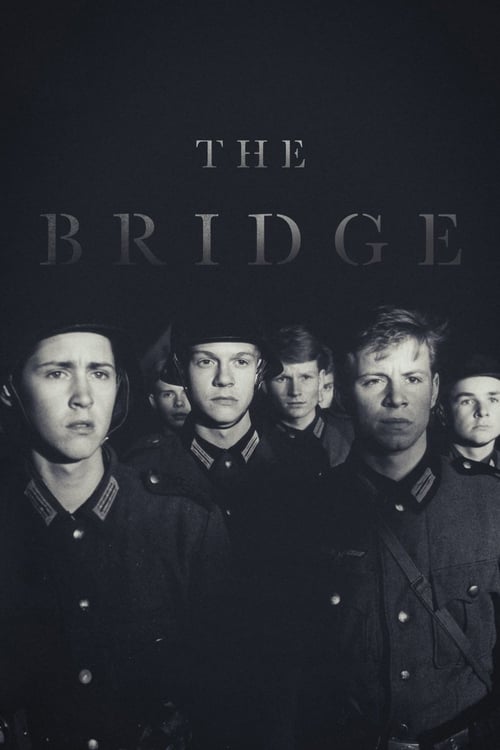
The Bridge
1959 · Bernhard Wicki
For when you want a serious, sobering film that stays with you — not comfort viewing, but the kind of stark moral clarity you're glad you sat through. Best watched when you have room to sit with it afterward.
What it's about
In the last days of the Second World War, seven sixteen-year-old German schoolboys are conscripted and posted to guard a small bridge in their home town — an assignment invented by an officer precisely to keep them away from real combat. As the defeated army streams past in retreat and the adults vanish one by one, the boys, raised on 'blood and honor' slogans, stay to defend a bridge that matters to no one but them.
The experience
Quiet, methodical and then devastating — it spends time letting you know each boy before the war arrives, so the final stretch lands with terrible force. This is anti-war cinema that refuses you any thrill.
The craft
Bernhard Wicki, an actor directing his first fiction feature, shoots in stark black and white with an almost documentary plainness, and the battle filmmaking is brutally convincing for 1959. The restraint is the craft: no glory, no swelling score, just consequence.
Why it matters
One of the first serious German cinematic reckonings with the Nazi past, it won the Golden Globe for best foreign-language film and became a foundation stone of postwar anti-war cinema.
Snapshot
Die Brücke is a West German anti-war film about seven sixteen-year-old schoolboys who are conscripted in the last days of the Second World War and assigned to guard a small, militarily worthless bridge in their home town — a posting an officer devises specifically to keep them out of the fighting. Through a chain of misunderstandings and abandonments the boys are left alone at the bridge, and, still intoxicated by the "blood and honor" rhetoric they were raised on, they defend it to near-total annihilation against advancing American forces. Directed by the actor Bernhard Wicki in his first fiction feature, the film adapts Manfred Gregor's 1958 novel and stands as one of the earliest serious cinematic reckonings with the Nazi past to emerge from Adenauer-era West Germany. It won the Golden Globe for Best Foreign-Language Foreign Film and earned an Academy Award nomination for Best Foreign Language Film, and it remains a landmark of the war genre and a precursor to the more radical German cinema of the following decade.
Industry & production
The film was produced in West Germany at the end of the 1950s, a period whose commercial cinema was dominated by Heimatfilme, light comedies, and escapist entertainment that largely avoided confronting the recent past. Die Brücke was in this sense a countercurrent: a low-key, black-and-white production built around unknown young performers rather than stars. The screenplay was developed from Gregor Dorfmeister's novel (published under the pen name Manfred Gregor), with credited screenwriters including Michael Mansfeld and Karl-Wilhelm Vivier working alongside Wicki. The precise corporate financing history is not something I can detail reliably here, and I will not invent budget or box-office figures; what is well established is that the film was made economically, shot on location rather than on elaborate sets, and cast largely with newcomers — a strategy that reduced costs and served the material's demand for unpolished authenticity.
The production is generally reported to have filmed in Bavaria, using a real town and a real river crossing to ground the action, though I would treat the exact location as a detail to verify rather than assert with full confidence. The choice of location shooting was itself consequential: it gave the film a documentary plainness that separates it from studio-bound war pictures of the era.
Technology
Die Brücke was made in black-and-white on 35mm and composed for the standard Academy-era frame (roughly 1.37:1), not for the widescreen formats that were then fashionable for spectacle. This is a meaningful technological choice: at a moment when CinemaScope and color were the industry's prestige currencies, Wicki and his collaborators worked in a deliberately austere, almost newsreel register. Monochrome flattens the pastoral spring setting into something grayer and more clinical, and the boxy frame keeps the drama intimate and hemmed-in rather than panoramic. Sound was, per the common practice of European production of the period, largely post-synchronized; the technical means are unremarkable, but they are used with restraint, and the film's power comes from its refusal of technological spectacle rather than any innovation in it.
Technique
Cinematography
The photography, by Gerd von Bonin, is functional and unsentimental in the film's first half — establishing the boys, their families, and their small-town world in a naturalistic, observational style — and then tightens as the situation at the bridge deteriorates. The combat passages are staged for confusion and proximity rather than for grandeur: the camera stays close to the boys, so that the American advance is experienced as sudden, fragmentary, and disorienting rather than as a legible military tableau. The gray tonalities of the black-and-white images work against any romanticizing of the fighting; there is no golden light, no ennobling composition, only the increasingly harsh contrast of a spring afternoon curdling into catastrophe.
Editing
The film's structure divides cleanly into two movements, and the editing (credited to Carl Otto Bartning) reflects this. The first part is patient and expository, cross-cutting among the seven boys to individuate them — their homes, their crushes, their family frictions, their bravado — so that they are not an anonymous group but distinct people. The second part accelerates into the chaos of the bridge, where the cutting becomes more urgent and disjunctive to convey the incoherence of the boys' improvised, doomed defense. The investment of the first half in characterization is precisely what makes the attritional losses of the second half land; the editing's earlier patience is repaid in the later horror.
Mise-en-scène / staging
Wicki stages the material for contrast between the ordinary and the catastrophic. The domestic and school-town settings are rendered as recognizably banal — this is a normal place, these are normal children — which makes the transformation of that place into a killing ground the film's central shock. At the bridge itself, the staging emphasizes the absurdity of the boys' position: the structure they defend has no strategic value, a fact the audience grasps well before the boys do. The blocking repeatedly isolates the boys within a space that dwarfs and exposes them, and the physical business of the fighting — the handling of the Panzerfaust, the scramble for cover — is choreographed to look amateurish and improvised, because that is exactly what it is.
Sound
The sound design favors restraint. Hans-Martin Majewski's score is used sparingly rather than as a constant emotional guide, which leaves the combat sequences to play largely on diegetic noise — engines, gunfire, shouting, silence. The effect is to withhold the swelling musical uplift that conventional war films use to make sacrifice feel meaningful; when the boys die, there is little to tell the viewer how to feel except the plain sound of what is happening. This acoustic austerity is one of the film's quiet anti-war strategies.
Performance
The performances by the young, mostly first-time actors are the film's foundation. Because the boys are individuated in the first half, their responses under fire read as distinct psychologies rather than as types — the show-off, the frightened one, the true believer, the boy desperate to prove himself. The cast, several of whom went on to substantial careers (Fritz Wepper and Volker Lechtenbrink among them), deliver naturalistic, unstarry work that Wicki — himself a seasoned actor — clearly shaped closely. The adult performances, particularly among the retreating soldiers and the officers who dispose of the boys' fate, provide the cynical, exhausted counterpoint to the children's fatal enthusiasm.
Narrative & dramatic mode
The film operates as a tragedy of dramatic irony. The audience understands from early on that the bridge is worthless and that the boys have been placed there to be kept safe; the boys understand neither, and it is the collapse of the adults' protective intention — the death or disappearance of the supervising figures — that leaves the children to enact the ideology they have been fed. The two-part structure functions almost as a fable: an unhurried, humane first act that earns our attachment, followed by a compressed, brutal second act that spends that attachment. There is no redemptive arc and no meaningful victory; the drama's engine is the gap between the boys' belief that they are doing something heroic and the film's unflinching demonstration that they are being destroyed for nothing.
Genre & cycle
Die Brücke belongs to the anti-war war film, and specifically to the lineage that uses the destruction of the young to indict the ideology that sends them to die — a tradition whose most obvious ancestor is All Quiet on the Western Front. Within German cinema it belongs to the small and important postwar cycle of films that attempted to confront the Nazi period honestly rather than to bury or aestheticize it. Against the surrounding commercial output of its moment, it reads as almost generically isolated: a serious war tragedy in an industry then given over to lighter fare, which is part of why it registered as so striking at home and abroad.
Authorship & method
The controlling authorial presence is Bernhard Wicki, an Austrian-born actor who had been imprisoned briefly under the Nazi regime and who came to directing after an established acting career; Die Brücke was his first fiction feature and remains the work most associated with his name. His method here is grounded in performance and observation — the careful, patient building of character before the catastrophe — which reflects his actor's sensibility. His key collaborators include cinematographer Gerd von Bonin, whose plain black-and-white photography sets the film's unromantic register; composer Hans-Martin Majewski, whose restraint keeps the film from tipping into sentiment; and editor Carl Otto Bartning, whose two-part rhythm structures the whole. The source material is Manfred Gregor's novel, itself informed by the author's own experience as a boy at the war's end, which lends the story a claim to lived authenticity. Wicki would go on to direct the German-language sequences of the international production The Longest Day (1962) and features including The Visit (1964) and Morituri (1965), but none eclipsed Die Brücke in his reputation.
Movement / national cinema
The film sits in West German cinema at the close of the 1950s, before the rupture of the 1962 Oberhausen Manifesto and the rise of New German Cinema. It is not itself part of that later movement, but it is frequently cited as a bridge — the pun is unavoidable — between the conventional postwar industry and the more critical, auteur-driven cinema to come. Its willingness to indict the Nazi indoctrination of children, and to show German boys dying pointlessly for a lost and criminal cause, marked a level of national self-examination that much of contemporary German popular cinema avoided. In that respect it is a key document of West Germany's halting, uneven cinematic engagement with its own recent history.
Era / period
The story is set in the final weeks of the war in the spring of 1945, as the Wehrmacht disintegrates and Allied forces advance into Germany — the moment of total collapse, when the regime was throwing its youngest into the breach. The film was made and released in 1959, fourteen years later, into a West Germany in the midst of the "economic miracle" and, many would argue, a broad social reluctance to dwell on the Nazi years. The tension between the story's period and the film's period is essential to its meaning: it addressed a generation of children destroyed by the war to an adult audience that had, in many cases, lived through and participated in it.
Themes
The film's central theme is the criminal betrayal of the young by an ideology and a state that indoctrinated them into their own destruction. It is concerned with the mechanics of that indoctrination — how "blood and honor" rhetoric, absorbed in school and society, converts frightened boys into willing sacrifices — and with the futility that exposes the lie: the bridge is worthless, the war is already lost, the deaths accomplish nothing. Adjacent themes include the loss of childhood, the failure and abdication of the adult world (the officers and soldiers who cannot or do not save the boys), and the specific German reckoning with complicity and inherited guilt. Its pacifism is not abstract; it is argued through the concrete, individuated deaths of children the audience has been made to know.
Reception, canon & influence
Die Brücke was received as a serious achievement and won significant recognition, most notably the Golden Globe for Best Foreign-Language Foreign Film and a nomination for the Academy Award for Best Foreign Language Film, along with domestic German honors. Critically it has been widely regarded as one of the finest German films of its decade and one of the most effective anti-war films of the postwar era; I would flag that I cannot reliably reconstruct specific contemporary reviews or quotations here, and I decline to invent them.
Looking backward, the film's clearest influence is the All Quiet on the Western Front tradition of using the death of the young to condemn the war that consumes them, filtered through the specific circumstances of Germany's 1945 collapse and drawing directly on Gregor's autobiographically informed novel. Looking forward, its stature within the German canon helped establish that domestic cinema could confront the Nazi past directly and seriously, anticipating (without belonging to) the more radical New German Cinema of the 1960s and 1970s. The story was adapted again for German television in the 2000s, a sign of its continued resonance, and the 1959 film endures as a fixture in accounts of the war genre and of postwar German cinema. Its lasting legacy lies less in a school of imitators than in its demonstration — early, and from within Germany — that a war film could refuse heroism entirely and make the refusal devastating.
A Deleuzian reading
A truck goes past.
The full Deleuzian reading of The Bridge →
Reception
Acclaimed from the start — Oscar-nominated, Golden Globe-winning — it broke the postwar German silence about the war and never really fell out of favour; today it's less reappraised than rediscovered, with a 2015 Criterion release introducing it to a new generation who mostly know German war cinema through Das Boot.
How The Bridge was received, from release to now →
How to watch The Bridge: what to notice on a first viewing
- Watch how ordinary the boys' town looks at first. Wicki spends the opening in recognizably banal school and family scenes, bicycles, bedrooms, small arguments, before the war reaches this place at all. The banality makes what happens to this place register as a shock rather than an expected war scene.
- Notice the film give each of the seven boys his own scene. Wicki and editor Carl Otto Bartning cross-cut among all seven, showing a home, a family friction, a crush, so none of them is a type. This patient introduction turns the boys from an anonymous group into people you actually know.
- Watch for flat gray light and no golden glow. Gerd von Bonin shoots in plain black and white, avoiding warm or heroic light, so the image never dresses up the violence to come. Refusing pretty light is one way the film argues against treating war as noble or beautiful.
- Listen for gunfire and engines instead of swelling music. Hans-Martin Majewski's score stays sparse, so the combat plays mostly on diegetic noise, engines, shouting, silence, rather than music cueing your emotions. Without music telling you how to feel, the plain sound of the fighting has to do that work.
- Watch each boy's face for a different reaction to fear. The young, mostly first-time cast plays distinct types under pressure, the show-off, the frightened one, the true believer, the boy desperate to prove himself. Individual faces under fire keep you watching people, not an anonymous unit.
The whole guide to watching The Bridge, with the keys for a rewatch →
Influences: the films it descends from and the films it influenced
- All Quiet on the Western Front (1930) — Founds the schoolboys-to-corpses structure Wicki inherits — recruits who march off as a class and are killed off one by one so their youth itself becomes the film's indictment of the war.
- Westfront 1918 (1930) — German pacifist realism that strips battle of heroic scoring and stages it in raw, near-documentary long takes with diegetic explosion-and-cry soundscapes — the unromantic register Die Brücke's sound restraint extends.
- La Grande Illusion (1937) — Builds its anti-war case from patient character observation and camaraderie rather than combat spectacle, the actor's-eye method Wicki uses to make us know the boys before he kills them.
- Rome, Open City (1945) — Neorealist template of nonprofessional faces and real streets, turning newsreel plainness into tragedy — the location-and-amateur casting grammar Wicki adopts for the town and its schoolboys.
- Paisan (1946) — Episodic construction driven by dramatic irony, where the viewer sees the futile end coming before the characters do, and nonprofessionals carry the emotional load — Wicki's two-part irony descends from this.
- Germany Year Zero (1948) — Shoots the 1945 German collapse through a child moving among real ruins, pioneering the banal-versus-catastrophic juxtaposition of ordinary boyhood against national apocalypse that structures Die Brücke.
- Battleship Potemkin (1925) — Establishes the cross-cutting rhythm that assembles a catastrophe from many small simultaneous actions, the editing logic Carl Otto Bartning applies to the boys' separate deaths at the bridge.
- The Longest Day (1962) — Direct authorial line: Wicki himself directed the German-language sequences, carrying his unglamorous, defeat-inflected staging of German soldiers into an international production.
- Ivan's Childhood (1962) — Extends the youth-destroyed-by-war subject, contrasting a boy's remembered innocence against the front's ruin — the betrayal-of-youth theme rendered through observed character rather than spectacle.
- Cross of Iron (1977) — Takes the war from the German enlisted man's viewpoint and refuses heroism entirely, continuing Wicki's inside-the-Wehrmacht, defeat-facing perspective on ordinary soldiers.
- The Tin Drum (1979) — The New German Cinema confrontation with the Nazi past that Die Brücke prefigured from within Germany — a domestic film insisting cinema face the war seriously and without absolution.
- Das Boot (1981) — German-perspective war realism built on claustrophobic proximity and mounting futility, denying its soldiers glory and heroism in the tradition Wicki established for postwar German cinema.
- Come and See (1985) — Makes a boy-soldier's ravaged face the true casualty of war through sensory, front-of-the-lens proximity — the most extreme heir to Wicki's betrayal-of-youth and handheld-closeness.
- Full Metal Jacket (1987) — Adopts the explicit two-part architecture — formation of the young men, then the combat that annihilates them — as moral structure, the diptych logic Bartning gave Die Brücke.
- Grave of the Fireflies (1988) — Sustains the banal-versus-catastrophic contrast and terminal dramatic irony — children going about ordinary life while the war closes on them — announcing the tragic end at the outset as Wicki foretells the bridge.
- Stalingrad (1993) — German-soldier war film of unheroic location realism and pure futility, following ordinary men to pointless deaths in the defeat-centered lineage Die Brücke opened for German cinema.
- Saving Private Ryan (1998) — Fuses handheld combat proximity with a climactic, futile bridge defense by a small doomed group ordered to hold a militarily worthless crossing — Die Brücke's exact tactical-and-emotional premise at feature scale.
- Land of Mine (2015) — Direct forerunner in depicting German boy-soldiers as children sacrificed at war's close, the anti-heroic reckoning with conscripted youth that Land of Mine transposes to the beach.
- The Steel Helmet (1951) — Contemporary small-squad war film using handheld proximity and an anti-heroic, expendable-men ethos that refuses uplift — the same lean, front-line-adjacent viewpoint Wicki keeps on his seven boys.
Similar films
- Das Boot (1981) — influence & lineage · same viewing thread
- All Quiet on the Western Front (1930) — influence & lineage
- The Tin Drum (1979) — influence & lineage
- Grand Illusion (1937) — influence & lineage
- Germany, Year Zero (1948) — influence & lineage
- The Longest Day (1962) — influence & lineage
- Cross of Iron (1977) — influence & lineage
- All Quiet on the Western Front (2022) — same viewing thread
All the films related to The Bridge →
Watch it with: curated runs of related films
- The Futility of War — A run of films about ordinary men fed into war's machinery — from the trenches to the Casbah to the Warsaw sewers — where the futility and human cost rhyme across a century and a dozen conflicts.