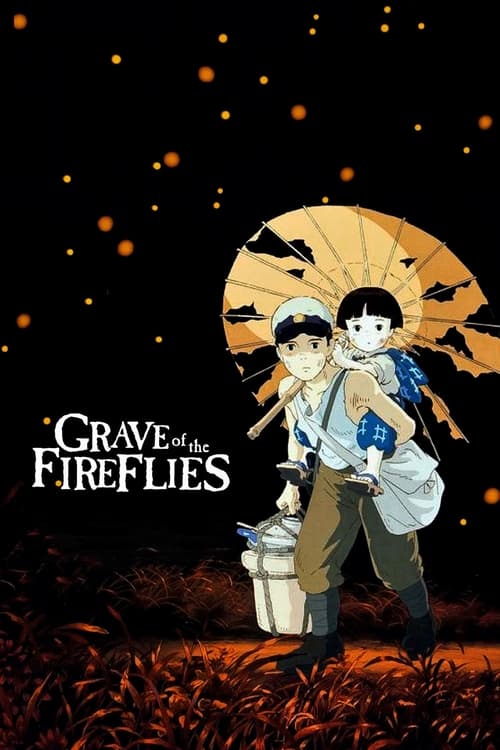
Grave of the Fireflies
1988 · Isao Takahata
Not comfort viewing — reach for it when you're ready to be wrecked by a masterpiece and to sit with it afterward. One to watch deliberately, not casually, and probably not twice in a row.
What it's about
In the last months of the Second World War, a teenage boy and his small sister are orphaned when firebombs destroy their neighborhood in Kobe. After life with an unwelcoming aunt becomes unbearable, the two set up house in an abandoned hillside bomb shelter and try to survive on their own as food runs out around them. The film tells you in its opening minutes that this is a tragedy — then makes you watch how it happened.
The experience
Devastating — arguably the most emotionally severe animated film ever made, unsparing about hunger and war yet full of small, luminous moments of tenderness between brother and sister that make the sorrow bearable and then unbearable. It will stay with you for a long time.
The craft
Takahata uses animation for merciless realism — the firebombing, the fireflies, the physical decline of a small child are drawn with a precision live action couldn't match and wouldn't dare. Its beauty is inseparable from its horror: gorgeous light and countryside framing a story of slow starvation.
Why it matters
A landmark in the case that animation can carry the most serious adult subjects, and one of the most powerful anti-war films in any medium — routinely named among the greatest films about war ever made.
Snapshot
Grave of the Fireflies (Hotaru no haka, 火垂るの墓) is Isao Takahata's adaptation of Akiyuki Nosaka's 1967 semi-autobiographical novella, produced at Studio Ghibli and released in Japan on 16 April 1988. It follows Seita, a teenage boy, and his small sister Setsuko as they are orphaned in the firebombing of Kobe in the closing months of the Second World War, break from an unwelcoming aunt, and slowly starve in an abandoned hillside shelter. The film announces its ending in its first minutes — the boy's spirit narrates from the moment of his own death — so that the entire narrative unfolds as an already-sealed tragedy witnessed in retrospect. It is one of the most emotionally severe films ever made in the animated medium, and a landmark in the argument that animation is a vehicle capable of unsparing realism rather than only fantasy. Its pairing on a double bill with Hayao Miyazaki's My Neighbor Totoro remains one of the most extraordinary programming decisions in film history: two visions of childhood in the Japanese countryside, one radiant, one annihilating.
Industry & production
The project's origin is unusual for Ghibli. The film was initiated and financed not by a film studio but by Shinchosha, the publishing house that held Nosaka's novella; the story's literary prestige — Nosaka had won the Naoki Prize for it — gave the venture cultural weight and gave the young Ghibli a second feature to develop alongside Miyazaki's. Rather than release the two films separately and risk each, distributor Toho packaged Grave of the Fireflies and My Neighbor Totoro as a single program. The commercial logic was fragile — a bleak war tragedy is not an obvious companion to a children's fantasy — and the double bill is generally understood to have underperformed on first release, with the two films' reputations (and Ghibli's fortunes) built substantially in the years afterward through television, video, and international circulation. I would avoid citing specific grosses here, as the reliable record for the 1988 theatrical run is thin and frequently conflated with later re-releases.
Production is widely reported to have been fraught and behind schedule, to the point that the film was not fully complete at its premiere — some passages reportedly went out in a rougher state than intended and were finished afterward. Takahata was a notoriously exacting and slow director, and the demands of the two simultaneous Ghibli productions strained a small studio's resources. The animation direction and character design were handled by Yoshifumi Kondō, one of the most gifted draughtsmen of his generation; the art direction (backgrounds) was by Nizō Yamamoto.
Technology
The film is a traditional cel animation, hand-drawn and painted, photographed on an animation stand — the standard technology of the late-1980s Japanese industry, before digital ink-and-paint. What is notable is less any novel apparatus than the exceptional discipline applied to conventional means: dense frame counts in key passages, meticulously observed physical behavior, and an unusually restrained, desaturated palette. One craft choice is technically distinctive: characters and objects are frequently outlined not in the standard black but in a warm brown, softening the graphic hardness of cel animation and lending the image the tonal warmth of aged photographs or memory. The result reads as a deliberate rejection of the "bright" cartoon register in favor of something closer to painted realism.
Technique
Cinematography
Working within animation's total control of the frame, Takahata and Yamamoto compose with the reticence of live-action realism rather than the dynamism typical of anime. The "camera" tends to hold, to observe from a stable middle distance, and to let action play out in the depth of the frame; fields, ponds, ruins, and interiors are rendered as fully inhabited spaces with consistent light. The palette runs to sepia, dun, and faded green, punctured by the amber of the Sakuma fruit-drop tin, the orange of incendiary fire, and the cold green-gold of the fireflies. The firebombing sequences are the film's one sustained release of kinetic spectacle — falling incendiaries, wind, running crowds — and they are staged with a documentary attentiveness to how fire moves through a wooden city.
Editing
The structure is governed by its frame: the opening establishes Seita already dead, and the film proceeds as a long flashback bracketed by the spirit-world present. Within that arc the cutting is patient and accretive, built from small domestic gestures and the slow arithmetic of dwindling resources. Takahata resists the montage compressions that would hurry the children toward death; instead the decline is measured out in incremental scenes, so that the audience registers starvation as a process rather than an event. Fireflies recur as an editing and imagistic motif linking the living and the dead — light that flares and is extinguished.
Mise-en-scène / staging
Takahata's realism is above all a realism of things and bodies. Food is rendered with almost unbearable specificity — rice, watermelon, the fruit drops dissolved in water to feed a dying child — and the physical facts of malnutrition (Setsuko's heat rash, her weakening, the sores) are shown without euphemism. The hillside shelter is dressed as a real, deteriorating habitation. Setsuko's play — her games, her tantrums, the way a small child's attention works — is observed with a precision that gives the film its documentary authority; the animators studied the behavior of real children so that grief lands on a recognizable rather than a stylized body.
Sound
Michio Mamiya's score is spare and often modal, avoiding the swelling romanticism that would sentimentalize the material; long stretches play with ambient sound alone — insects, water, distant aircraft, the drone and concussion of raids. The film's most famous musical gesture is diegetic: the sentimental parlor song "Home, Sweet Home," heard in a period recording, which sets the lost bourgeois comfort of the children's former life against their present destitution. (The specific vocalist on the recording is sometimes identified as Amelita Galli-Curci; I flag this as a detail worth verifying rather than asserting.) Voice work by Tsutomu Tatsumi (Seita) and the very young Ayano Shiraishi (Setsuko) is central to the film's realism, Shiraishi's performance in particular grounding the child in unaffected spontaneity.
Performance
Because the "acting" is animated, performance here is a fusion of vocal work and drawn behavior. The achievement is the refusal of cuteness: Setsuko is a real four-year-old — willful, uncomprehending, alternately delighted and miserable — and Seita is a proud, wounded adolescent whose care for his sister is inseparable from the errors of judgment that doom them both. The film asks the audience to love the children while also seeing, clearly, how Seita's pride prevents the compromises that might have saved them.
Narrative & dramatic mode
The dominant mode is tragedy of the most classical kind: the outcome is disclosed at the outset, and the drama lies in watching an inevitable end approach. Takahata layers onto this a ghost-story frame — the dead narrating and re-witnessing their own decline — which converts the whole film into an act of mourning and return, the spirits condemned (or choosing) to relive the passage toward death. The tone is realist and unsentimental in method even as the subject is overwhelmingly emotional; the film earns its feeling through observed detail rather than through musical or rhetorical cueing.
Genre & cycle
Nominally a war film and an animated drama, Grave of the Fireflies belongs less to the combat picture than to the Japanese tradition of the home-front war tragedy and the postwar reckoning with defeat and civilian suffering. It sits within a broad cycle of Japanese anti-militarist and "war victim" narratives, and within animation it is a founding text of the serious, adult-addressed, realist mode — proof that the medium could carry a subject usually reserved for prestige live-action drama.
Authorship & method
This is emphatically a Takahata film, and it exemplifies the method that distinguishes him from his Ghibli partner Miyazaki. Where Miyazaki's genius is flight, fantasy, and movement, Takahata pursued the texture of ordinary life, the ethnographic observation of gesture and place, and a realism grounded in research. He wrote the screenplay himself from Nosaka's novella, and famously resisted reading the film as simple anti-war pleading; his stated interest lay more in Seita's isolation and his failure to integrate into a society that, however harsh, still functioned — a critique he suggested was legible to contemporary Japanese youth as much as to the wartime generation. That reading gives the film its uncomfortable moral complexity: the aunt is unkind but not wrong that the children must contribute, and Seita's dignity is also his fatal flaw.
Key collaborators shaped the result decisively: Yoshifumi Kondō's character animation, which makes the children so specifically alive; Nizō Yamamoto's background art, which builds a coherent, weathered world; and Michio Mamiya's restrained score. The source author, Akiyuki Nosaka, is effectively a co-author of the film's emotional truth — the novella drew on his own wartime experience and the death of his younger sister from malnutrition, and that autobiographical wound is the bedrock of the story's authenticity.
Movement / national cinema
The film is a cornerstone of Studio Ghibli and, more broadly, of the elevation of Japanese animation to the status of major national cinema. It is inseparable from the postwar Japanese cultural project of confronting the war experience from the standpoint of ordinary suffering rather than martial glory. At the same time, it is distinctly Takahata's contribution to that project: an animator's realism that draws on Japanese traditions of everyday observation while insisting that the animated image can bear the full weight of historical trauma.
Era / period
Produced at the end of the 1980s, at the height of Japan's economic bubble and prosperity, the film looks back roughly four decades to the nation's most abject moment. That gap between the affluent present of its making and the starving past of its subject is part of its meaning; Takahata's suggestion that Seita's isolation would be legible to comfortable modern youth reads the wartime story as a mirror for a consumer society. Within animation history, 1988 stands as an annus mirabilis for Ghibli, the Fireflies/Totoro double bill marking the studio's emergence as a two-master workshop of world importance.
Themes
Central themes include the destruction of the family and the failure of the social fabric under total war; the tension between individual pride and communal survival; childhood innocence confronting, and being consumed by, catastrophe; and memory, mourning, and the impossibility of return. Fireflies furnish the governing metaphor — light that is beautiful and instantaneous, souls, and, in the film's most bitter association, the incendiary bombs that fell like glowing rain. The Sakuma drops tin becomes an object-emblem of the whole: sweetness rationed to nothing, and finally a vessel for ashes. The film also mounts a quiet critique of nostalgia itself, refusing to let the audience take comfort in a sentimentalized past.
Reception, canon & influence
Although the double bill's initial theatrical performance was modest, Grave of the Fireflies accrued over time a reputation as one of the great films of its medium and one of the most powerful war films from any tradition. Western critics embraced it once it circulated abroad; Roger Ebert, notably, placed it among his Great Movies and argued that it belonged in the company of the finest war films, animated or not — a judgment emblematic of the broader critical reassessment that treats the film as serious cinema without qualification. It is routinely cited in discussions of whether animation can be "adult" art, and it functions as Exhibit A for the affirmative.
Influences on the film (backward): Its bedrock is Nosaka's autobiographical novella and, behind that, the lived catastrophe of the Kobe firebombing and the postwar famine. Formally, Takahata's realist method draws on live-action observational cinema and on a Japanese aesthetic tradition of attentiveness to the textures of everyday life, imported into a medium that had rarely attempted them.
Legacy (forward): The film helped legitimize animation as a form for historically and emotionally serious subject matter, and it stands as the definitive statement of Takahata's realist wing of Studio Ghibli — a counter-tradition to Miyazaki's fantasy that runs through Takahata's later work such as Only Yesterday and The Tale of the Princess Kaguya. Its uncompromising treatment of civilian war suffering has made it a fixture of education and remembrance and a touchstone invoked whenever animation reaches for tragedy. Its influence is less a matter of direct stylistic imitation than of permission: it demonstrated, decisively, that the drawn image could look unflinchingly at the worst of history and be believed.
A Deleuzian reading
Setsuko digs a small grave.
The full Deleuzian reading of Grave of the Fireflies →
Reception
It opened in Japan in 1988 on a double bill with My Neighbor Totoro and underperformed, with the studio's own survival credited to Totoro merchandise; decades later it's routinely ranked among the greatest animated films — and greatest war films — ever made, with Roger Ebert's Great Movies essay helping cement it in the West.
How Grave of the Fireflies was received, from release to now →
How to watch Grave of the Fireflies: what to notice on a first viewing
- Listen for Seita's spirit narrating his own death at the very start. The film opens by disclosing the outcome, then proceeds as a long flashback bracketed by that spirit-world present, so nothing later can arrive as a twist. This is what the reading calls the time-image: a story unspooling as duration rather than suspense toward an ending.
- Listen for stretches with no music, just insects, water, distant planes. Mamiya's score often disappears entirely, letting ambient sound alone carry long scenes of errands, meals, and waiting. This is what the reading calls dead time: ordinary duration held long enough that starvation registers as a process, not an event.
- Notice the muted sepia and dun palette, broken by amber, orange, green-gold. Takahata reserves saturated color for the Sakuma tin, incendiary fire, and fireflies against an otherwise desaturated, weathered world. Each burst of color marks a feeling given visual weight before it fades back into the film's faded tone.
- Watch how the camera holds still at a stable middle distance. Takahata composes with the reticence of live-action realism, letting action play out in the depth of the frame rather than cutting for momentum. The stillness makes you an observer of ordinary life instead of someone swept toward a rescue that never comes.
- Watch Setsuko's small hands and tantrums, not stylized cuteness. Animators studied real four-year-olds so her play, heat rash, and sores read as an actual child's behavior, not an anime trope. Grief lands harder because the body onscreen is recognizable as a real, particular child, not a design.
The whole guide to watching Grave of the Fireflies, with the keys for a rewatch →
Influences: the films it descends from and the films it influenced
- Tokyo Story (1953) — Supplies the observational-stillness grammar Takahata transposes to cel — a low, static camera holding empty domestic space and 'pillow shot' interludes that let ambient time and household texture accumulate rather than dramatize.
- Bicycle Thieves (1948) — Neorealism's live-action method of documenting deprivation through ordinary streets, meals and errands is the model Takahata explicitly imports into animation, grounding tragedy in the material logistics of poverty rather than melodramatic staging.
- Twenty-Four Eyes (1954) — Establishes the Japanese home-front tragedy built on accretive-decline editing — war whittling a fixed group of children down one by one — the elegiac counting-off structure Grave applies to Seita and Setsuko.
- Fires on the Plain (1959) — Renders wartime starvation with unflinching documentary materialism, treating the body's malnourished breakdown as concrete physical fact — the bodily decline Grave animates in Setsuko's dying.
- Heidi, Girl of the Alps (1974) — Takahata's own TV work that built the systematic layout-and-observation method — ethnographic attention to chores, food preparation and gesture — later weaponized so the same everyday textures register as loss.
- Watership Down (1978) — Prior proof that cel animation could refuse cuteness and stare at mortality and violence directly, loosening the assumption that the drawn image must be childish.
- Barefoot Gen (1983) — The immediate animated precedent for depicting the firebombing/atomic destruction of Japanese civilians without flinching, demonstrating the drawn image could carry documented war atrocity.
- When the Wind Blows (1986) — Contemporaneous animated home-front tragedy that watches an ordinary couple's domestic routine consumed by an unseen war (radiation), pairing cel realism of daily habit with slow civilian death.
- Forbidden Games (1952) — Transposes the war-orphaned-children premise to animation, with the siblings' improvised domestic rituals of survival and burial standing in for the graveyard games as their coping structure.
- Threads (1985) — Opens with its protagonist's death and denies all catharsis, dramatizing civilian starvation after aerial bombing through the same elliptical fatalism and diegetic restraint Threads uses on Ruth.
- The King and the Mockingbird (1980) — Takahata — the film's champion and Japanese distributor — carries forward its Prévert-derived tenderness toward the powerless within a rigorously composed, non-cartoon dramatic register.
- The Bridge (1959) — Sustains the banal-versus-catastrophic contrast and terminal dramatic irony — children going about ordinary life while the war closes on them — announcing the tragic end at the outset as Wicki foretells the bridge.
- Only Yesterday (1991) — Direct continuation of the realist wing: flashback-frame structure and ethnographic observation of ordinary gesture, food and labor deployed for emotional weight without fantasy.
- The Tale of the Princess Kaguya (2013) — Completes Takahata's classical-tragedy method with an announced, foreordained ending and Mamiya-style restrained scoring, using deliberately unfinished brush-and-charcoal linework as the mature answer to Grave's brown-outline realism.
- In This Corner of the World (2016) — The most direct heir to the home-front method — documentary materialism of rationing, cooking and household craft under wartime, with the same accretive erosion of an ordinary life around Kure and Hiroshima.
- Giovanni's Island (2014) — Extends the childhood-consumed-by-war template into the Soviet occupation of the Kurils, again pairing two siblings' intimate perspective with a historically researched, desaturated wartime world.
- Grave of the Fireflies (dossier lineage: Persepolis) (2007) — Cashes in Grave's 'permission' — animation as a legitimate vehicle for adult, first-person historical testimony about political violence, treating the drawn image as documentary memoir.
- Waltz with Bashir (2008) — Uses animation to hold serious, traumatic war memory as non-fiction reckoning, inheriting the post-Grave assumption that the medium can look unflinchingly at atrocity and be believed.
- The Wind Rises (2013) — Ghibli's other war reckoning, applying the studio's cel craft and desaturated period backgrounds to civilian complicity and loss in the same 1930s–40s Japan, a fantasy-wing counterpart to Takahata's realist gaze.
- Up (2009) — Takahata established the categorical precedent that theatrical animation could make adult grief and irreversible loss its primary subject without comedic deflection, providing the genre permission structure within which Up's opening montage operates as formal argument rather than tonal aberration.
- Godzilla Minus One (2023) — Takahata encodes postwar civilian loss through domestic-object detail — the meaning of food tins and care routines under erasure — which Yamazaki borrows for the Ōfuna household sequences, where grief accrues through interrupted domesticity rather than direct spectacle, grounding the monster film in the classical Japanese home-as-wound construction.
- Persepolis (2007) — Proved hand-drawn animation could deliver serious, tragic, historically-grounded human drama about war and civilian suffering, legitimizing animation as a vehicle for grave autobiographical/historical testimony.
- The Breadwinner (2017) — Proved 2D animation could sustain unflinching war-drama realism centered on a child's survival, licensing Breadwinner's tonal seriousness.
- Violet Evergarden: The Movie (2020) — Establishes the postwar-orphan register Violet inherits — trauma conveyed through unsentimental observation of mundane objects and routines rather than dialogue, letting a former combatant's grief accrete in silence.
- My Neighbor Totoro (1988) — Literal double-bill partner sharing the same Ghibli cel pipeline and children's-physical-life character animation, defining the fork between Miyazaki's fantasy wing and Takahata's realist wing on one program.
- Come and See (1985) — Takahata's structural deployment of the inverted bildungsroman — wartime child experience staged as systematic physical and moral deterioration rather than growth — mirrors Come and See's formal-ethical inversion exactly, with Setsuko's body as temporal instrument in precisely the way Flyora's aged face measures the film's catastrophe.
- Warriors of the Wind (1984) — The sibling Ghibli film financed by Nausicaä's success that pushes the studio's pacifism into unflinching wartime tragedy, extending the anti-militarist conviction Nausicaä dramatizes via the Tolmekian war machine.
- A Silent Voice: The Movie (2016) — Ancestor in tonal control — handling potentially maudlin material (guilt, self-destruction) with an unsentimental, observational refusal to underline the pain.
- Farha (2021) — Keeps its children in the offscreen margins of the war's battles, dramatizing survival and slow deprivation in enclosed shelters rather than staging the bombing raids as action.
- Empire of the Sun (1987) — Children surviving the collapse of wartime society rendered through their restricted vantage, death-of-innocence delivered without Spielbergian consolation.
- Kannathil Muthamittal (2002) — Centers war's cost on children severed from family and a quest to survive, staging the loss of the parent-figure without letting the horror resolve into consolation.
- Testament (1983) — Builds its structure from a recurring burial motif and child-scale procedure — the daily arithmetic of feeding a sibling — so that the war registers as domestic attrition and the interment scenes, not the raids, carry the film's weight.
Similar films
- The Tale of The Princess Kaguya (2013) — influence & lineage · often watched together
- Tokyo Story (1953) — influence & lineage · often watched together
- Barefoot Gen (1983) — influence & lineage
- My Neighbor Totoro (1988) — influence & lineage
- Only Yesterday (1991) — influence & lineage
- Fires on the Plain (1959) — influence & lineage
- In This Corner of the World (2016) — influence & lineage
- The Wind Rises (2013) — influence & lineage
All the films related to Grave of the Fireflies →
Watch it with: curated runs of related films
- Where Children Meet the Dead — Watch these together and Coco's candlelit sweetness darkens by degrees into a run of folk fables where the dead won't stay buried and children bargain with mortality under the shadow of war and fascism.