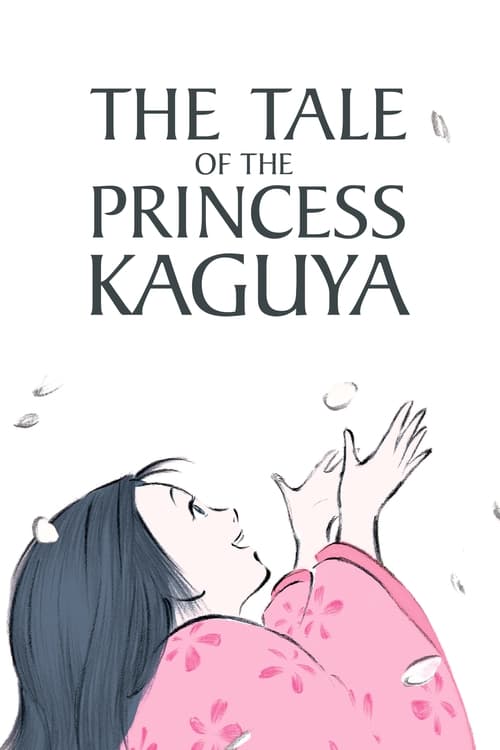
The Tale of The Princess Kaguya
2013 · Isao Takahata
When you want beauty and a good cry in the same evening — a film to watch when you're ready to feel something large about parents, childhood, and time passing. More meditative than cozy.
What it's about
An old bamboo cutter finds a tiny girl glowing inside a bamboo stalk and raises her as his own. She grows with unnatural speed into a young woman who enchants everyone she meets, and her father — convinced her destiny is nobility — moves the family to the capital to make her a princess. But the life being built for her is not the life she wants, and her mysterious origins wait at the edge of everything.
The experience
Serene for long stretches, then suddenly overwhelming — it drifts like a scroll painting until a rush of feeling breaks through, and the ending lands with a weight few animated films ever attempt. It leaves you quiet.
The craft
Takahata spent eight years building the film from watercolor washes and sketchy charcoal lines that tremble and fray with emotion — in one famous sequence the drawing itself seems to break apart in rage. Joe Hisaishi's score matches that restraint and release; on a big screen the hand-made texture is astonishing.
Why it matters
Isao Takahata's final film and one of the most expensive Japanese productions of its era, it proved animation could look like a living ink painting — a capstone to the career of Studio Ghibli's other master.
Isao Takahata's final film, eight years in the making and among the most expensive Japanese productions of its time, adapts the tenth-century Tale of the Bamboo Cutter — the oldest surviving Japanese prose narrative — into something that looks like no other animated feature. Working against the polished cel tradition of his own Studio Ghibli, Takahata built the film from watercolor washes and sketched charcoal lines that thin, tremble, and fray with feeling; in the celebrated sequence where the princess flees a banquet, the drawing itself seems to break apart in rage. Beneath the folktale — a girl found in a bamboo stalk, raised toward a destiny she never chose — runs a devastating meditation on parents who mistake status for love, and on how much living gets traded away for the sake of an image. Joe Hisaishi, scoring for Takahata for the first time, matches the restraint. Oscar-nominated, and released the same season as Miyazaki's The Wind Rises, it stands as the quieter, stranger half of Ghibli's great farewell — a career closed on a pencil line.
A Deleuzian reading
Look at the edge of the frame in the country scenes.
The full Deleuzian reading of The Tale of The Princess Kaguya →
Reception
Praised as a masterpiece on release but a box-office disappointment in Japan against its enormous budget, it has since climbed steadily — now routinely named among the greatest animated films of the century and, for many, the crown jewel of Studio Ghibli.
How The Tale of The Princess Kaguya was received, from release to now →
Influences: the films it descends from and the films it influenced
- My Neighbors the Yamadas (1999) — Takahata's first fully digital watercolor-and-sketch feature, where figures float in unpainted white negative space with deliberately unfinished linework — the exact aesthetic Kaguya refines into a whole film.
- Only Yesterday (1991) — Establishes the soft pastel-washed countryside and edge-dissolving pastoral backgrounds, plus the muted adult restraint in performance that Kaguya carries into its rural interludes.
- Grave of the Fireflies (1988) — Takahata's unsentimental, observational realism — emotion conveyed through small everyday gesture rather than melodrama — is the restraint discipline underpinning Kaguya's quiet tragedy.
- Horus, Prince of the Sun (1968) — Takahata's foundational folktale feature, built on collective peasant-village detail and mythic structure, prefigures Kaguya's folktale-adaptation architecture.
- The King and the Mockingbird (1980) — The European poetic-animation model Takahata openly cited as founding Ghibli's ethos — literate, painterly, unhurried — a direct lineage to Kaguya's hand-drawn lyricism.
- The Man Who Planted Trees (1987) — Back's impressionist crayon-and-pastel imagery, whose contours melt into blank paper, is the technical model for Kaguya's lines that trail off into unpainted margins; Takahata championed and wrote about Back.
- Tale of Tales (1979) — Norstein's hand-drawn, texturally impermanent poetic animation — which Takahata translated and promoted in Japan — models the sketch-as-final-image ephemerality Kaguya adopts.
- Pom Poko (1994) — Draws on Japanese folk-painting and scroll traditions, shifting drawing styles mid-scene for emotional register — a precedent for Kaguya's stylistic rupture during the flight sequence.
- Howl's Moving Castle (2004) — Ghibli descendant pushing embodied-aging and transformation into a woman's compressed life-cycle, rendered in expressive hand-drawn line as emotional register.
- Princess Mononoke (1997) — Advances Mononoke's animist folklore into a brushstroke aesthetic while keeping the tragic-epic register and the theme of an earthly world too corrupted for its divine visitor.
- Angel's Egg (1985) — Foregrounds the drawn line and unfinished painterly texture as the subject of the animation itself, extending the Belladonna/Angel's Egg idea that an illustrator's hand, not fluid motion, can carry an entire film's emotion.
- The Thief and the Cobbler (1993) — Virtuosic expressive hand-drawn line and long passages of pure motion-driven character animation as spectacle answer the Thief's belief in drawing itself as the medium.
- The Red Turtle (2016) — Ghibli-produced and Takahata-blessed, it extends Kaguya's minimalism into charcoal-and-watercolor restraint with near-total absence of dialogue, emotion carried by line and pause.
- Wolfwalkers (2020) — Leaves rough pencil and charcoal underdrawing visibly un-inked, and ruptures into scratchy chaotic linework at moments of fear — the same 'drawing-disintegration' device as Kaguya's flight.
- The Breadwinner (2017) — Cartoon Saloon folktale-within-a-story structure using flat, illustrative hand-drawn planes and restraint over spectacle, extending the storybook-as-animation lineage Kaguya crystallized.
- Little Amélie or the Character of Rain (2025) — Takahata's radical unfinished-sketch aesthetic — visible brush-strokes, bleeding watercolor, blank paper left as space — is the direct technical precedent for hand-painted watercolor animation depicting a child's raw perceptual world.
- Look Back (2024) — Takahata pushed the unfinished-drawing principle furthest here, letting charcoal and brush lines dissolve into raw paper during emotional peaks so the animation openly displays the animator's hand; Look Back inherits this idea that a visibly rough, gesture-preserving line carries more feeling than a finished cel.
- Cosmic Princess Kaguya! (2026) — Draws from the same Taketori Monogatari source and models the folklore-adaptation structure — earthly upbringing, suitor trials, lunar reclamation — that Yamashita retools, inverting Takahata's charcoal rushing-line minimalism into saturated digital bloom.
- Maquia: When the Promised Flower Blooms (2018) — Directly prefigures the immortal-observer premise — a being outside human time who must watch mortals age and die — treated as a tragedy of time itself rather than as a plot device.
- The Little Prince (2015) — Adapts a literary source by animating its original illustrative idiom itself — brush-and-watercolor texture becomes the film's surface, the same 'reincarnate the source art rather than illustrate it' move behind the paper sequences.
- The Wind Rises (2013) — The twin 2013 Ghibli 'farewell' feature, sharing Joe Hisaishi's score and a valedictory register — the two co-founders' parallel final statements on hand-drawn animation.
- Song of the Sea (2014) — A folktale (selkie) adaptation rendered in flat watercolor washes and visible hand-drawn contour, prioritizing decorative surface and line over cel-realism, exactly as Kaguya does.
- The Secret of Kells (2009) — Treats the animation frame as an illuminated-manuscript page — ornamental line and hand-drawn calligraphic mark as the medium itself — kin to Kaguya's brush-line-as-image approach.
- Ernest & Celestine (2012) — Built on translucent watercolor washes and deliberately incomplete sketch edges bleeding into white paper, a European contemporary of Kaguya's anti-cel, unfinished-drawing aesthetic.
- Princess Arete (2001) — A folktale of a maiden who resists being an object of possession, told with muted palette and quiet, anti-spectacle staging that parallels Kaguya's 'living traded for image' restraint.
- Spirited Away (2001) — Ghibli sibling that likewise fuses hand-drawn craft with folklore and a heroine dislocated from her own identity, radicalizing the hand-drawn ethos Spirited Away defended against CGI.
- Night Is Short, Walk On Girl (2017) — Takahata's exposed-charcoal-line, flat watercolor 'unfinished' look treats the white of the paper as space — a contemporaneous push toward graphic flatness over rendered depth that parallels the poster-flat staging here.
- The Secret World of Arrietty (2010) — A Ghibli-era elegiac work organized around mortality and a fading world, extending the studio's minor-key, hand-drawn intimacy alongside Arrietty.
- Kubo and the Two Strings (2016) — Takahata renders a Japanese folktale in the sparse, brush-and-negative-space sumi-e/ukiyo-e idiom that Kubo translates into physical sets and origami — a parallel modern homage to woodblock-print flatness and folklore.
- The Boy and the Heron (2023) — Ghibli's other late hand-drawn capstone: elliptical, mortality-haunted, and formally uncompromising, testing the same twilight viability of patient drawn craft as an art-film language.
- In This Corner of the World (2016) — Shares the 'hand-as-imagination' device by leaving the drawn brushstroke visibly unfinished and expressive, foregrounding the mark-making gesture the way Suzu's own drawing and watercolor sequences do.
- The Triplets of Belleville (2003) — Pushes deliberately unfinished, expressive sketch-line and negative space as an emotional device — a parallel insistence that visible hand-drawing conveys feeling CGI cannot, the very argument Belleville embodied.
Similar films
- Only Yesterday (1991) — influence & lineage · same viewing thread
- The Wind Rises (2013) — influence & lineage · same viewing thread
- Grave of the Fireflies (1988) — influence & lineage · often watched together
- Howl's Moving Castle (2004) — same viewing thread · often watched together
- Kiki's Delivery Service (1989) — same viewing thread · often watched together
- Spirited Away (2001) — same viewing thread
- My Neighbor Totoro (1988) — same viewing thread
- Ponyo (2008) — same viewing thread
All the films related to The Tale of The Princess Kaguya →
Watch it with: curated runs of related films
- The Studio Ghibli Canon — A run through the whole hand-drawn shelf of Miyazaki and Takahata — start with the childhood-wonder crowd-pleasers and drift toward the studio's quieter, adult, more elegiac corners.