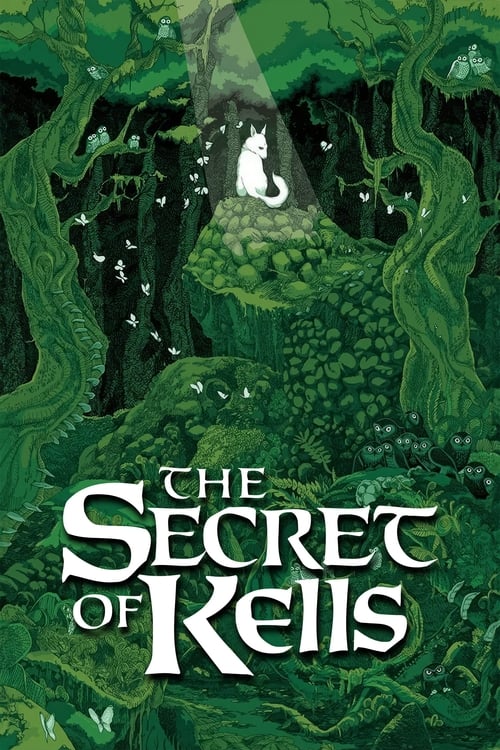
The Secret of Kells
2009 · Tomm Moore
For a family night or a rainy afternoon when you want enchantment — something beautiful and heartfelt that respects a child's intelligence. Comfort viewing with a little genuine peril in it.
What it's about
In a ninth-century Irish abbey braced for Viking raids, twelve-year-old Brendan is forbidden to leave the walls his uncle the Abbot is obsessively building. When a master illuminator arrives carrying an unfinished sacred book, Brendan sneaks into the enchanted forest beyond — where a shape-shifting wolf-girl, ancient serpent gods, and his own fear wait — to gather what the book needs to be completed.
The experience
Gentle and adventurous by turns, with real darkness at its edges — the raids are frightening without being graphic. Mostly it's a film you gawk at: nearly every frame is patterned like an illuminated page, and the forest scenes have a swirling, musical wonder that works on kids and adults alike.
Performances
Brendan Gleeson brings weight and wounded sternness to the voice of the Abbot, making the film's most complicated figure land.
The craft
Hand-drawn and deliberately flat — the film refuses perspective so the screen reads like the manuscript it celebrates, all spirals, borders, and Celtic knotwork. Bruno Coulais' score, made with the Irish group Kíla, gives the forest its magic; on a big screen the design detail is astonishing.
Why it matters
An out-of-nowhere Oscar nominee for Best Animated Feature, it launched the Irish studio Cartoon Saloon and opened its run of folklore films — proof that hand-drawn European animation could thrive on its own terms in a CG era.
Snapshot
A ninety-nine-percent flat, hand-drawn feature about the making of an illuminated manuscript, The Secret of Kells is the film that announced Cartoon Saloon — and, more broadly, announced that European hand-drawn animation could compete on the Academy's main stage without imitating anything American. Tomm Moore's debut (co-directed by Nora Twomey) takes the Book of Kells, the Insular Gospel manuscript now held at Trinity College Dublin, and invents a legend for it: a boy, Brendan, apprenticed in an abbey whose abbot has abandoned illumination for wall-building, who must go into the forbidden forest to gather what the book needs while Viking raiders close in.
Its governing idea is unusually pure for a family feature: the film looks like the object it is about. Perspective is refused, depth is refused, and the frame is treated as a page — bordered, gridded, ornamented, occasionally divided into simultaneous panels like a manuscript's registers. Running roughly seventy-five minutes, it is short, elliptical and formally aggressive, and it arrived in a year when the American industry had largely written off 2D. Its surprise Best Animated Feature nomination at the 2010 Academy Awards — the first release from the newly formed distributor GKIDS — is the single most consequential fact in its afterlife.
Industry & production
The project's gestation was long and largely artisanal. Moore conceived the idea in the mid-1990s as a student at Ballyfermot Senior College in Dublin, developing the visual premise with fellow student Ross Stewart, who would become the film's art director. Moore, Twomey and producer Paul Young founded Cartoon Saloon in Kilkenny in 1999; the studio spent roughly a decade on commercials, shorts and service work while assembling the financing for a feature that no conventional model wanted — a hand-drawn, historically remote, aggressively stylized film with no franchise, no stars and no toy line.
The film exists because of the European co-production apparatus. It was made as an Ireland–France–Belgium co-production with Didier Brunner's Les Armateurs — the French company behind Michel Ocelot's Kirikou and the Sorceress (1998) and Sylvain Chomet's The Triplets of Belleville (2003) — and Belgium's Vivi Film, drawing on national film-board support, broadcaster involvement and pan-European funds. That structure has consequences beyond the balance sheet: the credits distribute animation and production work across multiple partner studios, meaning a film about a scriptorium was itself made by a distributed, multinational workshop. Published budget figures vary and are not reliably documented; what is not in dispute is that the film was made for a small fraction of a contemporaneous American studio feature.
Distribution was the hard part. The film opened in Belgium and France in early 2009 and in Ireland that spring, with festival play including the Berlinale, but had no US distributor of consequence until GKIDS — Eric Beckman's company, an outgrowth of the New York International Children's Film Festival — took it on. The Oscar nomination in February 2010 was widely reported as a shock, displacing better-funded contenders, and it established the template GKIDS would run for a decade: acquire an under-distributed international animated feature, campaign it precisely at Academy animation voters, and convert critical goodwill into a nomination. Cartoon Saloon's subsequent nominations (Song of the Sea, The Breadwinner, Wolfwalkers) all descend from that first breach.
Technology
Kells is a landmark in the digital-2D transition. Contemporary accounts of the production describe a pipeline built around Adobe Flash for animation, with Photoshop and Illustrator work for backgrounds, ornament and texture, and After Effects for compositing — a toolset then associated with cheap television animation, deployed here for something the opposite of cheap. This is the film's quiet technical argument: vector-based digital 2D, usually a cost-cutting compromise that produces stiff, rubbery movement, can instead be matched to a design language that wants flatness, crisp edges, exact repetition and precisely tileable ornament. Knotwork, spirals and interlace are punishing to animate by hand and comparatively tractable in a vector-and-composite workflow.
There is essentially no dimensional CGI in the finished film, and no attempt to simulate volume with rendering. Where other productions of the period used digital tools to add depth — multiplane rigs, 3D-assisted camera moves, volumetric light — Kells uses them to hold the image resolutely to the picture plane. The technology serves a refusal.
Technique
Cinematography
There is no camera in the conventional sense, and the layout department behaves accordingly. Compositions are planimetric and frontal: figures are staged in profile or head-on against flat grounds, and the film moves laterally, in scale-jumps, or not at all, rather than pushing into space. Vanishing-point perspective appears mainly as a joke or a threat — the abbey's rectilinear grid, the tunnel of the wall — while the forest is built from circles, radial symmetry and kaleidoscopic repetition.
The dominant device is the frame within the frame. Arches, doorways, windows, roundels, chalk circles and ornamental borders constantly enclose the action, so that shots resemble illuminations on a page rather than views through a lens. The film also divides the screen into simultaneous panels, comic-strip or manuscript-register fashion, letting parallel actions sit side by side instead of alternating in cuts. Color does structural work: the abbey in grays, ochres and stone-browns; the forest in saturated, luminous greens and whites; the Vikings in black and blood-red, reduced to angular, near-faceless pictograms — a stylization that is both a design choice and an elegant solution to depicting massacre in a film for children. The Crom Cruach sequence abandons representation almost entirely for white line on black, a coiling near-abstraction that is, appropriately for this film, a monster made of drawing.
Editing
The cutting is rhythmic and graphic rather than continuity-driven. Transitions are frequently shaped — irises, geometric wipes, forms that unfurl or knot — treating the cut as an ornamental join. Graphic matches carry the film's arguments: circles rhyme with circles, the Chi Rho page's spirals with the forest's. The structure is unusually elliptical for a family feature; whole years are elided in montage, the wall rises, the mentor's story ends offscreen, and the film trusts the audience to bridge the gaps. That compression is why it runs seventy-five minutes and feels like a legend rather than an adventure — legends skip. The editing credit is held by Fabienne Alvarez-Giro, who also worked with Moore on Song of the Sea.
Mise-en-scène / staging
The film's world is organized as a binary of shapes. The abbey is square, gray, gridded, walled and vertical — an architecture of defense. The forest is round, green, spiraling and horizontal — an architecture of growth. Brendan's arc is literally a movement between geometries, and the film's tragedy is architectural: Abbot Cellach builds the strongest wall in Ireland and it does not work, while the book, portable and fragile, survives. Ornament is not decoration but staging: characters are placed inside patterns that comment on them, and the scriptorium's cosmopolitan brotherhood — brothers drawn from Italy, Africa and Asia — is staged as a communal workshop, a picture of monastic culture as an international network rather than a national relic.
Sound
Bruno Coulais's score, made in collaboration with the Irish traditional band Kíla, is the film's other great fusion. It sets plainchant-derived choral writing and Latin liturgical texture against Irish traditional instrumentation — pipes, whistles, frame drum — and modal, sometimes minimalist ostinati, refusing both pastiche-medievalism and Celtic-mysticism kitsch. Aisling's song, sung in Irish by Christen Mooney, places the Irish language at the film's emotional center rather than using it as flavoring. Sound design is similarly stylized: the Vikings arrive as rhythmic percussion and abstracted roars rather than intelligible speech, which keeps them mythic and keeps the violence legible without being graphic.
Performance
The voice work is emphatically Irish rather than mid-Atlantic. Mick Lally's Brother Aidan — the Iona refugee who arrives with the unfinished book and the cat Pangur Bán — is played with a weathered Connacht warmth that grounds the film's fantasy in a real vernacular; Lally, a fixture of Irish stage and television, died in 2010, and the role stands as a late signature performance. Brendan Gleeson gives Abbot Cellach the film's tragic weight: not a villain but a man who has seen the north burn and has converted his grief into masonry. Evan McGuire's Brendan is unshowy and age-appropriate, and Mooney's Aisling is played as a wild child rather than a cute sidekick. Animation performance is correspondingly restrained — expression comes from silhouette, posture and graphic distortion, not from naturalistic facial acting.
Narrative & dramatic mode
The mode is folk tale rather than novelistic drama, and the film is candid about it. Brendan crosses a forbidden threshold, meets a helper-spirit, descends to confront a serpent-god, returns with a boon (an eye that is also a lens), loses his mentor, is exiled, and comes home. This is Proppian scaffolding worn openly, and the film's brevity — motivations stated once, transitions taken in a jump — is a feature of the form, not an oversight, though it is also the most common critical objection to the film: characters are functions, and Aisling in particular is more presence than person.
What lifts it is that the quest object is not a weapon or a treasure but a tool for seeing more finely — a crystal that lets Brendan draw the intricate Chi Rho page. The climax of a fantasy adventure is therefore an act of drawing, and the film's final movement is a full-screen animated illumination: the book, at last, unfolding into the film's own medium. The frame narrative closes on transmission rather than triumph, the boy grown and the work handed on.
Genre & cycle
Kells sits in the European art-animation feature tradition — the lineage running through Ocelot's Kirikou and Princes et princesses, Chomet's Belleville, and the Les Armateurs house style of graphically bold, hand-drawn, unmistakably non-Disney features. It is also the first panel of what Moore and Cartoon Saloon came to call an Irish folklore trilogy, completed by Song of the Sea (2014) and Wolfwalkers (2020): three films about children, mythic Ireland, and the cost of adults trying to wall out the wild.
Its release year matters generically. 2009 was the moment American 2D was declared finished and briefly revived — The Princess and the Frog appeared the same season — while stop-motion (Coraline, Fantastic Mr. Fox) and CG (Up) dominated the conversation. Kells competed against all four for the Oscar and lost to Up, but its presence on that ballot reframed hand-drawn animation as an aesthetic choice rather than a legacy technology.
Authorship & method
Moore's authorship here is that of a designer-director: the film originates in a look and a source-object, and the story is built to justify them. He shares direction with Nora Twomey, a Cartoon Saloon co-founder who would go on to direct The Breadwinner (2017), and the graphic system is inseparable from art director Ross Stewart, later Moore's co-director on Wolfwalkers. The screenplay is credited to Fabrice Ziolkowski, working from Moore's story — a French writer on an Irish subject, which is characteristic of the whole co-production's cross-currents. Paul Young produced. Coulais's score began a long association: he would return for both later films in the trilogy, as he had scored Coraline the same year.
Moore has been consistently open about his sources, and they are heterodox: Insular manuscript art first, but also mid-century flat graphic design in the UPA tradition, Yellow Submarine, Klimt and Mucha, Genndy Tartakovsky's Samurai Jack, and Japanese animation's patience with landscape. The method is synthesis — medieval ornament read through modernist graphic design — rather than antiquarian reconstruction.
Movement / national cinema
The film belongs to the Irish cinema built after the re-establishment of the Irish Film Board in 1993, and specifically to the animation sector that became one of Ireland's most successful cultural-industrial bets, alongside Brown Bag Films and Boulder Media. Cartoon Saloon's decision to build in Kilkenny rather than Dublin or London is part of the story: a regional studio using European co-production money to make internationally legible work in a local idiom.
Its relationship to Irish cultural nationalism is deliberately oblique. Aisling's name is the Irish word for dream or vision, and invokes the aisling poetic genre in which Ireland appears to the poet as a woman — a nationalist form here rewritten as a wolf-girl of the woods. The white cat Pangur Bán comes from the ninth-century Old Irish poem written by an Irish monk abroad, comparing his hunt for meaning to his cat's hunt for mice. Crom Cruach is drawn from the pre-Christian idol of the Dindsenchas. But the abbey is staged as multi-ethnic and outward-facing, and the film's sympathies lie with transmission and hybridity rather than purity. Released as the Celtic Tiger economy collapsed, a film about a community that builds a wall against catastrophe and survives instead through what it made has invited topical readings; those are readings, not stated intent.
Era / period
Historically, the film sits in the late eighth and early ninth centuries, during the first Viking raids on Iona and the monastic migration to Kells in County Meath — events the film compresses and mythologizes freely, and about which it makes no documentary claims. Abbot Cellach shares a name with a historical abbot associated with the founding at Kells; Brother Aidan and Brendan are inventions.
Industrially, its period is the end of cel animation and the consolidation of digital 2D — the years when Flash-based pipelines were reshaping television animation, when Disney's traditional department had been dismantled and briefly reassembled, and when the international-feature slot at the Academy Awards was still an open frontier. Kells is a product of exactly that gap.
Themes
The wall and the book are the film's two poles: fortification versus transmission, fear versus attention. Cellach is not wrong that the Vikings are coming; he is wrong about what will survive them. Vision organizes the imagery — the crystal eye taken from Crom Cruach, the lens that permits fine work, Aisling as vision incarnate, the abbot who has stopped looking at anything but his own defenses. Illumination is literal (gold, pigment, ornament) and figurative (education, revelation, the lit interior against the dark forest).
Beneath that sit the apprenticeship narrative — the making of an artist as a series of transgressions against a protective adult — and a syncretic account of Irish culture in which pagan forest and Christian scriptorium are not enemies but collaborators; the book is finished only with what the woods and the old gods supply. The film is unusually willing to let loss stand: the forest is destroyed, the mentor dies, the abbey burns, and the compensation offered is a book, which is both a great deal and not nearly enough.
Reception, canon & influence
Critical reception was strong and broadly consistent in its terms: near-universal admiration for the design and the score, with a minority finding the characters thin and the storytelling more schematic than its images. The Oscar nomination reframed the film's commercial life, driving home-video and streaming discovery well beyond its modest theatrical footprint, and it accumulated festival and Irish national awards; the Academy nomination remains the securely documented headline.
Backward, its influences are legible and acknowledged: Insular manuscript illumination above all, the Ocelot–Chomet–Les Armateurs strand of European feature animation, UPA-derived flat design and its 1960s inheritors, Yellow Submarine, Art Nouveau's linear ornament, and the graphic economy of Samurai Jack.
Forward, its consequences are larger than its scale suggested. It made Cartoon Saloon a durable studio and Kilkenny an animation center, launched a trilogy that culminated in Wolfwalkers — the most critically decorated of the three — and gave GKIDS the proof-of-concept for a distribution practice that has since carried a dozen international animated features into the Oscar race. Within animation, it became a standing counterexample to the assumption that hand-drawn 2D was either nostalgic or economically impossible, and its specific vocabulary — flat planes, ornamental framing, color-coded geometry, digital tools used to defeat depth rather than manufacture it — has been widely absorbed by illustrators, independent animators and later stylized features. It is, fittingly for a film about a manuscript, a work whose main achievement was to be copied.
A Deleuzian reading
A wall goes up in a handful of pictures.
The full Deleuzian reading of The Secret of Kells →
Reception
A tiny Irish indie that most people had never heard of until it crashed the 2010 Oscars with a shock Best Animated Feature nomination — before it even had a proper US release. Now it's revered as the film that launched Cartoon Saloon and the first chapter of the beloved 'Irish folklore trilogy' with Song of the Sea and Wolfwalkers.
How The Secret of Kells was received, from release to now →
How to watch The Secret of Kells: what to notice on a first viewing
- Notice nearly every shot framed inside an arch or doorway. Arches, windows, roundels, and ornamental borders constantly enclose the action, so each shot reads like an illumination on a page rather than a view through a lens. The film keeps reminding you that you are looking at a decorated page, not through a window.
- Watch how the abbey's grays give way to the forest's greens. The abbey stays in grays, ochres, and stone browns, while the forest turns saturated and luminous, so a change of place always arrives as a change of palette. Color alone tells you which world Brendan is standing in before anything else does.
- Notice the screen split into panels showing two things at once. The film divides the frame like a manuscript's registers, letting parallel actions sit side by side instead of alternating through separate cuts. The film borrows its structure directly from the pages it is a story about.
- Listen for the Vikings arrive as drums instead of speech. The raiders are given rhythmic percussion and abstracted roars rather than intelligible dialogue, kept mythic instead of individual voices you could understand. They register as a force of nature rather than as people you could reason with.
- Notice the abbey is square and the forest is round. Every abbey space is gridded and vertical, while every forest space spirals and curves, so Brendan's journey is literally a walk from one shape into another. The film tells its whole story in shapes before it ever needs a word of dialogue.
The whole guide to watching The Secret of Kells, with the keys for a rewatch →
Influences: the films it descends from and the films it influenced
- The Adventures of Prince Achmed (1926) — Establishes silhouette acting as a complete performance system — readable intent from outline and gesture alone against flat decorative fields — the exact register Kells uses for the Vikings, the wolves and Aisling's transformations.
- Gerald McBoing-Boing (1950) — The UPA grammar Moore cites directly: unmodelled flat color fields, backgrounds asserted as design rather than place, and space stated by graphic adjacency instead of vanishing-point perspective.
- Sleeping Beauty (1959) — Eyvind Earle's vertical tapestry layouts — medieval illumination flattened into hard-edged stylized foliage that simultaneously ornaments the frame and blocks the actors' paths — is the direct precedent for Kells' forest built out of Insular knotwork.
- Andrei Rublev (1966) — The artisan-under-invasion structure that withholds the finished sacred object until a terminal revelation — Rublev's icons erupting into color after the monochrome film, Kells' Chi-Rho page finally opened as an unearned burst of gold.
- Yellow Submarine (1968) — Heinz Edelmann's Art Nouveau line married to pop flatness, plus the shaped transition — pattern morphing or wiping the frame into the next scene rather than a cut carrying us through depth — which Kells uses for nearly every scene change.
- Fantastic Planet (1973) — Topor's engraved line and cutout articulation paired with color-coded worlds (blue Draags against ochre Oms) doing the narrative separation that camera movement normally performs — Kells' abbey gray versus forest green works identically.
- My Neighbor Totoro (1988) — The source of what Moore calls Japanese animation's patience with landscape: held, actionless establishing shots where the drawn environment is allowed to be the event, which Kells borrows for its forest and scriptorium pauses.
- Kirikou and the Sorceress (1998) — The Ocelot/Les Armateurs house method Kells was produced inside — rigorously frontal planimetric staging, characters turning in profile or full-face and almost never in three-quarter, with flat decorative masses standing in for modeled volume.
- Samurai Jack (2001) — Explicitly cited by Moore: the split-screen panel grid, geometry-binary compositions (circle versus blade, curve versus grid) and violence rendered as abstracted shadow-shapes rather than depicted action — Kells' Viking raid is staged on this template.
- The Triplets of Belleville (2003) — The other Les Armateurs pole: near-wordless storytelling carried by caricatured body silhouette and elliptical compression, proving a European feature could drop dialogue-driven scene construction and let graphic design do the exposition.
- Azur & Asmar: The Princes' Quest (2006) — Cartoon Saloon builds perspectiveless compositions from illuminated-manuscript interlace and ornament—Ocelot's decorative-pattern staging transposed from Persian miniature to Celtic art.
- The King and the Mockingbird (1980) — Extends the anti-Disney graphic-modernist wing of European animation, building space from flat decorative pattern and vertical architectural stylization rather than illusionistic depth.
- Song of the Sea (2014) — Moore rebuilds the same system on a new axis — Kells' rectilinear grid and knotwork replaced by circles and spirals as the governing compositional geometry — while keeping Coulais and Kíla, the frame-within-frame apertures and the Irish-language song as structural device.
- Long Way North (2015) — Takes the flat-plane lesson to its limit by removing outlines entirely, building figures from adjacent unmodulated color shapes so that digital compositing actively strips depth cues rather than adding them — the technique Kells made economically credible.
- The Breadwinner (2017) — Kells' co-director carries over the two-register method — a naturalistic outer film interrupted by an inner tale rendered in flat cut-paper ornament — the same split Kells runs between abbey walls and Aisling's decorative forest.
- Spider-Man: Into the Spider-Verse (2018) — Mass-market vindication of Kells' central move — digital pipelines aimed at defeating depth, with halftone dots, registration offsets, split panels and comic-page framing devices standing in for photographic space.
- Wolfwalkers (2020) — Ross Stewart, Kells' art director, splits the graphic system into two competing rendering regimes — ruled ink and rigid perspective for the town, loose woodcut smudge and refused perspective for the forest — turning Kells' color-coded worlds into a formal argument the film is about.
- Persepolis (2007) — Contemporary proof of the same wager — high-contrast black-and-white flat panels with no depth cues, characters reduced to silhouette masses, and a national trauma narrated through graphic reduction rather than realist rendering.
- Coraline (2009) — Bruno Coulais scoring both films the same year with the identical device — wordless children's choir and nonsense-syllable vocalize used as texture rather than melody — which becomes the Cartoon Saloon sonic signature when he returns for the whole trilogy.
- The Tale of the Princess Kaguya (2013) — Pushes Kells' refusal of depth further by leaving the drawn line visibly unfinished and unfilled paper standing as space, treating digital tools as a way to preserve the hand's mark instead of manufacturing volume.
- Ernest & Celestine (2012) — Parallel European hand-drawn revival built on flat, ornamental 2D compositions consciously rejecting Hollywood 3D rendering.
- Klaus (2019) — Cartoon Saloon's proof that a stylized, flat-graphic 2D feature could win awards against CG is the parallel hand-drawn-revival argument Klaus makes, both prioritizing designed illustration over volume.
- Little Amélie or the Character of Rain (2025) — Cartoon Saloon's hand-painted, deliberately flat illustrative craft is a parallel European answer to CG animation, prizing painted texture over dimensional realism as the seed does.
- The Secret World of Arrietty (2010) — A near-contemporary hand-drawn 2D feature scored in a Celtic folk idiom (Kíla/Bruno Coulais), paralleling Corbel's harp-and-voice departure and its flat, layered-depth design.
- Princes and Princesses (2000) — Cartoon Saloon's deliberately flattened, frontal, ornament-driven staging — depth refused in favor of illuminated-manuscript friezes — pursues the same anti-perspectival decorative flatness Ocelot practices.
- The Princess and the Frog (2009) — Released the same year and nominated in the same Animated Feature category, it makes the parallel case for flat, deliberately graphic hand-drawn 2D built in a digital ink-and-paint pipeline as a live contemporary technique rather than heritage revival.
Similar films
- Song of the Sea (2014) — influence & lineage · same viewing thread
- Wolfwalkers (2020) — influence & lineage · same viewing thread
- The Breadwinner (2017) — influence & lineage · same viewing thread
- Kirikou and the Sorceress (1998) — influence & lineage · same viewing thread
- Coraline (2009) — influence & lineage
- Azur & Asmar: The Princes' Quest (2006) — same viewing thread
- Watership Down (1978) — same viewing thread
- Pan's Labyrinth (2006) — often watched together
All the films related to The Secret of Kells →
Watch it with: curated runs of related films
- Hand-Drawn Myths and Fairy Tales — Watch these as a run of traditional 2D animation that reaches back into folklore — Celtic selkies, Islamicate djinn, West African sorcery, English rabbit-lore — each rendered in a distinct storybook line.