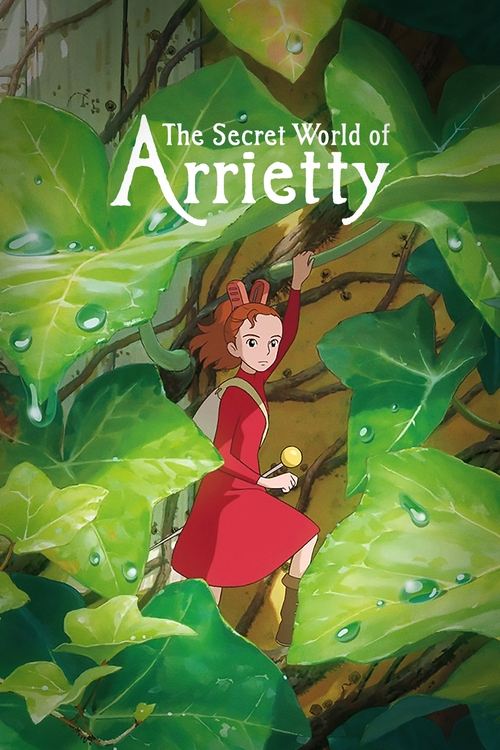
The Secret World of Arrietty
2010 · Hiromasa Yonebayashi
For a cozy, restorative night in — with kids, or just when you need the world to feel small, careful, and beautiful again. Pure comfort viewing with a soft undertow of melancholy.
What it's about
Fourteen-year-old Arrietty is a Borrower — one of a family of tiny people living secretly beneath the floorboards of a quiet house, surviving on 'borrowed' sugar cubes, pins, and scraps from the humans above. When a gentle, sickly boy comes to stay and glimpses her, the friendship that forms threatens the one rule that keeps her family safe: never be seen. Adapted by Studio Ghibli from Mary Norton's novel The Borrowers.
The experience
Calm, delicate, and quietly suspenseful — the thrill comes from scale, where crossing a kitchen counter plays like a mountain expedition and a house cat is a genuine predator. It leaves you with a gentle ache: warm, a little wistful, deeply soothing.
The craft
The film's glory is its miniature perspective: dewdrops that wobble like jelly, a single sugar cube as treasure, ordinary rooms redrawn as vast landscapes, all in Ghibli's lush hand-drawn style. Hiromasa Yonebayashi directs a screenplay co-written by Hayao Miyazaki, and the sound design makes human footsteps land like thunder — worth good speakers.
Why it matters
As the debut of Ghibli's youngest-ever feature director, it marked the studio's first real attempt to pass the torch beyond Miyazaki and Takahata, and it became one of Ghibli's biggest international successes of its era.
Snapshot
The Secret World of Arrietty (借りぐらしのアリエッティ, Kari-gurashi no Arrietti, literally "Arrietty the Borrower") is a 2010 Studio Ghibli feature, adapted from Mary Norton's 1952 children's novel The Borrowers. It marks the directorial debut of Hiromasa Yonebayashi, then in his mid-thirties and the youngest person to direct a Ghibli feature — an appointment widely read at the time as the studio's attempt to groom a successor generation behind Hayao Miyazaki and Isao Takahata. Miyazaki himself co-wrote the screenplay (with Keiko Niwa) and served as planner, drawing on a project he had reportedly wanted to make for decades. The film transposes Norton's English domestic fantasy to a house on the outskirts of Tokyo, where a family of tiny people who "borrow" from human households — sugar cubes, pins, a single tissue — live hidden beneath the floorboards. The story turns on the friendship that forms when Arrietty, a fourteen-year-old borrower, is seen by Shō, a frail human boy sent to the house to convalesce before heart surgery. It is a quiet, small-scaled film about scale itself: about vanishing populations, mortality, and the ethics of being seen.
Industry & production
The film was produced by Studio Ghibli under Toshio Suzuki, with Miyazaki taking the planning-and-scenario role rather than directing. The decision to hand a marquee project to a first-time director was deliberate studio strategy: Ghibli had long faced the "after Miyazaki and Takahata" question, and Yonebayashi — a veteran Ghibli in-betweener and key animator — was elevated from the ranks. Miyazaki's involvement as co-screenwriter provided both creative scaffolding and commercial reassurance.
Commercially, the film was a substantial domestic success. It was the highest-grossing Japanese film at the Japanese box office in 2010, continuing Ghibli's run of dependable summer tentpoles; I'd flag that precise figures vary across sources, so I won't cite an exact gross. Internationally it was handled by different distributors in different territories, which produced an unusual bifurcation. A British English-language version was prepared by StudioCanal/Optimum and released in 2011 (retitled Arrietty), with Saoirse Ronan voicing the lead alongside Mark Strong, Olivia Colman, and Tom Holland. A separate North American dub was produced by Disney and released in 2012 as The Secret World of Arrietty, with Bridgit Mendler as Arrietty and a cast including Amy Poehler, Will Arnett, and Carol Burnett. The two dubs use different scripts, different theme-song lyrics, and — notably — different names for the boy (Shō/Sho in the original; Shawn in the US version), a reminder that "the" English Arrietty is really two localizations.
Technology
Arrietty was made with Ghibli's mature hybrid pipeline of the late 2000s: fundamentally hand-drawn 2D character animation, composited and colored digitally, with backgrounds painted in the studio's characteristically lush watercolor-and-gouache manner. Computer imagery is present but subordinate and largely invisible, used for compositing, camera moves, and the integration of hand-drawn elements rather than for overt 3D set-pieces. This is consistent with Ghibli's house philosophy in the period immediately following Ponyo (2008), on which Miyazaki had pushed pointedly back toward hand-drawn density. The technological interest of Arrietty lies less in any single innovation than in the sustained precision required to render the miniature world convincingly — surface tension on water drops, the weight and translucency of a leaf, the texture of dust and grain at borrower scale.
Technique
Cinematography
Because this is drawn animation, "cinematography" means the film's virtual camera and its treatment of scale. The defining formal problem — and achievement — is the consistent dramatization of size difference. The camera repeatedly stages the human house as a landscape: a kitchen counter becomes a cliff, a strand of ivy a climbing route, a sugar cube a considered acquisition. Yonebayashi and his art directors exploit shifts in vantage — dropping to Arrietty's eye level to make ordinary objects monumental, then cutting to the humans' scale so the borrowers become nearly invisible specks. Depth is rendered through layered foliage, foreground blur, and the dense green of an overgrown garden, which the film treats as a genuine wilderness. Compositions favor stillness and observation over kineticism; the "camera" often holds so the viewer can register texture and quiet.
Editing
The cutting is patient and unhurried, prioritizing atmosphere and the accretion of small incident over propulsive plotting. Set-pieces — most famously Arrietty's first "borrowing" expedition with her father Pod into the human kitchen — are edited as suspense sequences built from scale and silence rather than action, closer to a heist or a stalking sequence than to conventional adventure montage. Several critics found the film's rhythm slow; that pacing is a deliberate register, matching the borrowers' cautious, marginal existence.
Mise-en-scène / staging
Production design is the film's central pleasure. The Clock family's under-floor home is realized with meticulous domestic detail — repurposed human objects (stamps as pictures, a clothespin, pins as tools) assembled into a plausible, cozy household economy. Art direction is credited to Yōji Takeshige and Noboru Yoshida, working in Ghibli's tradition of habitable, over-specified environments. The setting was relocated to a house modeled on the Koganei area of Tokyo, near the studio itself, and the period is loosely contemporary, though the human house is an old Western-style residence surrounded by an unkempt naturalistic garden. Staging consistently uses vertical space and threshold imagery — floorboards, gratings, walls — to figure the two worlds' proximity and separation.
Sound
Sound design does much of the work of selling scale. Small sounds are amplified and given weight: a ticking clock, a dripping tap, footsteps, the creak of the house are foregrounded so that the borrowers' world feels acoustically enormous. The result is an intimate, almost tactile soundscape in which quiet is an active element rather than absence.
Performance
In animation, performance is distributed across voice actors and the supervising animators who realize gesture. The Japanese cast includes Mirai Shida as Arrietty and the veteran Kirin Kiki as Haru, the suspicious housekeeper who functions as the story's human antagonist. Character animation stresses restraint and small behavioral detail — Arrietty's mix of adolescent curiosity and trained wariness, Pod's taciturn competence, the anxious Homily. The English dubs, discussed above, offer two distinct performance texts; Ronan's Arrietty (UK) and Mendler's (US) are frequently compared, with the British version often praised for tonal fit.
Narrative & dramatic mode
The film operates in a lyrical, low-conflict mode unusual for a family adventure. Its dramatic engine is not a villain's scheme but an ontological problem: borrowers survive by remaining unseen, so being seen is an existential threat, and the plot is set in motion the moment Shō glimpses Arrietty. From there the story braids two fragilities — the borrowers as a dwindling, possibly last remnant of their kind, and Shō as a boy facing a dangerous heart operation, uncertain of his own survival. Their friendship is tender and deliberately unresolved into romance; the register is elegiac rather than triumphant. Norton's episodic novel is compressed into a single household and a short span of time, and the film accepts an open, bittersweet ending over neat closure. This is coming-of-age crossed with a fable of coexistence, and its emotional payoff is measured in acceptance and departure rather than victory.
Genre & cycle
Arrietty sits within several overlapping traditions: Studio Ghibli's cycle of literary adaptations of English/European children's fantasy (alongside Howl's Moving Castle from Diana Wynne Jones, and later When Marnie Was There from Joan G. Robinson); the studio's recurring interest in miniature or hidden worlds adjacent to the human one; and the broader "small people among giants" fantasy lineage that The Borrowers itself helped define. Against the more spectacle-driven strain of Ghibli (Princess Mononoke, Howl's), it belongs to the studio's gentler, domestic, nature-attuned register, closer in spirit to My Neighbor Totoro or Kiki's Delivery Service — everyday-fantasy rather than epic.
Authorship & method
Arrietty is a genuinely collaborative authorship, which complicates any auteur reading. Hiromasa Yonebayashi directs, bringing an animator's sensibility — he had been a key animator on major Ghibli titles including Spirited Away, Howl's Moving Castle, and Ponyo — and the film reflects a craftsman's investment in surface, texture, and movement over grand thematic statement. But Hayao Miyazaki is the co-author of the screenplay (with Keiko Niwa) and the project's planner, and much of the film's conceptual architecture — the ecological framing, the emphasis on a vanishing world, the choice of source — bears his imprint; adapting The Borrowers had reportedly been a long-held Miyazaki ambition. The tension between the director's tactile craft and Miyazaki's thematic scaffolding is part of what makes the film feel like a transitional, "workshop" work.
Among key collaborators, the most distinctive is composer Cécile Corbel, a French Breton harpist and singer whose selection was itself notable: rather than Joe Hisaishi, Ghibli's usual composer, the studio used a European folk musician, giving the score a Celtic, harp-and-voice texture unusual in the Ghibli catalog. Corbel also performs the theme song "Arrietty's Song." Art direction by Yōji Takeshige and Noboru Yoshida anchors the film's habitable environments, and supervising animation was led by senior Ghibli hands (including Akihiko Yamashita and Megumi Kagawa). Producer Toshio Suzuki shaped the film's positioning as a debut vehicle. I'd note that editing on Ghibli films is typically overseen within the studio's production apparatus rather than credited as a single auteur-editor, so I won't attribute the cutting to one named figure.
Movement / national cinema
The film is a canonical product of Studio Ghibli, the most internationally significant institution in Japanese animation, and thus of the anime feature tradition at its most artisanal and prestige-oriented. It exemplifies the studio's distinctive position: hand-drawn, deeply humanist, nature-reverent filmmaking pursued against the grain of an industry increasingly shaped by television anime economics and, globally, by computer animation. As a Japanese adaptation of a mid-century English novel, it also sits at the studio's characteristic crossing point between Japanese sensibility and European literary/pictorial sources — a cross-cultural traffic reinforced here by the choice of a French composer and the film's dual Anglo-American localizations.
Era / period
Arrietty arrives at a specific moment in Ghibli's history — the late 2000s / early 2010s, after Ponyo and before Miyazaki's The Wind Rises (2013) and Takahata's The Tale of the Princess Kaguya (2013), during which the studio was openly preoccupied with succession and sustainability. It is, in retrospect, part of a short cluster of "next generation" Ghibli experiments that also includes Gorō Miyazaki's films and Yonebayashi's own follow-up. The period is one of maturity bordering on twilight for the classical hand-drawn Ghibli model; within a few years the studio would temporarily suspend feature production. Arrietty thus reads both as a confident late flowering of the house style and as a hinge toward an uncertain future.
Themes
The film's dominant theme is mortality and endangerment, treated with unusual directness for a family film: the borrowers may be a dying species, and Shō's heart condition makes his own future precarious; their bond is a mutual recognition of fragility. Related is a theme of coexistence and the ethics of being seen — the borrowers' survival depends on invisibility, and the drama asks what humans and small, marginal beings owe one another. Ghibli's recurring ecological consciousness is present in miniature: the film invites the viewer to perceive the enormous vitality of the small (insects, plants, water) and implicitly to value what is easily overlooked or destroyed. There is also a strong coming-of-age current in Arrietty's assertion of independence and her first borrowing, and a melancholy meditation on transience — homes are left behind, friendships are temporary, and the film honors departure as part of growth.
Reception, canon & influence
Critical reception was generally warm, with wide praise for the film's visual beauty, its production design, and its delicate handling of scale and atmosphere; the recurring reservation, from a minority of critics, concerned its gentle pacing and relative lack of dramatic incident. The film was recognized domestically, winning the Japan Academy Prize's Animation of the Year. Corbel's score drew particular attention as a departure from Ghibli's musical norms.
Influences on the film (backward): The foundational source is Mary Norton's The Borrowers (1952) and its sequels, part of a long lineage of miniature-people fantasy; the novel had already been adapted for British television and as a 1997 live-action feature (with John Goodman) before Ghibli's version. The film also inherits the whole prior Ghibli grammar — the domestic-fantasy warmth of Totoro, the literary-adaptation practice of Howl's Moving Castle, and the hand-drawn density Miyazaki reasserted on Ponyo. Corbel's contribution imports a European Celtic-folk musical tradition into that lineage.
Legacy (forward): Arrietty's most consequential downstream effect is the launching of Yonebayashi as a director. He would go on to make When Marnie Was There (2014), the last Ghibli feature before the studio's production hiatus, and then co-found Studio Ponoc, directing its first feature Mary and the Witch's Flower (2017) — meaning Arrietty is, in effect, the origin point of a new hand-drawn studio built by Ghibli alumni carrying the house style forward. Within Ghibli's own story, the film stands as a key data point in the succession experiment of the era. Its broader cultural footprint is diffuse rather than school-forming; its lasting reputation rests on its craft — the rendering of a huge world at tiny scale — and on its quiet, mortality-touched tenderness, which have made it an enduring favorite among the studio's more intimate, minor-key works. Where the historical record on its precise commercial and reception figures diverges across sources, I've kept claims general rather than risk false specificity.
A Deleuzian reading
A sugar cube.
The full Deleuzian reading of The Secret World of Arrietty →
Reception
Greeted in 2010 as 'pleasant minor Ghibli' — it was actually Japan's highest-grossing domestic film that year — it has since been quietly upgraded to comfort-watch essential, the gentle one people admit they rewatch most.
How The Secret World of Arrietty was received, from release to now →
How to watch The Secret World of Arrietty: what to notice on a first viewing
- Notice the camera drop to Arrietty's height, then cut up. Yonebayashi repeatedly stages the same room at two scales: low, where objects loom, and human height, where the borrowers vanish. This is what the reading calls the perception-image, a shot that admits it chose an angle, making size the subject.
- Listen for the amplified tick of the clock and drips. Ordinary domestic sounds, a dripping tap, footsteps, a creaking floorboard, are mixed loud enough to feel like weather. The mix teaches your ear the borrowers' scale before the plot explains anything.
- Track how often floorboards, gratings, and walls appear as thresholds. The film keeps returning to these gapped, vertical surfaces to mark the border between the human world and the world beneath it. The architecture itself enforces the separation the whole story depends on.
- Look for stamps used as pictures, pins as tools. The Clock family's under-floor home repurposes ordinary human objects, a clothespin, a stamp, a pin, into a plausible household economy. Every borrowed object shows survival built on reading a rich world as a list of things it won't miss.
- Follow Arrietty and Pod's first borrowing trip into the kitchen. The sequence is edited like a heist, built from scale and silence rather than action, needing no exposition to explain the borrowers' life. Suspense here comes from being small in a giant's house, not from violence.
The whole guide to watching The Secret World of Arrietty, with the keys for a rewatch →
Influences: the films it descends from and the films it influenced
- My Neighbor Totoro (1988) — Establishes the Ghibli grammar Arrietty inherits—rendering an ordinary house and garden as a site of quiet wonder observed from a low, child's-eye vantage that magnifies the everyday.
- Spirited Away (2001) — Yonebayashi trained here as a key animator; its threshold-crossing into a hidden parallel world and dense layered-depth compositions directly feed Arrietty's under-the-floorboards staging.
- Howl's Moving Castle (2004) — Yonebayashi key-animated it; it models Ghibli's practice of adapting a British children's novel and its intricately mechanized, densely detailed interior production design.
- Ponyo (2008) — Yonebayashi key-animated it; Miyazaki's deliberate reassertion of pure hand-drawn 2D density and fluid movement on Ponyo is the exact technical stance Arrietty carries forward.
- Only Yesterday (1991) — Takahata's patient, incident-light pacing and attention to naturalistic domestic gesture authorize Arrietty's elegiac, low-conflict register.
- Grave of the Fireflies (1988) — Its meticulous naturalistic sound design—amplifying small, everyday domestic sounds into emotional weight—prefigures Arrietty's sonic strategy of making tiny actions loom large.
- The Incredible Shrinking Man (1957) — Canonical forced-perspective scale cinema built on oversized props and sets to render a human tiny—the production-design problem Arrietty resolves in 2D layout plus amplified small sounds.
- The Borrowers (1997) — The prior feature adaptation of Mary Norton's source; its giant-household set construction and scale gags are the adaptation template Ghibli reworks.
- Kiki's Delivery Service (1989) — Sustains Ghibli's miniature-domestic detailing and multiplane depth staging, prizing the tactile texture of household space over incident, as Kiki does with the bakery and attic.
- The Cat Returns (2002) — Takes the scale-shift staging Morita deploys only for gags once Haru shrinks, and rebuilds it as sustained craft: sightlines, object weight, surface texture and sound perspective all recalculated from the miniature body outward.
- When Marnie Was There (2014) — Yonebayashi's follow-up extends his texture-first, tactile direction and mortality-touched tenderness onto another British-novel adaptation.
- Mary and the Witch's Flower (2017) — Yonebayashi's first Studio Ponoc feature, deliberately transplanting Ghibli's hand-drawn 2D house style into a successor studio he co-founded.
- Modest Heroes (2018) — Studio Ponoc's anthology continues the Ghibli-alumni hand-drawn craft and character-animation lineage that Arrietty seeded as Ponoc's origin point.
- Honey, I Shrunk the Kids (1989) — Miniaturized-protagonist filmmaking built on enlarged environment sets and scale-driven suspense set-pieces—the same craft problem as Arrietty's kitchen expedition.
- The Secret of Kells (2009) — A near-contemporary hand-drawn 2D feature scored in a Celtic folk idiom (Kíla/Bruno Coulais), paralleling Corbel's harp-and-voice departure and its flat, layered-depth design.
- From Up on Poppy Hill (2011) — The other Ghibli succession-era title, scripted by Miyazaki and Keiko Niwa in the same low-conflict, memory-tinged register and hand-drawn house style.
- The Tale of the Princess Kaguya (2013) — A Ghibli-era elegiac work organized around mortality and a fading world, extending the studio's minor-key, hand-drawn intimacy alongside Arrietty.
- Earwig and the Witch (2020) — A later Ghibli attempt to adapt a British children's fantasy novel, sharing Arrietty's literary-adaptation practice while marking the studio's departure from her hand-drawn 2D craft.
Similar films
- My Neighbor Totoro (1988) — influence & lineage · same viewing thread · often watched together
- Spirited Away (2001) — influence & lineage · same viewing thread · often watched together
- Ponyo (2008) — influence & lineage · same viewing thread · often watched together
- When Marnie Was There (2014) — influence & lineage · same viewing thread · often watched together
- From Up on Poppy Hill (2011) — influence & lineage · same viewing thread · often watched together
- Only Yesterday (1991) — influence & lineage · same viewing thread · often watched together
- The Tale of The Princess Kaguya (2013) — influence & lineage · same viewing thread
- Howl's Moving Castle (2004) — influence & lineage · same viewing thread
All the films related to The Secret World of Arrietty →
Watch it with: curated runs of related films
- The Studio Ghibli Canon — A run through the whole hand-drawn shelf of Miyazaki and Takahata — start with the childhood-wonder crowd-pleasers and drift toward the studio's quieter, adult, more elegiac corners.