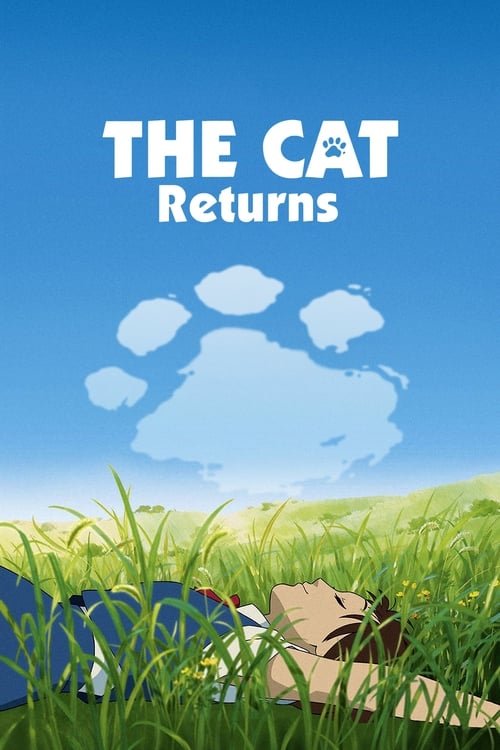
The Cat Returns
2002 · Hiroyuki Morita
For a cozy night when you want something sweet, short, and low-stakes — the animated equivalent of a good cup of tea. Perfect with kids, as a pick-me-up, or when you don't have the energy for anything heavy.
What it's about
A shy schoolgirl named Haru impulsively saves a cat from being hit by a truck — and the cat turns out to be the Prince of the Cat Kingdom. The kingdom's gratitude arrives as an avalanche of gifts she never asked for, escalating toward a marriage proposal she can't figure out how to refuse. Her only hope is the Baron, a dapper cat gentleman with a statuette's poise, who leads a rescue into a storybook otherworld.
The experience
Light, brisk, and effortlessly charming — at about seventy-five minutes it's a complete adventure with zero padding. It's gentle rather than epic, with a warm undercurrent about learning to speak up for yourself.
The craft
Studio Ghibli's shortest theatrical feature, directed by Hiroyuki Morita from a commission that outgrew its brief, it trades the studio's usual grandeur for a lighter, sketchbook-storybook touch. The Cat Kingdom sequences have a playful, toy-box inventiveness — chases, a sword fight, a castle maze — rendered with the studio's typical care.
Why it matters
A rarity in the Ghibli catalog — a spin-off built around a beloved side character, and one of the few features from the studio directed by neither of its founders — it became a modest, much-loved gateway film for younger viewers.
Snapshot
The Cat Returns (Neko no Ongaeshi) is Studio Ghibli's smallest theatrical feature and, in some ways, its most revealing one. At roughly seventy-five minutes it is the shortest film the studio has released to cinemas, and it was conceived not as an authored statement but as a commission that outgrew its brief. A schoolgirl named Haru saves a cat from a truck; the cat turns out to be Prince Lune of the Cat Kingdom, and the kingdom repays her with a gathering avalanche of gifts she does not want, culminating in a marriage proposal she cannot bring herself to refuse. Rescued by the Baron — a cat figurine who first appeared as an object of imagination in Whisper of the Heart (1995) — she is chased through a storybook otherworld and returned to herself.
The film matters less for its ambitions than for its position. It is the first Ghibli theatrical feature directed by someone from outside the Miyazaki–Takahata–Kondō line, made in the immediate wake of Spirited Away (2001), at a moment when the studio's succession problem had become urgent. It is also the only Ghibli film that functions as a sequel-adjacent spin-off, extending a character out of one film into another — a move the studio has otherwise almost entirely refused.
Industry & production
The project's origin is unusually well documented and unusually mundane. Ghibli was approached to produce a short film about cats for a Japanese theme park. Hayao Miyazaki, rather than developing it in-house, asked Aoi Hiiragi — the shōjo mangaka whose Mimi wo Sumaseba had been the source for Whisper of the Heart — to draw a new manga on the subject. Hiiragi produced Baron: Neko no Danshaku (Baron: The Cat Baron), which revived the Baron and the fat cat Moon from her earlier work. The theme park commission collapsed. The manga survived, and Ghibli elected to develop it as a feature.
The directing assignment went to Hiroyuki Morita, an animator rather than a storyboard-trained director, who had worked in the Japanese animation industry through the 1990s — including on Ghibli's My Neighbors the Yamadas (1999) — before being handed the film. The widely repeated account, propagated by the studio's own publicity and by producer Toshio Suzuki, is that Morita submitted an enormous volume of storyboard work unprompted and that this persuaded Miyazaki and Suzuki he could carry a feature. The specifics of that story have hardened through repetition, and the underlying documentation is thin; what is not in doubt is that Morita was an unexpected choice, that Suzuki produced, and that Miyazaki took a planning and supervisory role rather than a directing one.
The context is the succession crisis. Yoshifumi Kondō, who directed Whisper of the Heart and was understood inside and outside the studio as the intended heir, died in January 1998. Ghibli spent the following decade attempting to find a second generation, with results that were at best mixed. The Cat Returns is the first of those attempts to reach cinemas, and it was mounted quickly, on a modest scale, and with a running time that made it a partner rather than a headliner: it opened in Japan in July 2002 on a double bill with Yoshiyuki Momose's short Ghiblies Episode 2. It was a substantial domestic success, riding the extraordinary commercial and critical wave of Spirited Away, which had opened the previous summer and would take the Academy Award for Best Animated Feature in March 2003. Disney handled the English-language version and gave the film a limited North American theatrical release in 2005 — a comparatively low-key rollout by the standards of the studio's Miyazaki titles.
Technology
By 2002 Ghibli had completed its transition to a hybrid pipeline: hand-drawn animation on paper, scanned and then colored and composited digitally. The studio had experimented with digital tools on Princess Mononoke (1997) and made My Neighbors the Yamadas its first fully digital feature in 1999, working with a heavily customized version of the Toonz software suite. The Cat Returns inherits that pipeline in a settled, unremarkable state — which is precisely the point. There is no technological argument being made here.
What digital compositing buys the film is chiefly speed and control: consistent flat color across a large volume of cat characters, clean multiplane depth in the chase sequences, and the ability to hold saturated, storybook hues in the Cat Kingdom without the density problems of cel paint. A small amount of three-dimensional computer graphics supports camera moves and architecture in the kingdom's tower and maze, deployed conservatively and subordinated to the drawn image. Compared with the digital showpieces of the same period — the ink-wash effects of Mononoke, the crowd and water work of Spirited Away — the film's technical profile is deliberately modest, consistent with a production designed to be made fast and cheap.
Technique
Cinematography
Atsushi Okui, Ghibli's director of photography across the studio's digital era, shoots the film in 1.85:1. The photographic grammar is Ghibli house style in a lower register: eye-level framing, generous use of the held wide shot, and a preference for staging action across the frame rather than cutting into it. The suburban Japan of the opening reel is rendered in the studio's characteristic dense, unglamorous naturalism — power lines, retaining walls, the specific quality of late-afternoon light on concrete.
The Cat Kingdom is photographed differently and deliberately so: flatter, brighter, with a chromatic key pushed toward greens and warm golds and a shallower sense of atmospheric depth. The film's most confident camera work occurs in the movement between these registers — the descent along the Cat Bureau's miniature street, the passage through the tower — where the compositing allows a continuous glide from one visual world into another without a hard cut.
Editing
Takeshi Seyama, another long-serving Ghibli collaborator, cuts the film at a tempo notably faster than the studio's norm. Miyazaki's famous advocacy of ma — the held empty beat, the pause that lets a scene breathe — is largely absent. The Cat Returns is closer to a chase comedy: setups are established economically, the second half runs on near-continuous forward motion, and the film arrives at its resolution before its premise has had time to accumulate weight. Whether this reads as discipline or as thinness is the central critical question about the film, and it is fundamentally an editorial question rather than a script one.
Mise-en-scène / staging
The design work draws its authority from Hiiragi's manga and from the Baron's established look in Whisper of the Heart: the frock coat, the monocle, the fixed carved poise that the animation must both honor and overcome. The Cat Bureau, entered by shrinking down a narrow alley, is the film's finest piece of world-building — a doll's-house arcade of scale-shifted architecture that stages the film's real subject, which is proportion. Haru's problem throughout is that she is the wrong size for every space she is in: too large in the Bureau, too small before the Cat King's court, and, in the film's central visual joke, gradually growing whiskers and ears as the kingdom's hospitality converts her into one of its own.
The Cat Kingdom court is staged as broad, tumbling slapstick — bodies in heaps, gravity as punchline — while the tower labyrinth of the climax is staged vertically, as a puzzle of stairs and openings. The character animation is caricatural by Ghibli standards, with rounder shapes and looser deformation than the studio's naturalist tradition permits.
Sound
Yuji Nomi's score is the film's most direct link to Whisper of the Heart, which he also scored. Nomi writes in chamber textures — small ensembles, waltz and salon-jazz inflections, a lightness that positions the Baron as an Old World figure without lapsing into pastiche. The end theme, "Kaze ni Naru," performed by Ayano Tsuji with ukulele, is a deliberate tonal signature: unhurried, slightly homespun, tuned to the film's small scale rather than to fantasy grandeur.
Ambient design follows Ghibli practice: dense, specific environmental sound in the human world, thinner and more stylized in the kingdom. The film uses silence sparingly, consistent with its editorial impatience.
Performance
The Japanese cast is led by Chizuru Ikewaki as Haru, whose vocal performance carries the film's argument — a girl who agrees with everything, in a voice that gets smaller as the agreements accumulate. Yoshihiko Hakamada plays the Baron with a formality pitched just short of parody. The veteran actor Tetsurō Tanba brings a gravelly authority to the Cat King that makes the character funnier than the writing alone would, and Tetsu Watanabe's Muta supplies the film's bass line of grumbling.
The Disney English dub, released in 2005, assembled a notably strong cast — Anne Hathaway as Haru, Cary Elwes as the Baron, Peter Boyle as Muta, Tim Curry as the Cat King, Elliott Gould as Toto — and is generally regarded as one of the better Ghibli dubs of the period, in part because the film's comic register survives translation more easily than Miyazaki's tonal ambiguity does.
Narrative & dramatic mode
The film is a portal fantasy structured as a comedy of unwanted obligation. Its engine is not danger but courtesy: Haru cannot say no, and the plot is the cost of that inability compounding until it threatens to erase her. The title makes the mechanism explicit. Ongaeshi — the repayment of a kindness — is a category of Japanese folktale, most famously Tsuru no Ongaeshi, "The Crane's Return of a Favour," in which an animal repays a human rescuer and the arrangement ends badly when a boundary is crossed. The Cat Returns takes that structure and inverts its moral: here the repayment itself is the danger, and the resolution requires the heroine to refuse the gift.
Dramatically the film is unusually front-loaded and unusually forgiving. Haru's transformation into a cat operates as a visible clock, and the film supplies a hard deadline (return before dawn) and a rescuer (the Baron) rather than requiring her to generate her own escape. The consequence is that the climax is more kinetic than moral. Where Spirited Away makes Chihiro earn every increment of her return, The Cat Returns gives Haru a single decisive act of refusal and lets that stand for growth. This is a legitimate structural choice for a seventy-five-minute film, and also the reason it has never been mistaken for a major work.
Genre & cycle
The film sits at the intersection of three cycles. The first is the Carroll lineage — the girl who falls into an animal kingdom governed by absurd protocol, complete with a monarch's arbitrary edicts and a court that treats nonsense as law. The second is Ghibli's own cycle of young female protagonists who must survive an otherworld: Kiki's Delivery Service (1989), Spirited Away, and, later, Arrietty (2010). The third is the shōjo manga adaptation, a strand Ghibli entered with Whisper of the Heart and Ocean Waves (1993) and which supplies the film's register of everyday adolescent embarrassment.
It also belongs, more loosely, to the long tradition of anthropomorphic animal courts in animation, and to the specific Japanese affection for the cat as a figure of sovereign indifference — a lineage that runs from folk illustration through to the Nekobus of My Neighbor Totoro (1988) and beyond.
Authorship & method
Morita's authorship is real but constrained. His visible contribution is a lightness of touch and a comic timing not otherwise characteristic of Ghibli — a willingness to let bodies fall over, to play a scene for the joke rather than the wonder. What he does not attempt is the accretive world-density that defines Miyazaki, or the formal experimentation of Takahata. He directed no further Ghibli feature; his most substantial subsequent credit is the television series Bokurano (2007), a tonally severe science-fiction work with almost nothing in common with this film.
The collaborators supply most of the continuity. Reiko Yoshida's screenplay adapts Hiiragi's manga with a clean three-act economy and is largely responsible for the film's brisk, uncluttered shape; Yoshida went on to a prolific career in anime screenwriting. Nomi's score, Okui's photography, and Seyama's editing are the same hands that shaped the studio's other work of the period, which is why the film sounds and looks like Ghibli even where it does not think like Ghibli. Suzuki's producing decisions — the short length, the double bill, the fast schedule — are as determinative of the finished object as anything in the direction.
Movement / national cinema
The Cat Returns is a document of Japanese commercial animation at its moment of maximum international visibility. In 2002 Ghibli was, briefly, the most prestigious animation studio in the world; Spirited Away had taken the Golden Bear at Berlin in February and would take the Oscar the following March. The film benefits from that halo without contributing to it. Within Japanese cinema it belongs to the anime industry's studio system rather than to any auteurist movement — a mid-budget summer release aimed at a family audience, produced on an industrial schedule.
Its most nationally specific element is the ongaeshi frame, which gives the film a folkloric grounding that survives translation only partially. English-language viewers tend to read the plot as a fairy-tale abduction; Japanese viewers have a genre label for it.
Era / period
The film is a product of the exact seam between analog and digital animation, and of the exact seam in Ghibli's institutional history between its founding generation and whatever was supposed to come next. Made in the shadow of two deaths — Kondō's in 1998, and the slow attrition of the hand-painted cel — it is a transitional object in both senses. It also arrives just before the theatrical anime market's structural shift toward television-derived franchises, and reads now as one of the last unencumbered mid-scale original theatrical anime features of its kind.
Themes
The film's governing theme is the danger of being agreeable. Haru's defining trait is that she assents — to friends, to obligations, to a kingdom's gratitude — and the plot literalises what that costs: the more she accepts, the more she physically becomes what others want her to be. The growing fur and whiskers are not a curse in the classical sense; they are the visible accumulation of unrefused offers.
Against this the film sets self-possession, articulated most directly through the Baron's counsel to believe in herself. This is the film's most conventional element and also its most necessary one, since the whole structure is built to make a single "no" feel like an achievement.
A secondary theme, inherited from Whisper of the Heart, is the reality of imagined things. The Baron is a carved figurine who was, in the earlier film, the hero of a story a girl was writing; here he simply exists, without the earlier film's framing. That is either a betrayal of Whisper's premise or its most generous fulfillment — the story kept, the scaffolding removed — and the film's admirers and detractors tend to divide on exactly that point.
Underlying both is a quiet argument about adolescence as a period of undefined shape, in which the risk is not danger but drift.
Reception, canon & influence
Critical reception at the time was politely favourable and clearly graded on a curve. The consensus — then and since — is that the film is charming, brisk, and slight: a minor Ghibli, praised for its economy and its comic energy, faulted for its lack of resonance and for a protagonist whose arc is asserted more than earned. Comparison to Whisper of the Heart has been almost universally unkind to it, and comparison to Spirited Away, released twelve months earlier with a nearly identical premise executed at incomparably greater depth, unkinder still. It has never entered the studio's critical canon, and it is rarely the film anyone names first.
Its audience standing is warmer than its critical standing. The brevity that critics read as thinness makes it one of the most re-watchable entries in the catalog, and it has a durable constituency among viewers who encountered it young.
Backward. The film's direct antecedent is Whisper of the Heart, from which it takes the Baron, the cat Moon (renamed Muta), and the composer. Behind that lie Hiiragi's manga; the ongaeshi folktale tradition; Carroll's Alice; and, unavoidably, Spirited Away — the girl who enters a non-human world, is threatened with the loss of herself, and must find her way back before it is too late. The rhyme is close enough that the film has often been read as a lighter, smaller gloss on Miyazaki's masterpiece.
Forward. Its most consequential legacy is institutional rather than aesthetic. As Ghibli's first attempt to launch a director from outside the founding circle, its modest outcome fed directly into the studio's subsequent, and largely unresolved, succession problem — a line that runs through Tales from Earthsea (2006) to When Marnie Was There (2014) and Ghibli's effective retrenchment around Miyazaki. It also established the Baron as one of the very few Ghibli characters to persist across films, which is why the Cat Bureau appears as a built environment in the "Hill of Youth" area of Ghibli Park, opened in 2022. There is a real circularity in that: a film that began as an abandoned theme park commission ended, two decades later, as a theme park attraction.
Its influence on other filmmakers is difficult to trace and probably minimal. Its influence on how Studio Ghibli understood itself — as an institution that could not easily be reproduced — is considerable.
Reception
Released in Spirited Away's immediate shadow, it was widely filed as 'minor Ghibli' — a slight, for-kids spin-off. Two decades on it's been re-embraced as the studio's coziest comfort watch, the perennial answer to 'most underrated Ghibli'.
How The Cat Returns was received, from release to now →
How to watch The Cat Returns: what to notice on a first viewing
- Notice the color shift when Haru enters the Cat Kingdom. The human world is dense, plain, and true to life, while the kingdom turns flatter and brighter, keyed toward greens and warm golds. The palette change tells you Haru has crossed into somewhere that runs by different rules.
- Notice whether Haru is too big or too small for each room. In the Cat Bureau she looms over doll's-house architecture; before the Cat King's court she shrinks. The film keeps changing her size relative to the space around her. Never fitting the room is the film's way of showing a girl who does not yet know her own shape.
- Count how many cat features Haru has grown so far. Whiskers and ears creep onto her in stages across the film, a visible measure of how far the kingdom's gratitude has already changed her. The transformation works like a clock, so you can see exactly how much time she has left.
- Listen to Haru's voice get smaller each time she agrees. Ikewaki plays her as a girl who says yes to everyone, and each agreement is voiced a little more quietly and reluctantly than the last. You can hear the cost of politeness building up before the story ever explains it.
The whole guide to watching The Cat Returns, with the keys for a rewatch →
Influences: the films it descends from and the films it influenced
- Whisper of the Heart (1995) — Supplies the Baron, the cat Moon (renamed Muta) and composer Yuji Nomi wholesale, and converts Kondō's ten-minute embedded fantasy interlude — the only passage in that film with its own heightened palette and untethered airborne camera — into a feature-length working method.
- Spirited Away (2001) — Donates the load-bearing structure — girl crosses a threshold into a non-human service economy, is threatened with the erasure of her name and species, and is timed against a return deadline — which Yoshida's screenplay runs as the same beat sheet at half the length and a fraction of the world-density.
- The Castle of Cagliostro (1979) — The Baron's rescue is Miyazaki's Lupin chase choreography in miniature: dapper gentleman-thief poise, running along parapets and rooftops, and an escape from a tower that structurally disassembles beneath the pursued as they climb.
- Puss in Boots (1969) — The urtext of the anime cat-cavalier — booted, plumed, sword-drawing Pero, with Miyazaki on key animation for the climactic vertical castle chase — establishes the drawing convention and body language the Baron and the Cat King's court inherit.
- Alice in Wonderland (1951) — Fixes the anthropomorphic-court template the Cat Kingdom reproduces almost beat for beat: an arbitrary monarch, ceremonial nonsense standing in for law, a girl physically resized by what she is given to eat, and an episodic chase back toward the exit.
- The King and the Mockingbird (1980) — The Grimault/Prévert film Takahata and Miyazaki taught as in-house canon — vain absurd monarch, palace read as a vertical machine to be traversed and escaped, comedy carried by architecture rather than dialogue — is the staging grammar of the Cat Kingdom sequences.
- Pom Poko (1994) — Establishes Ghibli's register-shifting animal drawing, the same creature rendered naturalistic, cartoon-simplified, and human-standing within one picture — the license Morita uses to slide Muta between real cat, inert blob, and speaking character.
- My Neighbor Totoro (1988) — Catbus fixes the studio's cat-as-conveyance grammar — a grinning feline body used simultaneously as vehicle, impossible-speed transition, and comic scale gag — which this film reuses for the cat processions and the airborne exits from the kingdom.
- Ocean Waves (1993) — The production precedent rather than the aesthetic one: Suzuki's earlier experiment in handing a picture to a young non-founding director on a compressed, deliberately cheap schedule with the veteran department heads absorbing the risk.
- Panda! Go Panda! (1972) — The Takahata/Miyazaki short-feature model — sub-hour running time, double-bill release, gags built on falling bodies and deadpan anthropomorphic domesticity — is precisely the economy Suzuki reactivated for this commission.
- Night on the Galactic Railroad (1985) — Sugii's decision to play an entirely human story with cats in formal Victorian dress, performed with unblinking solemnity rather than cartoon mugging, is the precedent for the Baron's tailored, straight-faced gentleman-cat performance.
- Tales from Earthsea (2006) — The next run of the same Suzuki playbook this film opened — installing a director from outside the founding pair while the house crew does the load-bearing craft — and the second data point in Ghibli's unresolved succession experiment.
- The Secret World of Arrietty (2010) — Takes the scale-shift staging Morita deploys only for gags once Haru shrinks, and rebuilds it as sustained craft: sightlines, object weight, surface texture and sound perspective all recalculated from the miniature body outward.
- When Marnie Was There (2014) — Closes the succession line begun here — a second elevated in-house animator directing a girls'-fiction adaptation with the same veteran department heads, Takeshi Seyama's editing among them, supplying the continuity of look the director cannot.
- Mary and the Witch's Flower (2017) — Carries the house method out of the studio: ex-Ghibli staff reproducing Okui-style digital photography and the crossing-into-a-magical-institution structure as a transportable style, proving the craft was portable even where the authorship was not.
- A Silent Voice (2016) — Extends Reiko Yoshida's adaptation economy — compressing a serialized manga run into a clean three-act by ruthless subplot excision — the same screenwriting hand responsible for this film's brisk, uncluttered shape.
- The Boy and the Beast (2015) — Runs the same crossing into a fully governed anthropomorphic-animal polity — court, succession dispute, ceremonial combat, civic architecture — with the human body staged as the anomalous object inside an animal civil order.
- Coraline (2009) — Sibling in portal mechanics: a hospitable non-human household courts the girl, the hospitality resolves into a bid to keep and remake her body, and escape runs on a clock — the seduction-then-deadline structure the Cat King's marriage plot plays in comic register.
Similar films
- Whisper of the Heart (1995) — influence & lineage · same viewing thread · often watched together
- The Boy and the Beast (2015) — influence & lineage · same viewing thread
- The Secret World of Arrietty (2010) — influence & lineage · often watched together
- My Neighbor Totoro (1988) — influence & lineage · often watched together
- Spirited Away (2001) — influence & lineage · often watched together
- The King and the Mockingbird (1980) — influence & lineage
- The Castle of Cagliostro (1979) — influence & lineage
- Look Back (2024) — same viewing thread
All the films related to The Cat Returns →
Watch it with: curated runs of related films
- Anime's Dreaming Adolescents — Watch these together for the ache of being young — first crushes, imaginary worlds, and the small transformations that feel enormous when you're inside them.