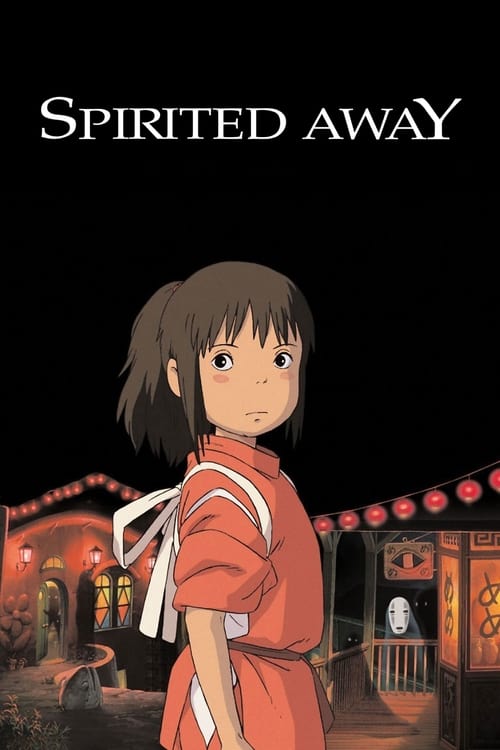
Spirited Away
2001 · Hayao Miyazaki
For when you want to be fully transported — total immersion in a world that feels invented and ancient at once. Gentle enough for kids, deep enough to chew on for days; a lifetime rewatcher.
What it's about
Ten-year-old Chihiro, sulking her way through a move to a new town, wanders with her parents into what looks like an abandoned theme park — and crosses into a spirit world centered on a vast bathhouse where gods come to be cleansed. When her parents undergo a horrifying transformation, she has to take a job, keep her wits, and hold on to her own name, because in this world names are how you become lost. A witch runs the books, and nothing is quite what it first appears.
The experience
It moves with the associative logic of a dream — wondrous, occasionally frightening, dense with strange creatures and small kindnesses — and it trusts you to keep up. You come out feeling scrubbed clean yourself: moved, a little haunted, weirdly hungry.
The craft
Hand-drawn animation at its absolute summit: the water, the food, the soot sprites, every background painted with extravagant care, and Joe Hisaishi's piano score doing half the emotional lifting. Miyazaki wrote it without a finished script, letting the story grow from the drawings, which is why it feels dreamed rather than plotted. Nothing on screen is decorative — the beauty carries the meaning.
Why it matters
It won the Golden Bear at Berlin and the Oscar for Best Animated Feature, broke Japanese box-office records, and did more than any single film to convince the West that animation could be great cinema, full stop.
The summit of Hayao Miyazaki's career and, by wide consensus, of hand-drawn animation itself. A sullen ten-year-old girl, mid-move to a new town, wanders with her parents into what seems an abandoned theme park and crosses into a spirit world governed by a bathhouse where gods come to be cleansed — and where names, once surrendered, are how you become lost. Miyazaki wrote the film for the daughters of friends, without a completed script, letting the story grow as the drawings did; the result has the associative logic of a dream and the moral seriousness of a fable about work, greed, and remembering who you are. Studio Ghibli's craft is at its most extravagant here — the food, the water, the soot sprites, Joe Hisaishi's piano — yet nothing is decorative. It won the Golden Bear at Berlin and the Academy Award for Best Animated Feature, and stood for nearly two decades as Japan's highest-grossing film. Miyazaki's monsters, characteristically, are never quite villains: even the film's most fearsome spirit is really just lonely.
A Deleuzian reading
A girl lies face-down across the back seat, sulking about a move she didn't choose.
The full Deleuzian reading of Spirited Away →
Reception
No reappraisal needed — it dethroned Titanic as Japan's highest-grossing film on release, then won the Golden Bear and the Animated Feature Oscar. Two decades on it's only climbed, from 'the anime even your parents saw' to fixture of all-time-greatest lists, animated or otherwise.
How Spirited Away was received, from release to now →
Influences: the films it descends from and the films it influenced
- The Snow Queen (1957) — The Soyuzmultfilm feature Miyazaki credits with saving his resolve to animate, its fluid rotoscoped Gerda showed him a heroine carried through episodic marvels by movement rather than plot mechanics.
- The King and the Mockingbird (1980) — Grimault's vast vertical architecture and tyrant-in-a-tower staging gave Miyazaki and Takahata their model for reading a whole moral world through built space — directly echoed in Yubaba's stacked bathhouse.
- Tale of Tales (1979) — Norstein's associative, memory-drift editing and refusal of expository causality models the 'dream-logic' scene-linking Miyazaki uses when Chihiro's world reorganizes without narrative justification.
- Alice in Wonderland (1951) — Establishes the template of a child falling through a threshold into a rule-bound nonsense realm where survival depends on decoding etiquette and contracts — the exact engine of the bathhouse's naming and labor rules.
- Panda! Go Panda! (1972) — Miyazaki's early scripting/layout here fixes his method of grounding fantasy in meticulously observed domestic routine — food prep, chores, bathing — the tactile 'staging of water and food' that anchors Spirited Away.
- My Neighbor Totoro (1988) — Miyazaki's own prototype for a small girl encountering benign spirits through curiosity, including the soot-sprite (susuwatari) design and the calm, wordless 'ma' pauses later expanded in the bathhouse.
- Princess Mononoke (1997) — Perfects Miyazaki's 'sympathetic monster' craft — spirits polluted by human greed (the Tatarigami, the boar god) whose corruption is cured, not killed, the exact arc of the stink-spirit/river-god bath.
- Kiki's Delivery Service (1989) — Miyazaki's earlier coming-of-age-through-work film, where a girl earns identity by laboring in a stranger's economy — the wage-and-belonging structure Chihiro re-enters under a stolen name.
- The Wizard of Oz (1939) — A girl swept from the ordinary world into a portal fantasy realm, questing through episodic encounters to find her way home — Oz's dream-frame quest fable transposed.
- The Castle of Cagliostro (1979) — The elaborate functional-architecture-as-set (the bathhouse) and the resourceful girl navigating a labyrinth of hoarded wealth are Cagliostro's mise-en-scène preoccupations fully matured.
- Howl's Moving Castle (2004) — Extends the same craft of identity theft as physical transformation — a witch steals Sophie's age as Yubaba steals Chihiro's name — with the shape-shifting building reprising the bathhouse-as-labyrinth.
- Ponyo (2008) — Pushes Spirited Away's water-and-transformation staging further into fully hand-drawn liquid animation, with a child crossing between human and spirit-sea worlds governed by a name-and-promise pact.
- When Marnie Was There (2014) — Yonebayashi, a Spirited Away key animator, carries forward its liminal spirit-world-meets-memory structure and its quiet, observational child protagonist navigating loss.
- Your Name (2016) — Inherits Spirited Away's Shinto premise that names, threads and memory bind identity across worlds, and its device of forgetting a crossed-over self on return — Chihiro's fading recollection made the film's whole spine.
- Song of the Sea (2014) — Explicitly Miyazaki-indebted: hand-drawn animation using folk-spirit cosmology (selkies, the Owl Witch) as a child's grief-work, with a Yubaba-like witch who hoards emotion/identity.
- Spirited Away's stink-spirit lineage — Mary and the Witch's Flower (2017) — Studio Ponoc's debut, by Spirited Away animators, replicates its bathhouse-transformation spectacle and rule-governed magical-labor institution as a direct stylistic continuation.
- The Secret World of Arrietty (2010) — Yonebayashi trained here as a key animator; its threshold-crossing into a hidden parallel world and dense layered-depth compositions directly feed Arrietty's under-the-floorboards staging.
- The Boy and the Heron (2023) — The same architecture of a bereft child pulled through a portal into a rule-bound labyrinthine otherworld governed by names and tasks — the earlier hand-drawn Oscar winner whose descent structure this film revisits and interrogates.
- Suzume (2022) — Model for the abandoned-place-as-liminal-portal and a girl crossing thresholds into a spirit world; Suzume's ruined sites as doors-into-the-Ever-After extend this threshold staging.
- The Boy and the Beast (2015) — The portal-fantasy bildungsroman in which a child crosses a threshold into a self-governing spirit/beast world where apprenticeship and labor are the path to selfhood, the exact narrative-spatial engine Hosoda adopts.
- The Legend of Hei 2 (2025) — Model for spirit-realm worldbuilding as a densely populated otherworld governed by its own social rules and hierarchy, which Hei 2's realm of spirits directly echoes in its layered background design.
- The Cat Returns (2002) — Donates the load-bearing structure — girl crosses a threshold into a non-human service economy, is threatened with the erasure of her name and species, and is timed against a return deadline — which Yoshida's screenplay runs as the same beat sheet at half the length and a fraction of the world-density.
- The Tale of the Princess Kaguya (2013) — Ghibli sibling that likewise fuses hand-drawn craft with folklore and a heroine dislocated from her own identity, radicalizing the hand-drawn ethos Spirited Away defended against CGI.
- Coraline (2009) — A near-parallel craft object: a girl crosses a threshold into an inverted parental world of seductive food and hidden menace, weaponizing hospitality and appetite exactly as the bathhouse feast turns Chihiro's parents to pigs.
- Pan's Labyrinth (2006) — Shares the rule-bound-tasks-in-a-spirit-underworld structure and the motif of a child forbidden to eat the fairy realm's food on pain of transformation — del Toro openly credits Miyazaki's threshold logic.
- Coco (2017) — The template for a child crossing a threshold into a densely populated spirit-world with its own bureaucracy, currency, and rules — Coco's Land of the Dead border-crossing and photo-passport gag descend directly from Chihiro's bathhouse.
- Soul (2020) — A protagonist trapped in a spirit world governed by contracts, thresholds and gatekeepers who must earn passage back — kindred rule-bound metaphysical world-building.
- Departures (2008) — Showcases Hisaishi's signature motif-driven orchestral scoring — the recurring melodic theme that swells at emotional pivots — the same authorial musical voice recruited to drive Departures' feeling.
Similar films
- My Neighbor Totoro (1988) — influence & lineage · same viewing thread · often watched together
- Ponyo (2008) — influence & lineage · same viewing thread · often watched together
- Kiki's Delivery Service (1989) — influence & lineage · same viewing thread · often watched together
- Princess Mononoke (1997) — influence & lineage · same viewing thread · often watched together
- When Marnie Was There (2014) — influence & lineage · same viewing thread · often watched together
- The Tale of The Princess Kaguya (2013) — influence & lineage · same viewing thread
- Howl's Moving Castle (2004) — influence & lineage · same viewing thread
- Your Name. (2016) — influence & lineage
All the films related to Spirited Away →
Watch it with: curated runs of related films
- The Studio Ghibli Canon — A run through the whole hand-drawn shelf of Miyazaki and Takahata — start with the childhood-wonder crowd-pleasers and drift toward the studio's quieter, adult, more elegiac corners.