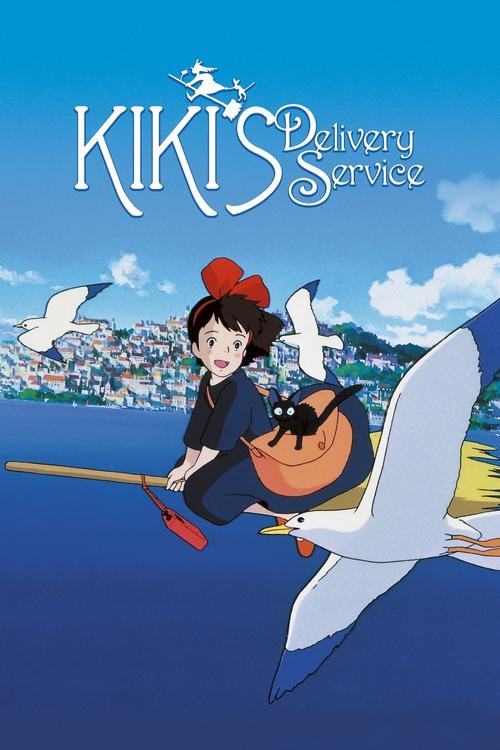
Kiki's Delivery Service
1989 · Hayao Miyazaki
The Boy and the Heron's no-marketing release and second Oscar fueled the eternal "final film" watch, while his resurfaced "an insult to life itself" AI clip made him the patron saint of anti-AI-art sentiment. Ghibli-style AI image generation controversies keep him at the center of a fight he never asked to join.
For a cozy night in when you're worn down and need a film that believes in you — pure comfort, especially if your creative spark has gone quiet and you need someone to tell you it comes back.
What it's about
A thirteen-year-old witch leaves home for her traditional year of independence, settling in a seaside city where her only marketable skill is flying a broom. She opens an air delivery service out of a bakery, and the film follows her first fumbling months of paying her own way — making friends, botching jobs, and learning what it costs to turn the thing you love into work. Her sardonic black cat comes along for the ride.
The experience
Gentle, sun-warmed, and almost plotless in the best way — it drifts like a good summer afternoon, then quietly sneaks up on you with how much it understands about self-doubt and burnout. You come out of it feeling steadied.
The craft
Miyazaki's hand-drawn flight is the draw: broom rides through gulls and over rooftops that feel physically real, with wind you can practically touch. The invented European seaside city is one of animation's great places to simply be in, rendered with painterly warmth and loving everyday detail — bread ovens, clocktowers, laundry on lines. Lovely on a big screen, but it glows on any screen.
Why it matters
This was the film that turned Studio Ghibli from an admired workshop into a commercial institution, proving a quiet, character-driven animated feature could be a blockbuster. It remains a touchstone for stories about young women's independence and for animators depicting ordinary life with care.
Snapshot
Kiki's Delivery Service (Majo no Takkyūbin) is Studio Ghibli's fourth feature and the film that transformed the young studio from a critically admired workshop into a commercially self-sustaining institution. Adapted from Eiko Kadono's 1985 children's novel, it follows a thirteen-year-old witch who, per tradition, leaves home for a year to establish herself in an unfamiliar seaside city, where she supports herself by flying deliveries on her broom. Beneath its gentle surface, the film is a study of adolescence, economic independence, and creative confidence — Kiki's temporary loss of her ability to fly reads transparently as a slump, a depression, or an artist's block. Where Miyazaki's Nausicaä and Laputa were adventure epics and My Neighbor Totoro a pastoral idyll, Kiki is a quiet, near-plotless coming-of-age story, its stakes internal rather than apocalyptic. It became the top-grossing domestic release in Japan for 1989 and, nearly a decade later, one of the first Ghibli titles Disney distributed in the English-speaking world.
Industry & production
The film was produced by Studio Ghibli under the Tokuma Shoten umbrella that had backed the studio since Nausicaä. It originated as a modest project: Miyazaki intended to serve only as producer and planner, handing direction to a younger filmmaker — Sunao Katabuchi, later known for In This Corner of the World — with the aim of developing new directorial talent inside the studio. As the project grew from a planned roughly hour-long feature into a full theatrical film, Miyazaki took over direction and rewrote the screenplay himself; Katabuchi remained as assistant director. This trajectory is well documented and is part of the studio's institutional lore about how difficult Miyazaki found it to delegate.
The production is also bound up with a notable commercial arrangement. "Takkyūbin," the word in the Japanese title, was a registered trademark of the parcel-delivery company Yamato Transport, whose corporate mascot is a black mother cat carrying a kitten. Rather than object, Yamato became a sponsor of the film — a fit made almost too neat by Kiki's own black cat, Jiji, and by the film's premise of a flying courier service. The partnership reflected the increasingly savvy commercial instincts forming around Ghibli in these years, a period in which producer Toshio Suzuki's role in shaping the studio's public strategy was growing.
Commercially, Kiki was the decisive success Ghibli needed. It was the highest-earning Japanese film at the domestic box office in 1989, and its performance is generally credited with stabilizing the studio's finances and validating the model of consistent feature production. Precise, fully reconciled box-office figures vary between sources, so the safest claim is the qualitative one: the film was a major hit that materially secured Ghibli's future.
A separate chapter belongs to the film's Western distribution. Under the deal between Tokuma and The Walt Disney Company, Kiki was among the first Ghibli films Disney dubbed into English, released in that form in 1998. That dub featured Kirsten Dunst as Kiki and Phil Hartman as Jiji — one of the comic actor's final completed roles before his death — and it added incidental dialogue, a pair of English-language pop songs, and expanded banter for the cat. A later reissue walked some of these additions back toward the original. The episode is a well-known example of the tension between localization and fidelity that characterized the early Disney–Ghibli relationship.
Technology
Kiki is a traditional cel-animation production of the late 1980s: hand-drawn, hand-inked and painted artwork photographed on an animation stand, without the digital compositing that Ghibli would begin integrating in the following decade. Its technical achievement lies not in novel machinery but in the density and control of conventional means — layered backgrounds, multiplane depth effects to separate foreground and distance, and the meticulous painted lighting that gives the imaginary city its solidity. The film predates Ghibli's digital-ink-and-paint era, so its textures — the grain of watercolor skies, the softness of painted cloud banks Kiki flies through — are the product of physical media. In this sense the film's "technology" is the accumulated craft of a studio operating at the height of the analog tradition rather than any new tool.
Technique
Cinematography
In animation the "camera" is a constructed act of layout and staging, and Miyazaki's control of it is central to the film's tone. The virtual camera favors clear, legible framings and patient full shots that let action play out in space rather than being carved up. The flight sequences are the showpiece: Miyazaki choreographs Kiki's broom against wind, weather, and the geometry of the city with a physical plausibility — buffeting gusts, banking turns, the danger of overhead wires — that grounds the fantasy. Elsewhere the film lingers on the ordinary: a bakery counter, a rented attic room, a harbor at dusk. The compositions consistently place Kiki within a richly detailed environment, using the imagined European cityscape as an active presence rather than a backdrop.
Editing
The film's cutting is unhurried, built on what is often described in relation to Miyazaki as ma — the deliberate use of stillness and pause. Scenes are allowed to breathe: a moment of Kiki resting, listening to a radio, or looking out a window is given room without narrative urgency. This rhythm is a deliberate counter to the accelerated cutting of much commercial animation and is essential to the film's slice-of-life register. Takeshi Seyama, a longtime Ghibli editor, is associated with this and other films of the studio's classic period; the editing supports Miyazaki's preference for observation over incident.
Mise-en-scène / staging
The invented city of Koriko is the film's great feat of world-building. Miyazaki and his art team drew on location research in Sweden — Stockholm and the walled town of Visby on Gotland are frequently cited touchstones — blended with Mediterranean and other northern-European elements to create a city that never existed yet feels wholly lived-in. Art direction by Hiroshi Ohno gives it cobbled streets, a clock tower, trams, cafés, and a working harbor, all rendered with the everyday clutter that signals real habitation. Staging emphasizes Kiki's smallness against this world early on and her gradual integration into it. The bakery that becomes her base, the attic she rents, and the recurring vantage points over the town function as a stable geography the audience comes to know, so that Kiki's belonging is registered spatially.
Sound
Joe Hisaishi's score, his continuing collaboration with Miyazaki, is warm and buoyant, using orchestral and lighter instrumentation to underscore both flight and domestic calm without overwhelming the film's quiet stretches. The Japanese version frames itself with two songs by Yumi Matsutoya (Yumi Arai) — the buoyant "Rouge no Dengon" over the opening and the tender "Yasashisa ni Tsutsumareta nara" over the close — pop songs that lend the film a specific period warmth. Sound design attends to the mundane and the elemental alike: wind, rain, the bustle of a bakery, the mechanical noise of the city. The contrast between the acoustic fullness of the town and the rushing air of flight is one of the film's quiet pleasures.
Performance
As animated performance, the film depends on subtle character animation and on its voice cast. Character design and animation direction by Katsuya Kondō give Kiki an expressive, unglamorous physicality — the slightly awkward gait of a self-conscious teenager, the small collapses of posture that read as discouragement. In the original Japanese, Minami Takayama voices both Kiki and the painter Ursula, a doubling that subtly links the two characters as versions of a young woman working through self-doubt; Rei Sakuma voices Jiji. The vocal performances favor naturalism over theatricality, in keeping with the film's grounded emotional key.
Narrative & dramatic mode
Kiki is structured as a low-stakes bildungsroman rather than a plot-driven adventure. Its dramatic mode is episodic and observational: Kiki arrives, struggles to fit in, launches her delivery business, makes friends and missteps, and confronts a crisis that is psychological rather than external. The pivotal turn is her sudden inability to fly and to understand Jiji — a loss of the very gift that defines her, arriving without villainous cause. The resolution comes not through combat but through recovery of confidence, catalyzed by a friend in danger. This refusal of conventional antagonism and spectacle is the film's defining formal choice; conflict is internalized, and growth, not victory, is the goal. The one late set piece — a rescue involving a runaway airship — functions less as an action climax than as the occasion for Kiki to reclaim her powers under pressure.
Genre & cycle
The film sits within, and quietly reworks, the Japanese majokko ("little witch") tradition — the television lineage of magical girls with special powers. Miyazaki strips that genre of its transformation sequences and wish-fulfillment, presenting magic as an inherited, unremarkable vocation that must be turned into a livelihood. It thus reads as much as a working-life story as a fantasy. Within Ghibli's own output it belongs to the studio's strand of grounded, domestic-scale films — closer to My Neighbor Totoro and later Whisper of the Heart than to the epic fantasies — and it is frequently cited as a foundational text for the "slice of life" and healing (iyashikei) sensibilities that would flourish in later anime.
Authorship & method
The film is unmistakably Miyazaki's, both in its recurring preoccupations — flight, capable young heroines, the dignity of everyday work, richly imagined pre-digital European-flavored settings — and in the circumstances by which he assumed direction. His method here is characteristically hands-on: he wrote the screenplay, drove the layout and storyboarding, and reshaped Kadono's source material substantially, notably deepening the crisis of the lost powers, an emphasis less present in the novel. The author's relationship to the adaptation was, by accounts, not without friction, a reminder that the film is a transformation of its source rather than a faithful transcription.
His key collaborators are the recurring core of Ghibli's classic period: composer Joe Hisaishi, whose scores are inseparable from Miyazaki's films; art director Hiroshi Ohno, responsible for Koriko's convincing solidity; character designer and animation director Katsuya Kondō; and editor Takeshi Seyama. Behind the production, the Tokuma organization and the studio's emerging producer Toshio Suzuki provided the institutional footing. The collaboration exemplifies the studio-auteur model Ghibli was consolidating — a strong directorial vision realized through a stable, highly skilled permanent team.
Movement / national cinema
Kiki is a landmark of Japanese animation and of Studio Ghibli specifically, arriving as anime was maturing into a medium capable of sustained, adult-serious feature work aimed at general audiences. It belongs to the broader elevation of theatrical anime in the 1980s but distinguishes itself by its restraint: where much of the era's celebrated animation trafficked in science fiction, apocalypse, or violence, Ghibli offered humane, family-oriented storytelling with rigorous craft. The film's European setting and its dialogue with Western picture-book and animation traditions also mark Miyazaki's cosmopolitan sensibility — a Japanese film that imagines an idealized, borderless mid-century Europe, contributing to anime's growing status as an internationally legible art form.
Era / period
The film is a product of Japan's late-1980s bubble economy, and commentators have often read its concern with a young person supporting herself, renting a room, and finding paying work as quietly attuned to the economic textures of its moment — the pressures and possibilities facing young women entering independent life. Aesthetically it belongs to the last flowering of fully analog cel animation, before digital tools reshaped the industry in the 1990s. Its nostalgic, indeterminate period setting — trams, propeller aircraft, radios, no televisions or computers — places it in a consciously pre-modern register, characteristic of Miyazaki's preference for a world of visible, mechanical craft.
Themes
The film's central theme is the passage into independence: leaving home, earning a living, and negotiating the loneliness of being new and unknown. Kiki's witchcraft functions as a metaphor for any inherited talent that must be developed through work rather than simply possessed. The loss and recovery of her powers dramatizes creative and emotional slump — the way confidence can evaporate and must be rebuilt, often with the help of others and through rest rather than force. The painter Ursula articulates this directly, framing flying and painting as kindred gifts subject to the same droughts. Around this run subtler themes: the value of ordinary work and kindness, the balance between self-reliance and community, and the bittersweet growth signaled by Jiji's eventual silence, widely read as Kiki outgrowing her childhood dependence — an interpretation Miyazaki himself has gestured toward, though the film leaves it open.
Reception, canon & influence
Kiki was warmly received in Japan and became the country's top-grossing domestic film of 1989, a commercial breakthrough that secured Studio Ghibli's viability. Over time it has settled into the canon as one of Miyazaki's most beloved works, particularly admired for its emotional honesty about adolescence and its refusal of melodrama; when it reached English-speaking audiences through Disney's 1998 release, it broadened Ghibli's international reputation, even as the localization choices drew scrutiny from purists.
Looking backward, the film's influences are clear: Eiko Kadono's source novel; the majokko television tradition it revises; Miyazaki's own established motifs; and the European locations, especially in Sweden, that shaped Koriko. Looking forward, its legacy is substantial. It helped establish the template for grounded, character-driven anime in which everyday life and gentle personal growth carry the drama, feeding into the slice-of-life and iyashikei modes and into Ghibli's own later domestic films. Its portrait of a young woman's working independence, and its treatment of creative block with compassion rather than spectacle, have made it a touchstone repeatedly invoked by animators and audiences alike. As with any film this widely discussed, some of its reception exists as popular consensus rather than settled scholarship; where the documentary record is thin — on precise box-office reconciliations or on Miyazaki's fully articulated intentions for the ending — this account has flagged the uncertainty rather than resolve it.
A Deleuzian reading
A girl lies in the grass with a radio by her ear, waiting for the forecast.
The full Deleuzian reading of Kiki's Delivery Service →
Reception
A smash on release — Japan's highest-grossing film of 1989 and Ghibli's first big commercial hit — it reached the West quietly via Disney's 1998 dub before being canonized as one of the studio's most beloved works. Once filed under 'minor, gentle Miyazaki', it's been reappraised as his great film about creative burnout — arguably the Ghibli that speaks most directly to adults.
How Kiki's Delivery Service was received, from release to now →
How to watch Kiki's Delivery Service: what to notice on a first viewing
- Watch how Kiki's broom fights the wind, not just flies. Miyazaki animates gusts, banking turns, and overhead wires as real forces Kiki has to answer, not just backdrop she flies past. Flying here looks like a skill you practice with weather, not a power you simply switch on.
- Notice how often the film just watches Kiki rest. Scenes linger on her lying in grass, listening to the radio, or looking out a window, moments most films would cut past on the way to the plot. You are watching an ordinary life at its actual pace, not only its highlights.
- Watch Kiki's shoulders and walk, not just her face. Kondo animates a slightly awkward gait and small collapses of posture, so her mood registers in how she carries herself before she says a word. Her body is doing narrative work here. You can read how she's doing without a line of dialogue.
- Notice the background details that have nothing to do with Kiki. Trams, cafes, a working harbor, and cobbled streets keep moving and functioning around her, a city that would carry on even without her business. The world feels bigger than the plot needs, which is exactly what makes Koriko feel real.
- Listen for how flight sounds different from the town below. The bustle of the bakery and harbor gives way to rushing air and Hisaishi's score once Kiki takes off, a clean acoustic break between two worlds. Sound alone tells you when she has left the ground, before you even see the sky.
The whole guide to watching Kiki's Delivery Service, with the keys for a rewatch →
Influences: the films it descends from and the films it influenced
- Snow White and the Seven Dwarfs (1937) — Pioneered the multiplane camera to layer foreground, midground and background at different depths — the parallax rig Kiki leans on for its townscape and flight compositions.
- Heidi, Girl of the Alps (1974) — As scene designer Miyazaki built the rigorous layout system here, anchoring everyday gestures — chores, meals, walking — inside a fully conceived European alpine geography, the grounded-domestic method Koriko inherits wholesale.
- Sally the Witch (1966) — Founded the majokko TV template of a magical girl among ordinary people; Kiki revises it by stripping the wish-fulfillment and reframing magic as unglamorous wage labor.
- Future Boy Conan (1978) — Miyazaki's TV debut fixed his kinetic staging of a resourceful child in motion — climbing, leaping, gliding — the physical-comedy character animation Kiki applies to broom-riding.
- Nausicaä of the Valley of the Wind (1984) — Established the 'virtual camera' flight choreography — the camera riding alongside a gliding figure with airborne banking and updraft — that Kiki extends into broom flight over rooftops.
- Castle in the Sky (1986) — Cemented the Hisaishi leitmotif-scoring partnership and the sustained aerial set-piece; Kiki carries over the same composer-driven emotional cueing and airborne spatial staging.
- My Neighbor Totoro (1988) — Immediately prior, it perfected the villain-free, low-stakes dramaturgy and the 'ma' editing of held stillness between beats — the quiet rhythmic breathing Kiki adopts as its baseline tempo.
- The Castle of Cagliostro (1979) — Reprises Cagliostro's European-fantastical town design and its dignified young-woman-at-the-moral-center protagonist as the emotional core.
- The Snow Queen (1957) — Its quiet, sincere young-girl protagonist and warmth-as-agency ethos carry forward the emotional register Miyazaki singled out in The Snow Queen over spectacle or villainy.
- Ocean Waves (1993) — A youth drama built entirely on internalized adolescent conflict and observational everyday detail, applying Kiki's episodic, low-incident emotional register to teenage social life.
- Whisper of the Heart (1995) — Miyazaki-scripted, it makes the creative-slump theme its whole spine — a young girl grinding through the doubt of learning a craft — directly descending from Kiki's compassionate treatment of blocked inspiration.
- Spirited Away (2001) — Reworks Kiki's dignity-of-work premise: a displaced girl earns her place through menial bathhouse labor, coming of age via economic self-reliance rather than magical triumph.
- The Secret World of Arrietty (2010) — Sustains Ghibli's miniature-domestic detailing and multiplane depth staging, prizing the tactile texture of household space over incident, as Kiki does with the bakery and attic.
- Wolf Children (2012) — Builds an iyashikei mode of healing, mundane domestic texture — seasons, chores, small growth — descended from Kiki's insistence that everyday routine can carry a whole film's drama.
- Little Witch Academia (2013) — Revives the majokko-plus-broom-flight lineage with expressive character animation of a striving young witch, extending Kiki's reframing of witchcraft as an apprenticeship rather than a birthright.
- When Marnie Was There (2014) — A Ghibli adolescent-girl bildungsroman driven by internalized emotion and a European-flavored seaside town, inheriting Kiki's restraint about naming feelings and its place-as-character setting.
- Song of the Sea (2014) — Openly modeled on Ghibli's hand-drawn register, it fuses folk-magic with a grounded childhood coming-of-age in the watercolor-toned, gently paced slice-of-life mode Kiki helped codify.
- Howl's Moving Castle (2004) — Prototype for flight animated as felt physical labor and for a young female protagonist whose interiority is carried by posture and gait, the embodied-performance technique Sophie's aging body refines.
- Ponyo (2008) — Establishes Miyazaki's coastal-town production design and the theme of a young girl's magical agency tied to emotional confidence, plus Hisaishi's warm orchestral scoring of ordinary domestic life.
- Luca (2021) — European seaside-town coming-of-age built from the unhurried textures of ordinary daily life that define Luca's summer rhythm.
- In This Corner of the World (2016) — Katabuchi worked as assistant director here, learning the choreography of mundane labor — sweeping, baking, hanging laundry — animated as full physical performance, which becomes Suzu's domestic-labor staging.
- Only Yesterday (1991) — Extends Ghibli's grounded slice-of-life into adult recollection, carrying forward Kiki's commitment to undramatized everyday labor and interior mood over plot mechanics.
Similar films
- Spirited Away (2001) — influence & lineage · same viewing thread · often watched together
- My Neighbor Totoro (1988) — influence & lineage · same viewing thread · often watched together
- The Secret World of Arrietty (2010) — influence & lineage · same viewing thread · often watched together
- Castle in the Sky (1986) — influence & lineage · same viewing thread · often watched together
- Only Yesterday (1991) — influence & lineage · same viewing thread · often watched together
- When Marnie Was There (2014) — influence & lineage · same viewing thread · often watched together
- Whisper of the Heart (1995) — influence & lineage · often watched together
- Howl's Moving Castle (2004) — same viewing thread · often watched together
All the films related to Kiki's Delivery Service →
Watch it with: curated runs of related films
- The Studio Ghibli Canon — A run through the whole hand-drawn shelf of Miyazaki and Takahata — start with the childhood-wonder crowd-pleasers and drift toward the studio's quieter, adult, more elegiac corners.