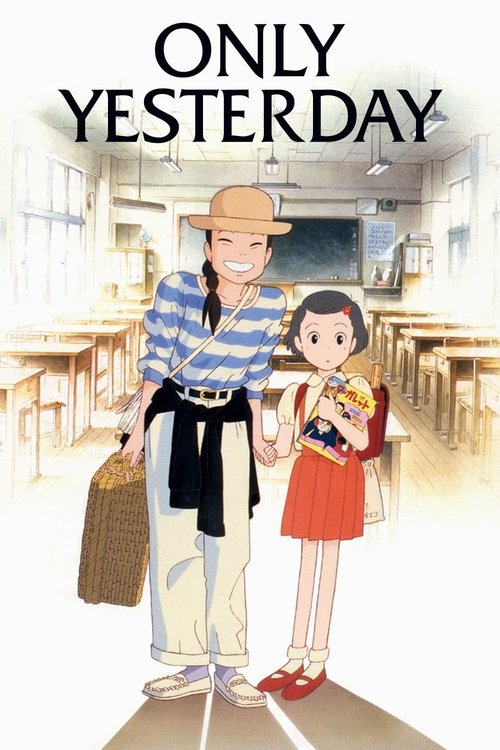
Only Yesterday
1991 · Isao Takahata
For a quiet Sunday evening when you want to feel wistful about who you used to be — comfort viewing with a soft ache in it, best watched when you're at a crossroads yourself.
What it's about
Taeko is 27, single, and working an office job in Tokyo when she takes her summer leave to harvest safflower with relatives in the countryside — and her ten-year-old self, the fifth-grader of 1966, comes along for the ride. The film moves between the two timelines: the adult woman among farmers and mountain air, and the child weathering the small enormities of grade school — a baffling fractions lesson, a first crush, a family that doesn't quite listen. Slowly the question sharpens: has the grown woman been faithful to the girl she was, and what would it cost to change her life now?
The experience
Gentle, unhurried, and quietly devastating in the way a shoebox of old letters can be. Nothing dramatic happens and yet the small scenes — a slap, a pineapple nobody enjoys, a boy's mumbled question — land with real weight, and it leaves you turning over your own childhood for days.
The craft
Takahata renders the adult scenes with unusual realism for animation — faces that crease and flush with actual muscle — while the childhood memories float on washed-out watercolor backgrounds that fade to white at the edges, like recollection itself. The rural sequences are lovingly researched, down to the labor of safflower picking, and the folk-inflected score gives the countryside a warmth that sneaks up on you. It rewards patience the way live-action rarely trusts itself to.
Why it matters
A landmark proof that animation could carry grown-up, plotless realist drama — a woman's inner life, no fantasy required — and a cornerstone of Studio Ghibli's quieter, Takahata-led tradition; it went unreleased in the US for 25 years before finding a devoted second life.
Snapshot
Omoide Poro Poro — literally something like "memories, trickling down," poroporo being the onomatopoeia for tears falling one after another — is Isao Takahata's fourth feature for Studio Ghibli and the studio's most deliberate act of anti-spectacle. A 27-year-old Tokyo office worker, Taeko Okajima, takes her summer leave in rural Yamagata to harvest safflower with the family of an in-law, and finds that her fifth-grade self, aged ten in 1966, has come along for the trip. The film alternates between the two time frames for 118 minutes without a villain, a chase, a transformation, or a plot in the conventional sense; its dramatic crises are a failed fractions lesson, an unwanted pineapple, a slap from a silent father, and the question of whether an adult woman is permitted to want a different life. Released in July 1991 by Toho and backed by Tokuma Shoten, it was the top-earning Japanese release of its year at the domestic box office — an outcome nobody could have modeled in advance — and then went unreleased in the United States for twenty-five years. It is the film in which Ghibli proved that animation could carry the weight of the adult shomingeki, the Japanese drama of ordinary lower-middle-class life, and it remains the studio's clearest bid for animation as a medium rather than a genre.
Industry & production
The project came out of a two-volume manga by writer Hotaru Okamoto and artist Yuko Tone, serialized in 1987 in Weekly Myojo, a magazine built around pop idols and youth culture. The source is entirely a memory book: disconnected comic vignettes of a girl's fifth-grade year in 1966, with no adult narrator and no through-line. The adult Taeko, the 1982 frame, Yamagata, the safflower harvest, the organic farmer Toshio, and the entire romantic and vocational dilemma are Takahata's invention. He wrote the screenplay himself, as he did for all his Ghibli features. The adaptation is therefore less an adaptation than a container built around found material — a structural decision that determines everything else about the film.
The production sat at a hinge point for Ghibli. Kiki's Delivery Service (1989) had been an enormous domestic success, and around that period the studio, under producer Toshio Suzuki and with Hayao Miyazaki's backing, moved away from the industry-standard model of per-drawing piecework and freelance crews toward salaried full-time animators and in-house training. That shift is legible in Only Yesterday, which demands sustained, uniform, unglamorous quality control across thousands of shots of people talking in rooms and picking flowers in fields — work that a rotating freelance pool cannot deliver. Miyazaki is credited as producer; Yasuyoshi Tokuma as executive producer; Suzuki managed the production. Takahata's reputation for overrunning schedules and budgets was already established from Grave of the Fireflies (1988), and Only Yesterday did nothing to dispel it.
Commercially, the film was improbable on its face. The Japanese animation market of 1991 was dominated by television franchises and the direct-to-video OVA boom, and the international idea of anime had just been set by Akira (1988) as kinetic dystopian spectacle. A feature whose protagonist is an unmarried female clerical worker contemplating her career and her childhood had no genre slot. Its success — driven substantially by adult and female audiences — helped establish that Ghibli's brand, not its content, was the draw, a fact that underwrote the studio's freedom for the next two decades.
Technology
Only Yesterday is a fully analog film: hand-inked and painted cels photographed on a rostrum camera, finished on 35mm at 1.85:1. It predates Ghibli's digital transition — limited computer work arrived with Pom Poko (1994), and full digital ink-and-paint and compositing with Princess Mononoke (1997). Every optical effect here is achieved chemically or in-camera: diffusion, soft focus, superimposition, the glow around the 1966 sequences.
The technological interest of the film lies elsewhere, in a workflow inversion. Japanese animation standardly uses after-recording — dialogue is dubbed to finished picture, which is why so much anime lip-sync is a generic flapping cycle. For the 1982 material Takahata pre-recorded his leads and animated to the existing performance, allowing the drawings to follow the actual rhythm, hesitation, and muscular consequence of speech. The result was a set of adult faces with visible cheekbones, nasolabial folds, and jaw articulation — faces that read as having ages rather than character-design types. Contemporary viewers found this strange, and it remains the single most-discussed technical feature of the film. Achieving it required the animation department to work from filmed reference of speech and facial mechanics rather than from the schematic vocabulary of anime expression.
Technique
Cinematography
The camera department, with Hisao Shirai credited as director of photography, executes two incompatible photographic regimes and never blends them. The 1982 material is composed with the sobriety of live-action television drama: level eyelines, considered depth, natural light logic, muted greens and grays, backgrounds by art director Kazuo Oga that are fully painted to the frame edge and dense with agricultural specificity. The 1966 material is high-key, washed, and — crucially — unfinished at the borders. Backgrounds dissolve into white paper; figures stand in fields of nothing; the frame declines to fill itself in. This is not stylization for charm. It is a claim about the epistemology of memory: recollection retains the center of an image and loses its periphery, and the film draws exactly that.
Editing
Takeshi Seyama, Ghibli's editor through this period, cuts the film on association rather than on incident. Transitions between 1982 and 1966 are usually triggered by a sensory or verbal rhyme — a phrase, a food, a texture, a sound — and the film almost never signals them with a dissolve or a stinger. The two time frames are simply adjacent, which is how memory actually intrudes. Within scenes the cutting is patient to the point of provocation: conversations run in long two-shots, the safflower harvest is given documentary duration, and the film repeatedly holds after a line has landed. The most radical editorial choice is placing the story's resolution in the end credits, where the ten-year-old Taeko and her 1966 classmates physically push the adult Taeko off a departing train and back toward Toshio. The decision is dramatized entirely in the space normally reserved for names.
Mise-en-scène / staging
The film is a compendium of Japanese domestic staging: the cramped Tokyo apartment with its low table and sliding doors, the sisters' shared room, the school desk, the farmhouse kitchen. Takahata blocks these spaces with obsessive attention to the choreography of a household — who sits where, who reaches for what, who is not looked at. The 1966 apartment sequences owe an evident debt to the domestic geometry of Ozu and Naruse, though Takahata's camera moves where theirs generally did not. Against this, the Yamagata exteriors are staged as landscape: Oga's backgrounds render terraced fields, irrigation channels, and mountain weather with a topographical precision that makes Toshio's argument — that this "natural" countryside is entirely man-made, the product of centuries of labor — visible before it is spoken.
Sound
The score is by Katz Hoshi, but the film's aural signature is its use of Eastern European folk music — Hungarian, Romanian, Bulgarian material — under the rural sequences. The choice is startling and deliberately non-illustrative: rather than scoring Japanese peasant labor with Japanese folk idiom, Takahata reaches for a music from another agrarian periphery, universalizing the film's subject and refusing the sentimental furusato ("old home village") register that Japanese nostalgia media of the 1980s had exhausted. The end-credits song is "Ai wa Hana, Kimi wa Sono Tane," a Japanese-language version of Amanda McBroom's "The Rose," performed by the veteran enka singer Harumi Miyako — a pointedly popular, unfashionable, generationally specific choice. Elsewhere the mix is dominated by ambience: cicadas, rain on eaves, train movement, the sound of stems being cut. Period is established aurally as much as visually, with 1966 anchored by the NHK puppet serial Hyokkori Hyōtanjima and the pop culture surrounding the Beatles' Japan tour.
Performance
Adult Taeko is voiced by Miki Imai, then a major pop singer, and Toshio by Toshirō Yanagiba, a television actor; young Taeko is Yōko Honna. Takahata's preference for performers from outside the anime voice industry is consistent across his career, and here it is structural rather than cosmetic: he wanted the unshowy, slightly flat cadence of ordinary Japanese conversation, not the projected clarity of seiyū technique. Because the adult performances were recorded first, Imai and Yanagiba effectively lead the animation rather than following it — the drawings are a record of their timing. The child performances, recorded conventionally, are broader and brighter, which reinforces the split.
Narrative & dramatic mode
The film has two narrative systems that do not resolve into one. The 1966 strand is anecdotal and anti-climactic, inherited from the manga: episodes that begin, embarrass, and end. The 1982 strand is a slow interior monologue with a decision at the end of it. What binds them is not causation but interrogation — the adult keeps asking why the child will not leave her alone, and the film's answer is that the unfinished business of a ten-year-old (a refused acting role, an unearned humiliation, a friendship never resumed) is precisely the material from which an adult's sense of permitted possibility is built. The mode is confessional and essayistic, closer to the Japanese shishōsetsu or "I-novel" than to any dramaturgy of conflict, and Takahata compounds this by letting characters simply lecture — Toshio on organic agriculture and rural depopulation, an elder on the history of safflower dye — in digressions that a conventional screenplay would cut. The only overtly fantastical gesture in the film, Taeko floating up into a cloud-strewn sky after a boy asks her whether she likes rain, cloudy days, or sunny days, is placed among the memories, where the license belongs.
Genre & cycle
Formally the film belongs to the shomingeki / home-drama lineage of Japanese live-action cinema, transposed into cel animation. Commercially it sits inside the late-Shōwa and early-Heisei nostalgia cycle: the bubble-era appetite for the recovered 1960s, for the rediscovered countryside, for a national childhood. But Only Yesterday is a critique of that cycle as much as a product of it. Taeko is a Tokyo child with no ancestral village to return to, and the film treats this rootlessness as the ordinary modern condition rather than a wound to be healed by scenery. Its release in July 1991, as the asset bubble was visibly collapsing, gives its rural turn a retrospective sharpness the production could not have planned. Within animation, it belongs to a small cycle of Ghibli-adjacent everyday-life features that includes Ocean Waves (1993) and Whisper of the Heart (1995).
Authorship & method
Takahata is the central case in animation of the director who does not draw. Trained in French literature at the University of Tokyo, drawn into the industry at Toei Dōga in 1959 by the example of Paul Grimault's French animated features, he worked as a constructor of structure, research, and performance rather than of images. His method was documentary-first: extensive location and archival research, then a screenplay, then an exacting negotiation with the artists who could realize it. The immediate precedent for Only Yesterday is not an animated film at all but The Story of Yanagawa's Canals (1987), the live-action documentary Takahata directed about waterway restoration and community labor — the safflower sequence and Toshio's speeches on manufactured landscape descend directly from it.
His collaborators here are exceptional. Kazuo Oga, art director, had defined the Ghibli landscape on My Neighbor Totoro and here builds an agricultural world of genuine botanical and topographic specificity. Yoshifumi Kondō served as character designer and animation director, and his work on adult faces — the most difficult assignment in the film — is the reason the performance experiment succeeds; he would go on to direct Whisper of the Heart before his death in 1998, a loss usually described as the collapse of Ghibli's succession plan. Takeshi Seyama edited; Katz Hoshi scored; Takahata alone wrote. Miyazaki's role was as producer and studio partner, and the two men's temperamental opposition — Miyazaki's motion and flight against Takahata's stillness and speech — is the productive antagonism at the heart of early Ghibli.
Movement / national cinema
The film is a Japanese national-cinema object in the most literal sense: it is about the postwar transformation of Japan, narrated through one household's consumption (a first pineapple, still an exotic luxury), one school year's curriculum, one broadcast schedule, and one region's declining agriculture. Its aesthetic allegiances run to Italian neorealism, which Takahata cited across his career, and to the domestic realists Ozu and Naruse; its ethical allegiance runs to a materialist account of labor and landscape that has no real counterpart in commercial animation anywhere. Within the anime tradition it stands against the two dominant tendencies of its moment — the science-fictional and the fantastic — and asserts instead that the medium's proper subject can be an adult woman's ordinary afternoon.
Era / period
Two periods are held in tension. 1966 is high-growth Japan: rising incomes, new appliances, imported fruit, television as a shared national text, and a set of expectations for girls that the film records without editorializing. 1982 is the stable, affluent, pre-bubble present of the salaried middle class, in which a 27-year-old unmarried woman is subject to constant low-grade interrogation about marriage — a social fact the film stages with unusual bluntness in the scene where Toshio's grandmother proposes a match and Taeko, cornered by kindness, flees. The film's own production era, 1989–1991, adds a third layer: a Japan at peak wealth, beginning to romanticize the countryside it had emptied.
Themes
Memory is the ostensible subject; labor is the actual one. The film's central argument is delivered through the safflower: the benibana whose petals produced the red rouge worn by city women were picked by farm girls whose hands were scarred by the plant's thorns, so that beauty and drudgery are the same object seen from two ends of a supply chain. Taeko — an urban consumer discovering the production side of the world — is that supply chain made autobiographical. Around this cluster the film's other themes: the constructedness of "nature," and the ecological politics of maintaining a landscape nobody can afford to farm; the female body as a site of public shame, in the extraordinary sequence on menstruation and the boys' teasing that follows; paternal authority exercised as silence and, once, as violence; the class and gender scripts that decide which children are allowed to have talents; and the possibility — the film's tenderest proposition — that the ten-year-old who was refused something might be owed restitution by the adult she became.
Reception, canon & influence
Backward. The film's influences are unusually legible: Grimault's animation, which brought Takahata into the field; Italian neorealism's ethic of ordinary life and non-professional texture; the Japanese home drama of Ozu and Naruse; the shishōsetsu tradition of confessional narration; Takahata's own documentary work at Yanagawa; and, at the level of raw material, the Okamoto–Tone manga, whose refusal of plot Takahata preserved rather than repaired.
Contemporary reception. In Japan the film was a substantial hit — the leading domestic release of 1991 by most accountings, though precise figures vary between sources — and it drew an adult audience, especially women, that anime features had not been designed to serve. Domestic critics generally received it as a serious work; the reservations, then and since, concern its didactic passages and its deliberate slowness, and some viewers found the realistically muscled adult faces uncanny. Internationally the story is one of absence. The film circulated in Europe and the UK from the 2000s, but despite Disney's Ghibli distribution arrangement it went unreleased theatrically in the United States for twenty-five years — a delay very widely attributed to the frankness of the menstruation sequence sitting badly with a family-brand distributor, though no formal explanation was ever given. GKIDS finally released it in North America in 2016, with an English dub featuring Daisy Ridley as Taeko and Dev Patel as Toshio. The reviews were close to unanimous, several critics placed it on year-end lists for 2016, and the belated release did more than anything else to move the film from Ghibli deep cut to acknowledged major work.
Forward. Its most direct descendants are inside the studio: Ocean Waves (1993), Whisper of the Heart (1995) — Kondō's film, and unimaginable without this one — and later When Marnie Was There (2014), all extending the proposition that everyday emotional life can carry an animated feature. Takahata's own Pom Poko (1994) takes the rural-development argument of Toshio's speeches and turns it into farce and tragedy. Beyond Ghibli, the film stands behind Mamoru Hosoda's Wolf Children (2012), with its urban woman relearning agriculture; behind Sunao Katabuchi's In This Corner of the World (2016), whose accumulation of period-specific domestic detail is a Takahata method applied to wartime Hiroshima; and behind the close-observation register of Naoko Yamada's work, where meaning is carried by gesture, footwear, and glance. More broadly, it is the reference point invoked whenever animation attempts adult realist drama, and the GKIDS release helped consolidate an arthouse-animation distribution niche in North America. Comparisons to Hirokazu Kore-eda's films of memory and family, and to later Western animation about the architecture of childhood recollection, are frequently and fairly drawn — though these are affinities of subject rather than documented lines of transmission, and the record on direct influence is thin enough that it should be described as resemblance, not inheritance.
A Deleuzian reading
The Okajima family's first pineapple arrives in the Tokyo apartment in 1966 as an event.
The full Deleuzian reading of Only Yesterday →
Reception
Japan's highest-grossing domestic film of 1991, it then went practically unseen in the US for 25 years — Disney sat on it during the Ghibli deal era — until GKIDS finally released it in 2016 to a full-scale rediscovery as one of the studio's quiet masterpieces.
How Only Yesterday was received, from release to now →
How to watch Only Yesterday: what to notice on a first viewing
- Watch where the background simply stops in the 1966 scenes. The 1982 material is painted fully to the frame's edge, but the 1966 material dissolves into blank white paper at its borders. The unfinished edges mimic how memory keeps a center and loses everything around it.
- Notice how the film jumps between decades with no dissolve at all. A phrase, a food, or a sound in 1982 lands the film straight into 1966, with no transitional device announcing the jump. The past arrives the way it actually does in memory, uninvited and unannounced.
- Watch how long the film lingers on ordinary farm labor. Safflower picking runs at the actual length safflower picking takes, with no dramatic payoff waiting at the end of the scene. The film spends its time on labor that has no plot use, because the labor is the point.
- Notice who sits closest to the table and who does not. Takahata blocks every household scene by exact position, who reaches for what, who is looked at and who is not. The seating arrangement tells you the family's whole hierarchy before anyone says a word.
- Listen for Hungarian or Balkan folk music under the Japanese countryside. The score reaches for Eastern European folk material rather than Japanese idiom, refusing the sentimental nostalgia music this kind of scene usually gets. The choice keeps the film from turning rural life into a postcard of itself.
The whole guide to watching Only Yesterday, with the keys for a rewatch →
Influences: the films it descends from and the films it influenced
- La Bergère et le Ramoneur (1952) — The film that pulled Takahata into animation, and the template for his entire practice: a writer-led production (Prévert's script, deep architectural layout) where authorship sits with structure and staging rather than with a lead draftsman's hand — the working model for a director who does not draw.
- Umberto D. (1952) — The maid's uninterrupted morning routine — grinding coffee, wetting the floor, closing the door with her foot — is the direct precedent for Only Yesterday's insistence on filming labor (safflower picking, the pre-dawn kitchen) at real duration with no narrative payoff.
- Late Spring (1949) — Ozu's marriage-question structure, in which the ostensible plot is suspended in favor of domestic ritual and punctuated by object and landscape inserts, becomes the 1982 frame story: a courtship advanced through meals, trains and talk in a vegetable field, with the answer withheld until the end credits.
- Repast (1951) — Naruse's technique of rendering a woman's dissatisfaction through household economy and repeated chores rather than confrontation underwrites Taeko's adult scenes, including the decision to deny her any dramatic crisis.
- Heidi, Girl of the Alps (1974) — Takahata's own precedent for location-scouted animation of everyday labor — bread, cheese, bedding-airing, each timed to the real rhythm of the work — is exactly the technique the safflower harvest scales to feature length.
- Jarinko Chie (1981) — His earlier shomingeki proves out two devices this film depends on: working-class regional speech cast from stage and comedy performers instead of voice actors, and comic timing animated to their recorded delivery rather than to lip-flap sheets.
- The Story of Yanagawa's Canals (1987) — The live-action documentary is the literal source of Toshio's lectures — that the 'natural' countryside is a manufactured, continuously maintained artifact — and of the essay-with-diagrams mode grafted onto a fiction feature.
- Grave of the Fireflies (1988) — The immediate technical rehearsal: Kazuo Oga's gouache backgrounds keyed to a single memory tone and Yoshifumi Kondō's anatomically weighted character animation — the same two artists who then split Only Yesterday into its two photographic regimes.
- My Neighbor Totoro (1988) — Extends Totoro's satoyama-nostalgia and observational ma pauses into live-action-grade naturalistic rural realism, foregrounding the farmed countryside as an animist emotional space.
- Ocean Waves (1993) — Takes the device wholesale — an adult in transit reconstructing an adolescent episode — and inherits the photo-referenced rendering of ordinary provincial streets as sufficient dramatic setting.
- Pom Poko (1994) — Toshio's speech on manufactured landscape becomes the whole argument, delivered through the same essayistic apparatus of narration, dates and documentary inserts, now wrapped around a fiction about suburban development.
- Whisper of the Heart (1995) — Kondō directs out of the acting vocabulary he built here as character designer: unidealized adolescent faces with visible cheek and jaw musculature, and drama staged in the prosaic geography of a danchi flat, a library and a hill road.
- My Neighbors the Yamadas (1999) — Pushes the soft, unclosed frame edge to its conclusion — watercolor figures floating in undrawn white — and the anti-plot into a strip-manga structure of domestic vignettes that refuse to resolve.
- The Tale of the Princess Kaguya (2013) — The end point of both experiments: the visible drawn line and unfinished edge become the film's actual surface, and dialogue is pre-recorded so the animation is built to the performers' breath rather than to a lip-sync track.
- Wolf Children (2012) — The urban woman relearning agriculture reuses the safflower logic — farming shown as procedure, taught by named neighbors, held for durations the plot does not require.
- When Marnie Was There (2014) — Reruns the dual-timeline architecture in which a girl's present-day rural stay is interleaved with a past she is partly constructing, and resolves it through a disclosure about family lineage rather than through event.
- In This Corner of the World (2016) — Applies the research method verbatim — period-exact recipes, rationing arithmetic, tools, street layouts — until accumulated domestic detail carries the history, here of wartime Hiroshima and Kure.
- Liz and the Blue Bird (2018) — Extends the close-observation register in which footwear, hands and the changing gap between two walking bodies carry the scene, held well past the point of information — animated gesture as the sole dramatic instrument.
- Tokyo Godfathers (2003) — Pioneers documentary-grade realism in hand-drawn animation — mundane everyday gesture and lived-in detail rendered with near-rotoscopic fidelity — the aesthetic Kon applies to homeless bodies and cluttered alleys.
- The Disappearance of Haruhi Suzumiya (2010) — Its patient, deliberately under-eventful pacing that trusts the texture of ordinary daily life to carry drama is the tempo the film's extended runtime inherits.
- Your Name. (2016) — Ghibli precedent for braiding two time-frames and a rural/urban split into one melancholic structure, and for treating the depopulating countryside as elegiac subject — Itomori's lake-town lament descends from this.
- Still Walking (2008) — Shares the shomingeki technique of letting a complete cooking procedure play out as the vehicle for family history, with the emotional turn arriving obliquely and late — a convergence of method, not a documented debt.
- A Silent Voice: The Movie (2016) — Grounds the ancestral method of undramatized realist introspection, mining ordinary memory and minute behavioral detail instead of plot mechanics.
- Little Amélie or the Character of Rain (2025) — Structures a film around the fine-grained sensory texture of childhood memory recalled in adulthood, the introspective register the seed's first-person toddler narration inhabits.
- Kiki's Delivery Service (1989) — Extends Ghibli's grounded slice-of-life into adult recollection, carrying forward Kiki's commitment to undramatized everyday labor and interior mood over plot mechanics.
Similar films
- When Marnie Was There (2014) — influence & lineage · same viewing thread · often watched together
- The Tale of The Princess Kaguya (2013) — influence & lineage · same viewing thread
- Wolf Children (2012) — influence & lineage · same viewing thread
- Whisper of the Heart (1995) — influence & lineage · often watched together
- Grave of the Fireflies (1988) — influence & lineage
- In This Corner of the World (2016) — influence & lineage
- My Neighbor Totoro (1988) — same viewing thread · often watched together
- Spirited Away (2001) — same viewing thread · often watched together
All the films related to Only Yesterday →
Watch it with: curated runs of related films
- The Studio Ghibli Canon — A run through the whole hand-drawn shelf of Miyazaki and Takahata — start with the childhood-wonder crowd-pleasers and drift toward the studio's quieter, adult, more elegiac corners.