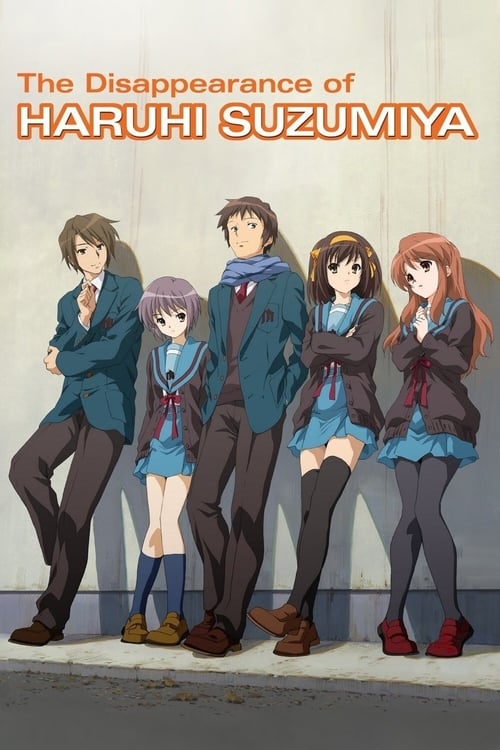
The Disappearance of Haruhi Suzumiya
2010 · Yasuhiro Takemoto
For when you want to sink into something long, quiet and bittersweet on a winter night — a slow-burn mystery to feel rather than race through. It rewards patience; come rested.
What it's about
A week before Christmas, Kyon — the dry-witted narrator long resigned to his high school club's supernatural chaos — wakes to find the world quietly rewritten. The classmates who dragged him into the extraordinary no longer know him, and the girl at the center of it all has vanished from the school register entirely. Alone with the change, he has to work out what happened, and what kind of world he actually wants to live in.
The experience
Patient, wintry and unexpectedly moving — a mystery that trades spectacle for long snowy walks, vending-machine light and mounting unease before it tightens into something genuinely emotional. At nearly three hours it asks for your evening and repays it.
Performances
Tomokazu Sugita's world-weary narration as Kyon anchors the film, and Minori Chihara does remarkable, minutely calibrated work as the near-silent Yuki.
The craft
Kyoto Animation renders winter with fanatical realism — breath in cold air, snow under streetlights, classrooms at dusk — and lets scenes breathe far longer than most animation dares. At 162 minutes it's among the longest animated features ever made, and the running time is a deliberate tool, not an indulgence.
Why it matters
Widely regarded as the crowning achievement of an era-defining anime franchise and a high-water mark for Kyoto Animation, it's the film fans point to when arguing what the studio's realism could do.
A week before Christmas, the perpetually put-upon narrator Kyon wakes to find his world subtly rewritten: the eccentric classmates who dragged him into the supernatural no longer know him, and the girl at the center of it all has vanished from the school register entirely. Kyoto Animation's feature continuation of its era-defining television series is a strange, patient marvel — at 162 minutes, among the longest animated films ever made, and unafraid of that length. Where the series delighted in formal pranks (episodes aired out of order; one arc infamously repeated eight times), the film spends its games' accumulated capital on melancholy: long walks through winter Tokyo rendered with the studio's fanatical realism, snow and vending-machine light and the dawning question of whether an ordinary life might be worth choosing. Co-director Yasuhiro Takemoto was among those killed in the 2019 arson attack on Kyoto Animation; this film stands as his largest and most cherished monument.
Reception
In 2010 it landed as KyoAni's grand apology after the infamous 'Endless Eight' arc had fans in open revolt — and it worked, instantly hailed as the franchise's peak. Today it's routinely canonized as one of the greatest anime films ever, its legacy made bittersweet by co-director Yasuhiro Takemoto's death in the 2019 Kyoto Animation arson attack.
How The Disappearance of Haruhi Suzumiya was received, from release to now →
Influences: the films it descends from and the films it influenced
- The Melancholy of Haruhi Suzumiya (2006) — The TV series this film continues, establishing Kyon's dry first-person voiceover and the fixed SOS Brigade ensemble blocking that the film weaponizes by subtracting Haruhi from every frame.
- It's a Wonderful Life (1946) — Supplies the structural device the second half reenacts: a protagonist dropped into a plausible reality where a pivotal person's impact has been erased, who must then actively choose to restore the world he'd resented.
- The Girl Who Leapt Through Time (2006) — Models the fusion of a single science-fiction reality-altering device with strictly mundane high-school stakes, rendered against photoreal contemporary-Japan backgrounds rather than genre spectacle.
- Perfect Blue (1997) — Its match-cut editing that splices subjective delusion into objective space is the grammar for making the audience share the narrator's inability to tell which continuity is the real one.
- Clannad After Story (2008) — The same director's earlier template of patient, low-incident melancholy built on Key visual-novel emotional beats and KyoAni's soft photoreal interiors.
- Whisper of the Heart (1995) — Pioneers the naturalist photoreal rendering of an ordinary suburban Tokyo — station stairs, convenience stores, apartment blocks — as emotionally weighted background art rather than neutral setting.
- Only Yesterday (1991) — Its patient, deliberately under-eventful pacing that trusts the texture of ordinary daily life to carry drama is the tempo the film's extended runtime inherits.
- The End of Evangelion (1997) — Precedent for resolving a TV series as a feature-length theatrical event routed through a character's subjective interior reality rather than external plot.
- Kanon (2006) — KyoAni's winter-set adaptation where snow-lit town backgrounds and slow emotional revelation establish the studio's cold-season melancholy palette reused here for winter Tokyo.
- Your Name. (2016) — Scales the exact formula — photoreal Tokyo naturalism plus a reality-rewrite undertaken to save one specific person — into blockbuster form.
- A Silent Voice (2016) — Carries KyoAni's patient pacing and reliance on micro-gesture acting — fingertips, averted eyes, foot-scuffs — into a feature-length melancholy drama.
- Hyouka (2012) — The same director refines the put-upon deadpan narrator and refractive, over-bright photoreal lighting into an everyday low-stakes mystery register.
- Erased (2016) — Extends the rewritten-reality premise where the protagonist alone retains memory across a changed timeline and must act to restore the version of the world that was lost.
- Liz and the Blue Bird (2018) — Pushes KyoAni's extended-length patient pacing to its limit, letting quiet school-corridor observation and negative space do the narrative work.
- Steins;Gate (2011) — Runs the same moral engine: editing a worldline back to safety erases a beloved character, forcing the hero to weigh comfort against a person's existence, exactly Kyon's dilemma.
- Puella Magi Madoka Magica (2011) — Contemporaneous deconstruction that hangs its structure on unreliable continuity and a timeline being secretly rewritten by one memory-retaining character.
Similar films
- Your Name. (2016) — influence & lineage
- The Girl Who Leapt Through Time (2006) — influence & lineage
- Whisper of the Heart (1995) — influence & lineage
- Liz and the Blue Bird (2018) — influence & lineage
- Only Yesterday (1991) — influence & lineage
- My Neighbor Totoro (1988) — shared sensibility
- Violet Evergarden: The Movie (2020) — shared sensibility
- When Marnie Was There (2014) — shared sensibility
All the films related to The Disappearance of Haruhi Suzumiya →