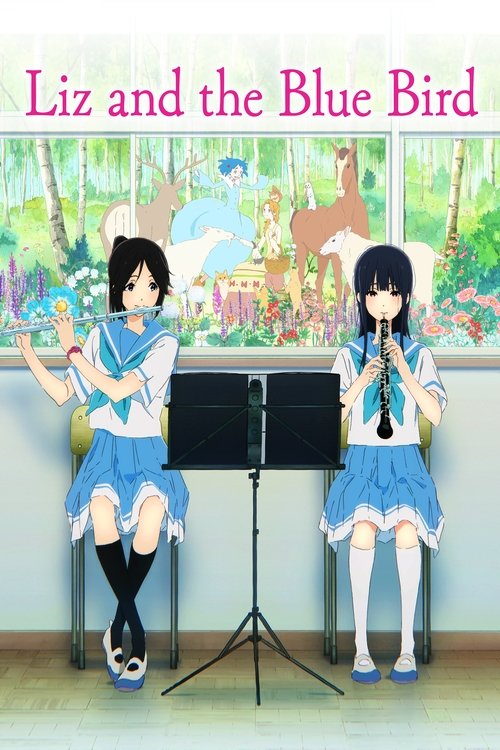
Liz and the Blue Bird
2018 · Naoko Yamada
For a quiet evening when you want something tender and bittersweet — the mood of remembering a friendship that mattered too much to name. A slow, delicate watch; bring patience and maybe tissues.
What it's about
Two girls in their last year of high school, best friends and the flute-and-oboe heart of their brass band, rehearse a competition piece based on a fairy tale about a girl and a bluebird who cannot stay together. Everyone around them can see how the story mirrors their friendship — graduation is coming, and one of them may be outgrowing the other. The film watches them figure out, note by note, what they mean to each other.
The experience
Hushed and precise, told through glances, footsteps, and the hesitation before a greeting rather than speeches — it asks you to lean in, and rewards you with an ache that builds almost imperceptibly until it's enormous. Gentle on the surface, quietly devastating underneath.
The craft
Naoko Yamada directs with a level of behavioral detail almost no one in animation attempts — weight shifts, fingers on an oboe key — while Kensuke Ushio's score builds its rhythms from footsteps and breath, so the film seems to listen to its characters as closely as it watches them. The fairy-tale interludes bloom in soft watercolor, a storybook world inside the school corridors. Good headphones or speakers make a real difference.
Why it matters
It confirmed Yamada as the most distinctive directorial voice to emerge from Kyoto Animation and became a touchstone for how much animation can say with how little — a small film with an outsized reputation among people who love the medium.
Naoko Yamada's chamber film — nominally a spin-off from the Sound! Euphonium series, in practice entirely self-contained — follows two girls in their final year of high school as their brass band rehearses a piece based on a fairy tale about a girl and a bluebird who cannot stay together. The parallel is obvious to everyone except, perhaps, the two of them. Yamada, the most distinctive director to emerge from Kyoto Animation, works at a level of behavioral detail almost no one else in animation attempts: the film is told through feet shifting weight, fingers on an oboe key, the half-second hesitation before a greeting. Kensuke Ushio's score builds its rhythms from footsteps and breath, so the film seems to be listening to its characters as closely as it watches them. The fairy-tale interludes bloom in soft watercolor, a storybook world pressing against the fluorescent hush of school corridors. A rehearsal of the piece's third-movement duet becomes the emotional summit — one of the great music scenes in animation, where performance says everything the friendship cannot.
A Deleuzian reading
The film would rather show you her shoes.
The full Deleuzian reading of Liz and the Blue Bird →
Reception
It slipped in and out of Japanese cinemas quietly in 2018 — a modest spin-off release by box-office standards — but critics adored it immediately, and streaming plus Letterboxd word-of-mouth have since elevated it to 'Naoko Yamada's masterpiece' status and a fixture on best-anime-of-the-2010s lists.
How Liz and the Blue Bird was received, from release to now →
Influences: the films it descends from and the films it influenced
- Sound! Euphonium (2015) — The parent KyoAni concert-band series whose ensemble the film extracts into a two-hander, using the same close-mic'd instrument sound and rehearsal-room blocking as raw material for a self-contained mise-en-abyme spinoff.
- A Silent Voice (2016) — Yamada's immediately prior feature establishes her system of legs-and-feet framing, downcast averted gazes, and Kensuke Ushio's fragile piano-and-found-sound score to carry unspoken emotion between two withdrawn characters.
- K-On! (2009) — Yamada's breakout builds her method of reading friendship through idle gesture and behavioral micro-detail — a fidget, a shared glance in a clubroom — and treating music-making itself as the film's emotional dialogue.
- Tamako Love Story (2014) — Her earlier chamber two-hander perfects the quiet, near-static staging of adolescent hesitation, holding on doorways and empty air so a single deferred confession lands as a structural climax.
- The Virgin Suicides (1999) — A cited touchstone: the diffuse, sun-hazed lyricism and observational distance on unknowable girls feeds Liz's watercolor interludes and its refusal to over-explain the interior life of its pair.
- Late Spring (1949) — Ozu's low tatami-height camera, pillow-shot cutaways to empty corridors, and dramatization of separation through restraint and silence underpin Yamada's still framing and elliptical emotional grammar.
- Whisper of the Heart (1995) — Its story-within-a-story (the Baron fantasy nested inside a realist adolescence) is the Ghibli precedent for the parallel Liz fairy tale that comments on the frame narrative in mise-en-abyme.
- Only Yesterday (1991) — Takahata's soft, unpainted-edge watercolor flashback passages and patient realism of small gesture model the film's diaphanous fairy-tale interludes rendered in a deliberately different, lighter palette.
- Pickpocket (1959) — Bresson's fragmentation of bodies into hands, feet and averted faces, and his use of curated diegetic sound over expression, is the deep grammar behind Yamada's tactile close-ups and listening-focused sound design.
- The Disappearance of Haruhi Suzumiya (2010) — Pushes KyoAni's extended-length patient pacing to its limit, letting quiet school-corridor observation and negative space do the narrative work.
- K-ON! The Movie (2011) — The ankle-level camera, footstep sound design, and limb-fragment framing reach their purest form, staging an entire relationship through the distance between two pairs of walking feet.
- Linda Linda Linda (2005) — Perfects silence-as-structure and negative-space school-corridor staging, letting held quiet and small physical gestures between girls carry the drama — the animated refinement of the reticent, naturalistic observation Yamashita practiced in live action.
- The Colors Within (2024) — Yamada's later chamber film about three musicians extends her signature of music-as-emotional-language and hushed behavioral staging, again letting a band's performance resolve what characters cannot say.
- The Heike Story (2021) — Her subsequent series carries forward the gestural-microexpression acting and diegetic-listening motif (a girl who watches and hears the future) into a new register while keeping her intimate observational eye.
- Ping Pong the Animation (2014) — Shares composer Kensuke Ushio, whose textural, rhythm-and-breath musique-concrète approach — treating ambient and bodily sound as score — is the same sonic signature deployed in Liz.
- Violet Evergarden (2018) — The contemporaneous KyoAni feature applies the studio's hyper-detailed acting animation — trembling fingers, welling eyes, precise weight shifts — to convey suppressed feeling in the same house style.
- The Garden of Words (2013) — A quiet two-person chamber film whose meticulous painterly light and rain, and dilation of small shared moments, parallel Liz's watercolor lyricism and intimate scale.
- Devilman Crybaby (2018) — Another Kensuke Ushio score from the same year, confirming the collaborator's method of scoring emotional rupture through minimal electronic pulses and processed acoustic sound rather than melody.
- A Silent Voice: The Movie (2016) — Direct descendant reuniting Yamada and Ushio: extends the muffled-hearing sound design and footstep foley into an entire film built on physical proximity and the acoustics of unspoken feeling.
- Dou kyu sei – Classmates (2016) — Fuses negative-space staging, near-silent glances and music-as-emotional-structure to render a queer-coded intimacy between two girls — the fullest sibling extension of Doukyusei's exact craft toolkit.
- Violet Evergarden: The Movie (2020) — Pushes KyoAni restraint to negative space and breath — tiny bodily gestures and pauses substituted for dialogue — the extreme of the silence-and-gesture craft Violet practices.
- Look Back (2024) — Yamada's chamber study of two girls bound by unequal talent and creative dependence, told through oblique observational staging and long held silences on gesture, runs the same restrained-naturalism-plus-rivalry craft Look Back deploys between Fujino and Kyomoto.
- When Marnie Was There (2014) — A parallel refinement of queerness-adjacent longing between two girls, built from micro-gestures, negative space, and quiet held framing — the same restraint-as-intimacy grammar Marnie uses for Anna and Marnie.
- Maquia: When the Promised Flower Blooms (2018) — Extends the same lighting-as-storytelling craft — hushed, color-graded interiors and performance-of-restraint — that Maquia uses to externalize interior feeling.
- Violet Evergarden: Eternity and the Auto Memory Doll (2019) — A near-contemporaneous KyoAni chamber two-hander staged inside girls'-school architecture, driven by expressive silence and micro-gesture acting rather than dialogue — the same enclosure-and-restraint staging.
Similar films
- Whisper of the Heart (1995) — influence & lineage · same viewing thread
- I Want to Eat Your Pancreas (2018) — same viewing thread · often watched together
- In This Corner of the World (2016) — same viewing thread · often watched together
- A Silent Voice: The Movie (2016) — same viewing thread
- Dou kyu sei – Classmates (2016) — same viewing thread
- Violet Evergarden: The Movie (2020) — same viewing thread
- Look Back (2024) — same viewing thread
- Kaguya-sama: Love Is War -The First Kiss That Never Ends- (2022) — same viewing thread
All the films related to Liz and the Blue Bird →
Watch it with: curated runs of related films
- Anime's Dreaming Adolescents — Watch these together for the ache of being young — first crushes, imaginary worlds, and the small transformations that feel enormous when you're inside them.