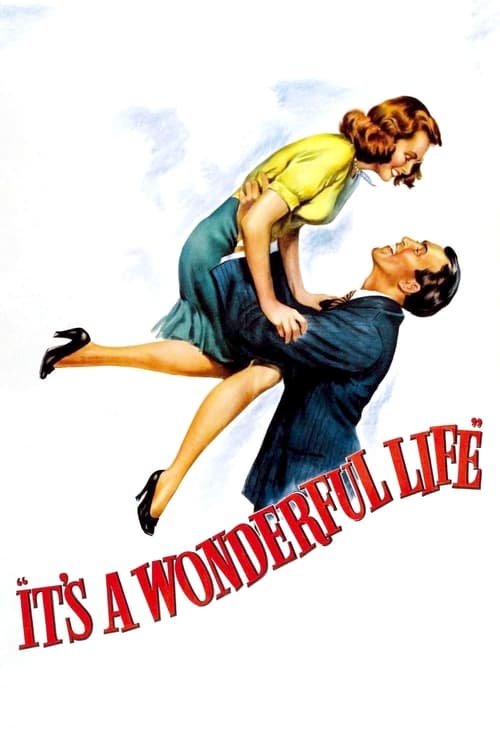
It's a Wonderful Life
1946 · Frank Capra
The definitive holiday-season pick for when you need a good cry that ends in genuine uplift — comfort viewing with real weight under it, best saved for a night when you can give in to it completely.
What it's about
George Bailey has spent his whole life in the small town of Bedford Falls, giving up his dreams of travel and adventure to keep his family's modest building-and-loan afloat — the one thing standing between the town and its richest, meanest man. When a catastrophic loss strikes on Christmas Eve, George is driven to the edge of despair, and help arrives from an unexpectedly heavenly direction.
The experience
Far darker and stranger than its cozy reputation — long stretches play like a story of dreams deferred and a good man grinding himself down — which is exactly why the warmth, when it comes, hits with overwhelming force. Yes, you will probably cry.
Performances
James Stewart, in his first role after the war, lets real desperation crack through his everyman charm — the raw panic and fury he brings to George's dark night is some of the bravest acting of the studio era.
The craft
Frank Capra's small-town Americana is rendered with astonishing texture and detail, and when the story turns bleak the film shifts into shadowy, near-noir territory that still startles first-time viewers. The black-and-white photography rewards a proper dark room and an uninterrupted sitting.
Why it matters
A commercial disappointment in 1946, it was resurrected decades later through television airings into the most beloved Christmas film in American culture — the rare flop that became a national ritual.
Snapshot
It's a Wonderful Life is Frank Capra's first postwar feature and the founding production of Liberty Films, the independent company he formed with William Wyler, George Stevens, and Samuel Briskin. Adapted from Philip Van Doren Stern's short story "The Greatest Gift," it follows George Bailey (James Stewart), a small-town man whose lifetime of thwarted ambitions and quiet self-sacrifice culminates, on a Christmas Eve of financial catastrophe, in a suicidal despair from which a bumbling angel rescues him by showing him a world in which he was never born. The film fuses Capra's Depression-era populism with a darker, near-noir vision of civic collapse, and it distills his career-long faith in the ordinary individual into its most personal and most shadowed statement. A commercial disappointment on release and shut out at the Academy Awards, it lapsed into the public domain in the mid-1970s, was rediscovered through relentless holiday television broadcast, and is now among the most beloved and canonical of all American films — the rare case where posthumous cultural reappraisal utterly reversed a film's contemporary fortunes.
Industry & production
The film was made at a hinge moment in Hollywood history: the brief window after World War II when major creative talent tried to break free of studio contracts and produce independently. Capra, returning from wartime service directing the Why We Fight series, co-founded Liberty Films precisely to control his own material. It's a Wonderful Life was Liberty's first and, as events unfolded, effectively defining project — its underperformance contributed to Liberty's financial strain and the company's subsequent absorption by Paramount, ending the independent experiment almost before it began.
The property had a long development history. Van Doren Stern, unable to place his story, printed it as a Christmas card in 1943; RKO bought the film rights and developed several screenplays — reportedly involving writers including Dalton Trumbo, Clifford Odets, and Marc Connelly — before abandoning the project and selling it to Capra. The final shooting script is credited to Frances Goodrich and Albert Hackett and Capra, with additional scenes by Jo Swerling; other writers, including Dorothy Parker, are commonly cited as having done polish work, though the precise division of authorship on such a heavily rewritten script is difficult to fix with certainty.
The production was distributed by RKO. It was shot largely in mid-1946, and the enormous Bedford Falls set — built on the RKO Encino Ranch, running several blocks with a long main street planted with real trees — was among the more ambitious standing sets of its era. A summer heat wave during filming reportedly forced Capra to suspend shooting on at least one day, an irony given the film's need to simulate deep winter. On release in late 1946 the film earned respectful but mixed notices and did not recoup its costs to the studio's satisfaction, entering history first as a well-regarded near-miss rather than a classic.
Technology
The film's most consequential technical contribution was its snow. Hollywood had long simulated snowfall with painted cornflakes, which crunched loudly underfoot and required dialogue to be dubbed later. For It's a Wonderful Life, RKO's special-effects department, led by Russell Shearman, developed a new chemical "snow" — a mixture built around foamite (fire-extinguisher foam), soap, water, and sugar — that fell more convincingly and, crucially, was quiet enough to allow live sound recording during snow scenes. The innovation earned a Class III technical citation from the Academy of Motion Picture Arts and Sciences and became an industry standard, one of the few tangible awards the production received.
Otherwise the film is a work of confident but conventional mid-1940s studio craft: black-and-white 35mm photography, optical effects for the celestial framing sequences (the twinkling "conversations" among the heavens rendered as pulsing points of light), and the large-scale set construction and controlled studio lighting that allowed the same Bedford Falls street to be transformed into the garish, degraded Pottersville of the unborn sequence.
Technique
Cinematography
The credited cinematography is principally Joseph Walker's — Capra's longtime collaborator across his Columbia classics — with Joseph Biroc also credited, reflecting a change of hands during the shoot. The photography moves deliberately between registers. The Bedford Falls scenes favor a warm, deep-focus classical clarity, with luminous close-ups of Stewart and Donna Reed. The film's most striking visual passage is the Pottersville nightmare, where the same locations are shot in harsh, high-contrast, noir-inflected style — rain-slicked streets, blaring signage, oppressive shadow — so that the town's moral degradation registers as a visual assault. This tonal split anticipates the way later filmmakers would use the vocabulary of film noir to figure a corrupted America.
Editing
Editing is credited to William Hornbeck, one of the era's most respected cutters. The film's structure poses a real editorial challenge: a long central flashback, narrated from a celestial vantage, that must compress George's entire life — childhood, adolescence, courtship, marriage, decades of frustration — into propulsive, emotionally legible movement before the single-night crisis that occupies the film's present tense. Hornbeck's cutting sustains momentum across these leaps in time while preserving the small behavioral beats on which Capra's sentiment depends. The film received an Academy Award nomination for its editing.
Mise-en-scène / staging
Capra stages for density of community. Bedford Falls interiors — the crowded Bailey Building and Loan, the Bailey home, Martini's bar, the high-school gym — are populated with overlapping bodies and cross-talk, so that George is perpetually hemmed in by the people he serves and cannot leave. The staging makes his entrapment physical: doorways, banisters, the drafty old Granville house he and Mary occupy. The single most famous staging coup is the high-school dance in which the gymnasium floor retracts to reveal a swimming pool beneath — filmed at Beverly Hills High School, whose gym actually possesses such a floor — dropping the dancing couple into the water in a set-piece of pure exuberance that the film later inverts into despair.
Sound
The chemical-snow innovation was itself a sound advance, permitting live recording where dubbing had previously been required, and the film's dense, overlapping dialogue — a Capra signature — depends on clean location-style sound. The picture earned an Academy Award nomination for its sound recording. The musical score is credited to Dimitri Tiomkin, though it is well documented that Capra rejected or replaced substantial portions of Tiomkin's work, substituting traditional songs and familiar cues; the finished soundtrack leans heavily on Christmas carols and standards such as "Auld Lang Syne" and "Buffalo Gals."
Performance
The performances anchor the film's reputation. James Stewart, in his first feature after wartime service as a bomber pilot, gives a performance of unusual rawness for its period — his George Bailey is not merely genial but frayed, angry, and frightened, and the descent into panic and self-loathing on Christmas Eve carries a psychological rawness that many contemporaries read, plausibly, as inflected by Stewart's own war experience. A frequently cited anecdote holds that during the barroom prayer scene Stewart began to weep unexpectedly, prompting Capra to enlarge and reframe the moment. Donna Reed grounds the film as Mary; Lionel Barrymore's Mr. Potter is one of American cinema's definitive misers; and the supporting ensemble — Thomas Mitchell's Uncle Billy, Henry Travers's angel Clarence, Beulah Bondi, Ward Bond, Frank Faylen, Gloria Grahame, and H.B. Warner as the grief-stricken druggist Gower — furnishes the thick communal texture the story requires. Stewart's performance received an Academy Award nomination.
Narrative & dramatic mode
The film's dramatic architecture is its boldest feature. It opens in a frame of prayer: unseen voices petition heaven on George's behalf, and the celestial powers dispatch the angel Clarence, briefing him — and us — through an extended flashback that constitutes most of the film. Only in the final act does the narrative reach its present-tense crisis and deploy its central conceit: Clarence grants George's despairing wish that he had never been born, and the film shifts into a counterfactual mode, showing Bedford Falls as Pottersville, a town deformed by George's absence. This "unlived life" device — the protagonist shown the aggregate value of his existence by witnessing the world without him — descends directly from Dickens's A Christmas Carol and its parade of might-have-beens, and the film's dark middle passage functions much as Scrooge's vision of a future does: as moral terror in service of redemption. The result braids fantasy, melodrama, social realism, and near-horror into a single arc.
Genre & cycle
It's a Wonderful Life sits at the intersection of several cycles. It is a Capra "populist comedy-drama" in the lineage of Mr. Deeds Goes to Town and Mr. Smith Goes to Washington, pitting the decent common man against concentrated wealth and cynicism. It is a fantasy film, with its angels and counterfactual world. It is, in its Pottersville sequence, adjacent to the film noir cycle then cresting in Hollywood, borrowing that mode's visual and moral vocabulary of urban corruption. And it became, retroactively, the archetypal Christmas film — though it is worth noting that its status as a fixed holiday perennial was a product of later television scheduling rather than of any generic intention at the time of release, when it was marketed as a major prestige drama rather than as seasonal entertainment.
Authorship & method
The film is inseparable from Capra, who called it, in effect, the picture he had been preparing his whole career to make, and who produced as well as directed it through Liberty. His method emphasized ensemble spontaneity, overlapping dialogue, many populated takes, and a close hands-on involvement across departments. His key collaborators recur from his Columbia years: cinematographer Joseph Walker (with Joseph Biroc completing the shoot); editor William Hornbeck; and the screenwriting team of Frances Goodrich and Albert Hackett, married co-writers known for polished character comedy and prestige literary adaptations, working alongside Capra himself and with additional scenes by Jo Swerling. Composer Dimitri Tiomkin received screen credit, though Capra's substantial revisions to the score complicate the question of musical authorship. The layered writing credits and the film's long, multi-author development history make it a genuinely collaborative object beneath its strong directorial signature.
Movement / national cinema
The film belongs to classical Hollywood at its zenith and, more specifically, to the short-lived postwar movement toward independent production by star directors. It is a distinctly American work — its subject is the American small town, the ideology of the local building-and-loan against the predatory bank, and a Jeffersonian faith in ordinary citizens — and it has often been read as an argument about what the nation had fought the war to preserve. That civic-populist reading has a documented political afterlife: a 1947 FBI memorandum notoriously flagged the film's demonization of the banker Potter as a possible instance of Communist influence in Hollywood, a reading that says more about the anxieties of the emerging Cold War and the coming blacklist era than about the film itself.
Era / period
Made in 1946, the film is saturated with the immediate postwar moment even as its story spans the 1920s through the Second World War. Its emotional undertow — the returning veteran, the deferred dreams, the fear that a life of duty has amounted to failure — speaks directly to an audience of demobilized servicemen and the families who waited for them. The Pottersville sequence's vision of a coarsened, commercialized America can be read as a postwar anxiety about the country's direction. That the film underperformed in 1946–47, in the same season that Wyler's The Best Years of Our Lives swept the Oscars and the box office with a more literal treatment of veterans' return, suggests audiences of the moment preferred their postwar reckoning in a realist rather than fantastical key.
Themes
The film's governing theme is the incalculable worth of an ordinary life measured not in achievement or wealth but in its web of effects on others — "no man is a failure who has friends." Around this cluster its major concerns: self-sacrifice and the tension between personal ambition and communal duty; the moral opposition between cooperative, human-scaled finance (the Building and Loan) and rapacious capital (Potter); the fragility of a decent community and its vulnerability to a single predatory actor; and, unusually for a film of its warmth, suicide, despair, and the sense of a wasted life, rendered with a seriousness that gives the eventual affirmation its weight. The counterfactual structure literalizes a philosophical claim — that value is relational and cumulative — turning an abstract idea about human interdependence into narrative spectacle.
Reception, canon & influence
Contemporary reception was respectful but divided; the film drew praise for Stewart's performance and Capra's craft alongside charges of sentimentality, and it failed to recoup its cost, contributing to Liberty Films' troubles. It received five Academy Award nominations — Picture, Director, Actor, Editing, and Sound — and won none of them in the competitive categories, taking only the technical citation for its snow effects.
Its backward influences are legible: the redemptive counterfactual owes an obvious debt to Dickens's A Christmas Carol, and its populist confrontation of common man and plutocrat continues Capra's own 1930s cycle. Its forward legacy is enormous and, unusually, a product of accident. When the copyright was not renewed in the mid-1970s, the film entered the public domain, and television stations — able to broadcast it without licensing fees — aired it incessantly at Christmas throughout the late 1970s and 1980s. This saturation, not its original release, made it a holiday institution and steadily elevated its critical standing; a later reassertion of rights (tied to the underlying story and music, and to the legal landscape around derivative works following the Supreme Court's Stewart v. Abend decision) eventually curtailed the free broadcasts, by which point the film's canonization was complete. The American Film Institute placed it high on its lists of the greatest American films and named it the most inspiring American film of all time. Its "what if I had never been born" premise has become one of the most imitated narrative devices in television and film, endlessly reprised as holiday-episode homage. Few films illustrate so starkly that a work's place in the canon can be made long after its makers have stopped listening for the verdict.
A Deleuzian reading
Remember the floor that opens.
The full Deleuzian reading of It's a Wonderful Life →
Reception
A box-office disappointment in 1946 that helped sink Capra's Liberty Films, it went 0-for-5 at the Oscars — then a lapsed copyright in 1974 let TV stations air it for free every December, and endless holiday reruns turned a flop into THE Christmas movie.
How It's a Wonderful Life was received, from release to now →
How to watch It's a Wonderful Life: what to notice on a first viewing
- Watch how many people crowd every interior George enters. Capra fills the Building and Loan, Martini's bar, and the Bailey home with overlapping bodies and cross-talk, so George is never alone. The staging makes George's civic entrapment physical, not just emotional.
- Watch the high-school gym floor when the dancing starts. The floor retracts to reveal a swimming pool, and the couple keeps dancing before they tumble in, laughing, with half the town after them. The scene is pure comic exuberance, with the whole town crowding the frame.
- Watch Stewart's hands when George is under pressure. Stewart plays George as frayed and quick to panic, not simply genial, carrying a rawness many trace to his own wartime service. This grounds the film's warmth in real strain rather than easy sentiment.
- Listen to how many people talk over each other at once. Capra records dense, overlapping dialogue across crowded scenes, made possible by new chemical snow quiet enough for live sound. The overlapping talk is what makes Bedford Falls feel inhabited rather than staged.
- Track how fast the film jumps through George's childhood and youth. Hornbeck's editing compresses decades of frustration and small choices into a handful of quick, legible scenes before slowing down for one night. The speed shows a whole life accumulating before the single crisis that will test it.
The whole guide to watching It's a Wonderful Life, with the keys for a rewatch →
Influences: the films it descends from and the films it influenced
- A Christmas Carol (Scrooge) (1938) — Supplies the core dramaturgy Capra retools: a supernatural chaperone marches a despairing man through visions of consequence — the guided counterfactual as an engine of redemption — which the film converts from 'past/future' to 'a world where you never existed.'
- Mr. Deeds Goes to Town (1936) — Establishes Capra's populist grammar of common-man-versus-plutocrat and the sentimental-idealist tonal register ('Capracorn') that Bailey-versus-Potter directly extends.
- You Can't Take It With You (1938) — Rehearses the crowded-household staging — overlapping dialogue and many-bodied 'populated takes' with cross-talk running under the principals — that gives the Bailey home and Building & Loan their community density.
- Mr. Smith Goes to Washington (1939) — Templates the James Stewart idealist-pushed-past-breaking performance, including the strangled, near-hysterical vocal register Capra draws on again in the bridge-and-bar breakdown.
- Meet John Doe (1941) — Builds its climax on the despairing everyman poised to jump — Capra's dry run for staging suicide as the emotional fulcrum of a populist fable, resolved by collective human intervention.
- Here Comes Mr. Jordan (1941) — Popularizes the celestial-bureaucracy framing device — heavenly functionaries in the clouds auditing an earthly life — that Capra adopts as the film's opening conceit and Clarence's dispatch.
- Citizen Kane (1941) — Codifies the deep-focus, staging-in-depth compositions (foreground-to-background action in single sustained frames) that Joseph Walker deploys for the Building & Loan and gymnasium crowd scenes.
- A Guy Named Joe (1943) — Extends the guardian-spirit device — a benevolent unseen agent shepherding a mortal toward the right choice — the wartime precedent for Clarence's earthbound apprentice-angel.
- The Phantom Carriage (1921) — Reproduces the redemptive-vision device — a supernatural guide walking a despairing man through the consequences of his life on a single fateful night to effect moral rescue.
- Remember the Night (1940) — Consolidates the Hollywood Christmas-redemption picture that Remember the Night helped set in motion — the seasonal frame as an engine for moral accounting and earned grace.
- Wings of Desire (1987) — Inverts and deepens the Clarence conceit — angels who observe, envy, and finally choose mortal ordinary life — extending the film's angel's-eye argument for the sensory worth of the everyday.
- Back to the Future Part II (1989) — Literalizes noir-inflected Pottersville as Biff's neon casino-dystopia Hill Valley — the counterfactual 'wrong-timeline' town rendered in the same lurid, tilted register as Capra's alternate Bedford Falls.
- Mr. Destiny (1990) — Near-remake of the never-born device: a supernatural stranger shows a man how a single altered choice reshapes every life around him, then returns him grateful to his actual existence.
- Groundhog Day (1993) — Extends the redemptive-fantasy mechanism — a cynic supernaturally compelled to relearn the value of an ordinary small town and its people — swapping the counterfactual glimpse for the repeated day.
- The Family Man (2000) — Directly revives the counterfactual-unlived-life: an angelic agent grants a 'glimpse' of the domestic life the protagonist forfeited, structurally mirroring George's tour of the road not taken.
- The Majestic (2001) — A self-conscious Capra pastiche — small-town civic gathering, populist idealism, and a Stewart-styled everyman restored to community — reconstructing the film's staging and tone as homage.
- The Adjustment Bureau (2011) — Secular-providential intervention — a low-ranking agent of fate sent to redirect a despairing everyman — the warm 'love-as-providence' resolution Nolfi's third act reaches for.
- The Truman Show (1998) — Built the idealized small-town Americana of total benevolent surveillance — a life secretly watched and curated from above — that Gassner's designed-utopia set both quotes and inverts.
- After Life (1999) — The Japanese title's explicit nod to Capra signals the borrowed structural device of distilling a whole life down to its single defining, meaning-bearing memory.
- Dogma (1999) — The angel-dispatched-to-earth intervention structure and bureaucratic Heaven, which Dogma inverts: angels who exploit a doctrinal loophole rather than earn their wings.
- Liar Liar (1997) — Supplies the foundational structure of a supernatural intervention forcing a flawed man to confront his failings, plus the unembarrassed sentimental redemptive machinery Liar Liar deploys around its star.
- Back to the Future (1985) — Supplies the alternate-timeline-town template — Pottersville's nightmare version of Bedford Falls is the direct structural model for the biff-ruled 'Hell Valley,' one changed life rewriting a whole small town's face.
- The Best Years of Our Lives (1946) — Shares the postwar-independent (Liberty/Goldwyn) mode, Toland-school deep focus, and ensemble small-town Americana of returning veterans — the same 1946 grammar of civilian community reassembling itself.
- Sullivan's Travels (1941) — Runs the parallel machinery of overlapping-dialogue populism toward the same thesis reversal — the worth of ordinary lives — via a protagonist stripped of status and shown the value of the common crowd.
- The Bishop's Wife (1947) — Immediately reprises the dispatched-angel-fixes-a-good-man's-crisis structure, with Dudley as Clarence's polished studio twin intervening in an earthly life at Christmas.
- Faraway, So Close! (1993) — Ancestor of the benevolent-supernatural-intercessor structure: a celestial figure descending into a man's earthly crisis, the redemptive-guardian template the angel diptych secularizes.
- Gintama: The Final Chapter - Be Forever Yorozuya (2013) — Supplies the exact narrative armature the film's plot borrows — a despairing hero shown a bleak alternate world in which he never existed, so his absence measures his worth to the 'found family' left behind.
- Scrooge (1951) — Independently deploys the same supernatural guided life-review structure — a despairing man shown his past and a counterfactual future to earn redemption through grief.
Similar films
- Citizen Kane (1941) — influence & lineage · often watched together
- The Best Years of Our Lives (1946) — influence & lineage
- Mr. Smith Goes to Washington (1939) — influence & lineage
- Groundhog Day (1993) — influence & lineage · same viewing thread
- Scrooge (1951) — same viewing thread
- The Shop Around the Corner (1940) — same viewing thread
- Meet Me in St. Louis (1944) — shared sensibility
- The Purple Rose of Cairo (1985) — shared sensibility
All the films related to It's a Wonderful Life →
Watch it with: curated runs of related films
- Grace in the Dead of Winter — A run of cold-season films where a lonely or cynical soul, snowbound and nearly out of hope, stumbles into connection — watch them across one dark week.