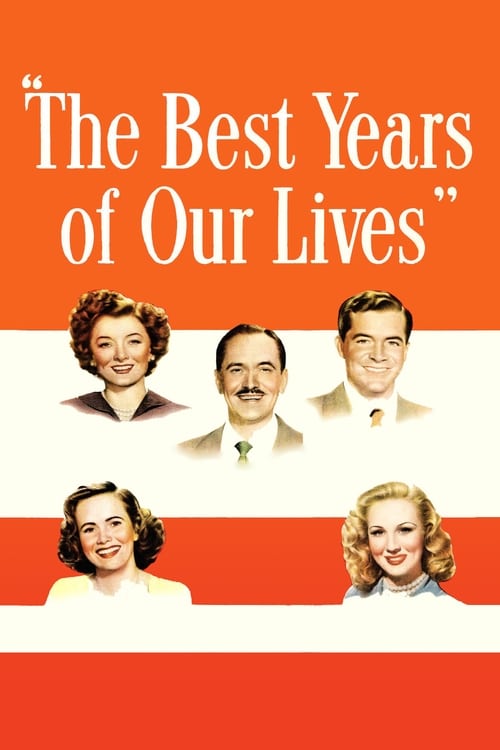
The Best Years of Our Lives
1946 · William Wyler
For when you want a big, humane drama to sink into — the kind that makes you cry without ever feeling manipulated. A film to watch when you want to feel that movies can be wise.
What it's about
Three servicemen fly home to the same Midwestern city after World War II: a middle-aged sergeant returning to his bank job and a family that grew up without him, a decorated bombardier coming back to a hasty wartime marriage and no job prospects, and a young sailor who lost both hands and dreads his sweetheart's pity more than anything the war did to him. The film follows the three of them, and the women in their lives, through the messy business of actually coming home.
The experience
Warm, wrenching, and startlingly honest — it takes its time (nearly three hours) and earns every minute, moving between tenderness, humor, and scenes of quiet devastation. Few films are this generous to every character on screen.
Performances
Harold Russell, a real veteran who lost both hands in the war and had never acted, gives one of the most moving performances in American film — he won two Oscars for it. Fredric March and Myrna Loy make middle-aged married love more romantic than most films manage with newlyweds.
The craft
Gregg Toland's deep-focus photography keeps whole rooms of people sharp at once, so you watch reactions ripple across a family instead of being told where to look. Wyler, just back from the war himself, directs with documentary-level honesty about drinking, nightmares, and money. The famous aircraft-graveyard sequence is worth the runtime alone.
Why it matters
It swept the 1947 Academy Awards, became one of the biggest hits of the postwar era, and remains the benchmark every film about veterans coming home is measured against.
Snapshot
The Best Years of Our Lives is the great American film about coming home from a war that the nation had already decided to celebrate. Released in late 1946, barely a year after V-J Day, it follows three servicemen — a middle-aged infantry sergeant turned bank executive, a working-class Air Force bombardier, and a young sailor who has lost both hands — as they return to the same Midwestern city and discover that demobilization is its own kind of campaign. Produced by Samuel Goldwyn, directed by William Wyler (himself just back from the war), photographed by Gregg Toland, and written by Robert E. Sherwood, it swept the 1947 Academy Awards and became one of the largest commercial successes of the postwar period. Nearly eighty years on it remains the touchstone against which films about veterans' reentry are measured: sober, unsentimental about institutions, and almost documentary in its attention to the texture of ordinary rooms.
Industry & production
The film originated not with a director but with a producer's instinct. Samuel Goldwyn, working as an independent releasing through RKO, is generally credited with seizing on the subject of returning veterans as both a national concern and a commercial opportunity; the commonly repeated account holds that he was struck by a 1944 magazine item about marines struggling to readjust to civilian life. He commissioned the novelist MacKinlay Kantor to develop the material. Kantor delivered, unusually, a novella written in blank verse titled Glory for Me — a form that Goldwyn found unwieldy and that was subsequently reworked into a conventional screenplay by Robert E. Sherwood, the Pulitzer-winning playwright and former Roosevelt speechwriter.
Wyler came to the project freshly demobilized. He had served as a major in the Army Air Forces and directed the combat documentary The Memphis Belle (1944), an experience that cost him much of his hearing and gave him a personal stake in the subject of men reentering civilian life. The collaboration reunited Wyler with Goldwyn, for whom he had made several prestige pictures in the late 1930s (Dodsworth, Wuthering Heights, The Little Foxes), and with cinematographer Gregg Toland. The production was lavish by Goldwyn's standards and the finished film ran roughly three hours — an exceptional length for the era that the studio nonetheless backed.
Commercially the gamble paid off spectacularly. The film was among the top-grossing releases of its time, frequently described as the most successful American film since Gone with the Wind; precise period grosses for films of this vintage are unreliable, so the safest statement is that it was an enormous and somewhat unexpected popular hit for a long, serious drama. Critically and within the industry it was equally dominant, taking seven competitive Academy Awards — Best Picture, Director, Actor, Supporting Actor, Screenplay, Film Editing, and Original Score — plus an honorary award and the Thalberg Award to Goldwyn.
Technology
Technologically the film is conservative and deliberately so. It was shot in black-and-white on standard 35mm at the Academy ratio, at a moment when Goldwyn could easily have afforded Technicolor. The monochrome was an aesthetic choice that suited the film's documentary plainness and Toland's preference for deep, hard-edged imagery. The decisive "technology" of the picture is optical rather than novel: Toland's use of fast lenses, small apertures, and heavy lighting to achieve great depth of field, a technique he had pushed furthest on Citizen Kane (1941). There is no process trickery foregrounded here, no spectacle of the apparatus — the innovation is in service of an almost invisible realism.
Technique
Cinematography
Gregg Toland's photography is the film's most studied technical achievement. Working in deep focus, Toland keeps foreground and background simultaneously sharp so that dramatic events can unfold across the full depth of a shot without cutting. The most celebrated instance is the drugstore sequence in which Homer's confrontation plays in the foreground while, far back across the store, Fred is seen in a phone booth — two crises composed within a single frame, the viewer left to distribute attention. The approach allies Toland's craft with Wyler's preference for the long take and the full shot over montage, producing images dense with simultaneous information. The visual register is restrained: available-light naturalism, few showy angles, a refusal of glamour even for Virginia Mayo and Teresa Wright. It was this work that the critic André Bazin would canonize as the model of a cinema that respects spatial reality.
Editing
Daniel Mandell's editing, which won the Academy Award, is notable precisely for its self-effacement. Because Wyler and Toland staged so much in depth and in sustained takes, the cutting tends to hold rather than fragment, letting scenes breathe to their full emotional length — the film's three-hour running time is partly a function of this patience. Mandell's contribution is one of rhythm and restraint, knowing when to stay on a wide two- or three-shot and let performance and staging carry the meaning rather than imposing pace through cutting.
Mise-en-scène / staging
This is the dimension Bazin singled out. Wyler's method places actors at varying distances within a deep, sharply rendered space and choreographs their movement so that blocking itself becomes the storytelling — who stands near whom, who turns away, who is framed small in the background. The homecoming sequences, the cramped domestic interiors, the bank, the nightclub run by Hoagy Carmichael's Butch: each is staged so that the social and emotional architecture is legible in the arrangement of bodies. Bazin's famous reading is that this style is "democratic," handing interpretive freedom to the viewer rather than dictating reaction through the cut.
Sound
The sound design is unobtrusive and realist, anchored in dialogue and ambient space, with Hugo Friedhofer's score used sparingly. Wyler's own war-acquired deafness has often been read into his sensitivity to the subjective experience of damaged senses, though this is interpretation rather than documented intent. The film's restraint with music — long stretches play unscored — heightens the documentary plainness and makes the score's entrances, particularly around Homer and in the closing wedding, register more strongly.
Performance
The acting ensemble is the film's emotional engine, and its boldest stroke was casting Harold Russell, a real Army veteran who had lost both hands in a training accident, as Homer Parrish. Russell was not a professional actor; his unaffected presence and the literal reality of his hooks give the film an authenticity no performance could simulate, and the scenes of him managing daily tasks — and of his fiancée Wilma helping him prepare for bed — carry documentary weight. Fredric March won Best Actor as the wry, drinking banker Al Stephenson; Dana Andrews gives perhaps the film's most quietly devastating turn as Fred Derry, the decorated bombardier reduced to a soda-fountain job. Myrna Loy and Teresa Wright supply the domestic ballast, and Virginia Mayo plays the faithless wife. Russell remains the only performer to win two Academy Awards for a single role — a competitive Supporting Actor award and an honorary award voted by the Board of Governors, the latter reportedly given because the Academy doubted he would win the competitive category.
Narrative & dramatic mode
The film's structure is a braided triptych: three returning men whose lives intersect on the journey home and continue to cross thereafter. Rather than building toward a single climax, it tracks parallel readjustments — Al's uneasy return to banking and family, Fred's collapsing marriage and economic humiliation, Homer's struggle to accept love despite his injury — and lets them rhyme against one another. The dramatic mode is realist domestic drama, episodic and observational, privileging small humiliations and accommodations over melodramatic incident. Its emotional climaxes are deliberately modest in scale: a man weeping in a junked bomber, a wedding at which two damaged lives quietly commit to one another. The screenplay, drawn from Sherwood's theatrical instincts, favors extended dialogue scenes and ensemble interplay, and trusts the audience to register social criticism — about banks, about the economy's failure to absorb its heroes — without underlining.
Genre & cycle
The Best Years of Our Lives sits at the head of the postwar "returning veteran" cycle, a body of late-1940s American films preoccupied with demobilization, readjustment, and the anxieties beneath the victory. It overlaps the social-problem film and the prestige drama, and its undercurrents of disillusion and economic threat connect it tonally to the noir sensibility coloring American cinema in the same years, even as its surface remains a warm humanist drama. Where wartime Hollywood had mobilized morale, this film belongs to the moment of reckoning that followed, and it effectively defined the template — three contrasting servicemen, a shared hometown, the gulf between homecoming fantasy and reality — that later veteran films would inherit.
Authorship & method
The dossier's authorship is genuinely collaborative, the product of a strong producer, a meticulous director, and an exceptional below-the-line team. William Wyler is the controlling intelligence: famous as a demanding perfectionist ("Forty-Take Wyler"), he extracted naturalistic performances through sheer repetition and favored a depth-staged, long-take style that subordinated technique to behavior. His personal war experience lends the project its felt authority. Gregg Toland supplied the deep-focus photography that made the style possible; the Wyler–Toland partnership is one of the era's defining director–cinematographer collaborations, and Toland would die only a couple of years later, making this among his last major works. Robert E. Sherwood shaped Kantor's verse novella into a literate, socially observant screenplay. Hugo Friedhofer composed the Oscar-winning score, an Americana-inflected work admired for its restraint. Daniel Mandell edited. Samuel Goldwyn, finally, must be counted an author of the project in the producer's sense — the subject, the scale, and the commitment to a difficult three-hour drama were his.
Movement / national cinema
The film is a product of the Hollywood studio system at its zenith, made just before the antitrust and television pressures of the late 1940s began to erode that system. It belongs to no formal movement, yet its style became a central exhibit in the international theorization of cinematic realism. Through Bazin and the critics of Cahiers du cinéma, Toland and Wyler's deep-focus, long-take aesthetic was positioned as an alternative to Soviet-derived montage and as kin to the spatial realism that French critics simultaneously prized in Italian neorealism — itself emerging in the same postwar years out of a comparable impulse to film social reality plainly. The film is thus a distinctly American work that became a touchstone in a transnational debate about what realism in cinema could be.
Era / period
Few films are so precisely the document of their moment. Made and set in the immediate aftermath of the Second World War, it captures the specific texture of late-1946 America: the housing shortage, the scramble for jobs, the wartime marriages strained by years of separation, the GI Bill and the banks' wariness of lending, the awkward coexistence of national triumphalism and private dislocation. It also carries the period's anxieties about the next war — Fred and others voice fears that the peace is fragile — and a quiet skepticism toward the institutions that profited while soldiers fought. As social history it is nearly as valuable as it is as drama.
Themes
At its center is the theme of homecoming as loss as much as return — the recognition that the men who left are not the men who come back, and that the homes they left have changed too. Around this radiate several others: the wound, literal in Homer and psychological in Fred, and the labor of accepting and being accepted with it; class, in the contrast between Al's executive comfort and Fred's precarious working-class footing; the failure of the economy and of institutions to honor wartime sacrifice; the strain and repair of marriage; masculinity remade by trauma and dependence. The film resists easy uplift — its hopefulness, voiced in the closing wedding, is explicitly qualified by Fred's warning to Peggy that they face hard, poor years ahead.
Reception, canon & influence
Critically the film was received as a major and serious achievement and was embraced by audiences on a scale rare for a drama of its length and gravity; its Academy sweep confirmed its standing as the prestige picture of its year. Its most consequential afterlife in criticism came through André Bazin, whose late-1940s writings on Wyler treated the film's mise-en-scène and depth of field as exemplary of a realist cinema that grants freedom to the spectator — an argument that helped shape postwar film theory and the politique of Cahiers du cinéma.
Its influences run backward to the social-realist and prestige-drama traditions of 1930s Hollywood that Wyler himself had helped build with Goldwyn, and to the documentary sensibility Wyler and Toland brought home from their war service. Forward, its legacy is the entire subsequent lineage of American films about veterans' return and the costs of war — the readjustment dramas that followed in the late 1940s and, in spirit, the post-Vietnam reckonings of Coming Home (1978), The Deer Hunter (1978), and Born on the Fourth of July (1989), all of which inherit its central insight that the war's true subject is the homecoming. Harold Russell's casting prefigured later movements toward authentic representation of disability on screen, and the film is routinely cited among the finest American films, preserved in the National Film Registry. It endures because it refused the easy ending its moment invited, and chose instead to look steadily at the difficult years it knew were coming.
A Deleuzian reading
Three of them ride home in the glass nose of a bomber — the one place on the aircraft built for nothing but looking down.
The full Deleuzian reading of The Best Years of Our Lives →
Reception
A colossal hit in 1946 — it swept seven Oscars and out-grossed everything since Gone with the Wind — then spent decades tagged as worthy middlebrow before being reappraised as startlingly honest about PTSD and coming home, decades before anyone had the vocabulary for it.
How The Best Years of Our Lives was received, from release to now →
Influences: the films it descends from and the films it influenced
- Citizen Kane (1941) — Gregg Toland's wide-angle deep-focus photography here — coated lenses, stopped-down apertures, ceilinged sets keeping foreground and deep background equally sharp — is the exact optical toolkit Toland carried into Best Years' simultaneous-plane staging.
- The Long Voyage Home (1940) — Toland's expressionist deep-focus and his practice of lighting for full depth on a single coordinated stage directly prefigure the Wyler–Toland method of letting an entire room read in one shot.
- The Grapes of Wrath (1940) — Toland's documentary-inflected deep-focus realism applied to American social hardship establishes the sober, location-grounded prestige-realist register Best Years extends to the homecoming subject.
- The Little Foxes (1941) — Wyler and Toland choreograph foreground/background tension in one unbroken deep-focus frame (the famous staircase) — the morally weighted depth-staging Best Years reuses to hold characters in the same shot.
- Grand Illusion (1937) — Renoir's deep-space camerawork granting the spectator freedom to scan the frame is the Bazinian realist lineage Best Years was canonized as the Hollywood exemplar of.
- Mrs. Miniver (1942) — Wyler and Toland's answer in the same grammar stripped of diffusion — domestic space as where war is metabolized, with the refusal to cut away pushed further (Homer's hands, the phone booth held in deep background behind the piano).
- The Heiress (1949) — Wyler continues his depth-staged, long-take chamber method, blocking emotional power shifts within a single sustained interior frame as in Best Years.
- The Deer Hunter (1978) — Inherits the structural insight that the war film's true subject is the fractured return, devoting its long final movement to homecoming-as-loss rather than combat.
- Anatomy of a Murder (1959) — Wyler and Toland demonstrate that deep-focus long-take staging can sustain dramatic performance across wide social ensembles without editorial intervention — the compositional patience and temporal trust Preminger adopts for the trial's extended two-shots and group exchanges.
- Ikiru (1952) — Toland and Wyler's systematic deployment of deep-focus photography to embed characters within institutional space — background relationships carrying equal visual weight to foreground action — directly informs Nakai's compositions burying Watanabe in the geometry of files, desks, and subordinates.
- From Here to Eternity (1953) — Wyler's multi-strand novelistic pacing across three parallel soldier stories — edited without melodramatic urgency over 172 minutes — and Gregg Toland's deep-focus location naturalism are the direct formal precursors to Zinnemann's four-strand Hawaii narrative and Guffey's documentary-inflected cinematography.
- High and Low (1963) — Wyler's deep-focus ensemble staging across differentiated spatial planes in widescreen directly informs Kurosawa's sustained apartment sequences, where Gondo, his family, and the police simultaneously occupy legible depth zones without cutting — the dossier names Wyler explicitly as the source.
- The Human Condition I: No Greater Love (1959) — Gregg Toland's deep-focus staging deployed across a long-form postwar reckoning, layering foreground and background action so social pressure is composed into the frame rather than cut to.
- Bridge of Spies (2015) — Postwar conscience cinema staged in patient deep-focus two-shots, the classical-Hollywood blocking of moral conversation that Spielberg's restrained two-shot negotiation scenes deliberately echo.
- Ben-Hur (1959) — Wyler's deep-focus, long-take dramaturgy developed with Gregg Toland — staging actors in layered planes so a single uncut frame carries the drama — is the intimate technique he transplants onto the epic's vast sets.
- Brothers (2004) — Founding template of the returning-veteran reintegration drama — the awkward homecoming, the marriage and household realigned around a man presumed changed or lost.
- Roman Holiday (1953) — Wyler-Toland deep-focus, performance-centered staging in long takes — keeping actors in sustained spatial relationships within the frame — the directorial method he carries into Roman Holiday with Planer and Alekan.
- The Last Picture Show (1971) — Wyler and Toland's deep-focus staging of multiple overlapping ensemble lives in long takes, without cutting to isolate, models Picture Show's group-blocked naturalism.
- Dead End (1937) — Earliest major Wyler–Toland collaboration, building action in stacked planes across a single large set — the depth-staging grammar later refined in Best Years' drugstore and home interiors.
- Wuthering Heights (1939) — Wyler's long-take, repetition-driven direction with Toland's soft deep-focus monochrome cemented the director–cinematographer partnership and the 'subordinate technique to behavior' approach of Best Years.
- The Rules of the Game (1939) — Renoir's depth-staging — multiple simultaneous actions in deep space within a long take — is the European realist model Bazin used to theorize exactly what he praised in Wyler's mise-en-scène.
- Greed (1924) — Stroheim's uncompromising long-form realist domestic drama, refusing melodramatic relief, is the ancestor of Best Years' commitment to extended, unflinching everyday observation.
- Pride of the Marines (1945) — Immediate sibling in the returning-veteran cycle, dramatizing a blinded combat veteran's readjustment with the same insistence that the war's real subject is the difficult homecoming.
- Till the End of Time (1946) — Contemporaneous sibling braiding several discharged servicemen's reentry stories — the same multi-protagonist readjustment-drama structure released the same year.
- The Men (1950) — Extends Harold Russell's authenticity precedent by casting real paraplegic veterans alongside Brando and shooting in an actual VA hospital — direct descendant of the disability-representation and non-professional-casting move.
- Bicycle Thieves (1948) — Neorealist sibling sharing the non-professional casting and observational realist-domestic register that Bazin theorized across both, prizing duration and spectator freedom over montage manipulation.
- Touch of Evil (1958) — Welles pushes the Toland-derived deep-focus long take to its virtuoso extreme, descending from the same simultaneous-plane staging principle Best Years institutionalized.
- Coming Home (1978) — Post-Vietnam descendant inheriting the paralyzed-veteran homecoming as central drama, its restrained domestic realism tracing directly to Best Years' Russell-rooted disability portrait.
- Born on the Fourth of July (1989) — Late descendant centering a wheelchair-using veteran's embittered readjustment, extending the disability-and-trauma homecoming lineage Best Years originated.
- It's a Wonderful Life (1946) — Shares the postwar-independent (Liberty/Goldwyn) mode, Toland-school deep focus, and ensemble small-town Americana of returning veterans — the same 1946 grammar of civilian community reassembling itself.
Similar films
- The Deer Hunter (1978) — influence & lineage
- The Long Voyage Home (1940) — influence & lineage
- The Little Foxes (1941) — influence & lineage
- Mrs. Miniver (1942) — shared sensibility
- All Quiet on the Western Front (1930) — shared sensibility
- Saving Private Ryan (1998) — shared sensibility
- It's a Wonderful Life (1946) — shared sensibility
- Forrest Gump (1994) — shared sensibility
All the films related to The Best Years of Our Lives →