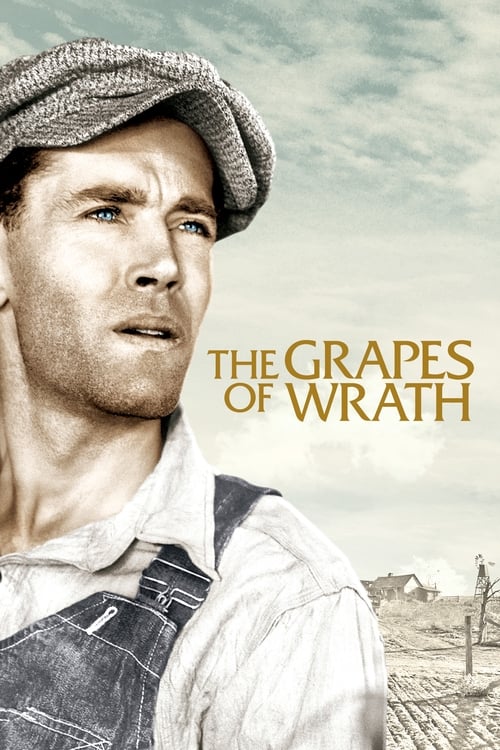
The Grapes of Wrath
1940 · John Ford
For when you want a film with moral weight — a good cry that leaves you steadier, not wrecked, and a reminder of what dignity under pressure looks like. A demanding watch, but a deeply nourishing one.
What it's about
Tom Joad comes home from prison to find his family thrown off their Oklahoma farm by drought and bank foreclosure. The Joads pile everything they own onto a truck and head west on Route 66 toward California, chasing handbills that promise picking work — and finding, at each stop, what those promises are actually worth. It's the story of one family trying to stay whole while everything built to break them.
The experience
Grave, humane, and quietly furious — it moves at the pace of the road, hardship after hardship, but it's lit by the family's stubborn decency. Expect a lump in your throat more than once; it earns every bit of it.
Performances
Henry Fonda's Tom Joad is one of the defining American screen performances — plain-spoken, coiled, slowly waking up to injustice — and Jane Darwell, as Ma Joad, is the film's unbreakable heart.
The craft
John Ford and cinematographer Gregg Toland shot it like documentary photography of the Dust Bowl — stark, shadowed black-and-white faces that look carved out of the era itself. Adapted from Steinbeck's incendiary novel barely a year after it was published, it kept a startling amount of the book's anger for a big studio picture.
Why it matters
The definitive Hollywood film of the Great Depression, proof that a major studio could take on a politically explosive bestseller and make popular art from it; Fonda's closing words entered the American vocabulary.
Snapshot
The Grapes of Wrath is the most enduring American film made directly from the social wreckage of the Great Depression, and it remains the rare studio production that translated a controversial, recently published, politically incendiary novel into a work of broad popular and critical acclaim without wholly defanging it. Adapted by Nunnally Johnson from John Steinbeck's 1939 Pulitzer Prize-winning novel and produced by Darryl F. Zanuck at Twentieth Century-Fox, the film follows the Joad family — Oklahoma tenant farmers dispossessed by drought, mechanization, and bank foreclosure — on their migration west to California along Route 66, chasing handbills that promise work that does not exist. Henry Fonda plays Tom Joad, newly paroled from prison, and Jane Darwell plays Ma Joad, the family's moral and emotional center. Photographed by Gregg Toland in a stark, low-key documentary idiom and directed by John Ford with characteristic restraint and compositional gravity, the film won Ford the Academy Award for Best Director and Darwell the award for Best Supporting Actress. It stands as a landmark of Hollywood social realism, a high point in Ford's career, and one of the films most often cited when critics argue that the studio system was capable of genuine political seriousness.
Industry & production
The film was a Twentieth Century-Fox production driven personally by Darryl F. Zanuck, the studio's head of production, who purchased the screen rights to Steinbeck's novel for a reported sum in the range of $75,000 — a figure widely cited in the historical literature, though one should treat exact dollar amounts with some caution. The purchase was itself a gamble: the novel had been banned and burned in parts of the country, denounced as Communist propaganda by agricultural interests in California and Oklahoma, and was the subject of organized political hostility. Zanuck reportedly hired investigators to confirm that conditions in the migrant camps were as dire as Steinbeck described, in part to protect the studio against accusations of falsehood. Production proceeded under a degree of secrecy, with a working title used to deflect attention.
The adaptation was entrusted to Nunnally Johnson, a Fox staff writer and producer whose screenplay compresses Steinbeck's sprawling narrative and, crucially, reorders its ending. Ford was assigned to direct; he came to the project fresh from a remarkable run that included Stagecoach, Young Mr. Lincoln, and Drums Along the Mohawk, all released in 1939. The film was shot largely on the Fox lot and on locations in the American Southwest, with a second-unit and location work used to lend authenticity to the highway journey. The production is often discussed as an example of the studio system operating at its most efficient and its most ambitious simultaneously: a major star vehicle, a prestige literary adaptation, and a piece of topical social commentary, all delivered within the controlled industrial conditions of a major studio. The Production Code and the political sensitivities surrounding the material shaped what could be shown, and the film notably softens or omits the novel's harsher language and its more explicit radicalism.
Technology
The Grapes of Wrath was made with the standard professional apparatus of late-1930s Hollywood: 35mm black-and-white film, optical sound recording, and studio-standard cameras and lighting. What distinguishes it technologically is less any novel apparatus than the expressive use of existing tools, particularly in the domain of low-light cinematography. Gregg Toland, working at the leading edge of the era's emulsion and lens technology, exploited faster film stocks and careful exposure control to shoot scenes with minimal fill light, allowing large areas of the frame to fall into deep shadow. This was a period of rapid advance in film stock sensitivity and lens coating, and Toland — who would the following year photograph Citizen Kane — was among the cinematographers most aggressively testing the limits of what the medium could register in darkness. The film's reliance on practical-seeming sources (a candle, a single bulb, headlights, firelight) reflects both an aesthetic choice and a technical capability that had only recently become reliable.
Technique
Cinematography
Gregg Toland's photography is the film's most celebrated formal achievement and one of the touchstones of American black-and-white cinematography. Working in a low-key, high-contrast register, Toland repeatedly stages action in near-darkness, with figures lit by a single visible source and the surrounding space swallowed in shadow. The famous sequence in which Tom returns to the abandoned, wind-scoured family home and talks with the half-deranged Muley is lit so that faces emerge from blackness, an approach that aligns the film with the documentary photography of the Farm Security Administration — the work of Dorothea Lange and Walker Evans — as much as with Hollywood convention. Toland favors stable, frontal, often slightly low compositions that monumentalize the Joads, lending the migrant poor a dignity and statuary weight. The deep, planar staging and willingness to let the frame go dark anticipate the deep-focus experiments Toland would push further in Citizen Kane the next year, though here the effect is more austere than baroque.
Editing
The film was edited by Robert L. Simpson. The cutting is classical and unobtrusive, organized around the forward momentum of the journey and the clarity of Ford's staging; Ford was famously economical in shooting, providing editors with limited coverage and effectively cutting the film in the camera, which gave the finished work its disciplined, inevitable rhythm. The montage of the highway — signposts, the jalopy laboring west, the procession of the dispossessed — uses associative cutting to generalize the Joads' particular plight into a national movement of people, a technique indebted to the documentary tradition.
Mise-en-scène / staging
Ford's staging consistently subordinates the individual to the group and to the land. Interiors are cramped, low-ceilinged, crowded with bodies; exteriors are vast, flat, and emptying. The director repeatedly frames the family in doorways and windows — thresholds that mark departure and dispossession — and arranges the Joads in tableaux that recall both religious painting and Depression-era photojournalism. The government camp at Weedpatch, with its order and decency, is staged in deliberate contrast to the squalor and menace of the privately run camps, a visual argument made through space and arrangement rather than dialogue.
Sound
The film's sound design is restrained and largely realist, but it is anchored by Alfred Newman's use of the folk tune "Red River Valley," played on accordion, as a recurring motif. The melody threads through the film as a kind of vernacular American lament, binding the score to the world of the characters rather than imposing an external symphonic commentary. Newman's sparing approach — long stretches play with ambient sound and silence — reinforces the documentary austerity of the images.
Performance
Henry Fonda's Tom Joad is one of the defining performances of his career and of American screen acting in the period: contained, watchful, slow to anger, and capable of a banked intensity that erupts only at the film's climactic moments. Fonda underplays, trusting stillness and the camera's proximity. Jane Darwell's Ma Joad is the film's emotional keystone, a performance of weathered endurance that the Academy recognized with a Best Supporting Actress award; her quiet management of grief — burning keepsakes before the journey, holding the family together by force of will — gives the film its moral spine. John Carradine brings a haunted lyricism to the ex-preacher Casy, and the supporting ensemble, drawn from Ford's stock company and Fox's contract players, lends the migrant world a lived-in texture.
Narrative & dramatic mode
The film operates as a social-realist road narrative organized around a journey that is at once geographic, economic, and moral. Its dramatic mode fuses the intimate family chronicle with the broader sweep of a collective ordeal, so that the Joads function simultaneously as particular characters and as representatives of a displaced people. The screenplay's most consequential intervention is structural: where Steinbeck's novel ends on the bleak, ambiguous image of Rose of Sharon nursing a starving stranger, Johnson and Zanuck reorder events so that the film concludes with the family leaving the relative safety of the government camp and with Ma Joad's affirming "we're the people" speech. This rearrangement shifts the narrative from despair toward a guarded, populist hopefulness, and it has been the central point of scholarly debate about the adaptation — whether it constitutes a betrayal of Steinbeck's vision or a legitimate translation into a different, more affirmative register. Tom Joad's famous farewell to Ma — his "I'll be all around in the dark" speech — provides the film's ideological climax, transmuting personal vengeance into a diffuse promise of collective solidarity.
Genre & cycle
The Grapes of Wrath belongs to the cycle of Hollywood social-problem films that flourished in the 1930s, pictures that engaged directly with unemployment, poverty, labor, and injustice — a cycle that includes works like I Am a Fugitive from a Chain Gang and the more sentimental populism of Frank Capra. Within that cycle it is among the most unflinching, and it also reaches back toward the rural American epic and forward toward the postwar tradition of location-based realism. It is not a Western, yet it is unmistakably a Ford film about Americans moving across the land, and it shares with his Westerns a preoccupation with the family, the journey, community, and the dispossessed. The film helped consolidate a strain of literary-prestige adaptation at Fox and demonstrated that topical social material could be commercially viable when filtered through star casting and classical form.
Authorship & method
The film is the product of an unusually strong convergence of authorial sensibilities. John Ford directs with the compositional monumentality and emotional reticence that define his mature style; his Catholic sense of family, ritual, and endurance shapes the Joads into something close to a sacred community, and his preference for staging over cutting gives the film its sculptural stillness. Ford reportedly approached the material as a story about people rather than a political tract, and his instinct for sentiment and dignity, rather than ideology, governs the result. Gregg Toland, the cinematographer, is arguably the film's co-author, his low-key realism providing the visual grammar through which Ford's humanism is expressed; the collaboration is frequently cited as one of the great director-cinematographer pairings of the era. Nunnally Johnson, the screenwriter and an associate producer on the film, performed the delicate work of compression and political modulation, preserving the novel's emotional force while blunting its hardest edges. Alfred Newman supplied the spare, folk-rooted score. And Darryl F. Zanuck, the producer, exercised decisive creative authority — the reordered ending is generally attributed to him — making this one of the clearest cases in which a studio producer functioned as a genuine shaping author. The film is thus best understood not as the unmediated expression of a single artist but as a controlled negotiation among Ford's humanism, Toland's realism, Johnson's craftsmanship, and Zanuck's commercial and political calculation.
Movement / national cinema
The film is a central document of American social realism within the studio system, and it sits at the intersection of Hollywood classical style and the documentary impulse of the New Deal era. Its visual kinship with Farm Security Administration photography ties it to a broader national project of representing the rural poor, and its sensibility resonates with the documentary work of Pare Lorentz, whose government films The Plow That Broke the Plains and The River addressed the same ecological and economic catastrophe. Internationally, the film's austere realism and its sympathy for the dispossessed connect it loosely to the currents of 1930s social cinema abroad, and it is frequently cited as a precursor and acknowledged influence on Italian neorealism, whose practitioners admired its location-rooted treatment of ordinary lives — though the film remains, in its construction and gloss, fully a product of Hollywood rather than of any oppositional movement.
Era / period
The Grapes of Wrath is inseparable from its immediate historical moment: the tail end of the Great Depression and the Dust Bowl, the New Deal, and the labor struggles of the 1930s. Released in 1940, on the eve of American entry into the Second World War and at the close of one of the most extraordinary years in Hollywood history, it captures a nation still reckoning with economic catastrophe even as the world order was about to be remade. The film's populist faith in ordinary people and its implicit endorsement of New Deal institutions — the clean, democratically self-governed government camp is the film's image of hope — locate it firmly within the political imagination of the Roosevelt era. Coming at the end of Ford's astonishing run of 1939–1940 productions, it also marks a particular peak of confidence and craft in the classical studio system.
Themes
The film's governing themes are dispossession and endurance: the loss of land, home, and economic security, and the human capacity to survive it through family and solidarity. It dramatizes the collision between an older agrarian order and the impersonal forces of finance and mechanization — the bank and the tractor as faceless agents of ruin — and it mourns the severing of people from the land they have worked. Family, and specifically the maternal principle embodied in Ma Joad, is presented as the last durable institution when economic and social structures fail. The film moves toward a theme of widening solidarity: Casy's evolving folk theology of one big human soul, and Tom's final dedication of himself to the struggle of the dispossessed wherever it occurs, transmute private grief into collective commitment. Dignity in poverty is asserted throughout, both thematically and formally, in the visual ennoblement of the migrant poor. Underlying it all is a tension, never fully resolved, between despair at systemic injustice and a populist faith in the resilience and ultimate vindication of "the people."
Reception, canon & influence
On release, The Grapes of Wrath was met with substantial critical acclaim and was widely regarded as a serious, even courageous, achievement for a major studio, though it also drew predictable political hostility from those who found its sympathies dangerous. It was recognized at the Academy Awards with the Best Director prize for Ford and Best Supporting Actress for Jane Darwell, and it received multiple additional nominations including Best Picture; the precise tally is part of the well-documented record of that ceremony. Over time it has settled firmly into the canon of American cinema, regularly appearing on institutional lists of the greatest American films and selected in 1989 in the first group of titles inducted into the Library of Congress's National Film Registry.
The influences on the film flow from several directions: Steinbeck's novel and the broader tradition of Depression literature; the documentary photography of the FSA and the government films of Pare Lorentz; and Ford's own evolving body of work, with its preoccupation with family, community, and the American landscape. Toland's contemporaneous experiments in low-key and deep-focus cinematography draw on the technical advances of the period.
The film's forward influence is considerable. It became a model for socially engaged American filmmaking and a benchmark against which later films about poverty and labor would be measured. Toland's work here fed directly into the deep-focus revolution he helped consummate in Citizen Kane the following year. The film is frequently named as an influence on Italian neorealism and on the postwar international turn toward location realism. Henry Fonda's Tom Joad became an enduring cultural icon, his final speech echoing through American political and popular culture for generations — most famously in Woody Guthrie's "Tom Joad" and, decades later, in Bruce Springsteen's "The Ghost of Tom Joad," a measure of how thoroughly the film fixed Steinbeck's character in the national imagination. As a demonstration that Hollywood could marry commercial form to social conscience, The Grapes of Wrath remains a continual point of reference in debates about American cinema's political possibilities.
A Deleuzian reading
Tom Joad walks into a house with no one in it.
The full Deleuzian reading of The Grapes of Wrath →
Reception
No reappraisal arc needed — it was consecrated on arrival, winning Ford his second Best Director Oscar and Jane Darwell one for Ma Joad, and it's never really left the canon. If anything the modern shift is viewers noticing how much gentler and more hopeful it is than Steinbeck's furious novel.
How The Grapes of Wrath was received, from release to now →
Influences: the films it descends from and the films it influenced
- Sunrise (1927) — Ford absorbed Murnau's Fox-studio pictorial monumentality — the sculptural, lyrical staging of figures against landscape that gives the Joads their hieratic stillness rather than cut-driven kineticism.
- The Crowd (1928) — Established the American social-realist subordination of the individual to the anonymous mass — Ford's 'group-over-individual' framing of the Joads as one cell in a migrant tide descends from Vidor's treatment of the worker as crowd-member.
- Our Daily Bread (1934) — Vidor's Depression-era cooperative-farm drama supplied the template of communal endurance and collective labor that Ford reworks into the Joads' sacred-community ethos.
- The Informer (1935) — Ford's own prior experiment in expressionist low-key lighting, fog, and Catholic moral atmosphere is the immediate authorial precedent for the chiaroscuro humanism Toland systematizes here.
- The Plow That Broke the Plains (1936) — Lorentz's New Deal documentary fixed the Dust Bowl iconography — eroded land, dispossessed farmers, folk-rooted scoring — that the film's FSA-derived visual grammar and Alfred Newman's spare folk leitmotifs directly echo.
- Dead End (1937) — Toland's earlier social-problem collaboration with Wyler rehearsed the deep planar staging and tenement realism — actors arranged across foreground-to-background depth — that he brings to the Joad interiors.
- The River (1938) — Lorentz's associative-montage poetics of land and dispossession, with incantatory folk narration, model the film's documentary-realist sympathy and its rhythmic, image-driven sense of an exodus.
- I Am a Fugitive from a Chain Gang (1932) — Turns first-person social testimony into commercially viable moral indictment via documentary-hard lighting (Toland) — the poor destroyed by an economic system, the studio social-conscience picture at its apex.
- Citizen Kane (1941) — Toland carried the deep-focus and low-key innovations rehearsed for Ford into their full consummation the next year, where foreground-to-infinity sharpness becomes the film's defining formal device.
- How Green Was My Valley (1941) — Ford extends the identical method — doorway-threshold framing, group-over-individual staging of a laboring family, and elegiac communal ritual — onto a Welsh mining village.
- The Ox-Bow Incident (1943) — Inherits the studio social-problem film's marriage of commercial form to moral argument, using Fonda's restrained underplaying as the conscience-figure pioneered by his Tom Joad.
- Rome, Open City (1945) — Italian neorealism's postwar turn to location realism, nonprofessional-feeling performance, and the dignity of the poor is repeatedly traced back to this film as a Hollywood precursor.
- The Best Years of Our Lives (1946) — Toland reunites his deep-focus social realism with Wyler, staging ordinary postwar Americans in long-held deep-planar compositions — the technique matured directly out of the Joad cycle.
- Bicycle Thieves (1948) — Carries forward the social-realist journey structure of a poor man and his family moving through an indifferent economy, with the affirmative-humanist closing gesture De Sica learned from this strain of American realism.
- My Darling Clementine (1946) — Ford and Fonda extend the Tom Joad register of reticent underplaying and the silhouetted doorway-threshold composition into the Western, the same authorial signature of staging-over-cutting.
- Bound for Glory (1976) — A direct lineal heir — it dramatizes Woody Guthrie's Dust Bowl migration (the same Okie exodus, and Guthrie wrote 'Tom Joad' from the film), translating the FSA-photographic look into golden-hued Steadicam realism.
- Nomadland (2020) — Revives the social-realist road journey of economic dispossession, blending nonprofessional performers with landscape in a documentary register and the same reordered-toward-endurance ending that affirms community over despair.
- To Kill a Mockingbird (1962) — Gregg Toland's low-key monochrome, explicitly modeled on Walker Evans and Dorothea Lange's FSA photography, establishes the visual register Harlan consciously inherits to ground Mockingbird's Depression-era Maycomb in documentary moral authority rather than studio artifice.
- The Treasure of the Sierra Madre (1948) — Ford and Toland's adaptation of a literary moral fable into a three-phase journey — departure, struggle, systematic stripping of hope — without sentimentalizing the outcome provides the structural blueprint Huston follows, including the restraint of ending on ironic wide distance rather than cathartic close-up.
- El Norte (1983) — Nava explicitly adapted Ford's three-part journey structure — dispossession in the homeland, the crossing, exploitation in the promised land — including the ironic inversion that arrival merely transforms the migrants' subjugation rather than ending it.
- Wuthering Heights (1939) — Toland's contemporaneous low-key, deep-focus cinematography for Wyler is the parallel laboratory in which he was developing the same realist lighting grammar he deploys for Ford.
- Sullivan's Travels (1941) — Sturges directly answers the film's social-conscience mode, staging a Dust Bowl-style boxcar-and-breadline sequence that quotes Ford-Toland's documentary realism to interrogate Hollywood's capacity for it.
- Mr. Smith Goes to Washington (1939) — Gregg Toland's deep-focus documentary-texture cinematography — mixing studio work with authentic American location footage to anchor New Deal populism in real geography — directly extends the visual strategy Capra and Walker established for Washington in Mr. Smith, applied to a more politically radical subject.
- The Long Voyage Home (1940) — The same-year Ford–Toland pairing applies identical low-key naturalist chiaroscuro to a folk odyssey, the twin experiment in Ford's poetic monochrome vein.
- High Sierra (1941) — Toland's deep-focus staging of dispossessed migrant families around jalopies and roadside camps is imported almost intact for the Goodhue family, whose scenes carry the Depression film's environmental argument into a gangster picture.
Similar films
- My Darling Clementine (1946) — influence & lineage · often watched together
- How Green Was My Valley (1941) — influence & lineage
- The Ox-Bow Incident (1943) — influence & lineage
- Rome, Open City (1945) — influence & lineage · often watched together
- Stagecoach (1939) — often watched together
- The Man Who Shot Liberty Valance (1962) — often watched together
- Five Easy Pieces (1970) — often watched together
- Wagon Master (1950) — shared sensibility
All the films related to The Grapes of Wrath →