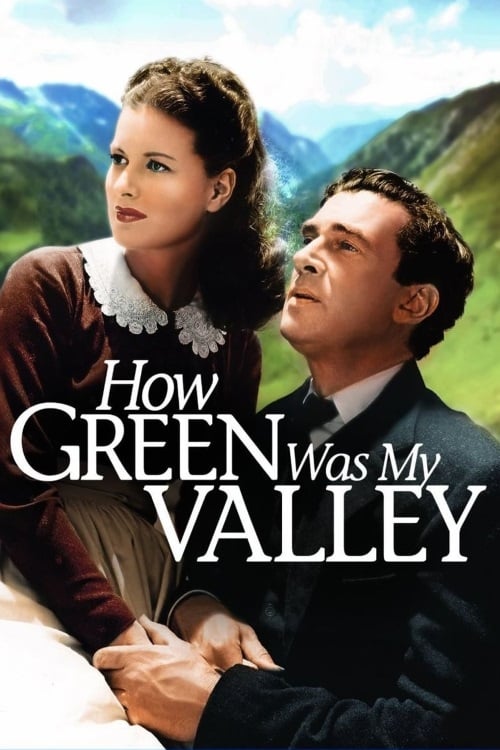
How Green Was My Valley
1941 · John Ford
For a rainy Sunday when you want a good cry and a film that feels like being told a family story — comfort with an ache in it, about home, memory and what progress takes away.
What it's about
A grown man looks back on his boyhood in a Welsh coal-mining village at the turn of the twentieth century: a big, proud family of miners ruled by a warm mother and a stern, loving father, a chapel, a schoolroom, and a valley slowly darkening. When a strike divides the sons from their father, it's the first crack in a way of life the film watches dissolve, marriage by marriage, departure by departure.
The experience
Warm, wistful and openly sentimental in the best sense — it wraps you in hymn-singing and kitchen-table ritual, then keeps landing small, honest losses. It leaves you homesick for a place you've never been.
Performances
Young Roddy McDowall is remarkably unaffected as Huw, and Donald Crisp and Sara Allgood give the parents such lived-in warmth and gravity that the household feels like one you grew up in.
The craft
Ford built an entire Welsh village on a California hillside and shoots it in luminous black and white, framing doorways, processions and the pit-head like remembered pictures. The narration-over-memory structure and the constant Welsh choral singing give it the texture of an elegy. It's studio-era craft at full power.
Why it matters
It swept the 1942 Oscars, famously beating Citizen Kane to Best Picture — a result that has shadowed its reputation ever since, though it stands among John Ford's most personal and affecting work.
Snapshot
How Green Was My Valley is John Ford's elegiac adaptation of Richard Llewellyn's 1939 best-selling novel, a memory-film narrated by the grown Huw Morgan looking back on a Welsh coal-mining village and the slow dissolution of his family and community across the turn of the twentieth century. Produced by Darryl F. Zanuck at 20th Century-Fox, it is at once a domestic chronicle — strikes, marriages, a chapel, a schoolroom, a kitchen ruled by a beloved mother and a stern, loving father — and a lament for a vanishing way of life, structured entirely as recollection. Its enduring notoriety rests partly on the 1942 Academy Awards, where it won Best Picture, Best Director, Best Supporting Actor, Best Cinematography, and Best Art Direction, famously defeating Citizen Kane. That outcome has shadowed the film's reputation ever since, but the picture stands on its own as one of Ford's most fully realized works: a study of community, memory, and loss rendered with deep-focus monochrome grandeur and an almost liturgical sense of rhythm.
Industry & production
The film was a major prestige undertaking at 20th Century-Fox under production chief Darryl F. Zanuck. Llewellyn's novel had been a publishing sensation, and the studio's initial ambitions were correspondingly large: early development envisioned a long, possibly four-hour Technicolor epic, with William Wyler attached at one stage during preparation. The combination of escalating costs and the outbreak of war in Europe — which foreclosed any possibility of location shooting in Wales and constricted budgets and running times — forced a substantial rethink. The project was scaled down, shot in black and white, and ultimately handed to John Ford, who delivered it as a roughly two-hour studio production.
Because Wales itself was inaccessible, the production built an entire Welsh mining village — terraced houses, the colliery, slag tip, and chapel — as a standing exterior set in the Santa Monica Mountains north of Los Angeles. This constructed valley, designed by art director Richard Day, became one of the film's defining assets, allowing Ford to stage the community as a coherent physical world rather than a series of disconnected backlot fragments. Philip Dunne wrote the screenplay, compressing Llewellyn's sprawling chronicle into a tighter arc organized around Huw's coming of age and the family's fracturing. The picture was released in 1941 to strong reviews and went on to its sweep at the 14th Academy Awards in early 1942, where Ford collected his third Best Director Oscar.
Technology
The film was photographed in 35mm black-and-white at a moment when deep-focus cinematography — sharp rendering of foreground and background within the same frame — was a live technical and aesthetic preoccupation in Hollywood, the same year as Citizen Kane. Cinematographer Arthur C. Miller achieved depth and tonal richness through hard, controlled lighting and careful staging rather than flamboyant optical trickery, exploiting fast film stock and the precision of studio control. The decision to forgo Technicolor — driven by wartime economics rather than purely artistic preference — proved fortuitous: monochrome suits the film's coal-dust world and its mood of remembrance far better than color would have, lending the imagery a graphic, almost engraved quality. The artificial valley set itself was a feat of physical production technology, engineered so that the colliery, the village street, and the surrounding hills could be photographed convincingly across seasons and times of day.
Technique
Cinematography
Arthur C. Miller's Oscar-winning photography is among the film's chief glories. He composes the village in deep, legible space — figures arranged in the foreground against the receding terrace of houses and the looming pithead — and lights interiors, especially the Morgan kitchen, with a warmth that makes the hearth the moral center of the frame. Exteriors carry a contrasting severity: the black slag heap creeping toward the green hillside is a recurring visual figure for industrial encroachment. Miller's work is notable for restraint; the camera tends to hold and observe rather than chase, trusting composition and light to carry emotion. The grading from luminous, idealized early scenes to darker, more shadowed later passages mirrors the narrative's movement from communal wholeness toward dispersal and grief.
Editing
Edited by James B. Clark, the film is structured as a chain of remembered episodes rather than a tightly causal plot, and the cutting respects that elegiac, anthological rhythm. Scenes are allowed to breathe, often built around ceremonies and gatherings — meals, weddings, chapel singing, paydays at the kitchen table. Transitions frequently lean on Huw's narration to bridge ellipses of time, and the editing favors continuity and emotional accumulation over montage bravura. The result is a measured tempo that can feel processional, accruing weight through repetition and return rather than acceleration.
Mise-en-scène / staging
Ford's staging is the film's deepest signature. He organizes the community spatially and ritually: the men marching home from the pit, the family ranged around the dinner table in fixed hierarchy, the congregation filling the chapel. Doorways, thresholds, and the village street recur as framing devices, and Ford repeatedly stages the family as a tableau — bodies arranged to express the order, and later the disintegration, of the household. The valley set permits an unusually convincing sense of a whole society in physical relation to its labor: home, chapel, and mine are always visibly part of one landscape. This integration of domestic interior and industrial exterior is central to the film's meaning.
Sound
Music and the human voice carry exceptional weight. Welsh choral singing functions almost as a structural element, the community expressing itself collectively through hymn and song; the men's voices rising as they walk to and from the colliery is one of the film's defining sonic motifs. Alfred Newman's score weaves around and supports this choral material rather than overpowering it. Layered above everything is the retrospective narration of the adult Huw, an unseen voice that frames the entire film as memory and lends it the cadence of recollection — wistful, valedictory, addressed from a present in which the green valley is already gone.
Performance
The ensemble performance is unusually cohesive, in keeping with the film's communal subject. Donald Crisp won the Academy Award for Best Supporting Actor as Gwilym Morgan, the father — a portrait of patriarchal authority tempered by tenderness and ultimately by tragedy. Sara Allgood, as the mother Beth Morgan, anchors the household with fierce warmth and earned an Oscar nomination. The young Roddy McDowall, as Huw, gives a remarkably composed child performance that holds the film's perspective. Walter Pidgeon plays the minister Mr. Gruffydd with grave restraint, and Maureen O'Hara, as the daughter Angharad, brings a charged intensity to the film's central thwarted romance. The casting of largely non-Welsh actors (with players of Irish and other backgrounds) is a period compromise, but the performances are pitched toward a unified emotional register rather than dialect verisimilitude.
Narrative & dramatic mode
The film's defining formal choice is its retrospective, first-person frame: the entire story is the adult Huw's memory, narrated as he prepares to leave the valley for good. This casts everything in the past tense of loss before a single dramatic event unfolds, suffusing even happy scenes with elegy. The mode is episodic and chronicle-like rather than driven by a single propulsive conflict; it accumulates incidents — a strike, a marriage, deaths in the mine, Angharad's loveless match, Huw's schooling and beating, the sons' emigration — into a portrait of gradual erosion. Dramatic tension arises less from suspense than from the inexorability of decline: we watch a whole world come apart, knowing from the framing voice that it cannot be recovered. The sentiment is openly avowed, and the film does not shy from pathos, but its emotional architecture is disciplined by Ford's formal control.
Genre & cycle
How Green Was My Valley sits at the intersection of the family melodrama, the social-problem drama, and the literary prestige adaptation that Hollywood cultivated in the late 1930s and early 1940s. It shares the period's appetite for adapting serious best-sellers into awards-caliber productions, and it engages — through the strike, the union question, and the dangers of the mine — with the social-consciousness strain of the era's filmmaking, though it ultimately subordinates politics to family feeling and nostalgia. As a memory-film about the loss of an organic community, it also belongs to a broader cultural cycle of pastoral elegy for pre-industrial or pre-modern ways of life. Within Ford's own output it prefigures the elegiac communal portraiture he would deepen across his career.
Authorship & method
The film is a meeting point of strong authorial sensibilities. John Ford, by 1941 already a multiple Oscar winner, brought his abiding preoccupations — family, community, ritual, memory, the dignity of ordinary labor, and the ache of things passing — to material that suited him perfectly. His method favored economical shooting, strong compositional instincts, and trust in his collaborators and cast; the film's processional rhythm and tableau staging are recognizably his. Cinematographer Arthur C. Miller, one of Fox's finest, was a frequent and crucial Ford collaborator in this period, and the deep, sculpted monochrome is as much his achievement as Ford's. Composer Alfred Newman, head of Fox's music department, integrated Welsh choral tradition into the film's fabric. Editor James B. Clark shaped the episodic structure into a flowing whole. Screenwriter Philip Dunne performed the essential act of compression, distilling Llewellyn's long novel into a focused dramatic line while preserving its retrospective frame. Producer Darryl F. Zanuck drove the project as a prestige vehicle and made the decisive, war-shaped choices — black-and-white, reduced scope, Ford as director — that defined the film that exists. Art director Richard Day built the world.
Movement / national cinema
This is a product of the Hollywood studio system at its most polished — a Fox prestige picture made entirely on American soil, with a largely American and Irish cast portraying a Welsh community. It is therefore not an artifact of any Welsh or British national cinema but a Hollywood reconstruction of one, an instance of the studio system's capacity to manufacture a convincing foreign world from a constructed set and an act of imaginative empathy. That said, its sympathetic treatment of working-class community and industrial labor aligns it loosely with the social-realist currents stirring in 1930s–40s cinema internationally, even as its idiom remains thoroughly Hollywood. The "Welshness" it presents — choral, chapel-centered, proud — is a romanticized literary and cinematic construction rather than a documentary one.
Era / period
Released in 1941, on the eve of American entry into the Second World War, the film arrived at a moment when Hollywood was both reaching new technical heights and turning toward themes of community, home, and shared values. Its very production circumstances — the abandonment of Technicolor and location shooting because of the war in Europe — mark it as a wartime-shaped artifact. Its nostalgia for a stable, cohesive community carried particular resonance for audiences facing the upheavals of 1941. The film also belongs to a high-water moment in black-and-white deep-focus aesthetics, sharing 1941 with Citizen Kane and standing as evidence that the period's interest in spatial depth and expressive monochrome extended well beyond a single landmark.
Themes
At its heart the film is about memory and irrecoverable loss — the green valley of the title is already gone, blackened by the slag of industry, by the time Huw recounts it. Family and community cohesion is the central value, embodied in the Morgan household and the chapel, and the drama traces its slow fragmentation: sons leaving for America and elsewhere, deaths in the mine, the corrosion of the strike's divisions, Angharad's sacrifice of love to propriety. Labor and its dignity and danger run throughout, as does the tension between solidarity and the father's caution about the union. Religion and the moral authority of the chapel — and its capacity for hypocrisy and cruelty, as in the treatment of Angharad — form another major strand. Above all the film is suffused with a conservative, elegiac sentiment: the past as a lost wholeness, education and emigration as both opportunity and the very forces that scatter the community. Coming of age, the passage from innocence to experience, threads it all together through Huw's eyes.
Reception, canon & influence
The film was received as a major prestige achievement on release and triumphed at the 14th Academy Awards, winning Best Picture, Ford's third Best Director, Donald Crisp's Best Supporting Actor, Arthur Miller's Best Cinematography, and Best Art Direction, with further nominations including Sara Allgood and the score. Its victory over Citizen Kane has become one of the most-cited episodes in Oscar history, frequently invoked as a parable of the Academy's preference for accessible warmth over formal radicalism. That framing has been somewhat unfair to the film, which has at times been reduced to "the movie that beat Kane"; serious critical reassessment has restored appreciation for it as a fully achieved work of Fordian art on its own terms.
Looking backward, the film draws on Llewellyn's novel and on the literary tradition of the regional and family chronicle, as well as on Hollywood's established prestige-adaptation machinery and the social dramas of the 1930s. Its choral and communal texture reflects a romantic literary image of Welsh life. Looking forward, it consolidated and advanced Ford's elegiac mode — the loving, ritualized portrait of community and its passing — that would echo through his later work and influence subsequent memory-films and nostalgic community dramas. It demonstrated the expressive power of constructed environments and integrated choral sound, and it remains a touchstone in debates about sentiment versus formalism in film art. Within the canon it endures as both a beloved, much-revisited classic and a perennial subject of the "was the right film honored?" argument — a sign of how firmly it has lodged in film history.
A Deleuzian reading
The men come up out of the mine at the end of a shift, faces black with coal, and they are singing.
The full Deleuzian reading of How Green Was My Valley →
Reception
A huge prestige hit in 1941 — it swept five Oscars including Best Picture — but it's spent the decades since as 'the film that beat Citizen Kane,' with each generation of Ford devotees mounting a rescue mission to argue it's a masterpiece on its own terms.
How How Green Was My Valley was received, from release to now →
Influences: the films it descends from and the films it influenced
- Sunrise: A Song of Two Humans (1927) — Established the Fox prestige model of the wholly constructed studio environment paired with a lyrical, emotion-keyed camera that Ford's built-from-scratch valley set and elegiac mood directly inherit.
- Man of Aran (1934) — Romanticized a labor community bound by elemental work and ritual; Ford (an avowed Flaherty admirer) borrows this reverent dignifying of the miners' communal toil rather than dramatizing it as social problem.
- The Informer (1935) — Ford's earlier studio-bound, fog-stylized atmosphere and his integration of a continuous musical/choral score into mood prefigure the Welsh choral fabric and constructed-set expressionism here.
- Young Mr. Lincoln (1939) — Codifies Ford's tableau composition and processional staging of folk Americana ritual, the exact compositional grammar later transposed onto the Welsh village's communal gatherings.
- The Grapes of Wrath (1940) — The immediate precursor: an episodic family chronicle of labor and dispossession rendered in deep, sculpted monochrome, carrying forward the dignity-of-labor theme one year before.
- The Long Voyage Home (1940) — Ford transposes the elegiac enclosed-community mood, chiaroscuro interiors, and exile-nostalgia voice-over into another stylized non-Western memory piece.
- The Magnificent Ambersons (1942) — Builds an elegiac chronicle of a family and town's passing around retrospective narration and a processional sense of decline, the same backward-mourning structure deployed a year later.
- My Darling Clementine (1946) — Extends the processional rhythm, threshold-doorway framing, and the communal-ritual set piece (the church-floor dance) into Ford's Western elegy for a forming community.
- I Remember Mama (1948) — Directly inherits the retrospective first-person narration framing an immigrant family's life as a warm sequence of recalled episodes, the memory-frame device made explicit.
- The Quiet Man (1952) — Carries Ford's Celtic communal choral texture and idealized constructed-pastoral village into a nostalgic homecoming, completing the elegiac-community mode begun in the Welsh valley.
- The Last Picture Show (1971) — A consciously Fordian elegy in deep monochrome for a small town's vanishing communal life, using threshold framing and the rhythm of ritual to mourn a passing world.
- The Tree of Wooden Clogs (1978) — An ensemble chronicle of a peasant labor community across episodic seasons that dignifies ordinary work and shared ritual, secularizing Ford's reverence for communal labor.
- Days of Heaven (1978) — Frames a lyrically photographed world of agricultural labor through a retrospective child-narrator's recollection, extending the memory-voice-over over a vanished working landscape.
- Hope and Glory (1987) — A wartime childhood memory-frame with retrospective narration recalling family and neighborhood, applying the looking-back structure of recalled community to the home front.
- Distant Voices, Still Lives (1988) — The most direct heir: a working-class family memory-film structured by communal singing as integrated choral sound, frozen tableau staging, and retrospective recollection, by a director who openly venerates Ford's film.
- To Kill a Mockingbird (1962) — Arthur C. Miller's monochrome cinematography and Ford's adult male voiceover narrating an idealized boyhood community's dissolution establishes the form's central grammar: low-angle child-height framing of a looming adult world filtered through retrospective elegy, which Mulligan and Kim Stanley's narration inherit wholesale.
- if.... (1968) — Ford's compositional technique of filming collective ceremony — chapel assembly, processional — in wide-angle long shots that invest institutional ritual with mythic gravity is echoed in Anderson's treatment of the school chapel and Combined Cadet Force parade.
- The Fabelmans (2022) — The film literally invokes Ford's horizon-line doctrine (dramatized in the Lynch cameo)—interesting is 'the horizon at the bottom or the top,' the compositional discipline of pinning the horizon high or low to charge the frame, which becomes Sammy's parting inheritance.
- Citizen Kane (1941) — The contemporaneous rival shares the deep-focus sculpted monochrome of the moment and structures a life through a retrospective memory frame, making it the formal counter-case in the sentiment-vs-radicalism debate.
- Meet Me in St. Louis (1944) — A nostalgic memory-film assembled as a seasonal episodic chronicle of one close family, with song integrated into communal life and warm tableau framing of the home.
Similar films
- The Grapes of Wrath (1940) — influence & lineage
- My Darling Clementine (1946) — influence & lineage
- Citizen Kane (1941) — influence & lineage
- The Magnificent Ambersons (1942) — influence & lineage
- The Tree of Wooden Clogs (1978) — influence & lineage
- The Last Picture Show (1971) — influence & lineage
- Distant Voices, Still Lives (1988) — influence & lineage
- The Long Voyage Home (1940) — shared sensibility
All the films related to How Green Was My Valley →