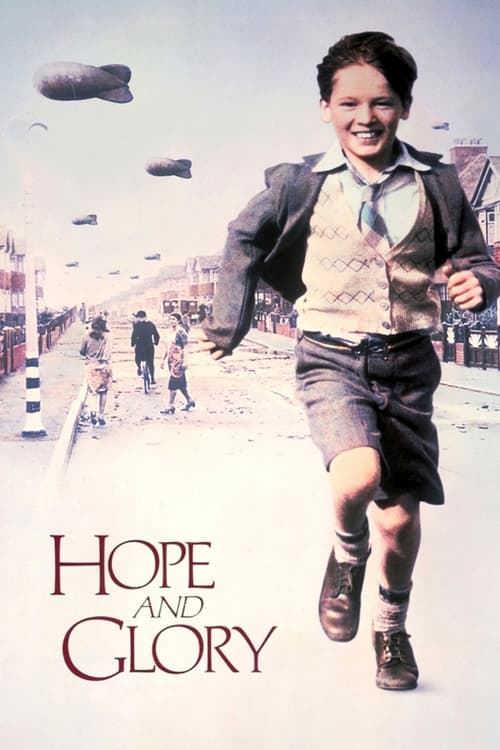
Hope and Glory
1987 · John Boorman
For a nostalgic Sunday-afternoon watch that's smarter than it looks — when you want family-friendly warmth with a genuine idea underneath, comfort with an aftertaste.
What it's about
Nine-year-old Bill Rohan is growing up in suburban London when the Second World War arrives — and to his amazement, it's the best thing that's ever happened to him. Schools get blown up, bomb sites become playgrounds, and the adult world's rules come loose, all while his mother holds a family together on the home front. It's John Boorman's own childhood, remembered with startling honesty about how catastrophe felt from below.
The experience
Warm, funny, and quietly subversive — a war film that keeps catching you smiling at things you feel you shouldn't smile at. It flows like memory: episodic, golden-hued, tinged with loss the boy can't see but you can.
Performances
Sebastian Rice-Edwards is wonderfully unaffected as Bill, and Sarah Miles gives the film its emotional spine as a mother improvising through the Blitz with more spirit than the stiff-upper-lip tradition usually allows.
The craft
Boorman rebuilds an entire wartime suburban street to stage his memories, and the scale pays off — the Blitz here is tactile, domestic, seen from doorsteps and garden fences rather than cockpits. The writing has an autobiographical specificity you can't fake: it earned Oscar attention and it shows in every detail.
Why it matters
A beloved outlier in war cinema that reframed the British home front through a child's delight rather than adult sacrifice, and one of the most personal and celebrated films of Boorman's career.
Snapshot
Hope and Glory is John Boorman's semi-autobiographical recreation of his own childhood in the suburbs of London during the Blitz — a war film told entirely from the vantage of a boy for whom the war is less a catastrophe than the most thrilling thing that has ever happened. Its surrogate is nine-year-old Bill Rohan (Sebastian Rice-Edwards), who watches the disruption of the Second World War tear up the routines of lower-middle-class suburban life and discovers, to his delight, that the bombs bring adventure, freedom, and an unexpected loosening of the adult world's grip. Where most cinema of the home front trades in stoicism, sacrifice, and pathos, Boorman's film insists on a more disconcerting truth remembered from the inside: that for a child, catastrophe and liberation can be the same event. Schools are blown up to cheers, streets become playgrounds of shrapnel and rubble, family tensions surface and resolve in the strange permission granted by emergency, and an idyll opens up on the Thames at the grandfather's house. Critically embraced on its 1987 release and showered with award nominations — including five Academy Award nominations — Hope and Glory marked Boorman's return from large-scale fantasy and adventure filmmaking to a deeply personal, intimately observed register, and it remains one of the finest and most distinctive films ever made about the British experience of the war.
Industry & production
Hope and Glory was a British production that Boorman developed, wrote, produced, and directed himself, drawing directly on his memories of growing up in the suburbs southwest of London during 1939–41. After a run of expensive, internationally financed spectacles — the Arthurian Excalibur (1981) and the Amazonian The Emerald Forest (1985) — Boorman turned to a small, personal subject he had carried for years, and the film bears the marks of a long-gestated labor of memory. It was distributed by Columbia Pictures, which gave a modestly budgeted English memoir film substantial international reach.
The project's central production decision was its commitment to physical recreation rather than location shooting. Boorman and production designer Anthony Pratt built a full-scale suburban street — the cul-de-sac of semi-detached houses that is the film's principal world — on a studio backlot, allowing the controlled staging of bomb damage, fires, and the progressive transformation of the neighborhood across the seasons of the war. This constructed environment is fundamental to the film: it let Boorman choreograph destruction and continuity within a single, completely governable space, and it gave the recreated 1940 of his childhood a tactile, lived-in solidity.
Casting balanced experienced players against a child performer carrying the film. Sarah Miles plays the mother, Grace, the film's emotional anchor; David Hayman is the father, Clive, who departs for war service early; Sammi Davis is the older teenage sister, Dawn, whose coming-of-age runs parallel to Bill's; and the veteran Ian Bannen gives a robust comic-elegiac turn as the irascible grandfather George, whose riverside house provides the film's pastoral final movement. Susan Wooldridge appears as the neighbor Molly, and Geraldine Muir as Bill's small sister, Sue. At the center, Sebastian Rice-Edwards plays Bill — a non-star child performance around which the entire point-of-view structure is organized.
Technology
Hope and Glory is a 35mm color production made with the conventional means of mid-1980s narrative cinema, and it advances no technological novelty; its sophistication lies in craft and design rather than apparatus. What is technically notable is the integration of practical, in-camera effects — controlled fires, smoke, falling debris, the recreated aftermath of air raids — within the purpose-built street set, which allowed destruction to be staged repeatably and safely at scale. The period illusion is achieved through production design, costume, and photochemical color rendering rather than optical trickery. The film's anti-air-raid spectacle (barrage balloons, searchlights, the night sky lit by incendiaries) is realized through a combination of physical staging and traditional effects work; the record gives no indication of unusual technical innovation, and it would be invention to claim otherwise.
Technique
Cinematography
The cinematography is by Philippe Rousselot, the French cinematographer who had shot Diva and Boorman's The Emerald Forest and who would later win an Academy Award for A River Runs Through It. Rousselot's work here is central to the film's meaning: he photographs wartime devastation with a warm, golden, nostalgic light, rendering rubble, fire, and ruin not as horror but as wonder seen through a child's eyes. The palette glows — the saturated warmth of memory rather than the gray documentary realism conventional to Blitz cinema. The camera frequently adopts Bill's scale and curiosity, lingering on the textures that fascinate a boy: the gleam of shrapnel, the geometry of a barrage balloon, a downed aircraft, the alien beauty of a bombed-out house with its rooms exposed. The riverside sequences at the grandfather's home shift the register toward a luminous English pastoral, an Edenic openness that contrasts with the dense, enclosed suburban street. Throughout, the photography refuses the expected iconography of suffering, and that refusal is the film's argument.
Editing
The editing, by Ian Crafford, organizes the film as a loosely episodic chronicle rather than a tightly plotted drama — a structure faithful to the texture of remembered childhood, in which events arrive as a sequence of vivid, discontinuous incidents rather than as a causal chain. The cutting accumulates set-pieces and small domestic scenes, modulating between the comic and the lyrical, and it trusts the audience to find the emotional continuity beneath the anecdotal surface. The rhythm is unhurried, allowing scenes to breathe and performances to develop, and the film's larger movement — from the disrupted suburb to the liberating idyll of the river — is achieved through this patient accretion rather than through conventional narrative escalation.
Mise-en-scène / staging
Boorman's staging is built on the contrast between two recreated worlds: the tight suburban cul-de-sac, with its semi-detached houses, gardens, and the social rituals of a respectable lower-middle-class street; and the open, almost timeless riverside of the grandfather's house, where the film's final act unfolds. Within the suburban world, the production design tracks the war's gradual transformation of ordinary life — the blackout, the Anderson shelters, the ration-era domestic interiors, the bomb sites that become children's territory. The staging repeatedly frames the war as a backdrop to family drama and childhood play rather than as the foreground, and Boorman choreographs the famous scenes of boyish anarchy — children scavenging in ruins, the destruction of the school greeted with jubilation — with an exuberance that captures the period's loosening of authority. The costuming and decor are precise without being museum-like, and the constructed environment lets Boorman compose the neighborhood as a complete, knowable society.
Sound
The film's sound is organized around the auditory signature of the home front: the rise and fall of air-raid sirens, the drone of bombers, the crump of distant explosions, the all-clear — sounds that for Boorman's generation were the texture of childhood. These are deployed not chiefly for terror but as part of the remembered fabric of daily life. The original score is by Peter Martin, and the film draws on period popular music and the cultural soundscape of wartime Britain. The title itself invokes Elgar's "Land of Hope and Glory," the patriotic anthem whose grandiose imperial sentiment the film gently ironizes against the modest, muddled, and frequently comic reality of the suburban war it depicts. The contrast between official patriotic rhetoric and the lived experience of ordinary families is one of the film's quiet running jokes.
Performance
The performances balance seasoned adult playing against the naturalism required of the child at the center. Sebastian Rice-Edwards anchors the film as Bill with an unforced watchfulness, functioning as the observing consciousness through which everything is filtered; the performance avoids precocity and stays credibly within a nine-year-old's range of comprehension. Sarah Miles gives the film its emotional weight as Grace, the mother holding the family together, capable of conveying suppressed longing and resilience beneath domestic competence. Ian Bannen's grandfather George is the film's great comic creation — gruff, profane, vital, and finally tender — and his scenes provide both broad humor and the elegiac warmth of the riverside finale. Sammi Davis's Dawn carries the film's most adult strand, a teenage sexual awakening set against the disorder of war, and David Hayman, Susan Wooldridge, and the young Geraldine Muir fill out a convincingly ordinary family and neighborhood. The ensemble's naturalism is essential to the film's tone: these are recognizable people, not icons of wartime sacrifice.
Narrative & dramatic mode
Hope and Glory's dramatic mode is the memoir — an episodic, first-person chronicle organized around remembered incident rather than a goal-driven plot. The narrative is bound to Bill's point of view and his scale of understanding, and its great structural decision is to present the war as a child experiences it: as an interruption of school and routine that opens onto freedom, mischief, and wonder, with adult fears and griefs registering only at the edges of comprehension. There is no central conflict to be resolved in the conventional sense; instead the film accumulates the events of roughly a year — the father's departure, the bombing of the neighborhood, the destruction of the school, the older sister's romance and its consequences, the family's eventual decampment to the grandfather's house on the river. The dramatic interest lies in the gap between the children's exhilaration and the adults' strain, and in the disconcerting recognition the film asks of the viewer: that the same events can be, simultaneously, disaster and the happiest time of a life. The mode is comic and lyrical rather than tragic, but it is shadowed throughout by the adult narrator's retrospective knowledge of what the war meant.
Genre & cycle
The film is a Second World War home-front drama, but it deliberately subverts the conventions of that British cinematic tradition. Classic home-front cinema — the wartime and postwar films of British studios — emphasized collective stoicism, sacrifice, and quiet heroism. Hope and Glory belongs instead to a later cycle of revisionist, memory-based war films told from a child's perspective, in which the war is rendered strange, beautiful, and even joyous through the unmoralized eyes of the young. Its most direct contemporary kinship is with Steven Spielberg's Empire of the Sun, released the same year (1987) and likewise a child's-eye account of the war, drawn from J. G. Ballard's autobiographical novel — the two films make a striking pair, each finding in a boy's-eye view of catastrophe a register of wonder unavailable to adult-centered war drama. Hope and Glory also belongs to the broader genre of the autobiographical childhood film, the filmmaker's recreation of his own formative years, and it sits within the tradition of the British coming-of-age memoir. Its refusal of sentimentality about the war, combined with deep affection for the period, is what distinguishes it within the cycle.
Authorship & method
Hope and Glory is among the most personal films in John Boorman's body of work, and it is most legible as the act of a major director turning the apparatus of cinema on his own remembered childhood. Boorman's career to that point — Point Blank (1967), Deliverance (1972), Zardoz (1974), Excalibur (1981), The Emerald Forest (1985) — had ranged across crime, survival adventure, science fiction, and myth, often on a large scale and with a strong visionary, even mystical, streak. Hope and Glory channels that visionary sensibility into the intimate and the autobiographical: the same eye for the numinous and the strange that animates his fantasy films is here trained on the wonder a child finds in a bombed-out suburb. As writer-producer-director, Boorman exercised near-total authorship, and the film's distinctive perspective — war as liberation, catastrophe as wonder — is unmistakably his own remembered truth rather than a received convention.
Among the key collaborators, cinematographer Philippe Rousselot is the decisive creative partner, his warm, golden photography embodying the film's argument that memory transfigures even devastation; their collaboration extended across The Emerald Forest as well. Production designer Anthony Pratt's recreation of the suburban street and its progressive ruin gave Boorman the controllable world the film required. Editor Ian Crafford shaped the episodic, memory-faithful structure, and composer Peter Martin supplied a score that works with the period soundscape rather than overwhelming it. The film's authorship, however, is fundamentally singular: it is Boorman recovering and reconstructing his own past, and its emotional authenticity derives from that personal source. Boorman would return to this autobiographical vein decades later with Queen and Country (2014), a sequel following the same character, Bill, into young adulthood and National Service.
Movement / national cinema
Hope and Glory is a significant work of the resurgent British cinema of the 1980s, a decade in which a combination of independent finance, renewed international interest in British subjects, and a generation of confident directors produced a notable body of distinctive features. It belongs more specifically to a strand of British filmmaking concerned with national memory and the recovery of the recent past, and to the long, central tradition of British cinema's preoccupation with the Second World War as the formative national experience. Where earlier British war cinema had treated the home front as a site of consensus and collective virtue, Boorman's film revisits that mythology from within and complicates it — affectionate toward the period and its people, but resistant to its official pieties. As an autobiographical project by an established director working in his own national idiom, it stands as one of the decade's defining statements of British cinematic memory.
Era / period
The film is set with precision in suburban London at the outbreak and early years of the Second World War — roughly 1939 to 1941, encompassing the period of the Blitz. Its texture is densely period-specific: the declaration of war, the issuing of gas masks and the digging of Anderson shelters, rationing, the blackout, evacuation, the departure of fathers for military service, and the nightly reality of German bombing raids over London. The film captures the particular social world of the respectable lower-middle-class suburb — its proprieties, its routines, its small snobberies — and the way the war both threatened and, paradoxically, loosened that world's constraints. The period's patriotic culture, invoked by the Elgarian title, is set against the muddled, frightened, and often comic reality of how the war was actually lived by ordinary families. Made in the mid-1980s, the film looks back across four decades to recover this world, and its retrospective vantage — the adult Boorman remembering the child he was — is built into its very perspective.
Themes
The film's governing theme is the radical difference between a child's experience of war and an adult's — the recognition that catastrophe, freed of the comprehension of its stakes, can be experienced as adventure, wonder, and liberation. From this flow the film's central preoccupations. There is the theme of memory itself and its transfiguring power: the golden light in which devastation is bathed is the light of nostalgia, and the film is honest about the way recollection beautifies. There is the theme of freedom within disorder — the way the war's disruption of school, authority, and routine grants the children (and, in subtler ways, the adults) a holiday from ordinary constraint, captured most famously in the children's jubilation at the destruction of their school. There is the theme of family and its resilience, centered on the mother who holds her household together in the father's absence, and on the older sister's sexual coming-of-age. And there is the pastoral theme of the riverside idyll, where the grandfather's house offers an Edenic refuge and the film modulates from wartime suburb to timeless English landscape. Beneath all of it runs an unsentimental affection for a vanished world and a refusal of the conventional moral framing of the war — an insistence that the truth of a childhood is not the truth of the history books.
Reception, canon & influence
Hope and Glory was met with warm critical acclaim on its 1987 release, widely praised for its freshness of perspective, its emotional honesty, the warmth of its performances, and the beauty of Rousselot's photography. It went on to a strong awards season, earning five Academy Award nominations, including Best Picture, Best Director, and Best Original Screenplay for Boorman, Best Cinematography for Rousselot, and Best Art Direction; in a year dominated at the Oscars by The Last Emperor, it did not convert these nominations into wins. It was, however, recognized by several major critics' organizations and won the Golden Globe for Best Motion Picture in the Comedy or Musical category, and it featured prominently in critics' year-end lists. (The precise roster of its critics'-circle honors is best verified against the award records rather than asserted from memory.) The film is generally regarded as one of Boorman's finest achievements and a high point of 1980s British cinema.
Influences on the film run, most importantly, to Boorman's own lived memory — the film's primary source is autobiographical rather than cinematic. Behind it stands the long tradition of British home-front war cinema, which Hope and Glory both honors and revises, and the broader genre of the autobiographical memory film. Its title gestures to the patriotic musical culture of imperial Britain, which it sets in ironic counterpoint to the modest suburban reality it depicts.
Its influence forward is felt in the continued vitality of the child's-eye war film and the autobiographical childhood memoir as cinematic forms; together with the contemporaneous Empire of the Sun, it helped consolidate the idea that the war could be powerfully re-seen through a young protagonist for whom it meant wonder as much as terror. Within Boorman's own career it stands as the personal touchstone to which he returned in Queen and Country (2014), extending Bill's story and confirming Hope and Glory as the foundational installment of an autobiographical project. More broadly, the film endures as a model of how a filmmaker can transmute private memory into universal observation, and it retains a secure place in the canon of British cinema and of films about the Second World War.
A Deleuzian reading
A bomb takes the school in the night.
The full Deleuzian reading of Hope and Glory →
Reception
A critical darling on release — five Oscar nominations including Best Picture, plus the LA critics' top prize — it's since slipped into the shadow of Boorman's Deliverance and Excalibur, quietly waiting for each new generation to rediscover it.
How Hope and Glory was received, from release to now →
Influences: the films it descends from and the films it influenced
- How Green Was My Valley (1941) — A wartime childhood memory-frame with retrospective narration recalling family and neighborhood, applying the looking-back structure of recalled community to the home front.
- When Father Was Away on Business (1985) — Renders WWII as warm tragicomic childhood memoir in which historical catastrophe is refracted as a boy's adventure and domestic detail.
- Mrs. Miniver (1942) — Reworks the exact grammar Miniver codified — Anderson shelter, blackout, aircraft passing over a child's bedroom — by relocating the point of audition to a child, so the same sound design produces delight instead of dread.
- The Boy in the Striped Pyjamas (2008) — Domesticates WWII into the texture of family and household seen from a child's eye level, the humane domestic-texture instinct Herman carries over from his character-driven British comedy-drama roots.
- Forbidden Games (1952) — Ancestor for the child's-eye war film: filters wartime death and bombing through a young protagonist's uncomprehending play, the template Boorman adapts in treating the Blitz as a child's arena of games rather than adult terror.
- Hope and Glory's home-front predecessor — Mrs. Miniver (1942) — Ancestor in the British home-front tradition Boorman both honors and revises: the suburban family enduring the Blitz, which Hope and Glory ironizes by stripping out the patriotic uplift in favor of domestic comedy and a child's wonder.
- The Spirit of the Beehive (1973) — Sibling in child-naturalist staging: builds wartime meaning entirely from a small child's gaze and silences, the same trust in the unspeaking, watching child's face that Boorman uses for Bill.
- Empire of the Sun (1987) — Contemporaneous sibling explicitly cited as influence: war re-seen as a child's spectacle of wonder rather than only terror, the two films jointly consolidating the WWII-through-a-boy's-eyes mode.
- Distant Voices, Still Lives (1988) — Sibling in memoir-episodic British autobiography: reconstructs a working-class wartime childhood as a tableau of remembered fragments fused to period song, the same memory-as-music structure Boorman pursues.
- Au Revoir les Enfants (1987) — Sibling autobiographical war-childhood film released the same year: a director reconstructing his own remembered boyhood under occupation, transmuting private memory into observation exactly as Boorman does.
- Amarcord (1973) — Ancestor of the transfiguring memory-chronicle: episodic, warmly exaggerated recollection of a provincial childhood under a regime, where memory inflates the comic and numinous over the historical — Boorman's golden-palette method of remembering.
- The 400 Blows (1959) — Ancestor in child naturalism and autobiographical authorship: a director's own boyhood recovered through a non-performing child's behavior and a roving observational eye, the performance register Boorman draws from Sebastian Rice-Edwards.
- Fanny and Alexander (1982) — Ancestor of the late-career autobiographical childhood epic: a major director turning the full apparatus of cinema onto his own remembered boyhood, structured as episodic family chronicle suffused with a child's sense of the magical.
- My Life as a Dog (1985) — Sibling coming-of-age memoir from a child's point of view: uses a boy's resilient, wonder-tinged narration to reframe loss and upheaval as adventure, the tonal counterpoint Boorman applies to the Blitz.
- Deliverance (1972) — Authorial ancestor: Boorman's command of staging a controllable, threatening physical world (the river) on location reappears as the constructed suburban street and its progressive ruin, his recurring need for a built environment he can choreograph.
- The Emerald Forest (1985) — Authorial sibling: the immediately prior Boorman–Rousselot collaboration whose warm, light-drenched photography of a numinous world is carried directly into Hope and Glory's golden, memory-transfiguring palette.
Similar films
- Au Revoir les Enfants (1987) — influence & lineage
- Empire of the Sun (1987) — influence & lineage
- My Life as a Dog (1985) — influence & lineage
- Fanny and Alexander (1982) — influence & lineage
- The Best Years of Our Lives (1946) — shared sensibility
- The Life and Death of Colonel Blimp (1943) — shared sensibility
- Life Is Beautiful (1997) — shared sensibility
- All Quiet on the Western Front (2022) — shared sensibility