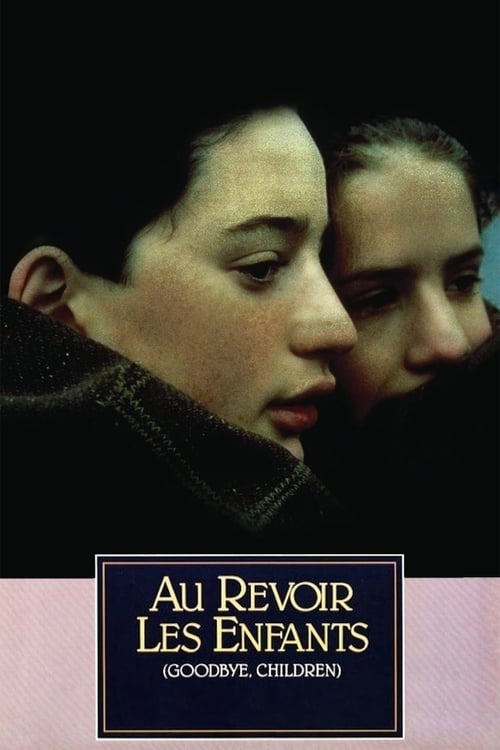
Au Revoir les Enfants
1987 · Louis Malle
For when you want a film that will genuinely move you and that you'll carry for days — quiet, humane, and ultimately heartbreaking. Bring tissues; don't bring anyone who'll talk over it.
What it's about
At a Catholic boarding school in Nazi-occupied France, 1944, a privileged, sharp-witted boy strikes up a wary rivalry-turned-friendship with a mysterious new student who keeps to himself. The new boy is hiding something, the priests who run the school know more than they say, and the war outside presses ever closer to the school gates. Louis Malle drew it directly from his own childhood.
The experience
Gentle and closely observed for most of its running time — chilblains, dormitory pranks, piano lessons — which is exactly what gives its gravity such force. It's tender, then devastating, and its restraint stays with you far longer than any dramatics would.
Performances
The two young leads, Gaspard Manesse and Raphaël Fejtö, give remarkably unaffected performances — their friendship feels observed rather than acted, which is everything the film needs.
The craft
Malle's direction is a masterclass in restraint: wintry, muted photography, no melodrama, meaning carried in glances and small accumulated details of school life. Because it never raises its voice, the moments that matter land with extraordinary weight.
Why it matters
Winner of the Golden Lion at Venice and the emotional summit of Malle's career — a memory he carried for four decades before filming, and now one of the defining films about childhood under occupation.
Snapshot
Au Revoir les Enfants is Louis Malle's autobiographical reckoning with the single most formative trauma of his childhood: the day in January 1944 when the Gestapo came to his Catholic boarding school near Fontainebleau and removed three Jewish boys and the priest who had been sheltering them under false names. Malle, then eleven, witnessed it; he carried the memory for more than four decades before he felt able to film it. The result is a work of deliberate restraint and almost documentary plainness, a film that withholds melodrama precisely because its maker understood that the events needed no amplification. Centered on the wary, deepening friendship between Julien Quentin — Malle's clear surrogate — and the new boy Jean Bonnet, it builds through accumulated small observations of school life toward an ending whose devastation lies in its quietness. The film won the Golden Lion at the 1987 Venice Film Festival, swept the 1988 Césars, and earned two Academy Award nominations. It is widely regarded as the summation of Malle's career and one of the central French films about the Occupation, memory, and complicity.
Industry & production
By the mid-1980s Malle was an established international figure who had spent roughly a decade working in the United States — Pretty Baby (1978), Atlantic City (1980), My Dinner with Andre (1981), Alamo Bay (1985). Au Revoir les Enfants marked his deliberate return to France and to intensely personal material. He produced it through his own company, Nouvelles Éditions de Films (NEF), structured as a French production with West German and Italian co-financing — a typical European arrangement of the period that pooled national subsidies and television money to fund a mid-budget art film without major-studio backing.
Malle wrote the screenplay himself, drawing directly on his own memory rather than on an existing literary source; this is the film's claim to authority and the reason he resisted making it for so long, fearing he would sentimentalize or distort what he remembered. He cast almost entirely with unknown children, holding extensive auditions to find faces that would read as ordinary rather than performed. The film was shot on location in wintry French settings (the production worked in and around Provins, dressing real period architecture) to capture the cold, gray, under-heated atmosphere of an Occupation-era school. Precise budget and box-office figures are not something I can cite reliably here; what is well established is that the film was a substantial critical and commercial success in France and abroad relative to its scale, and that its festival prizes drove its international distribution.
Technology
Technologically the film is conservative by design. It was shot on 35mm color stock using conventional equipment of the late 1980s, with no recourse to optical novelty, flashy camera rigs, or visual effects. Malle's choices run counter to the era's tendency toward gloss; the "technology" of the film is essentially the technology of classical narrative cinema deployed for maximum transparency. The most consequential technical decisions are photochemical and atmospheric — the use of available and low-key light, the muted desaturated winter palette, and naturalistic location sound — all aimed at erasing the sense of a constructed image. Where many 1987 productions leaned into expressive cinematography, Au Revoir les Enfants uses the medium to disappear, so that nothing stands between the viewer and the observed event.
Technique
Cinematography
The cinematography is by Renato Berta, the Swiss cinematographer whose career spans collaborations with Alain Resnais, Jean-Luc Godard, André Téchiné, and Manoel de Oliveira. Berta's work here is a model of disciplined naturalism. The palette is cold and tonally narrow — grays, browns, the bluish white of winter light — evoking both the literal chill of an unheated wartime school and the emotional austerity of the institution. Compositions favor a fixed, observational distance; the camera tends to watch rather than dramatize, holding on faces and rooms long enough for behavior to reveal itself. Berta lights interiors with a sense of real, insufficient sources — classroom windows, candlelight, the dimness of dormitories — reinforcing the period's privations without underlining them. The restraint is purposeful: the most famous images, including the final arrest in the courtyard, gain their force from being framed plainly, without the editorializing of dramatic angles.
Editing
The editing, by Emmanuelle Castro, sustains an unhurried, accumulative rhythm. The film is structured as a chronicle of school days — lessons, meals, a treasure hunt in the woods, a bombing scare, a restaurant lunch — and the cutting allows scenes to breathe to their natural length rather than compressing them into beats. This patience is dramatically strategic: by immersing the viewer in the texture of ordinary routine, the editing makes the eventual intrusion of history feel like a violation of a world we have come to inhabit. The climactic sequence is cut with the same composure as the rest, refusing the acceleration a conventional thriller would apply, so that the horror registers as something that happens within everyday time rather than apart from it.
Mise-en-scène / staging
Malle's staging is anchored in the spaces of the school — corridors, the chapel, the refectory, the dormitory, the cold courtyard — which function as a closed world with its own hierarchies and rituals. He stages the boys in groups and crowds with great naturalism, capturing the cruelty, camaraderie, and casual hierarchy of children, then isolates Julien and Jean in quieter two-shots as their bond forms. The mise-en-scène is attentive to period detail — uniforms, ration-era food, blackout conditions, the bureaucratic and ecclesiastical authority figures — without ever pausing to display its research. Crucially, Malle stages the central act of betrayal as a matter of glances and bodies in space: the geography of who looks where, and when, carries the film's moral weight more than any line of dialogue.
Sound
The soundtrack is dominated by source music rather than an original score, which is one of the film's defining aesthetic choices. Classical pieces — including music by Schubert and Saint-Saëns — appear largely as diegetic elements, performed at the piano within the world of the school, tying culture and beauty to the fragile civilization the war is destroying. The absence of a conventional emotive score denies the audience the cue to feel; grief is not orchestrated. Ambient sound — footsteps on stone, distant aircraft, the noise of children — builds the realist envelope. The film's single most important sonic gesture is verbal: Malle's own adult voice delivers the closing narration, breaking the fictional surface to confirm that this was memory, not invention.
Performance
Performance is built on non-professional and first-time child actors, with Gaspard Manesse as Julien and Raphaël Fejtö as Jean Bonnet. Malle draws from them an unforced naturalism — the alternating bravado, vulnerability, competitiveness, and tenderness of boys — that anchors the film's credibility. Manesse conveys Julien's mixture of privilege, curiosity, and dawning conscience largely through watchfulness; Fejtö gives Bonnet a guarded intelligence and the strain of a child living under a false identity. Among the adults, Philippe Morier-Genoud plays the headmaster Père Jean with quiet moral gravity, and François Négret plays Joseph, the resentful kitchen worker whose grievance becomes the hinge of catastrophe. Francine Racette, Malle's wife, appears as Julien's elegant, distracted mother. The performances are uniformly pitched below the level of "acting," in keeping with the film's documentary instincts.
Narrative & dramatic mode
The film operates in the mode of observational realism organized as memoir. There is no conventional plot engine in the first two-thirds; instead the narrative proceeds episodically, building character and milieu through the rhythms of institutional life. Dramatic irony saturates the experience for any viewer who senses where the story must go, but Malle withholds overt foreshadowing, trusting accumulation over suspense. The emotional architecture is a slow approach to a single catastrophic event, after which the film stops almost immediately — there is no extended aftermath, no redemptive coda. The closing first-person narration recasts the entire film retroactively as an act of remembrance and confession, locating the drama not only in 1944 but in the adult Malle's lifelong inability to forget. The famous final glance — Julien's involuntary look toward Bonnet as the Gestapo officer scans the classroom — is left deliberately ambiguous as to whether it sealed his friend's fate, and that ambiguity is the film's true subject: the unbearable possibility of innocent complicity.
Genre & cycle
Au Revoir les Enfants sits within several overlapping cycles. It is a war film told from the civilian margins, a coming-of-age story, and above all a film of the Occupation — part of the French cinema's long, contested engagement with the Vichy years. It belongs to a distinguished lineage of films about childhood under war, most obviously René Clément's Forbidden Games (1952), and it arrived in a remarkable cluster of 1987 memory films about children and the Second World War, alongside John Boorman's Hope and Glory and Steven Spielberg's Empire of the Sun. Within Malle's own filmography it forms a clear diptych with Lacombe Lucien (1974), his earlier, more provocative study of Occupation-era collaboration; where that film examined a drifting youth who falls in with the Gestapo's auxiliaries, Au Revoir les Enfants examines the bourgeois child who is shielded from history until it breaks in.
Authorship & method
The film is the most directly personal of Malle's works and the clearest statement of his sensibility — humane, skeptical, allergic to sentimentality, fascinated by moral ambiguity and the failures of "good" people. Malle's method here was to subordinate style to memory: to recreate, as faithfully as he could, what he had seen and felt, and to refuse the consolations of dramatization. His key collaborators serve that program. Renato Berta's cinematography supplies the cold, plain images; Emmanuelle Castro's editing supplies the patient rhythm; the decision to forgo an original score in favor of period classical music is itself an authorial gesture against emotional manipulation. As writer, Malle is his own primary source, and the closing voiceover — delivered in his own voice — makes the authorship explicit, collapsing the distance between filmmaker and witness. The casting of his wife, Francine Racette, and of unknown children reflects his preference for faces uncolored by star associations.
Movement / national cinema
Malle is a singular figure within French cinema rather than a card-carrying member of any movement. He emerged at the same moment as the Nouvelle Vague — his Elevator to the Gallows and The Lovers both date to 1958 — and shared the New Wave's youth and independence, but he came from a documentary background (he had co-directed The Silent World with Jacques-Yves Cousteau) and never belonged to the Cahiers du cinéma critical fraternity. Au Revoir les Enfants is best understood within the broader French reckoning with the Occupation and the Holocaust that intensified from the late 1960s onward — Marcel Ophüls's The Sorrow and the Pity (1969) and Claude Lanzmann's Shoah (1985) being the towering nonfiction landmarks. Malle's contribution to this "duty of memory" is intimate and confessional rather than investigative: a national trauma rendered as one man's irreducible personal guilt.
Era / period
The film depicts the winter of 1944 under German occupation, a moment when the persecution of Jews in France had reached its deadliest phase and when sheltering them carried lethal risk. It registers the period through privation and atmosphere — rationing, the black market, air-raid alarms, collaborationist militia, the omnipresence of German authority — and through the moral confusion of a society in which heroism, indifference, and betrayal coexisted within a single institution. Made in 1987, it also belongs to its own era: a decade in which France was publicly confronting the Vichy past with new directness, and in which Malle, late in his career and back on home ground, could finally translate private memory into national reckoning.
Themes
The film's central themes are memory and guilt — the adult's inability to absolve himself of a childhood glance — and the loss of innocence, dramatized as the moment a sheltered boy discovers that history is real and lethal. It is profoundly concerned with complicity and the gradations between active betrayal (Joseph's informing), institutional courage (Père Jean's sheltering of the boys), and unwitting harm. Class runs throughout: Julien's bourgeois security is contrasted with Joseph's resentment and exclusion, and Malle implicates privilege itself in the catastrophe. The film examines friendship across an enforced divide, the Catholic milieu and its capacity for both moral courage and ordinary anti-Semitism, and the persistence of prejudice as casual social fact. Above all it dramatizes courage and cowardice not as heroic abstractions but as small human reflexes under pressure.
Reception, canon & influence
Critically, Au Revoir les Enfants was received as a major and deeply moving work and as the crowning achievement of Malle's late career. It won the Golden Lion at the 1987 Venice Film Festival, dominated the 1988 Césars with awards including Best Film and Best Director, and was nominated for two Academy Awards, for Best Foreign Language Film and Best Original Screenplay. Its critical standing has remained high, and it is frequently cited as one of the essential films about the Occupation and about childhood under fascism.
Looking backward, the film draws on a French tradition of war-childhood cinema epitomized by Clément's Forbidden Games, on the postwar documentary realism that shaped Malle's eye, and on the autobiographical impulse Malle had already explored in Murmur of the Heart (1971) and on the Occupation theme he had confronted in Lacombe Lucien (1974). Its deeper "influence" is biographical: the film is the artistic discharge of a memory Malle had nursed since boyhood.
Looking forward, the film became a touchstone for restrained, memory-driven Holocaust and Occupation storytelling — an example of how to render atrocity through understatement and the perspective of a child rather than through spectacle. It reinforced the value of source music and the withheld score as instruments of emotional honesty, and it stands as a frequently taught model of autobiographical filmmaking. Within Malle's own arc it secured his late reputation in France after his American years and stands alongside Lacombe Lucien as his enduring contribution to cinema's confrontation with Vichy. Where the precise mechanics of its commercial performance are concerned the public record I can cite is thin, but its canonical place — anchored by the Venice and César honors and its continued circulation in repertory and education — is not in doubt.
A Deleuzian reading
A German officer walks the rows of a cold classroom, reading faces.
The full Deleuzian reading of Au Revoir les Enfants →
Reception
No reappraisal needed — it landed as an instant classic, winning the Golden Lion at Venice in 1987 and sweeping seven Césars including Best Film, and was hailed as the homecoming triumph of Malle's career after his Hollywood decade. Nearly forty years on it's only consolidated, now a fixture of the foreign-language canon and of every 'films that will emotionally wreck you' list.
How Au Revoir les Enfants was received, from release to now →
Influences: the films it descends from and the films it influenced
- Forbidden Games (1952) — Establishes the war-childhood mode Malle inherits directly: catastrophe registered through a child's uncomprehending eyes and small domestic ritual rather than combat spectacle, carried by nonprofessional child performers.
- Zéro de conduite (1933) — Supplies the boarding-school template Malle restages — boys observed as an ensemble in dorm, refectory and washroom rhythms, collective child life set against the cold authority of clergy and masters.
- The 400 Blows (1959) — Models the autobiographical boyhood filmed with an unknown child lead and observational, anti-melodramatic realism, the camera holding at a watchful distance through institutional confinement.
- Germany Year Zero (1948) — The neorealist child-witness to war's moral collapse, shot with nonprofessional casting and available light on real locations — the postwar documentary eye Malle credits as shaping his own.
- Diary of a Country Priest (1951) — Pioneers the first-person confessional voiceover laid over withheld, undemonstrative 'model' performances — the device Malle ends on, his own voice collapsing the distance between filmmaker and witness.
- Lacombe Lucien (1974) — Malle's own prior Vichy film: a nonprofessional lead and a deliberately non-judging observational distance on the banality of collaboration, the complicity theme he returns to from the victim's side.
- Murmur of the Heart (1971) — His earlier autobiographical bourgeois-childhood memoir scored entirely with diegetic period music and viewed with the same sympathetic-but-skeptical eye on the family.
- The Sorrow and the Pity (1969) — The documentary that demolished the resistance myth and forced everyday Vichy complicity into view — the historiographic ground beneath Malle's refusal to let 'good' people off the hook.
- The Spirit of the Beehive (1973) — Renders a child's-eye life under fascism through available low-key light, observational stillness and meaning carried almost entirely in glances and bodies rather than dialogue.
- The Last Metro (1980) — Extends Truffaut's Occupation restraint: a hidden Jewish presence inside an enclosed institution, deportation kept offscreen, and narration restricted to a witness who cannot see the whole — the arrest registered as a look, not a scene.
- Atonement (2007) — Builds its engine from dramatic irony rooted in a child's fatal misperception, closing on a retrospective authorial confession that fuses narrator and witness — Malle's final-voiceover gesture as whole structure.
- The White Ribbon (2009) — Extends the austere observational distance on children and incipient fascism, complicity withheld and implied through omitted information, off-screen events and held glances.
- The Tree of Life (2011) — Structures autobiographical memory as an accumulation of impressions under available natural light, threaded by hushed first-person voiceover rather than plotted scenes.
- Boyhood (2014) — Pushes the accumulative, undramatized observational rhythm of childhood to its limit, refusing climactic plotting so that growth registers as the steady deposit of ordinary moments.
- Schindler's List (1993) — Malle's observational, available-light witness cinema for depicting the deportation of Jewish children from a French boarding school — camera as recorder rather than interpreter, climax withheld rather than performed — established the ethical stance of the restrained historical witness film that Spielberg adopted and then amplified into studio-prestige scale.
- Joint Security Area (2000) — Proxemic staging of cross-ideological forbidden friendship: the camera holds observational distance as bodies navigate socially enforced separation, trusting physical closeness between the boys to carry moral weight without editorial comment — exactly the method JSA uses in its nocturnal North Korean guard-post scenes.
- Europa Europa (1990) — Hidden Jewish identity among gentile boys carried by suppressed feeling and a single lethal exposure scene — restraint-as-register and the dramatic-irony of the audience knowing the secret the persecutors don't.
- The Pianist (2002) — The director mining personal childhood memory of occupation for autobiographical restraint, suppressing stylization to honor lived detail.
- Jojo Rabbit (2019) — Filters the Holocaust through a boy's limited sightline and a cross-divide friendship with a hidden Jewish child — the child's-POV and concealed-Jew armature Jojo inherits.
- The Boy in the Striped Pyjamas (2008) — The direct model for a cross-the-line boyhood friendship staged under limited child POV, where the Jewish reality stays largely unspoken and the deportation is delivered through restraint and offscreen fate rather than depicted atrocity.
- Just an Illusion (2026) — Perfects child-limited knowledge as a withholding device: the boy overhears and half-sees what the adults transact, and Malle refuses the reverse angle that would complete it, so comprehension arrives only in the last shot — the structural bet the seed's overheard-domestic-conflict staging makes.
- Fanny and Alexander (1982) — Autobiographical childhood memoir that scales its whole world to a child's height of observation, period-bourgeois texture recreated as remembered rather than dramatized.
- My Life as a Dog (1985) — A child narrator's retrospective voiceover over a nonprofessional young lead, building an undramatized, accumulative coming-of-age from observed incident.
- Hope and Glory (1987) — Contemporary autobiographical WWII-childhood memoir narrated in adult retrospect, war refracted through a boy's everyday wonder and routine instead of through battle.
- Cinema Paradiso (1988) — Both films are retrospective childhood memoirs structured around an institutional setting and a formative male friendship terminated by external authority; Malle's warm-lit classroom and dormitory interiors achieve the same formal grammar as Tornatore's booth — physical warmth as the visual register for grief that neither the child nor the adult narrator can speak directly.
- Come and See (1985) — Malle casts non-professional Gaspard Manesse for reactive authenticity rather than trained expression and uses the child's face as the register of incomprehensible Nazi violence; the gap between what the boy's face can show and what the adult viewer must infer is the film's ethical mechanism, applying Come and See's non-professional-lead strategy at a restrained register.
- The Chorus (2004) — Sibling in postwar-French boys'-boarding-school memory cinema — shares the autumnal heritage palette, the enclosed dormitory world, and the adult-remembering-boyhood frame, though Malle refuses the consolation Barratier delivers.
- Story of Women (1988) — A contemporaneous entry in the Vichy-reckoning cycle that stages everyday complicity and betrayal without accusation, sharing the evenhanded gaze on Occupation moral failure.
Similar films
- Forbidden Games (1952) — influence & lineage
- Murmur of the Heart (1971) — influence & lineage
- The White Ribbon (2009) — influence & lineage
- The 400 Blows (1959) — influence & lineage
- Just an Illusion (2026) — same viewing thread
- The Spirit of the Beehive (1973) — influence & lineage · often watched together
- My Life as a Dog (1985) — influence & lineage · often watched together
- Hiroshima Mon Amour (1959) — often watched together
All the films related to Au Revoir les Enfants →
Watch it with: curated runs of related films
- The Past Is a Foreign Country — A run of films that reach back through memory — lost summers, vanished friends, the golden light of a place you can never return to — best watched in a row when you're in the mood to ache a little.