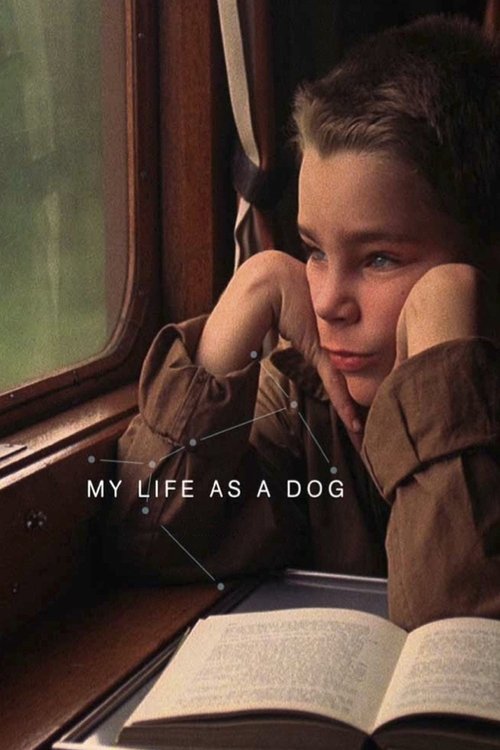
My Life as a Dog
1985 · Lasse Hallström
For a soft, nostalgic evening when you want to feel your own childhood again — the ache and the sweetness together. Comfort viewing that still leaves a mark.
What it's about
In late-1950s Sweden, twelve-year-old Ingemar is more than his ailing mother can handle, so he's sent to live with his uncle in a small glassworks village full of gentle eccentrics. Missing his mother and his dog, he copes by comparing his lot to those worse off — especially Laika, the Soviet space dog — while stumbling through first crushes, village rituals, and the confusing edge of growing up.
The experience
Tender and melancholy with a steady undercurrent of comedy — it drifts like a childhood summer, sweet one minute and quietly heartbreaking the next. It sneaks up on you; you're smiling at some village absurdity and then suddenly there's a lump in your throat.
Performances
Anton Glanzelius, the young lead, gives one of the great child performances — scrappy, funny, and transparently wounded without ever seeming coached.
The craft
Hallström shoots the village with unforced warmth, letting small rituals and odd neighbors accumulate into a whole world, and the film's rhythm — episodic, unhurried — mirrors how a kid actually experiences a year. Ingemar's musings about Laika thread the comedy and the grief together beautifully.
Why it matters
The breakout international hit of post-Bergman Swedish cinema, it made Hallström's name worldwide and launched his Hollywood career, and it remains a touchstone for bittersweet childhood films.
Snapshot
My Life as a Dog (Mitt liv som hund) is Lasse Hallström's tender, melancholy comedy of childhood displacement, adapted from Reidar Jönsson's semi-autobiographical 1983 novel. Its protagonist is Ingemar Johansson — named, like the heavyweight champion, for a boxer's resilience — a roughly twelve-year-old boy in late-1950s Sweden whose tubercular mother can no longer care for him and his brother. Sent to live with relatives in a rural Småland glassworks village, Ingemar navigates grief, sexual awakening, and the loss of his dog through a survival philosophy of comparison: things could always be worse, and to prove it he repeatedly invokes Laika, the Soviet space dog launched to certain death aboard Sputnik 2. The film became the breakout international success of Swedish cinema in the post-Bergman era, earning Hallström Academy Award nominations and launching a Hollywood career. It endures as one of the canonical screen treatments of childhood from the inside — observed, unsentimental in structure even as it is warm in texture, and refusing the consolations of a tidy resolution.
Industry & production
The film originated in Reidar Jönsson's novel, the second in a loosely autobiographical sequence, which gave Hallström both a ready-made structure of episodes and an authenticating claim to lived Swedish working-class childhood. Production was mounted within the Swedish film system, which since the 1960s had been organized around the Swedish Film Institute's support mechanisms; My Life as a Dog is a representative product of that subsidized, mid-budget national cinema rather than a commercial blockbuster. Precise budget figures are not reliably documented in the public record, and I will not invent them; the film's modest scale is evident on screen in its village locations and ensemble of largely non-star players.
Hallström came to the project as a director already seasoned in Swedish popular entertainment — television comedy and, famously, a long run of ABBA's promotional films — but without international standing. The decisive industrial fact about My Life as a Dog is its afterlife abroad. Following its 1985 Swedish release, the film reached the United States in 1987 through arthouse distribution (Skouras Pictures handled the American release), where strong critical reception and word of mouth carried it to two Oscar nominations at the 1988 ceremony — Best Director and Best Adapted Screenplay — an unusual feat for a foreign-language film that was not even its country's submission in the Foreign Language category that year. That recognition transformed Hallström from a national figure into a transatlantic one and effectively created the template by which Scandinavian directors of the period crossed into English-language production.
Technology
The film was shot on 35mm color film stock using conventional late-period analog technology; there is nothing technologically experimental about its production, and its interest lies in the application of familiar tools rather than novelty. Its imagery depends on photochemical color rendering — warm, slightly desaturated period tones — achieved in-camera and in the lab rather than through any optical or electronic trickery. The film's "technology," in the sense of its diegetic preoccupations, is more thematically significant than its production apparatus: the narrative is saturated with the technological mythology of the late 1950s, above all the Space Race. Laika, Sputnik, and the radio reports of orbital flight function as the period's most potent image of human reach and human expendability, and Ingemar's recurring meditations on the dog hurled into space anchor the film's emotional logic. Period radio broadcasts, particularly of Ingemar Johansson's boxing triumphs, similarly use the era's mass-communication technology as a structuring sound motif.
Technique
Cinematography
The photography, credited to Jörgen Persson (one of Sweden's pre-eminent cinematographers, whose earlier work included Bo Widerberg's Elvira Madigan and who would go on to shoot Bille August's Pelle the Conqueror and The Best Intentions), is the film's chief aesthetic signature. Persson favors a warm, golden, summer-lit palette that lends the village interludes a nostalgic glow without tipping into postcard prettiness. The camera tends toward an observational, often handheld intimacy, staying close to Ingemar's eye level and physical scale so that the adult world is frequently framed from a child's vantage. Compositions privilege faces and the textures of domestic and rural life; the recurring image of Ingemar lying on his back beneath the night sky — talking himself through his litany of others worse off — is shot to make the boy small against a vast indifferent cosmos, visually rhyming his predicament with Laika's.
Editing
The cutting follows the episodic, anecdotal rhythm of the source novel rather than a tightly causal plot. Sequences accumulate as vignettes of village eccentricity and seasonal change, and the editing's task is to braid these loose episodes around the steady undertow of Ingemar's grief and his mother's decline. Crucial information — most painfully, the fate of Ingemar's dog Sickan — is withheld and revealed across the film's span, so that the editing manages an emotional reticence: the boy's losses register in displacement and delay rather than in confronted scenes. The pacing is unhurried, trusting accumulation over incident.
Mise-en-scène / staging
The film's world is the Småland glassblowing community, and its staging is dense with comic-grotesque local color: the bedridden old man who has Ingemar read aloud from a lingerie catalog; the amateur sculptor whose model scandalizes the village; the man perpetually repairing his roof; the glassworks itself as a communal hearth. Hallström stages these figures as an affectionate ensemble rather than caricatures, and the village functions as a surrogate extended family whose warmth gradually displaces the broken nuclear one. Period production design — clothing, interiors, the textures of a 1958–59 provincial Sweden — is detailed but understated, never foregrounded as spectacle.
Sound
Björn Isfält's score is gentle and folk-inflected, supporting the film's wistfulness without underlining it. The sound design leans on the era's radio culture: boxing commentary, news of the space program, popular music of the period. Ingemar's interior voice-over — the recurring "you have to compare" monologues — is the film's most distinctive sonic device, giving direct access to a coping mechanism the boy cannot articulate to anyone around him.
Performance
The film rests on Anton Glanzelius's performance as Ingemar, widely regarded as one of the finest child performances in European cinema: alert, physical, comic, and capable of conveying repressed sorrow without precocious emoting. Glanzelius makes Ingemar's regressions — his literal play at being a dog, barking and crawling — read as grief rather than whimsy. Tomas von Brömssen as the warm, eccentric Uncle Gunnar and Anki Lidén as the dying mother anchor the adult world, while Melinda Kinnaman as Saga — the tomboy who boxes and binds her chest to keep playing on the boys' football team — provides the film's most charged peer relationship, a study in adolescent gender confusion handled with notable tact for its period.
Narrative & dramatic mode
The film operates in a coming-of-age register organized around episodic realism rather than dramatic crisis. Its through-line is internal: Ingemar's strategy of survival is comparison, the deliberate measuring of his own misfortune against greater catastrophes — Laika in orbit, a man crushed by farm machinery, a faraway accident heard on the radio. This is dramatized as a recurring voice-over ritual, and the film's quiet power comes from watching the strategy strain and partly fail as losses mount: the dog he loved, the mother who dies, the home he cannot return to. The narrative resists catharsis; rather than a redemptive climax it offers a guarded equilibrium, the boy finding a tenuous belonging in the village and with Saga. The dramatic mode is tragicomic — genuinely funny in its village episodes, genuinely sorrowful underneath — and its sophistication lies in keeping both registers alive at once.
Genre & cycle
My Life as a Dog belongs to the international art-cinema cycle of childhood films told from a child's subjective vantage — a lineage that includes Truffaut's The 400 Blows, René Clément's Forbidden Games, and later works such as Fanny and Alexander. Within that tradition it sits on the warmer, comic end rather than the bleak, favoring tenderness over trauma without denying loss. It also participates in the period-nostalgia subgenre, recreating a specific national past (late-1950s provincial Sweden) with affection. Generically it is best described as tragicomedy or humanist drama; its episodic, anecdotal construction aligns it with literary adaptation traditions in which the source's picaresque shape survives into the film.
Authorship & method
Hallström is the controlling authorial presence, and the film established what would become his signature: an empathetic, ensemble-driven humanism attentive to eccentric communities and emotionally guarded protagonists. The screenplay was a collaborative effort — Hallström worked with the novelist Reidar Jönsson and additional writers (the credited writing team also included Brasse Brännström and Per Berglund) to distill the novel's episodes into the film's loose but cumulative structure. The adaptation's method is selective and tonal rather than comprehensive, preserving the book's anecdotal texture while shaping it around the Laika motif and the mother's decline.
Among collaborators, cinematographer Jörgen Persson is the most consequential, supplying the warm observational look that defines the film. Composer Björn Isfält provided the unobtrusive folk-toned score. The editing is credited to Christer Furubrand and Susanne Linnman (the precise division of labor between them is not something I can document reliably). Hallström's prior decade in television and music-video work — efficient, performer-focused, popular-facing — plainly informs the film's accessibility and its comic timing; My Life as a Dog is the film in which that commercial fluency married a serious literary subject. Its success carried Hallström directly into English-language cinema: What's Eating Gilbert Grape (1993), The Cider House Rules (1999), Chocolat (2000), and The Shipping News (2001), all of which extend the same humanist, ensemble-warm sensibility to Anglo-American material.
Movement / national cinema
The film is a landmark of post-Bergman Swedish cinema. Ingmar Bergman's austere modernist introspection had defined Swedish film abroad for decades; Hallström offered a deliberately different national image — warmer, more comic, populist, and rooted in ordinary provincial life rather than metaphysical anguish. It exemplifies the subsidized national cinema fostered by the Swedish Film Institute, and it stands alongside the work of contemporaries such as Bille August as evidence of a Scandinavian cinema that, in the 1980s, found a humanist register capable of crossing borders. Its international breakthrough helped reposition Swedish film for English-language audiences as something other than Bergmanesque severity.
Era / period
The film is doubly periodized: made in the mid-1980s, set in 1958–59. Its setting is precise and load-bearing — the late 1950s of the Space Race, of Ingemar Johansson's boxing fame, of a still-rural Sweden on the cusp of fuller modernity. The historical moment supplies the film's governing metaphor (Laika) and its texture of radio-mediated national events. As a mid-1980s production, it belongs to a moment when European art cinema was finding renewed access to American arthouse distribution, and its 1987 U.S. release and 1988 awards run are inseparable from that distribution climate.
Themes
The film's central theme is grief managed through displacement and comparison — Ingemar's insistence that one must measure one's suffering against the world's greater catastrophes is at once a child's wisdom and a defense against feeling. Bound up with this are the themes of abandonment and belonging: the dissolution of the nuclear family (dying mother, absent father, separated brother) and its partial replacement by the surrogate community of the village. Mortality runs throughout, figured most hauntingly in Laika — the dog sent to die so that humans might reach the stars, a creature both sacrificed and exalted, mirroring Ingemar's sense of being expelled from his own home. Adolescent sexuality and gender ambiguity form a third strand, handled with unusual delicacy in the Saga relationship and in the village's comic erotica. Underlying all of these is the resilience of childhood itself — the capacity to absorb loss through play, ritual, and the stories one tells oneself.
Reception, canon & influence
Critical reception was strongly positive in both Sweden and abroad; the film was embraced internationally as a humane, beautifully observed work, and Anton Glanzelius's performance drew particular praise. In the United States it accumulated significant critical honors during its 1987 run, including recognition from major critics' bodies, and it won the Golden Globe for Best Foreign Language Film. Its two Academy Award nominations — Best Director and Best Adapted Screenplay — were a notable distinction for a non-English-language film and remain the film's highest-profile institutional recognition. It was also honored within Sweden's own awards culture, though I would caution that I cannot verify the precise tally of Guldbagge or other domestic prizes without risk of error.
The influences on the film are clearest in the European child's-eye tradition descending from Truffaut's The 400 Blows, and in the Swedish literary-realist habit of locating large feeling in small provincial life; Bergman's Fanny and Alexander (1982) is a proximate domestic precedent for the period-childhood film, though Hallström's tone is markedly warmer and less stylized.
Its influence forward is twofold. First, it functioned as a career-defining calling card: the film's success opened Hollywood to Hallström and, more broadly, helped establish a pathway by which Scandinavian directors of sensitive humanist dramas could move into prestige English-language filmmaking. Second, its model of subjective, tragicomic childhood — funny on the surface, grieving underneath, structurally episodic and resistant to neat resolution — became a widely felt reference point for later coming-of-age cinema. A made-for-television American adaptation followed some years later, a further mark of the property's reach, though the original remains definitive. Within the canon, My Life as a Dog is securely lodged as both a high point of 1980s Swedish cinema and one of the enduring films about what it is to be a child enduring loss.
A Deleuzian reading
Start with the boy on his back in the grass, talking himself to sleep.
The full Deleuzian reading of My Life as a Dog →
Reception
A sleeper Swedish import that became a genuine US arthouse phenomenon in 1987, landing Hallström Oscar nominations for Best Director and Adapted Screenplay — almost unheard of for a foreign-language film. Today it's remembered warmly, but often through the lens of 'before Hollywood got hold of Hallström.'
How My Life as a Dog was received, from release to now →
Influences: the films it descends from and the films it influenced
- The 400 Blows (1959) — Establishes the child-eye-level handheld observation of a guarded boy-protagonist and the refused-catharsis ending (freeze-frame) that Hallström's withheld-revelation structure directly inherits.
- Forbidden Games (1952) — Models a child metabolizing death through ritual and animal-attachment play — the displacement-onto-a-creature logic Hallström restages via Ingemar's Laika identification.
- The Spirit of the Beehive (1973) — Pairs a warm golden rural palette with a child's-eye withheld revelation, locating large grief inside small provincial life — the exact tonal architecture Persson's cinematography reproduces.
- Kes (1969) — Films a lonely boy's bond with an animal in unforced observational realism amid an eccentric working community, ending on refused catharsis rather than uplift.
- Amarcord (1973) — Supplies the episodic-vignette structure of a provincial community rendered as ensemble grotesque, with comic surface laid over collective melancholy.
- Small Change (1976) — Builds a film from loosely linked anecdotal vignettes of children where comedy continuously guards pathos — the cumulative-not-plotted method Hallström's adaptation adopts.
- Wild Strawberries (1957) — Originates the Swedish voice-over comparison/memory monologue as a structuring device for subjective recollection, the precedent for Ingemar's 'compared to' narration.
- Fanny and Alexander (1982) — Proximate domestic precedent: a period-childhood film told from a child's subjective POV in provincial Sweden, which Hallström warms and de-stylizes.
- Hugo and Josephine (1967) — Defines the post-Bergman Swedish child's-eye art-cinema lyricism — a national tradition of provincial childhood whose accessible humanism Hallström extends.
- What's Eating Gilbert Grape (1993) — Same director transposing the eccentric-community ensemble humanism and emotionally guarded protagonist intact onto American small-town material.
- Show Me Love (1998) — Extends post-Bergman Swedish provincial coming-of-age with handheld observation and a deliberately untidy, refused-catharsis tonal honesty inherited from Hallström.
- Boyhood (2014) — Accumulates childhood as a chain of small episodic moments that resist dramatic climax, privileging texture over plot in the withheld-revelation lineage.
- The Florida Project (2017) — Keeps the camera at child-eye-level so the audience grasps the off-screen parental decline only obliquely, sustaining a comic surface over withheld catastrophe and refusing catharsis.
- The Cider House Rules (1999) — Hallström's breakthrough fixed his signature method — observing a wounded child-outsider with unsentimental tenderness and a performance-first, low-flourish camera — which he transplants directly onto Homer Wells and the orphanage.
- Summer 1993 (2017) — Prototype of the grieving child dispatched to rural relatives for a summer, structuring the film as a fragmentary memory-collage of a specific landscape and season.
- The Quiet Girl (2022) — Shares the fostered-out-child structure in which a boy sent to warmer rural relatives is healed by their attentive care, told with tender understatement.
- Barking at the Stars (1998) — Soft, sunlit child's-eye memoir of provincial mid-century life, carried by a gently comic character-actor ensemble of local types rather than by incident.
- Hachi: A Dog's Tale (2009) — Hallström's own template: a protagonist who is never told the truth about what he lost and copes by displacement and daily routine, filmed in low-affect ensemble coverage that withholds the emphasis the material invites.
- Pelle the Conqueror (1987) — Scandinavian humanist child-POV drama that followed the same Foreign-Oscar pathway, extending the Swedish/Danish literary-realist habit of large feeling in small provincial life.
- Cinema Paradiso (1988) — Nostalgic provincial-childhood film assembled from episodic vignettes over a folk-warm score, deploying comic surface to defer underlying grief.
- Hope and Glory (1987) — Subjective tragicomic childhood memoir, episodic and resistant to neat resolution, finding comedy in a child's-eye reading of adult catastrophe.
- Stand By Me (1986) — Frames an episodic boyhood marked by death through retrospective comparison-voice-over, comedy and anecdote masking grief — the same tragicomic-recollection mode.
- Au Revoir les Enfants (1987) — A child narrator's retrospective voiceover over a nonprofessional young lead, building an undramatized, accumulative coming-of-age from observed incident.
- My Sweet Orange Tree (2012) — Hallström's warm, retrospective child-narrator voice — a boy narrating his own coping strategies for loss with rueful humor and consolation — is a close ancestor of the film's elegiac first-person interiority.
Similar films
- Wild Strawberries (1957) — influence & lineage · often watched together
- Fanny and Alexander (1982) — influence & lineage
- Stand by Me (1986) — influence & lineage · often watched together
- The Spirit of the Beehive (1973) — influence & lineage · often watched together
- Kolya (1996) — often watched together
- Au Revoir les Enfants (1987) — often watched together
- The Tin Drum (1979) — often watched together
- The Love That Remains (2025) — shared sensibility