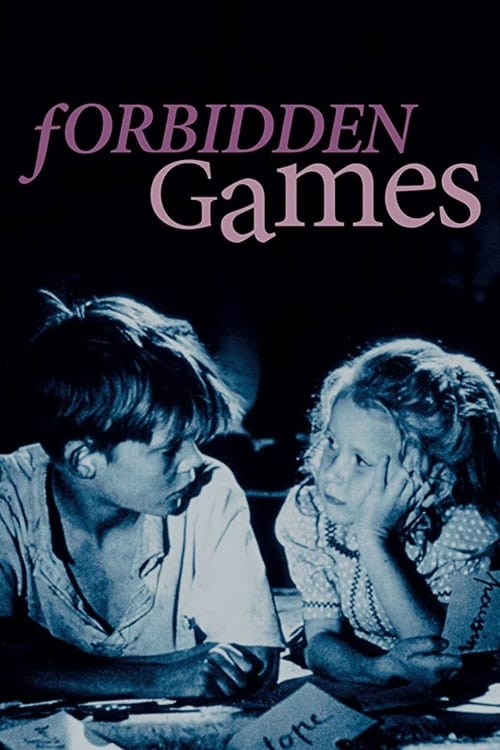
Forbidden Games
1952 · René Clément
For when you want a film that earns real tears honestly, without manipulation — a serious, beautiful heartbreaker rather than comfort viewing. Choose it on a reflective evening when you're ready to be moved.
What it's about
In the chaos of the 1940 exodus from Paris, a five-year-old girl named Paulette is orphaned when German planes strafe the refugee column on a country road. She wanders into the care of a peasant family and bonds with Michel, their youngest son, an older boy who becomes her protector and co-conspirator. Together the two children invent a secret ritual — a hidden cemetery for dead animals — that lets them play at mourning in a world where the adults around them are too busy feuding and surviving to notice their grief.
The experience
Quiet, tender, and quietly devastating — it moves at the unhurried pace of rural life while a knot slowly tightens in your chest. The children's games are funny and strange in the moment, but the film never lets you forget what they're standing in for, and the ending lands with a force that stays for days.
Performances
Brigitte Fossey, barely five years old when it was shot, gives one of the most extraordinary child performances ever filmed — unaffected, watchful, completely believable in grief and play alike. Georges Poujouly matches her as Michel, tough and tender at once.
The craft
Clément directs children the way almost no one else has: he shoots at their eye level and lets scenes breathe until behavior stops looking like acting. The opening air-raid sequence is staged with a documentary bluntness that shocks even now, and Narciso Yepes's solo guitar theme became world-famous on its own — a simple, aching melody that carries the whole film's sorrow.
Why it matters
It won the Grand Prize at Venice and an honorary Oscar, made Clément's international reputation, and became one of the defining films about children and war — a touchstone every later film on the subject gets measured against.
Snapshot
Forbidden Games (Jeux interdits) is René Clément's third major feature and the film that carried his reputation beyond France. Adapted from François Boyer's novel, it follows Paulette, a small Parisian girl orphaned in the June 1940 exodus when German aircraft strafe a column of refugees on a country road, and Michel, the adolescent peasant boy whose family takes her in. Their grief curdles into a private ritual: a secret animal cemetery for which the children begin stealing crosses — from graves, a hearse, finally the church altar — to consecrate the burials of insects, chicks, a mole, and Paulette's dead dog. The "forbidden games" of the title are this childish liturgy, a mimicry of adult mourning that the adults themselves cannot recognize as such. The film is a landmark of postwar French cinema, a devastating study of children improvising sense out of catastrophe, and the source of one of the most widely recognized pieces of guitar music in the world. It won the Golden Lion at Venice and an honorary Academy Award, and remains Clément's most durable achievement.
Industry & production
The film was produced by Robert Dorfmann for Silver Films, a French production in the early 1950s, a period when the French industry was rebuilding audiences and prestige after the Occupation and courting the growing international art-house market. It emerged from the dominant production model of its moment: literary adaptation handled by established screenwriters, the mode later labeled the cinéma de qualité ("tradition of quality"). The source was François Boyer's novel about the two children (published as Les Jeux inconnus, and known in English as The Secret Game), which Boyer had reportedly first conceived in screenplay form before turning it into fiction.
The production's most consequential decision was casting. Clément built the film around two children — Brigitte Fossey, roughly five years old, as Paulette, and Georges Poujouly, around eleven, as Michel — and staked the entire emotional architecture on performances he would have to coax rather than direct in any conventional sense. The exact circumstances of the shoot are not exhaustively documented in the popular record, and I will not invent detail here; what is well established is that the film was shot in the French countryside using rural locations and interiors that lend the peasant milieu its grounded, unglamorous texture. The picture's international festival strategy proved decisive to its commercial life: acclaim abroad, particularly the Venice prize and the American honorary Oscar, gave a modestly scaled French drama a global afterlife it might not otherwise have had.
Technology
Technically, Forbidden Games is unremarkable for its era, and deliberately so — it is shot on 35mm black-and-white film in the standard Academy ratio with monaural optical sound, the default apparatus of early-1950s European production. There is no widescreen, no color, no technical novelty being showcased. The one genuinely distinctive technological-aesthetic choice sits in the sound domain rather than the image: the entire score is carried by a single classical guitar rather than an orchestra, an unusually spare sonic signature for a war drama of the period. That restraint — foregoing the swelling orchestral pathos a Hollywood equivalent would have reached for — is the film's most notable departure from period convention, and it is a choice about instrumentation and mixing more than about hardware.
Technique
Cinematography
Robert Juillard's black-and-white photography moves between two registers. The opening sequence on the bridge and road — the strafing of the refugee column — is staged with a documentary bluntness that recalls the newsreel and the neorealist reportage of the immediate postwar years: chaos, running figures, sudden death rendered without lyricism. Once the story settles into the Dollé farm, the imagery turns to the earthbound naturalism of the peasant world — dim interiors, animals, weather, mud — while reserving a quieter, more composed grammar for the children's clandestine cemetery, the one space the film treats with something like reverence. Juillard keeps the camera close to the children's scale, so that the adult world is frequently framed from below or at its edges, an optical expression of the film's governing point of view.
Editing
Roger Dwyre's cutting is at its most aggressive in the aerial-attack prologue, where rapid assembly conveys panic and the arbitrariness of the killing. The body of the film relaxes into a more classical, observational pace suited to rural rhythms and to the slow accretion of the children's game. The most discussed structural feature is the ending's brutal editorial logic: Paulette, separated from Michel and processed through a wartime relief center, is left crying out for both the boy and her dead mother, the cut to her disappearance in the crowd delivering the emotional blow without cushioning. Some prints and versions carry a storybook-style framing device around the narrative; the precise history of these variants is not something I can reconstruct reliably, and I flag it rather than assert a definitive cut.
Mise-en-scène / staging
The staging draws a hard line between the children's interior world and the adults' feuding, venal one. Michel's family, the Dollés, are locked in a running quarrel with the neighboring Gouard family, a rivalry played out over funerals, insults, and a graveyard brawl that Clément stages as grotesque farce. Against this, the animal cemetery — the children's ordered, tender, secret domain — becomes the moral center of the frame. The film's irony is spatial and behavioral: the adults perform the forms of Christian mourning without feeling, while the children feel without understanding the forms, and Clément arranges his farmyard and church settings so that the two orders of ritual constantly rhyme and collide.
Sound
The sound design is defined by absence and substitution. Where a conventional war film underscores its horrors, Forbidden Games frequently withholds music, then lets the solo guitar enter as a thread of fragile lyricism against images of loss. The guitar theme functions almost as the voice of the children's inner life — plaintive, simple, unmartial — and its recurrence binds the episodic narrative together. Diegetic sound (animals, the countryside, the clangor of the family feud) carries much of the film's realism, with the score used sparingly enough that each entrance registers.
Performance
The film is, above all, a monument to child performance. Brigitte Fossey's Paulette — grave, watchful, uncomprehending and utterly present — is routinely cited among the great performances by a very young child in cinema, and Georges Poujouly's Michel supplies the older child's mixture of protectiveness, devotion, and moral confusion. The adult cast plays the peasant families in a broader, near-caricatural key that throws the children's gravity into relief. Clément's ability to elicit unforced, interiorized playing from performers too young to "act" in any technical sense is the film's central directorial feat.
Narrative & dramatic mode
The film operates in a realist-tragic mode inflected by irony. Its structure is largely episodic — a sequence of the children's escalating thefts and burials, intercut with the adults' feud — bracketed by two shattering set pieces: the massacre on the road at the start and the separation at the end. The dramatic engine is dramatic irony: the audience understands the children's game as an act of displaced grief, while the adults read it only as sacrilege and delinquency. The tone is unstable by design, sliding between tenderness, black comedy (the Dollé–Gouard rivalry), and unbearable pathos, so that the viewer is never allowed a settled emotional footing.
Genre & cycle
Nominally a war drama, Forbidden Games belongs more precisely to a small, potent category: the war film told from a child's point of view, in which the historical catastrophe is refracted through a child's incomprehension. It also sits within the broader cycle of European postwar cinema reckoning with the recent conflict's civilian toll. Unlike the Resistance-heroic register of some 1940s French war films — including Clément's own earlier work — it is anti-heroic and domestic, locating the war's meaning not on the battlefield but in a farmyard and a makeshift graveyard.
Authorship & method
Clément's method here fuses two strands of his formation. He had come to prominence with La Bataille du rail (1946), a Resistance film shot with a documentary, quasi-neorealist immediacy, and that observational instinct survives in the prologue and the peasant-milieu realism of Forbidden Games. At the same time, the film is a showcase of the tradition of quality: its screenplay was written by Jean Aurenche and Pierre Bost, the pre-eminent adaptation team of the period, from Boyer's novel (Boyer is also credited on the writing). This authorship is historically loaded — Aurenche and Bost would become the chief targets of François Truffaut's 1954 polemic "Une certaine tendance du cinéma français," the manifesto that helped launch the New Wave's assault on literary adaptation. The irony, frequently noted, is that Forbidden Games is among the most admired products of exactly the school Truffaut condemned.
The key collaborators complete the picture. Robert Juillard supplied the black-and-white cinematography; Roger Dwyre edited. The score is credited to the Spanish guitarist Narciso Yepes, who performed the solo-guitar music, most famously the theme popularly known as "Romance" (or "Romance Anónimo"). The provenance of that melody is genuinely contested: it is an anonymous Spanish piece of long standing that circulated well before the film, and while Yepes was long associated with — and by some accounts claimed authorship of — its arrangement, the historical record on who "wrote" it is unsettled, and I flag that rather than resolve it. Clément's authorial signature across the film is his control of tone and his direction of children, holding realist observation and orchestrated pathos in a single frame.
Movement / national cinema
The film is a product of mainstream French cinema of the early 1950s, before the New Wave, and it exemplifies the cinéma de qualité in its literary source and its blue-chip screenwriting. Yet its affinities reach toward Italian neorealism — the location shooting, the child protagonists, the aftermath-of-war subject, the refusal of studio gloss in the peasant scenes. It thus occupies a hinge position in French film history: canonized abroad as French art cinema, later semi-repudiated at home by the critics who would remake that cinema, and stylistically closer to its Italian contemporaries than to the polished adaptations it is otherwise grouped with.
Era / period
Made in 1952, the film speaks from the early postwar moment when European cinema was still metabolizing the war and its civilian catastrophes. Its narrative present is June 1940 — the fall of France and the mass civilian exodus southward — and its emotional subject is the wound that event left. It arrives before the technological upheavals of widescreen and before the aesthetic rupture of the New Wave, squarely within the classical French sound cinema of its day, while pointing, in its realism and its child's-eye anti-heroism, toward the more skeptical war cinema to come.
Themes
The film's governing theme is the collision between children's authentic grief and adults' hollowed-out rituals. The crosses the children steal dramatize this directly: the machinery of Christian mourning is, in adult hands, a matter of property, propriety, and feud, while for the children the same objects are charged with real feeling they have no other language to express. From this flow the film's other concerns — the loss of innocence not through corruption but through exposure to death; the arbitrariness and cruelty of war as experienced by non-combatants; a pointed anticlericalism and satire of adult hypocrisy, embodied in the venal Dollé–Gouard rivalry; and the human compulsion to ritualize and domesticate death in order to survive it. The final separation universalizes the grief into something like a statement about war's ultimate cost: the severing of the bonds children make to stay alive inside it.
Reception, canon & influence
Internationally, the film was a triumph. It won the Golden Lion at the 1952 Venice Film Festival and received an honorary Academy Award as the outstanding foreign-language film released in the United States (in the years before that Oscar category became a competitive award); Boyer's story also drew an Academy Award nomination for its writing. It was widely honored by American critics' circles as well. Notably, the film's reception in France was cooler and more divided than its reception abroad — it was more rapturously received internationally than at home — and it soon became entangled in the New Wave's critique of the tradition of quality through its Aurenche-and-Bost screenplay, even as most critics continued to regard the film itself as an exceptional achievement. (Anecdotes circulate about its festival path, including its route to Venice; where I am not certain of the specifics I decline to assert them.)
Looking backward, the film's influences are legible: the documentary-neorealist reportage of the late 1940s (including Clément's own La Bataille du rail), the postwar Italian model of location realism and non-professional-feeling child performance, and the French literary-adaptation craft of its screenwriters. Looking forward, its legacy is twofold. As cinema, it established a durable template for the war-through-a-child's-eyes film and a benchmark for the direction of very young performers; critics routinely invoke it as a touchstone when later films render war through childhood, though such lineage is a matter of critical framing rather than documented, direct causation, and I present it as such. Its most concretely traceable influence, however, is musical: the solo-guitar theme escaped the film entirely to become one of the most recognized and most frequently learned pieces in the classical guitar repertoire, so that "the theme from Forbidden Games" is known to countless people who have never seen the picture — a rare case of a film's score achieving a wider cultural circulation than the film itself.
A Deleuzian reading
After the planes go, a girl of about five is left standing on a country road holding a dead dog.
The full Deleuzian reading of Forbidden Games →
Reception
Snubbed by Cannes' selection committee in 1952, it promptly won the Golden Lion at Venice and an honorary Oscar — then got caught in the crossfire when the New Wave critics went after its screenwriters, Aurenche and Bost, as the embodiment of stuffy 'tradition of quality' cinema. Today the Cahiers polemics are a footnote and it sits comfortably among the great films about children and war.
How Forbidden Games was received, from release to now →
How to watch Forbidden Games: what to notice on a first viewing
- Watch adults appear mostly from below or the frame's edge. Robert Juillard keeps the camera close to the children's scale throughout, so the adult world is repeatedly framed from below or crowded to the edges of the shot. You are made to see this world at exactly Paulette's height, not an adult's.
- Track where each cross in the animal cemetery comes from. Michel takes crosses from graves and from a hearse, and each theft escalates the children's private ritual a little further. An ordinary object of mourning keeps getting stolen and repurposed by hands too small to understand the rule they are breaking.
- Listen for a single classical guitar, and nothing else. Narciso Yepes plays the entire score alone on guitar, and Clement withholds it often enough that each entrance registers against long stretches of ordinary farm sound. The film trusts one plain instrument to carry feeling that dialogue never states directly.
- Compare the children's careful graves to the adults' graveyard brawl. The Dolle and Gouard families feud over funerals and insults, staged by Clement as near-farce, right beside the children's quiet, ordered animal cemetery. The same rituals of mourning look completely different depending on who is performing them.
- Watch how little Brigitte Fossey's face changes throughout the film. Fossey plays Paulette grave, watchful, and uncomprehending, holding a single steady quality rather than performing a young child's usual range of visible emotion. That stillness is not a lack of feeling. It is feeling with nowhere yet to go.
The whole guide to watching Forbidden Games, with the keys for a rewatch →
Influences: the films it descends from and the films it influenced
- La Bataille du rail (1946) — Clément's own Resistance-film reportage method — handheld, quasi-documentary staging of trains and sabotage — is the direct source of the strafing prologue's observational, uncushioned realism.
- Rome, Open City (1945) — Supplies the neorealist template of location shooting in real peasant/street milieus and children as unsentimental witnesses to occupation violence that Clément grafts onto a French rural setting.
- Germany, Year Zero (1948) — Establishes the structural device of routing an entire war narrative through a single child's uncomprehending gaze, with the adult world's cruelty registered as the child's-eye framing captures it.
- Bicycle Thieves (1948) — Models the direction of a very young non-professional to shadow and mirror an adult through a landscape, extracting 'unactorly' behavior that Clément replicates in his coaching of Brigitte Fossey.
- Shoeshine (1946) — Pioneers the De Sica–Zavattini technique of building pathos from children improvising within war's wreckage, the benchmark for child-direction that critics measure Forbidden Games against.
- Zéro de conduite (1933) — Originates the anticlerical satire in which children's play parodies and exposes the empty ritual of adult/church authority — the exact register of the cross-stealing graveyard game.
- Le Diable au corps (1947) — The definitive Aurenche-and-Bost literary adaptation whose 'tradition of quality' screenwriting craft — condensation, ironic dialogue, structural elegance — is the same authorial engine behind Forbidden Games' script.
- The Fallen Idol (1948) — Perfects the low, child-height camera and sustained dramatic irony of a child misreading adult secrets, the formal grammar Clément uses to keep the audience ahead of Paulette's understanding.
- Ivan's Childhood (1962) — Extends the war-through-a-child's-eyes template by refracting the front lines entirely through a boy's perception, alternating documentary-hard combat with the child's interior world.
- The Spirit of the Beehive (1973) — Inherits the rhyming ritual-spaces and near-total musical/dialogue restraint, building a postwar rural film almost entirely from a small girl's silent, ceremonial encounters with death.
- Cría Cuervos (1976) — Carries forward the child-invented rite around death and burial as a coping game, staged in low child's-eye framing that lets the audience read the adult tragedy the child cannot.
- The Tin Drum (1979) — Applies the child-as-satirist device to expose adult and clerical hypocrisy through a boy's willful refusal of the grown-up world, a grotesque escalation of the anticlerical ritual-mockery.
- Come and See (1985) — Pushes the child-witness structure to its extreme, using the boy's face in tight framing as the sole instrument that registers atrocity, the war rendered as damage to a child's perception.
- Au revoir les enfants (1987) — Reworks the child's-eye occupation drama with sustained dramatic irony and an anticlerical undercurrent, ending on the same kind of uncushioned, devastating final cut.
- Empire of the Sun (1987) — Directly revives the strafing-attack-seen-from-below and the child's awestruck misreading of combat, extending the war-through-a-child's-eye lineage into large-scale production.
- Grave of the Fireflies (1988) — Transposes the war-orphaned-children premise to animation, with the siblings' improvised domestic rituals of survival and burial standing in for the graveyard games as their coping structure.
- Pan's Labyrinth (2006) — Builds on the child's invented parallel game-world as refuge from adult war, cross-cutting the girl's private ritual against fascist brutality exactly as Clément juxtaposes the animal cemetery against the front.
- My Life as a Dog (1985) — Models a child metabolizing death through ritual and animal-attachment play — the displacement-onto-a-creature logic Hallström restages via Ingemar's Laika identification.
- Blue Heron (2026) — Establishes the template of staging adult death and grief entirely through a small child's uncomprehending ritual play, the restricted-POV strategy Romvari uses to keep loss off-screen and refracted.
- Turtles Can Fly (2004) — Its children processing war through games and burials — innocence pressed against death and buried ordnance — is the gallows-comedy-of-childhood register Ghobadi revives around live mines.
- The 400 Blows (1959) — The polemicist who attacked the Aurenche-Bost 'tradition of quality' answers with his own child's-eye realism — location shooting, a non-professional lead, and an uncushioned final cut echoing Forbidden Games' abrupt ending.
- The Young and the Damned (1950) — Observes children's intimacy with death matter-of-factly, treating cruelty without sentiment — the contemporaneous European counterpart to Buñuel's non-sentimental child.
- Hope and Glory (1987) — Ancestor for the child's-eye war film: filters wartime death and bombing through a young protagonist's uncomprehending play, the template Boorman adapts in treating the Blitz as a child's arena of games rather than adult terror.
- My Sweet Orange Tree (2012) — Clément's model of a child metabolizing death through a private invented ritual is the direct ancestor of the film's imagination-as-survival mechanism, where make-believe becomes the child's structural defense against loss.
- Aniki-Bóbó (1942) — Children construct a secret moral world with its own rites and guilt, framed as a fable, sharing Aniki-Bóbó's treatment of childhood as a self-contained ethical microcosm.
Similar films
- Cria! (1976) — influence & lineage · same viewing thread
- Au Revoir les Enfants (1987) — influence & lineage
- The 400 Blows (1959) — influence & lineage
- Grave of the Fireflies (1988) — influence & lineage
- Come and See (1985) — influence & lineage
- Pan's Labyrinth (2006) — influence & lineage
- The Tin Drum (1979) — influence & lineage · same viewing thread
- The Spirit of the Beehive (1973) — influence & lineage · same viewing thread
All the films related to Forbidden Games →
Watch it with: curated runs of related films
- War Through a Child's Eyes — Watch these in a run for how each sets a small, watchful child in front of a history far too big to understand — occupation, civil war, dictatorship, genocide — so the child's innocence throws the adult brutality into unbearable relief.