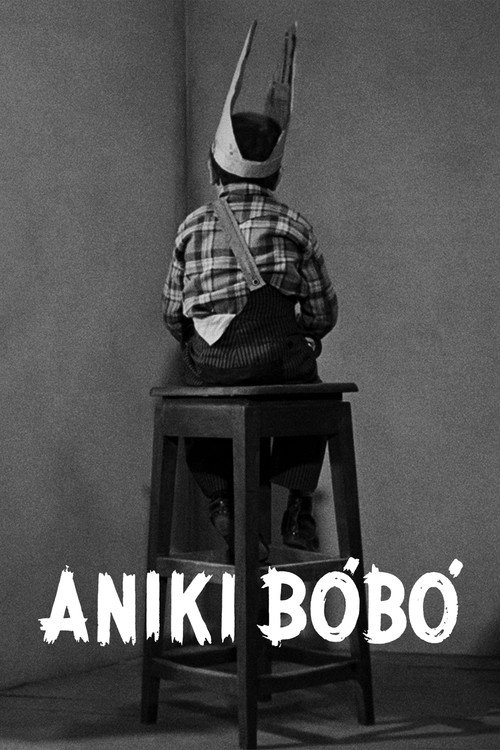
Aniki-Bóbó
1942 · Manoel de Oliveira
For a curious night when you want a short, humane classic — something gentle and genuinely charming that still gives you a knot in the stomach. Comfort viewing with a conscience.
What it's about
In the riverside streets of Porto, two schoolboys — timid Carlitos and his bolder rival Eduardo — compete for the affection of a girl named Teresinha. To win her over, Carlitos steals a doll from a shop window, and his small transgression curdles into guilt and dread when an accident by the river raises the stakes. It's a child's first brush with jealousy, courage, and conscience, treated with complete seriousness.
The experience
Light on its feet but morally weighty — it plays like a street game that keeps tipping into something darker, seen entirely at a child's eye level. Tender, a little suspenseful, and surprisingly modern in feel for a film from 1942.
The craft
Manoel de Oliveira shot on real Porto streets and quaysides with non-professional child actors, years before that approach became a European movement — the location texture and unforced kid performances still feel fresh. The famous 'Shop of Temptations' storefront shows his gift for making a single image carry a whole moral idea.
Why it matters
A founding landmark of Portuguese cinema and the fiction debut of Manoel de Oliveira, who would go on to one of the longest directing careers in film history; its street-level realism anticipated where European cinema was headed.
Snapshot
Aniki-Bóbó is Manoel de Oliveira's first fiction feature and one of the singular objects in the history of Portuguese cinema: a modestly scaled story of children — a shy boy, a bolder rival, and the girl they both want — that quietly rewired what a Portuguese film could look and sound like. Adapted from a short story by João Rodrigues de Freitas (commonly cited as Os Meninos Milionários), it follows Carlitos, a timid schoolboy who steals a doll from a shopfront tellingly marked Loja das Tentações ("Shop of Temptations") to win Teresinha's affection, and whose small transgression tips into guilt and dread when his rival Eduardo is injured in an accident by the river. Shot on the streets and quaysides of Porto with non-professional children, the film treats a child's moral world with complete seriousness, staging jealousy, theft, conscience, and fear of punishment as a compressed model of adult society. Its title comes from a Portuguese children's counting-out rhyme — the equivalent of "eeny-meeny" — signaling from the outset that games, rules, and their breaking are the film's real subject. Received tepidly, even dismissively, on release, it was later reclaimed as a masterwork and as an uncanny anticipation of Italian neorealism, made before the movement it seems to foreshadow.
Industry & production
Aniki-Bóbó was produced within the Portuguese film industry of the Estado Novo, the authoritarian corporatist regime under António de Oliveira Salazar. In 1942, with Europe at war and Portugal officially neutral, domestic cinema was dominated by the comédia à portuguesa — light musical comedies of manners — and by an emergent culture of state-sanctioned, folkloric or historical filmmaking. Against that commercial and ideological grain, a serious, location-shot children's drama was anomalous.
The film is generally associated with the production apparatus of António Lopes Ribeiro, the most powerful Portuguese producer-director of the period, whose company was central to feature production in these years; the exact contractual arrangements are documented unevenly in English-language sources, and I flag that as a genuine gap rather than fill it. What is not in doubt is that Oliveira, then in his early thirties and known chiefly for a single avant-garde documentary short, was working at the margins of an industry that had little use for what he was attempting. The production drew on Porto — Oliveira's native city — as both setting and resource: real streets, real river traffic on the Douro, and children recruited locally rather than trained performers. This grounding in a specific place and social milieu is itself a production decision with aesthetic consequences, and it distinguishes the film sharply from the studio-bound norm of its moment.
Technology
Technically, Aniki-Bóbó is a black-and-white, 35mm sound film of the early 1940s, running roughly seventy minutes. Like most Portuguese features of the era, it relies on post-synchronized sound: dialogue and effects were assembled in post-production rather than captured cleanly on location, a standard workaround given the difficulty of live sound recording on exterior shoots with the heavy equipment of the day. This technological reality shapes the film's texture — voices sit slightly apart from bodies, and the soundtrack has the constructed, slightly stylized quality typical of dubbed cinema of the period. The camera technology of 1942 imposed practical limits on mobility and low-light shooting, which makes the film's substantial use of real exteriors — quaysides, alleys, rooftops, the riverbank — notable: Oliveira and his crew carried a fiction narrative out of the controlled studio into an environment that the prevailing technology did not make easy. There is no exotic technical innovation to claim here; the achievement is one of pressing ordinary period tools toward an unusual, documentary-inflected end.
Technique
Cinematography
The photography is the film's most celebrated formal dimension. Working in Porto's granite streets and along the Douro, the film alternates between intimate, closely observed framings of the children and wider compositions that treat the city as a living stage — laundry, boats, staircases, the river as a horizontal band organizing the frame. The imagery draws directly on the tradition of the 1930s "city symphony" that Oliveira knew from his own earlier documentary work, and the film repeatedly pauses on the labor and rhythm of the riverfront in ways that exceed narrative necessity. English-language sources are inconsistent on the precise credit for director of photography, and rather than assert a name with false confidence I note that the technical crew is documented thinly outside Portuguese-language scholarship. What is clear on the screen is a sensibility that values real light, real depth, and the expressive charge of an actual place over decorative studio effect.
Editing
The cutting is broadly legible and classical in its storytelling — it tracks the rivalry, the theft, the accident, and the aftermath with clarity — but it is punctuated by more lyrical, associative passages, especially those built around the river and the working city. These documentary-like interludes give the film a rhythm closer to observation than to plot mechanics, so that the drama of the children is periodically dissolved into the larger drama of Porto itself. The editing thus performs the film's central move: it keeps sliding between the particular (these children, this doll, this fall) and the general (childhood as a condition, the town as a world).
Mise-en-scène / staging
Oliveira stages the children's world as a self-contained society with its own hierarchies, rituals, and codes of honor, mapped onto real urban geography. Schoolroom, street, shopfront, and riverbank each function as a distinct moral zone. The Loja das Tentações sign is the clearest instance of the film's willingness to let the physical set speak allegorically — temptation is literally lettered above the object of desire. Yet the staging never tips into heavy symbolism; the children are allowed to be genuinely childlike, chasing, taunting, and playing, so that the moral scheme emerges from behavior rather than being imposed on it. This tension — a rigorously organized symbolic space inhabited by loose, spontaneous life — is the signature of the film's mise-en-scène.
Sound
Given the post-synchronized production, sound is handled as a composed layer rather than a captured one. Music, the children's voices, the counting-rhyme motif of the title, and the ambient life of the river are woven into a track that supports the film's oscillation between fable and reportage. The specific musical credits are, again, documented unevenly in accessible sources, and I decline to invent them; what can be said is that the score and song material work with, not against, the film's tender-but-unsentimental tone.
Performance
The performances by non-professional children are central to the film's lasting reputation. Oliveira draws naturalistic, unforced playing from his young cast — Carlitos's downcast shyness, Eduardo's swagger, Teresinha's poised indifference — without the mannered "cuteness" that childhood subjects so often invite. The record on the young performers is thin: Carlitos is played by a boy usually credited as Horácio Silva, and the two other principal children are likewise local non-professionals, but full and reliable cast attributions are not consistently available in English sources, and I flag that rather than guess. The point that survives is methodological: Oliveira sought truth of behavior from untrained subjects in real places, a choice that aligns him, avant la lettre, with the casting philosophy of postwar realist cinema.
Narrative & dramatic mode
The dramatic mode is that of the moral fable rendered in a realist register. On its surface the film is a simple love-triangle among children; structurally it is a study of transgression and conscience. Carlitos's theft is petty in scale but total in its psychic consequence: the film is far more interested in the guilt that follows than in the act itself. Eduardo's fall introduces a second, graver moral weight — the fear of having caused harm — and the narrative's tension comes from whether truth, punishment, or grace will resolve the boy's dread. The mode is thus melodramatic in the precise, non-pejorative sense: it externalizes inner moral states into events. But Oliveira keeps the melodrama in check by embedding it in documentary observation and by refusing to sentimentalize either the crime or its resolution, so that the film reads as a serious inquiry into how conscience is formed, disguised as a story about kids.
Genre & cycle
Nominally a family drama and a "children's film," Aniki-Bóbó belongs to no comfortable genre of its national moment. It stands apart from the dominant comédia à portuguesa and from state-favoured folkloric production, and it does not fit the sentimental children's picture either. In the longer view it is most usefully placed at the head of a cycle it partly anticipates and partly inaugurates: the international tendency, crystallized after the war, to treat children's experience with realist gravity and to use childhood as a lens on social and moral order. Within Portuguese cinema it functions less as part of a cycle than as an isolated precursor whose "cycle" only arrives decades later, when the Novo Cinema generation adopts it as a founding text.
Authorship & method
The decisive authorial fact is that this is Manoel de Oliveira's first feature, made by a man who would go on to one of the most extraordinary careers in film history — directing into his second century and dying in 2015 at the age of 106. Aniki-Bóbó connects directly to his 1931 debut short, Douro, Faina Fluvial, a silent city-symphony documentary about labor on the Douro that was itself coolly received; the feature carries that documentary's river, its rhythms, and its fascination with Porto's working life into a fiction frame. Method here is characteristically Oliveira: adaptation of a literary source (the Rodrigues de Freitas story, reworked by Oliveira himself), fidelity to a specific place, and a willingness to let observation interrupt narrative. It is worth stressing that the film's lyrical, mobile, location-driven manner differs markedly from the austere, theatrical, frontally staged style of Oliveira's celebrated late work from the 1970s onward; Aniki-Bóbó shows the artist before that austerity set in, and is often loved precisely for its warmth. On collaborators: the screenplay is Oliveira's adaptation of Rodrigues de Freitas; the film is tied to the Lopes Ribeiro production milieu; and the cinematography and music credits, as noted above, are documented inconsistently in English-language scholarship — a real limit of the accessible record that I will not paper over with invented names.
Movement / national cinema
Within Portuguese national cinema, Aniki-Bóbó is a keystone. Made under the Estado Novo and out of step with that regime's preferred cinema, it later became the touchstone for the Novo Cinema (Portuguese New Cinema) that emerged in the early 1960s, whose filmmakers claimed Oliveira and this film as ancestors of a more personal, realist, socially attentive national practice. Internationally, the film is repeatedly discussed as an anticipation of Italian neorealism: its non-professional children, real locations, working-class milieu, and moral seriousness prefigure the postwar Italian films of Rossellini and De Sica by several years. That framing should be handled with care — Oliveira did not belong to and did not found neorealism — but the formal and ethical kinship is genuine and is the principal reason the film circulates in movement histories beyond Portugal.
Era / period
The film is a product of the early 1940s and of Salazarist Portugal during the Second World War. Its era shapes it in the negative as much as the positive: the constraints of a small, censored, comedy-dominated industry make its seriousness and its location realism read as acts of quiet independence. The period's technological conditions (post-synced sound, cumbersome cameras) and its ideological climate (a regime with clear preferences about what cinema should depict) form the backdrop against which the film's turn toward ordinary children in an ordinary city acquires meaning. It is very much a wartime European film in one respect — inward-turned, small-scale, humane — while remaining entirely local in its textures.
Themes
The film's governing themes are temptation, transgression, and conscience. Carlitos's theft and its aftermath dramatize the birth of moral awareness — the discovery that desire can lead to wrongdoing and that wrongdoing carries an inner cost. Guilt and the fear of punishment are rendered with real psychological weight, treated not as childish trifles but as the stuff of an ethical life. Around this sits a second cluster: childhood as a microcosm of society, where the children's games, rivalries, and codes mirror adult hierarchies and justice. The river runs through the film as an image of freedom, fate, and danger at once — the open horizon the boys dream toward and the site of the accident that endangers them. The recurring motif of watching and being watched — shopkeeper, schoolmaster, peers — gives the film a quiet preoccupation with surveillance and social judgment that some readings connect, cautiously, to the atmosphere of its authoritarian moment. Above all, the film insists on tenderness: it takes children seriously without punishing them, and its moral vision leans toward understanding rather than condemnation.
Reception, canon & influence
On release, Aniki-Bóbó was, by the consistent account of Oliveira's biographers, a commercial and critical disappointment, poorly understood in a market attuned to comedy and spectacle. The failure had lasting consequences for Oliveira, who did not build a steady feature career on it; he spent much of the following decades on documentary and short work and did not become a prolific maker of features until much later in life. Over time, however, the film's standing inverted completely. It came to be regarded as a masterpiece and as one of the founding works of modern Portuguese cinema, and the Novo Cinema generation embraced it as a precursor to their own project.
Its influences run backward to the 1930s avant-garde documentary and city-symphony tradition that Oliveira absorbed in Douro, Faina Fluvial — the observational treatment of urban labor and rhythm carried into fiction. Its influence forward is twofold. Domestically, it seeded a lineage of realist, personal Portuguese filmmaking and anchored Oliveira's own century-spanning body of work. Internationally, it is enshrined in film history as a startling anticipation of neorealism, cited whenever the movement's prehistory is discussed. On the frequently repeated claim that specific major critics championed it — André Bazin is sometimes invoked in connection with its neorealist affinities — the precise citations are handled loosely in circulating accounts, and I flag that the attribution of particular contemporaneous critical endorsements should be treated with caution rather than asserted as settled fact. What is secure is the trajectory: a film dismissed in 1942 that became, in retrospect, both a national foundation stone and a small, luminous puzzle in the international story of realist cinema — a movement it seems to belong to, yet arrived before.
Reception
A flop in Salazar-era Portugal in 1942 — audiences and critics shrugged, and Oliveira retreated to the family business — it was later rediscovered and hailed as a precursor of Italian neorealism, arriving years before Rome, Open City.
How Aniki-Bóbó was received, from release to now →
Influences: the films it descends from and the films it influenced
- Douro, Faina Fluvial (1931) — Oliveira carries his own silent city-symphony's observational treatment of Porto's docks — the Douro's currents, the rhythm of manual labor, the mobile documentary eye — directly into a fiction frame.
- Rien que les heures (1926) — Establishes the day-in-a-city armature and associative interludes that let observed street life interrupt narrative, the montage grammar Oliveira applies to Porto.
- Berlin: Symphony of a Great City (1927) — Model for rhythmic montage of urban labor and machinery organized by tempo rather than plot, the city-symphony template underlying Aniki-Bóbó's texture.
- Man with a Movie Camera (1929) — Camera-eye observation of daily work and associative cutting between unrelated actions, the editing logic behind Oliveira's lyrical documentary interludes.
- À propos de Nice (1930) — Fuses the city-symphony survey with social satire and an editorializing gaze, showing how observed urban rhythm can carry moral commentary.
- Zéro de conduite (1933) — Non-professional child performers enact a poetic-realist revolt against adult surveillance and authority, with dreamlike interludes suspending the plot — the exact register of Aniki-Bóbó's children under the watching adult world.
- Emil and the Detectives (1931) — A literary adaptation staging a self-organizing child society that enforces its own justice, shot among real city streets — the moral-microcosm-of-children structure Oliveira reworks from Rodrigues de Freitas.
- Sciuscià (1946) — Casts non-professional street children in a moral drama of transgression and guilt shot in real urban locations, extending Aniki-Bóbó's method four years later at neorealism's center.
- Ladri di biciclette (1948) — Builds a moral fable from non-professional actors and authentic location shooting, letting the observed rhythm of the working city surround the story — the neorealist consummation of Oliveira's premature realism.
- Germania anno zero (1948) — Threads a single child's conscience and transgression through documentary footage of a real, morally ruined city, the child-as-microcosm device on location.
- Los Olvidados (1950) — Non-professional street children, a watchful punitive adult order, and the tension between transgression and conscience play out in real Mexico City streets shot with near-documentary observation.
- The 400 Blows (1959) — A child's-eye chronicle of petty transgression and adult surveillance shot on real Paris locations with a non-professional lead, the childhood-fable-in-the-actual-city lineage carried into the New Wave.
- Os Verdes Anos (1963) — The founding Novo Cinema feature that explicitly claims Oliveira's inheritance — location-driven realism rooted in a specific Portuguese place and vernacular life, made by the generation that canonized Aniki-Bóbó.
- Pixote (1981) — Uses actual street children as non-professional actors in a location-shot moral fable of transgression and lost innocence, the harshest late extension of the child-microcosm realist line.
- Forbidden Games (1952) — Children construct a secret moral world with its own rites and guilt, framed as a fable, sharing Aniki-Bóbó's treatment of childhood as a self-contained ethical microcosm.
Similar films
- The 400 Blows (1959) — influence & lineage
- Bicycle Thieves (1948) — influence & lineage
- Shoeshine (1946) — influence & lineage
- The Young and the Damned (1950) — influence & lineage
- Germany, Year Zero (1948) — influence & lineage
- Pixote (1980) — shared sensibility
- My Sweet Orange Tree (2012) — shared sensibility
- Boy & the World (2014) — shared sensibility