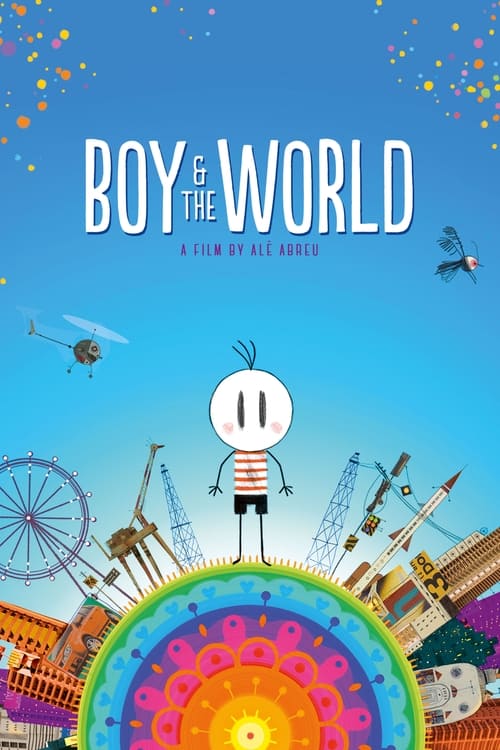
Boy & the World
2014 · Alê Abreu
For when you want beauty and imagination with real substance underneath — a family-friendly surface with an adult ache. Great with kids, but just as rewarding alone when you want a film that says a lot without words.
What it's about
A small boy in a Brazilian hillside village watches his father leave for work in the big city, and sets off to find him. His journey carries him through cotton fields, factories, ports, and a teeming metropolis — the whole machinery of the modern world seen through a child's eyes, rendered as a child might draw it. There's almost no intelligible dialogue; the story is told entirely in image, music, and sound.
The experience
Dazzling and bittersweet — it starts as pure play, all crayon color and samba, and gradually deepens into something melancholy and pointed about what the grown-up world costs. You come out moved and a little stunned that drawings this simple can carry this much.
The craft
The animation is the event: crayon, colored pencil, felt-tip, collage, and even flashes of live-action footage all sharing one white page, made over years by a tiny São Paulo team. The Brazilian score and inventive sound design do the storytelling that dialogue normally would — this one genuinely rewards good speakers and a big, bright screen.
Why it matters
It put Brazilian animation on the world map, riding festival acclaim to an Oscar nomination and proving a handmade, nearly wordless feature could travel globally.
Snapshot
O Menino e o Mundo is an eighty-minute Brazilian animated feature that tells the story of global capitalism as a child's drawing. A small boy in a hillside village loses his father to the train that carries labor toward the city; he sets out after him and travels, in effect, up the length of a commodity chain — cotton field, textile mill, port, metropolis — before the journey folds back on itself. The film has almost no comprehensible dialogue, no conventional voice performance, and no fixed graphic register: crayon, colored pencil, felt-tip, ballpoint, oil pastel, torn magazine collage and, late in the film, documentary live-action footage all share the same white page.
Made over roughly four years by a very small team working out of Alê Abreu's own São Paulo operation, Filme de Papel, it emerged from the festival circuit as one of the decade's genuine surprises: the Cristal for best feature and the Audience Award at Annecy in 2014, then, after a qualifying release from the American distributor GKIDS, an Academy Award nomination for Best Animated Feature at the 88th ceremony, where it stood alongside Inside Out, Anomalisa, Shaun the Sheep Movie and When Marnie Was There. For a hand-drawn Brazilian film with a budget that would not have covered a week of a major studio's production schedule, that placement was itself an argument about what animation could be.
Industry & production
The film's industrial interest lies in its scale — or rather its refusal of scale. Feature animation is, structurally, one of the most capital-intensive forms in cinema: pipelines, departments, hundreds of artists, multi-year overheads. Boy & the World was made under nearly opposite conditions, by a crew small enough that the film's visual signature is legibly the product of individual hands rather than a house style. Precise budget and headcount figures are not reliably documented in the English-language record, and I will not invent them; what is clear from the production's own account is that the film was assembled slowly, in a studio rather than a factory, with Abreu himself carrying the design, writing and direction.
That was possible because Brazil in the late 2000s and early 2010s had, for the first time in a long while, a functioning public film-financing architecture — the audiovisual tax-incentive laws, ANCINE's regulatory apparatus, and the sectoral fund established in the second half of the 2000s — that could underwrite projects with no commercial precedent. Brazilian animated features had historically been isolated events rather than an industry: Anélio Latini Filho's Sinfonia Amazônica (1953), Ypê Nakashima's Piconzé (1972), Clóvis Vieira's computer-animated Cassiopéia (1996), and the Maurício de Sousa Turma da Mônica pictures. What changed in the 2010s was continuity. The Annecy Cristal went to a Brazilian feature two years running — Luiz Bolognesi's Uma História de Amor e Fúria (Rio 2096) in 2013, Abreu's film in 2014 — which is less a coincidence than a signal that a cohort had reached maturity at once.
The other decisive industrial actor was GKIDS. Through the 2010s the New York distributor built a reliable pipeline by which internationally produced, hand-drawn, non-studio animation reached the Academy's animated-feature category: The Secret of Kells, Ernest & Celestine, The Tale of the Princess Kaguya, Song of the Sea, My Life as a Zucchini, The Red Turtle. Abreu's film entered American circulation through that channel in late 2015, roughly two years after its Brazilian release. Without it, the film would very likely have remained a festival object.
Technology
The relevant technology here is subtractive. Boy & the World was drawn on paper, scanned, and composited digitally; the pipeline is a desktop pipeline, and the film is a demonstration of what cheap scanning, digital compositing and non-linear assembly made possible for a director working outside an institution. Specific software credits are not well documented in accessible sources, and the film's makers have generally described the process in artisanal rather than technical terms.
What matters aesthetically is that the digital layer is used to preserve rather than clean up the analog one. Paper tooth, crayon skip, the waxy edge of an oil pastel, the halftone dots of a magazine clipping — all survive at full resolution. Compositing lets Abreu stack materials that could never coexist on a single physical cel: a ballpoint-line boy in front of a photographic newsprint skyline in front of a wash of pure white. The film's most technologically pointed gesture is its late incorporation of live-action documentary footage — clear-cut forest, industrial plant, smoke, machinery — dropped into the drawn world as raw indexical evidence. The seam is not hidden. The shift from drawn abstraction to photographic record is the argument.
Technique
Cinematography
There is no cinematographer, and the film makes a virtue of that. Its default camera is frontal and planar: figures move laterally across a blank field, staged almost as a scroll or a frieze. Depth, when it arrives, arrives violently — the descent into the city delivers plunging perspective, stacked verticals and a sudden crowding of the frame that reads as spatial assault after so much emptiness. White is used as negative space in the way a printmaker uses it, so that a single small figure against an unmarked page carries a charge that a rendered environment could not. Scale is the film's chief pictorial weapon: the boy is drawn tiny and simple; the machines, ships and towers are drawn vast and detailed, and the mismatch does the political work before a single event occurs.
Editing
Because the film is entirely constructed, cutting is inseparable from design; the record on a discrete editorial credit is thin. Formally, the film alternates two rhythms. Long, unhurried passages of travel and looking are built from held compositions and slow lateral movement. Against these, Abreu deploys accelerating montage — the harvest, the mill, the loading of the port — where cutting rate, graphic repetition and music lock together into something closer to a musical number than a sequence of dramatic beats. The film's largest structural move is a circular one: the closing passages return to the opening's imagery and to the old man, so that the journey can be read as memory, and the boy, the father and the old man collapse into a single life seen at three points. The film withholds the connective tissue that would make this a twist and instead lets it settle as recognition.
Mise-en-scène / staging
The design system is the film's thesis. Every element of the village and the natural world is drawn in curved, wobbling, hand-made line and saturated primary color; every element of the industrial order is drawn with rulers, grids, mechanical repetition and desaturated grays and blacks. Vehicles and machines are assembled as insect-like organisms — segmented, many-legged, exhaling — so that industry appears as an infestation rather than a construction. The film's central set piece pits an enormous plumed bird of many colors against a black armored bird, an allegory legible on contact: plural, syncretic popular culture against monocultural industrial force. The staging of labor is similarly diagrammatic — workers sorted at a gate, the rejected simply discarded — and this is where the film's abstraction acquires teeth.
Sound
Sound carries the narrative burden that dialogue would ordinarily carry. Characters speak an invented tongue produced, per the production's own account, by recording Portuguese and reversing it: the result has the cadence, warmth and emotional contour of speech without semantic content, which makes the film both universally legible and pointedly stripped of explanation. The score is credited to Ruben Feffer and Gustavo Kurlat, and the soundtrack draws widely on Brazilian and pan-Latin American musical resources — Andean flute timbres that quietly extend the film's geography beyond Brazil, samba and carnival percussion, body-percussion textures associated with the ensemble Barbatuques, and a contribution from the rapper Emicida whose entry into the film's late movement shifts it into contemporary urban Brazil. The organizing device is a three-note melodic fragment associated with the father, kept by the boy as a portable possession; the film's emotional architecture is the loss, corruption and recovery of that phrase, and color in the image tracks it.
Performance
There is no performance in the naturalistic sense. The boy is a circle, two dots, a line, a striped shirt — a figure with almost no capacity for facial expression. Everything expressive is therefore relocated: into the whole-body gesture of running, curling, reaching; into timing; into the scale relation between the figure and what surrounds him. This is animation acting in its oldest sense, closer to Chaplin's silent pantomime than to the vocally driven acting of contemporary studio features, and it is one reason the film travels across languages without dubbing.
Narrative & dramatic mode
The film's mode is picaresque-allegorical rather than dramatic. There is no antagonist with intentions, no negotiation, no reversal produced by a character's choice. The boy moves, and the world reveals successive layers of its own organization; the structure is a descent through a system — extraction, manufacture, circulation, consumption, waste — with each stage rendered as a distinct visual regime. Dramatic questions ("will he find his father?") are raised sincerely and then dissolved into a larger recognition, which is that the father cannot be found because the father has been absorbed into the machinery the boy is walking through. The film's final movement, in which allegory yields to documentary footage and then to a wounded landscape, has divided viewers: some read it as the necessary unmasking of everything the fable has encoded, others as a lapse into direct statement in a film that had until then trusted its images entirely. That tension is real and worth naming.
Genre & cycle
Nominally family animation, in practice art cinema in animated form. The film belongs to the 2010s cycle of internationally produced auteur animation that consolidated around Annecy and GKIDS — hand-drawn or hand-adjacent, formally distinctive, aimed at a dual audience, and defined against the American CG feature. Within that cycle it sits at the abstract, least narrative-driven end, closer to the essay-film tradition and to the ecological allegories of the National Film Board of Canada than to the folkloric storytelling of Cartoon Saloon or the domestic realism of Studio Ghibli's Takahata. It is also, straightforwardly, a rural-exodus narrative — one of the durable Brazilian subjects — transposed into a register where the migration can be shown as a national and continental process rather than a family incident.
Authorship & method
Abreu (b. 1971, São Paulo) came to the film through short work and one prior feature, Garoto Cósmico (2007), a comparatively conventional, more polished science-fiction animation whose reception evidently pushed him toward something less mediated. By his own repeated account, Boy & the World began as a research-driven project on Latin American history — the extraction economy, the coups, the dependency — and stalled under the weight of that material until a drawing of a small boy in a notebook suggested that the entire history could be told through a child's perception. The film's method is that substitution: everything that would have been exposition became image.
Abreu functioned as director, writer and principal designer, which is what makes the film's graphic incoherence coherent — the shifts between media are authored rather than departmental. Key collaborators are fewer and less individually documented than in a studio production: Feffer and Kurlat on score, Emicida and Barbatuques among the musical contributors, and a small animation team whose individual attributions are not well recorded in English-language sources. There is no cinematographer, and no widely credited editor; the film was cut from within its own construction.
Abreu returned to features with Perlimps (2022), a more conventionally narrated and more elaborately produced film that again premiered at Annecy — useful mainly as a contrast, since it demonstrates how specific to Boy & the World the earlier film's austerity was.
Movement / national cinema
The film's clearest inheritance is from Cinema Novo, and specifically from Glauber Rocha's "Aesthetic of Hunger" (1965): the insistence that material scarcity be converted into formal principle rather than concealed. A white page is not a shortcut here, it is a position. The rural-migration subject connects it to Nelson Pereira dos Santos's Vidas Secas (1963) and to a long Brazilian literary lineage of the sertão and the exodus, while the anti-extractivist argument places it within the broader Third Cinema tradition articulated by Solanas and Getino for a continent whose wealth leaves by ship.
Equally present is Brazilian modernism's antropofagia — Oswald de Andrade's 1928 proposition that the culture's method is the digestion of foreign forms into something native. A film that eats European modernist abstraction, American pop collage, Andean folk music, cordel woodcut and children's drawing, and produces from them a coherent Brazilian object, is enacting that program rather than illustrating it. The deliberate blurring of Brazil into a wider Latin America — the Andean flute, the condor-like bird — is a choice to make the film continental.
Era / period
2014 caught Brazil at an inflection: the tail of the commodities boom, the World Cup year, and the eve of a severe recession and political crisis. A film whose narrative engine is the export of raw material and the import of manufactured desire arrives with unusual timing, though its argument is structural rather than topical and has not dated. Internationally, it landed during the period when the animated feature's dominant form had become photoreal-adjacent CG and when festival and specialty distribution were building a parallel canon in deliberate opposition. Its Oscar nomination — hand-drawn, wordless, Brazilian, made by a handful of people — is best read as an artifact of that parallel system finally reaching the mainstream ballot.
Themes
Loss of the father, and the recognition that the father was taken by an economy rather than by choice. The child's perception as an epistemological instrument: the film argues that a child's eye sees the shape of a system more clearly than an adult's, because it does not naturalize it. Color as vitality and grayscale as extraction — the film's entire moral scheme is administered chromatically. Music as memory and as the last portable form of a culture. Rural exodus and the destruction of the village. Monoculture, in both agricultural and cultural senses, as the film's true antagonist. And, in the circular structure, time: the discovery that the boy's future is the ruined old age he has already met, which converts the film from a lament about the past into a warning about the present.
Reception, canon & influence
Critical reception was strong and remarkably consistent across territories — the Annecy Cristal and Audience Award in 2014 (a rare double, indicating it satisfied both the specialist jury and a general audience), a long run of festival prizes through 2014–15, and, following GKIDS's American release, the Academy Award nomination. English-language criticism converged on the film's formal daring and emotional directness; the principal dissenting line concerned the final act's turn toward explicit environmental didacticism and the live-action insert, which some critics found blunt after so much confidence in metaphor.
Backward, the influences are broad and mostly acknowledged in the film's surface. The crayon-textured ecological allegories of Frédéric Back (Crac!, The Man Who Planted Trees) are the closest animation antecedent. Modernism's long fascination with the child's hand — Klee, Miró, Dubuffet's art brut — underwrites the design premise that naïveté can be a rigorous technique. The pop-collage psychedelia of Yellow Submarine (1968) informs the city and carnival passages; Chaplin's Modern Times (1936) and Lang's Metropolis (1927) stand behind the mill and the machine-city; the wordless, gestural comedy of Sylvain Chomet's The Triplets of Belleville (2003) is a nearer contemporary parallel. And beneath all of it sits Brazilian popular graphic culture, especially the woodcut idiom of cordel pamphlets.
Forward, the film's influence has been institutional as much as stylistic. It, together with Rio 2096, established that Latin American animation could compete at the top of the festival system rather than in a regional bracket, and it contributed materially to the visibility that carried later Latin American features — Colombia's Virus Tropical (2017), Brazil's stop-motion Bob Cuspe (2021), Abreu's own Perlimps (2022) — into international circulation. Stylistically, it functions as a standing proof that a feature can abandon dialogue, consistent rendering, and narrative causality and still hold a general audience, which is a permission that independent animators have continued to draw on. It has also had a substantial second life in education and environmental programming, where its wordlessness makes it borderless. Within the canon, it is now routinely cited as one of the two or three essential Brazilian animated features and as a key entry in the 2010s international auteur-animation wave — a film whose smallness of means is inseparable from the size of its subject.
A Deleuzian reading
A boy stands on a white page.
The full Deleuzian reading of Boy & the World →
Reception
A festival darling from the start — it took the Cristal at Annecy 2014 — but its real breakout was the 2016 Oscar nomination, which turned a tiny Brazilian indie into the little-film-that-could of the animation world overnight.
How Boy & the World was received, from release to now →
How to watch Boy & the World: what to notice on a first viewing
- Watch how much blank white space surrounds the boy. Abreu draws the boy as a tiny circle, two dots, and a line against mostly empty white pages, refusing to fill the frame with rendered background. The emptiness keeps you focused on how small he actually is inside everything that follows.
- Notice how tiny the boy looks next to the machines. The boy stays a simple, small figure throughout, while ships, towers, and machinery are drawn vast and mechanically detailed, so the mismatch in scale is constant. You register the imbalance of power before the story tells you anything about who is in charge.
- Notice the switch from crayon color to gray ruled lines. Everything from the village and natural world is drawn in wobbling hand-made line and saturated primary color, while the industrial order arrives in rulers, grids, and desaturated grays and blacks. You can read which world a scene belongs to just from its color and line, before anything happens in it.
- Listen for speech that has cadence but no actual words. Characters speak an invented tongue made by recording Portuguese and playing it backward, so voices carry warmth and emotion without any meaning you could translate. You are made to read the story the way the boy does, through tone and gesture rather than words.
- Notice how the machines look segmented and many-legged, almost alive. Vehicles and industrial equipment are designed like insects, jointed and exhaling, so factories and ships read as a kind of infestation rather than ordinary construction. Industry looks like something that could crawl, which makes it feel like a threat before it does anything threatening.
The whole guide to watching Boy & the World, with the keys for a rewatch →
Influences: the films it descends from and the films it influenced
- Metropolis (1927) — The vertically stratified machine-city and the Moloch-machine that eats shift-changing workers in lockstep files supplies Abreu's tiered metropolis and his gear-driven 'insect machines,' where laborers are drawn as identical small units fed into an animate industrial organism.
- Modern Times (1936) — Wordless pantomime as the sole carrier of social critique — the body threaded through conveyor and cogwheel in flat lateral framing — is the direct model for the cotton-mill and factory passages, where the boy's gestures and the machine's rhythm do all the exposition.
- Begone Dull Care (1949) — Hand-worked abstract color forms cut and pulsed to a percussive jazz track establish the visual-music discipline behind Abreu's non-representational montage bursts, where shape and stain are edited to the beat of the Barbatuques/Feffer percussion rather than to story.
- Black God, White Devil (1964) — Cinema Novo's 'aesthetics of hunger' — cordel woodcut iconography and a sung ballad-narrator organizing national history as folk pamphlet — underwrites Abreu's decision to render Brazilian extraction economics in the graphic idiom of cheap popular print and to let song, not dialogue, carry chronology.
- Yellow Submarine (1968) — Pop-collage animation that switches media mid-sequence — photo cutout, halftone print texture, rotoscope, flat color field — is the precedent for Abreu's authored graphic incoherence in the city and carnival passages, where scanned paper, crayon and printed matter coexist in one shot.
- Macunaíma (1969) — Antropofagia turned into film form: a naïve folkloric protagonist swallowed by the industrial city, with foreign visual languages deliberately eaten and re-spat in a Brazilian register — the same structural move Abreu makes by absorbing European modernist drawing into a cordel-derived design system.
- Bye Bye Brasil (1980) — The caravan structure that carries characters from the emptied backland through plantation and port to the coastal metropolis, with each stop measuring what modernity has displaced, is the itinerary Abreu reuses as his boy's cotton-field-to-city-to-return journey.
- Crac! (1981) — Wordless, music-driven crayon animation that follows a single humble rural object into the industrialized city across decades — with drawn texture left visibly unrendered and white paper breathing through the frame — is the closest formal template for Abreu's whole method.
- Koyaanisqatsi (1982) — A dialogue-free feature built entirely from rhythmic montage of extraction, assembly line and commodity flow, locked to a repetitive minimalist score, plus the tactic of cutting to unmediated documentary footage of ecological damage — precisely the device of Abreu's contested live-action insert.
- The Man Who Planted Trees (1987) — Colored pencil on frosted cel with deliberate white negative space and dissolving edges proves that ecological allegory can be carried by an unstable, hand-visible drawing surface; Abreu's paper-scan-and-digital-composite pipeline reproduces that tactility without cel.
- Virus Tropical (2017) — A Colombian feature animated from raw ink drawing with visible line weight and unpolished frames, released into the international circulation Abreu's Annecy-and-Oscar run opened for Latin American hand-made animation outside the regional bracket.
- Tito and the Birds (2018) — Brazilian political allegory told through a deliberately non-uniform painterly surface — oil-on-glass-derived textures that smear and destabilize with the characters' fear — extending Abreu's premise that rendering inconsistency can itself be the film's argument.
- Bob Cuspe: We Do Not Like People (2021) — Brazilian stop-motion that translates a national print-comics idiom (Angeli's scratchy underground line) into puppet and set design, and reached Annecy competition through the festival channel Abreu's success established for Brazilian feature animation.
- Perlimps (2022) — Abreu's own return: the same crayon-and-collage vocabulary, invented-language dialogue and scale-contrast staging of tiny figures against vast flat color fields, now applied inside a conventionally narrated plot rather than a perceptual chronicle.
- Flow (2024) — A feature with no dialogue at all, built on near-solo authorship and carrying meaning through non-verbal vocalization, camera movement and a leitmotif score — the clearest recent exercise of the permission Boy & the World won for the wordless, small-team animated feature.
- The Triplets of Belleville (2003) — A feature that runs on caricatured silhouette design, grunt-and-gesture performance and a found-object percussion score instead of dialogue — the nearest contemporary demonstration that wordless character animation can hold ninety minutes of a general audience.
- Rio 2096: A Story of Love and Fury (2013) — The other Brazilian feature of the same moment to compress five centuries of colonization, dictatorship and resource conflict into a single allegorical animated arc, sharing the strategy of standing historical exposition in for image and pushing Latin American animation into the top festival bracket alongside it.
- Song of the Sea (2014) — Same-year proof of the flat-graphic auteur feature: planar frontal staging and compositions built from decorative folk pattern and geometric flat color rather than volumetric perspective, with national vernacular ornament used as the primary design system.
Similar films
- Flow (2024) — influence & lineage · same viewing thread
- Rio 2096: A Story of Love and Fury (2013) — influence & lineage
- Arco (2025) — same viewing thread
- Robot Dreams (2023) — same viewing thread
- Memoir of a Snail (2024) — same viewing thread
- Isle of Dogs (2018) — same viewing thread
- WALL·E (2008) — same viewing thread
- The Wild Robot (2024) — same viewing thread
All the films related to Boy & the World →
Watch it with: curated runs of related films
- Animation That Aches — A run of animated films that take loneliness, grief, and memory as seriously as any live-action drama — watch them in a row and the cartoon surface stops mattering.