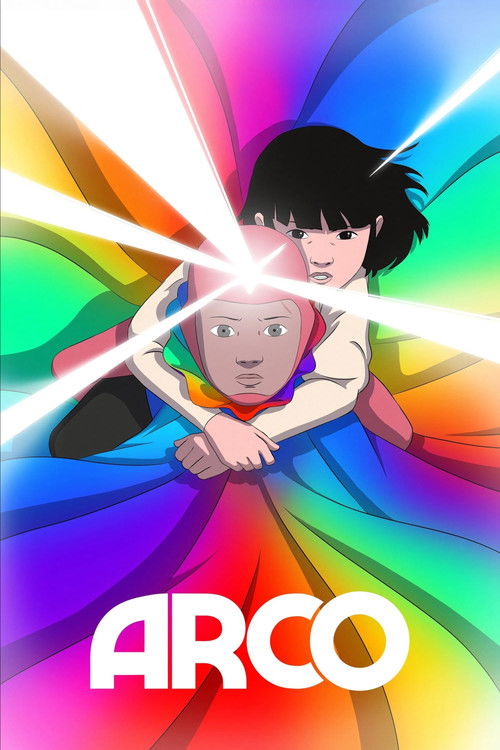
Arco
2025 · Ugo Bienvenu
For when you want animation that feels hopeful without being sugary — a family night, or a solo evening when you need to believe the future might still be beautiful. Comfort viewing with a real heart, not a challenge.
What it's about
A ten-year-old boy named Arco lives in a luminous far future where children fly by putting on rainbows. On his very first flight the suit gets away from him and he tumbles backward through time, crash-landing in the year 2075 — a nearer, more troubled world — where a girl his own age named Iris takes him in and quietly resolves to get him home. It's a friendship story stretched across centuries, with a conspiracy-tinged adult world circling the two kids.
The experience
Gentle, wondrous, and quietly melancholy — it moves at a child's pace of discovery, with bursts of airborne joy and an undertow of worry about the world Iris actually lives in. It leaves you tender rather than wrecked.
The craft
Hand-drawn 2D animation from a director who came out of graphic novels, and it shows: clean lines, glowing color, and a central image — a child flying on a rainbow — that the whole film is built around. The Cannes premiere and Annecy's top prize, plus a César for its original score, point to how much care went into both the images and the music. It rewards a big screen where the color can really pour.
Why it matters
A breakout feature debut that swept from Cannes to the Cristal at Annecy to César wins, instantly placing Ugo Bienvenu among the names to watch in European animation.
Snapshot
Arco is the feature-directing debut of Ugo Bienvenu, a French cartoonist and illustrator who arrived at animation from the world of the graphic novel. Running roughly 89 minutes, it is a hand-crafted 2D science-fiction fable in which a ten-year-old boy, Arco, falls out of a luminous far future — the film places his home in the year 2932 — and crash-lands in a troubled 2075, where he is taken in by Iris, a girl of his own age. Its central image is disarmingly simple: a child who flies by donning a rainbow, the arc of colored light doubling as a time machine and as the film's emblem of hope. Premiered in the Cannes Special Screenings section on 16 May 2025 and crowned with the Cristal for Best Feature at Annecy weeks later, Arco went on to an unusually decorated season — César Awards for Best Animated Film and Best Original Music, an Annie for Best Independent Feature, a Lumière Award, and a nomination for the Academy Award for Best Animated Feature at the 98th ceremony. That a first-time feature director's independent, artisanal French film reached the Oscar shortlist marks it as one of the notable animation events of its year.
Industry & production
Arco is a European auteur-animation project scaled up by American producing muscle. It was made through Remembers, the Paris studio Bienvenu co-founded with Félix de Givry, and co-produced by MountainA, the Paris–New York banner of Natalie Portman and Sophie Mas; additional partners included France 3 Cinéma, Fit Via Vi Film Productions, and Sons of Rigor, with support from the Fondation Gan pour le Cinéma, a body with a long record of backing first features. Portman's involvement — as producer and, in the English-language version, a voice — gave a modestly budgeted French film transatlantic reach: Diaphana handled French distribution while Neon took North America, and the picture was assembled with two casts, a French track and an English-language dub aimed at the U.S. market. The production reportedly drew on a team of around 130 people, and much of the interest in the industry coverage centered on Bienvenu's effort to keep a handmade look intact while coordinating a crew of that size — the recurring tension of contemporary artisanal animation, where a singular drawn sensibility must survive an industrial pipeline. Exact budget figures and box-office returns are not something the public record establishes clearly, and this dossier will not guess at them.
Technology
As a drawn film, Arco belongs to the tradition of 2D animation rather than the CG-and-simulation lineage that dominates studio family features. Its technological signature is the marriage of a hand-drawn, illustrative surface with digital production tools — the compositing, color, and camera moves of a modern 2D pipeline deployed in service of an image that reads as ink and painted color rather than rendered volume. The most conspicuous "technology" on screen is diegetic and thematic: the rainbow suit that lets Arco fly and slip through time, and, in the 2075 strand, a near-future domestic world textured by screens, surveillance, and household robotics. The film's imagination of the future is deliberately retro-futurist — warm, analog, and optimistic — rather than the cold chrome of much screen science fiction, and that choice is itself a statement about technology: a plea for tenderness against a technocratic default. Precise details of the studio's software and rendering pipeline are not well documented publicly, so the account here stays with what the finished images and the production's own descriptions support.
Technique
Cinematography
Because Arco is fully animated, "cinematography" means designed framing, staged depth, and a virtual camera rather than photographed light. The film's visual scheme is organized around color as structure: the spectrum of the rainbow is not merely a motif but a compositional and emotional key, with the far-future passages tending toward luminous, saturated harmony and the 2075 sequences toward a more grounded, muted register. Compositions favor clarity and legibility — a debt to Bienvenu's page-design instincts — with depth built through flat planes and considered staging rather than photoreal atmosphere. The precise contribution of individual technical leads on framing and camera is not thoroughly documented in available sources.
Editing
The film was cut by Nathan Jacquard. Its dramatic architecture is a cross-time structure — Arco's arrival and the pull of home set against Iris's present — and the editing's task is to bind those registers into a single propulsive adventure at family-film length. Reviewers received it as brisk and emotionally direct, a compact fable rather than a sprawling epic, which is consistent with the roughly 89-minute runtime.
Mise-en-scène / staging
Staging is where Bienvenu's origins as a cartoonist are most legible. The film composes its worlds with the graphic economy of the bande dessinée: strong silhouettes, readable spatial relationships, and settings that function as designed objects — the future as a coherent illustrated place, the 2075 household as a lived-in near-present. The rainbow flight sequences are the set-pieces the whole conception builds toward, staging movement as an arc of color across the frame. Production and festival materials stress the "handcrafted" quality of this world-building, and the film's optimism is carried as much by design and palette as by plot.
Sound
Music is central to the film's reception and to its awards: Arnaud Toulon's score won the Best Original Soundtrack prize at Annecy and the César for Best Original Music, an unusually strong showing for the sound side of an animated feature and a signal that the music does substantial dramatic work rather than merely accompanying. Detailed accounts of the sound design and mix are thin in the public record, so this dossier notes the score's prominence without overstating what can be verified about the wider soundtrack.
Performance
Voice performance carries the characters, and Arco was built in two vocal versions. The French track pairs newcomers in the child roles — Oscar Tresanini as Arco and Margot Ringard Oldra as Iris — with a deep bench of French screen and music talent, including Swann Arlaud, Alma Jodorowsky, Vincent Macaigne, Louis Garrel, William Lebghil, the rapper Oxmo Puccino, and producer Sophie Mas. The English-language version assembles a marquee American cast including Mark Ruffalo, Natalie Portman, Will Ferrell, Andy Samberg, Flea, and America Ferrera, with young performers in the leads. The two casts give the film distinct textures — the French version rooted in a specific national performance culture, the English one pitched toward broad crossover — a duality typical of internationally-minded European animation.
Narrative & dramatic mode
The dramatic mode is the children's time-travel adventure inflected toward the fable and the tearjerker. Its engine is a classic separation-and-return structure: a child stranded far from home, a rescuer who becomes a friend, and a race to send him back — a shape that runs from mythic quest to the domestic wonder of a Spielbergian friendship story. But Arco leans less on suspense than on tenderness and idea. The premise carries a built-in melancholy — to go home is to leave Iris — and the film uses its cross-time device to reflect on hope, loss, and the future we bequeath to children. Bienvenu has described the film in explicitly affective terms, calling it "a big hug" and "a metaphor for the best thing that could happen," which locates its ambitions in feeling and moral clarity rather than plot mechanics.
Genre & cycle
Arco sits at the intersection of family animation and science fiction, drawing on the utopian/near-future tradition rather than dystopia: even its chaotic 2075 is framed as something to be redeemed by tenderness. Within animation, it belongs to the ongoing cycle of adult-authored, artisanally hand-drawn features that European festivals — Annecy above all — have championed as an alternative to computer-generated studio product. Its emphasis on a singular illustrator's hand, its literary-fable ambitions, and its festival-first release pattern align it with that auteur-animation cycle more than with mainstream family franchises, even as its bilingual casting and Neon release reach for the latter's audience.
Authorship & method
This is decisively an author's film. Bienvenu came to Arco from the graphic novel, where he built a reputation for clean, illustrative draftsmanship and science-fiction storytelling preoccupied with memory, preservation, and the future — concerns that run directly into this film. He co-wrote the screenplay with his longtime collaborator and Remembers co-founder Félix de Givry, making the film an extension of a sustained creative partnership rather than a work-for-hire assignment. The method is that of a cartoonist directing: world and character designed with a page-maker's economy, then animated by a large team charged with preserving that hand. His key above-the-line collaborators are legible in the credits and the awards — composer Arnaud Toulon, whose score was singled out repeatedly, and editor Nathan Jacquard — while the producing partnership with Natalie Portman and Sophie Mas at MountainA gave the project its international scaffolding. Where individual department heads beyond these names are concerned, the public record is comparatively sparse, and this account does not fill those gaps with invention.
Movement / national cinema
Arco is a French film and a product of France's distinctive animation ecosystem — a national cinema that, backed by public support and a strong bande dessinée culture, has become one of the world's leading sources of auteur-driven animated features. It stands in the lineage that runs from the graphic sensibilities of French comics into the cinema, and it is precisely the kind of work the Annecy festival exists to elevate. Bienvenu's move from published comics into feature animation is itself characteristic of the French model, where the boundary between the drawn page and the animated screen is unusually porous.
Era / period
The film is a mid-2020s work, released in 2025 into a moment when hand-drawn and non-photoreal animation had regained critical prestige as a deliberate alternative to hyperreal CG. Its optimism reads as a period statement: made in an anxious decade, it consciously chooses hope and tenderness, and its retro-futurist design looks back to older, warmer imaginations of tomorrow rather than forward to a sleek dystopia. In that sense the film is doubly "period" — set across two future dates, 2932 and 2075, yet unmistakably a document of the sensibilities of its own moment of making.
Themes
The film's governing themes are hope, tenderness, and the ethics of the future — what kind of world adults are building for the children who will inherit it. Time travel becomes a device for meditating on loss and connection: friendship formed across an impassable gap, and the ache of a homecoming that is also a parting. Memory and preservation, longstanding preoccupations in Bienvenu's comics, surface again in the film's concern with what is worth keeping across time. And color itself is thematized — the rainbow as an image of possibility, wonder, and reconciliation, binding the film's science-fiction premise to its emotional argument that the future can be met with warmth rather than dread.
Reception, canon & influence
Critically, Arco was received as a charming, visually distinctive, emotionally generous fable, and its festival and awards record is the strongest evidence of its standing: a Cannes Special Screenings launch, the Annecy Cristal for Best Feature plus the festival's soundtrack prize, César Awards for Best Animated Film and Best Original Music, an Annie for Best Independent Feature, a Lumière Award, and an Academy Award nomination for Best Animated Feature. For a debut feature by a cartoonist, working independently and at artisanal scale, that is a remarkable trajectory.
The influences on the film run backward through French comics and its retro-futurist forebears — the bande dessinée tradition that shaped Bienvenu's line and world-building, and the wider heritage of humane, wonder-driven science fiction in animation and children's adventure. Bienvenu's own graphic novels, with their recurring themes of memory and the future, are the most direct source, making Arco the cinematic outgrowth of a body of work already circling these ideas.
Its influence forward is, at this writing in 2026, still emerging and should be described with appropriate caution. What can be said is that Arco has functioned as a proof of concept: that a singular illustrator's hand-drawn vision, backed by nimble international producing and a boutique distributor, can travel from Cannes to the Oscars. As a high-water mark for Remembers and for MountainA's move into auteur animation, and as a visible success for French hand-drawn feature-making in the mid-2020s, it is positioned to encourage similar cartoonist-to-cinema crossovers. Any larger claim about a lasting legacy would be premature, and this dossier flags it as an open question rather than a settled fact.
Reception
Arco had a charmed first year rather than a reappraisal: a Cannes 2025 Special Screening premiere, then the Cristal — Annecy's top prize — weeks later, then a Neon pickup and a proper awards push, including European Film Award nominations.
How Arco was received, from release to now →
Influences: the films it descends from and the films it influenced
- Le Roi et l'oiseau (1980) — Establishes the French poetic-auteur hand-drawn feature in which a single artist's line governs an elaborate retro-futurist vertical architecture — the tower-city model of building a whole world from an illustrator's draughtsmanship that Bienvenu inherits.
- La Planète sauvage (1973) — Proves a graphic artist's flat illustrative design (Roland Topor's ligne) can carry a feature-length science-fiction fable, the illustrator-drives-the-world method underpinning Arco's page-maker economy.
- Les Maîtres du temps (1982) — Moebius's bande dessinée line designing a children's time-and-rescue sci-fi adventure is the direct BD-artist-to-cinema precedent for Arco's retro-futurist cross-time structure.
- Nausicaä of the Valley of the Wind (1984) — A comics author directing an adaptation of his own drawn serial, preserving the mangaka's hand across a large animation team — the exact authorship model of a cartoonist transposing his page to the screen.
- Castle in the Sky (1986) — Codifies the humane, wonder-driven retro-futurism — a child's flight through anachronistic sky-machines — that Arco's rainbow-flight fable descends from tonally and in world-design.
- Persepolis (2007) — The paradigmatic bande dessinée author directing her own graphic novel into 2D animation, keeping the book's stark ligne-claire flatness intact — the cartoonist-to-cinema crossover Arco explicitly extends.
- Avril et le monde truqué (2015) — Built on Jacques Tardi's ligne-claire designs to render an alternate retro-futurist France, the BD-master-drives-a-sci-fi-feature template closest to Arco's own visual DNA.
- Ernest & Célestine (2012) — Reproduces an illustrator's loose, tender watercolor line (Gabrielle Vincent's) at feature scale for a children's story of separation and return — the same warmth-preserving artisanal approach to a picture-maker's hand.
- L'Illusionniste (2010) — An artisanal French feature that subordinates a whole team to preserving one draughtsman's delicate line and muted palette, modeling the hand-first production discipline Arco requires.
- Song of the Sea (2014) — Cartoon Saloon's flat decorative illustration where color fields, not depth, organize the frame — the color-as-structure staging Arco borrows from illustration rather than cinematography.
- The Red Turtle (2016) — A wordless, minimalist illustrative fable of loss and return whose restraint and clean contour show the same illustrator's economy applied to a humane wonder-tale.
- J'ai perdu mon corps (2019) — Part of the French adult-auteur 2D revival, using a cross-time flashback structure and hand-drawn intimacy that parallels Arco's memory-and-preservation editing logic.
- Le Sommet des dieux (2021) — A French hand-drawn feature adapting a comics source with disciplined clean-line draftsmanship, contemporary proof of the BD-to-screen line-preservation Arco practices.
- Linda veut du poulet! (2023) — Assigns each character a single flat solid color so hue itself carries staging and legibility — the most literal sibling to Arco's color-as-structure facet.
- Mars Express (2023) — A French 2D retro-futurist science-fiction feature that, like Arco, keeps hand-drawn character line inside a designed future world rather than defaulting to CG.
- The Boy and the Heron (2023) — A contemporary author-animator's hand-drawn fable of separation, memory and passage between worlds, sharing Arco's tender-wonder register and single-authored vision.
- Wolfwalkers (2020) — Foregrounds visible pencil line and graphic pattern as the animation's organizing system, a mid-2020s hand-drawn-revival peer asserting illustration over photorealism alongside Arco.
Similar films
- The Boy and the Heron (2023) — influence & lineage
- Boy & the World (2014) — same viewing thread
- In Waves (2026) — same viewing thread
- Flow (2024) — same viewing thread
- Little Amélie or the Character of Rain (2025) — shared sensibility
- Nimona (2023) — shared sensibility
- The Little Prince (2015) — shared sensibility
- Ponyo (2008) — shared sensibility
All the films related to Arco →
Watch it with: curated runs of related films
- Animation That Aches — A run of animated films that take loneliness, grief, and memory as seriously as any live-action drama — watch them in a row and the cartoon surface stops mattering.