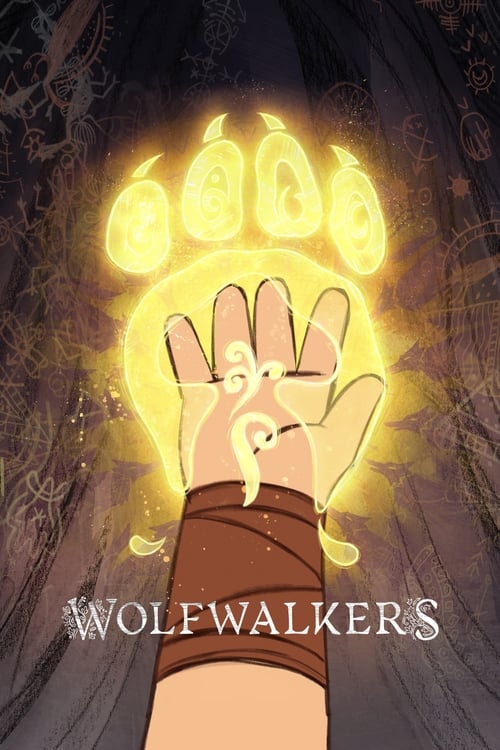
Wolfwalkers
2020 · Tomm Moore
For a family night when you want something genuinely beautiful, not just babysitting — or when you're craving an adventure with real heart and a wild streak. Comfort viewing with claws: warm at the center, thrilling at the edges.
What it's about
Kilkenny, 1650: an English hunter has been brought to Ireland to wipe out the last wolf pack, and his daughter Robyn — an eager apprentice with a crossbow — sneaks into the forbidden forest to prove herself. There she meets Mebh, a wild red-haired girl who can leave her body when she sleeps and run with the wolves. Their friendship pulls Robyn into the hidden world of the Wolfwalkers, setting her loyalties against everything her father has been ordered to destroy.
The experience
It moves like a storybook that keeps breaking into a sprint — cozy and funny when the two girls are together, then suddenly breathless when the hunt closes in. The wolf-run sequences are pure sensory joy, and the last stretch will have kids and adults equally on the edge of the couch.
Performances
Honor Kneafsey and Eva Whittaker voice the two girls with unforced warmth — Whittaker's Mebh in particular is all giggles, growls, and sudden ferocity — while Sean Bean brings a weary tenderness to the hunter father caught between duty and his daughter.
The craft
Every frame argues with itself: the occupied town is drawn in rigid verticals and woodcut crosshatching, all cages and right angles, while the forest breathes in loose, rounded pencil lines with the sketch marks left deliberately visible. When the film drops into wolf-vision — rushing charcoal-and-gold passages built from scent and sound — hand-drawn animation does something no camera could. See it as big as you can, with the folk-inflected score turned up.
Why it matters
The Oscar-nominated closing panel of Tomm Moore's Irish folklore trilogy, it confirmed Cartoon Saloon as the world's standard-bearer for hand-drawn animation in the CG era.
The closing panel of Tomm Moore's Irish folklore triptych — after The Secret of Kells and Song of the Sea — is set in Kilkenny in 1650, where Cartoon Saloon itself keeps its studio: an English hunter's daughter, brought over to help exterminate the last wolves, befriends a wild girl who leaves her body when she sleeps and runs with the pack. Moore and co-director Ross Stewart build the entire film on a graphic opposition. The Cromwellian town is drawn in rigid verticals and woodcut crosshatching, all cages and right angles; the forest breathes in loose, rounded pencil lines with the construction sketches deliberately left visible, as if the wild refused to be finished. When the film shifts into wolf-vision, it drops into rushing charcoal-and-gold sequences rendered from scent and sound — hand-drawn animation doing something no camera could. Beneath the children's-adventure surface runs a pointed colonial allegory about the taming of Ireland, its language, and its women. Oscar-nominated in a pandemic year when it could barely be seen in cinemas, it confirmed Cartoon Saloon as the great keeper of the 2D flame — a studio of national draughtsmanship to set beside Ghibli and Aardman.
A Deleuzian reading
Look at the trees before you look at what happens in them.
The full Deleuzian reading of Wolfwalkers →
Reception
Acclaimed instantly in 2020 but semi-buried by its pandemic release on a then-young Apple TV+, it's since become the consensus pick as the film that should have beaten Soul at the Oscars — its stature has only climbed as the capstone of Cartoon Saloon's folklore trilogy.
How Wolfwalkers was received, from release to now →
Influences: the films it descends from and the films it influenced
- The Secret of Kells (2009) — Establishes Cartoon Saloon's flattened, illuminated-manuscript picture-space where Celtic knotwork and geometric interlace organize the frame, the same logic that renders Wolfwalkers' forest as swirling organic linework against the town's grid.
- Song of the Sea (2014) — Its watercolor palette, spiral/circular compositional motifs, and human-to-seal transformation folklore are the direct formal template for the human-wolf transformation and roundness-versus-rigidity staging of Wolfwalkers.
- Princess Mononoke (1997) — Stages wild-versus-civilization as forest spirits against an industrial iron-town, and its wolf-raised girl San is the clear character template for feral Mebh and the wolfwalker pack.
- The Tale of the Princess Kaguya (2013) — Deliberately leaves charcoal and brush construction lines visible with passages of bare paper, the exact 'visible construction sketches' device Wolfwalkers borrows to keep the drawn mark present.
- Hedgehog in the Fog (1975) — Renders atmosphere, scent, and sound as tangible glowing visual layers within fog, precedent for Wolfwalkers' wolf-vision that makes smell and sound legible as radiating graphic forms.
- The King and the Mockingbird (1980) — Opposes the towering rigid architectural verticals of tyranny to organic, rounded freedom, the 'rigid verticals vs rounded lines' compositional grammar Wolfwalkers uses for walled town against wild wood.
- Kirikou and the Sorceress (1998) — Builds folklore from flat decorative silhouette and bold pattern drawn from non-Western graphic traditions, a precedent for reading character and landscape through graphic opposition rather than modeled volume.
- The Man Who Planted Trees (1987) — Soft-pencil, dissolving hand-worked textures in which the drawing visibly breathes and reforms, a texture precedent for Wolfwalkers' loose, hand-hatched line that refuses clean digital edges.
- The Wrong Trousers (1993) — Aardman's rounded, homely English-domestic character staging and comic warmth is half of the 'Ghibli and Aardman' DNA behind the Goodfellowe household's soft shapes and humor.
- Gerald McBoing-Boing (1950) — UPA's flat modernist design rejected Disney's rounded volumetric depth for bold shape and negative space, the deep root of the graphic-opposition, anti-illusionist 2D that Wolfwalkers extends.
- The Breadwinner (2017) — Cartoon Saloon stablemate using the same flat geometric folk-illustration language and a colonial/oppression allegory, with an embedded story-within-story shift in graphic register.
- Klaus (2019) — Revives 2D hand-drawn feature animation with volumetric painted lighting, part of the same late-2010s hand-drawn renaissance that made a lavish drawn feature like Wolfwalkers commercially viable.
- Puss in Boots: The Last Wish (2022) — Adopts a painterly, reduced-frame-rate look with visible brushstroke and outline that non-photoreal hand-crafted features like Wolfwalkers helped legitimize inside mainstream CG animation.
- My Father's Dragon (2022) — Cartoon Saloon's next feature extends the studio's rounded-line, flat-plane folklore-adventure craft and warm hand-drawn character staging into a new fable.
- Samurai Jack (2001) — Pushes extreme graphic opposition — flat bold shapes, angular geometry against curves, aggressive negative space — the television cousin of Wolfwalkers' compositional contrast.
- Spider-Man: Into the Spider-Verse (2018) — Foregrounds visible construction — comic linework, halftone, un-erased hand marks — sharing Wolfwalkers' rejection of smooth photoreal 3D in favor of leaving the mark-making on screen.
- The Red Turtle (2016) — Wordless human-animal transformation folklore rendered in spare, confident graphic line and flat color fields, a Ghibli-produced cousin to Wolfwalkers' transformation myth.
- Little Amélie or the Character of Rain (2025) — Extends painterly hand-drawn artisanal animation staged through a child protagonist's shifting perception, where line quality itself encodes emotional state.
- The Wild Robot (2024) — Cartoon Saloon's hand-drawn painterly wildness treats the forest as a living, mark-made character and centers a feral child — the same painterly-revival ethos in 2D.
- Wolf Children (2012) — Independently develops the wolf-child as a figure of difference and the nature-versus-civilization theme, with wolf-running through wild landscape as the visual emblem of freedom.
- Flow (2024) — Auteur European art-animation that stages an environmental fable through a non-human perspective and roaming movement, a sibling in the wave Flow belongs to.
- The Peasants (2023) — Builds an entire feature's visual grammar out of a national art-historical tradition (illuminated manuscript and woodcut), paralleling Peasants' sourcing of Young Poland painting as the film's total look.
- I Lost My Body (2019) — Marries hand-drawn 2D texture to 3D-informed camera and space and rode streaming (Apple) to Annecy and Oscar recognition — the same hybrid-technique, non-franchise prestige model launched near-simultaneously.
- Arco (2025) — Foregrounds visible pencil line and graphic pattern as the animation's organizing system, a mid-2020s hand-drawn-revival peer asserting illustration over photorealism alongside Arco.
- The Legend of Hei 2 (2025) — Cartoon Saloon's flagship case that hand-drawn 2D remains a viable feature format against CG dominance, carrying the identical human/nature-spirit coexistence theme in drawn form.
Similar films
- The Secret of Kells (2009) — influence & lineage · same viewing thread
- Song of the Sea (2014) — influence & lineage · same viewing thread
- The Breadwinner (2017) — influence & lineage · same viewing thread
- Puss in Boots: The Last Wish (2022) — influence & lineage
- Kirikou and the Sorceress (1998) — influence & lineage · same viewing thread
- Watership Down (1978) — same viewing thread
- Wolf Children (2012) — shared sensibility
- How to Train Your Dragon (2010) — shared sensibility
All the films related to Wolfwalkers →
Watch it with: curated runs of related films
- Hand-Drawn Myths and Fairy Tales — Watch these as a run of traditional 2D animation that reaches back into folklore — Celtic selkies, Islamicate djinn, West African sorcery, English rabbit-lore — each rendered in a distinct storybook line.