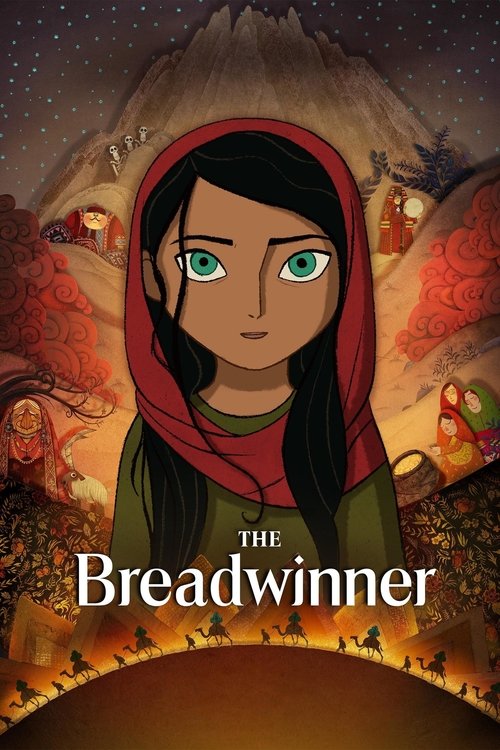
The Breadwinner
2017 · Nora Twomey
For when you want a film with real stakes and real heart — something that takes you somewhere hard and brings you back believing in people. Emotionally serious but safe to watch with older kids; a challenge that pays off in hope.
What it's about
In Kabul under Taliban rule, a headstrong eleven-year-old girl watches her family lose its only means of survival when her father is taken away. Because women can't work or even shop unaccompanied, she cuts her hair, dresses as a boy, and slips into the markets to become the family breadwinner. Between the dangers of the street, she spins a wild adventure tale for her little brother — a story that grows into a lifeline for everyone listening.
The experience
Tense and grounded but never punishing — the dread of a checkpoint sits right next to the warmth of a family joke, and the storytelling sequences lift you out of the dust into pure color. It moves briskly, hits hard in quiet moments, and leaves you moved rather than wrecked.
Performances
Saara Chaudry's voice work as Parvana carries the film — defiant, scared, and tender by turns, without a false note of cuteness.
The craft
Cartoon Saloon animates in two registers: the real Kabul in flat, dust-toned, unsentimental planes, and the girl's invented tale in glowing cut-paper collage that looks like a storybook come alive. The contrast is the whole argument of the film, and it's gorgeous on a big screen. Hand-drawn animation used for reportage, not whimsy — rare and striking.
Why it matters
Oscar-nominated for animated feature and executive-produced by Angelina Jolie, it proved the Irish studio behind The Secret of Kells could leave myth behind for the news and lose none of its power — and it announced Nora Twomey as a major director in her own right.
The third feature from Cartoon Saloon, the Irish studio behind The Secret of Kells and Song of the Sea, and the first directed solo by co-founder Nora Twomey — an adaptation of Deborah Ellis's novel about a girl in Taliban-ruled Kabul who cuts her hair and passes as a boy so her family can eat. Twomey works in two visual registers: the main story in crisp, flat-planed realism, dust-colored and unsentimental, and the tale the heroine spins for her little brother rendered in luminous cut-paper collage, a story-within-the-story that becomes the film's beating heart. It's the studio's sternest work, trading Celtic myth for reportage, yet the animating faith is the same — that storytelling is not escape from hardship but a tool for surviving it. Executive-produced by Angelina Jolie, Oscar-nominated for animated feature, and voiced largely by actors of Afghan descent, it stands with Persepolis among the rare animated films trusted to carry recent history. The bacha posh tradition it depicts is real, and older than the Taliban.
A Deleuzian reading
The hair comes off.
The full Deleuzian reading of The Breadwinner →
Reception
Acclaimed on release and Oscar-nominated, it was still slightly overshadowed by Cartoon Saloon's Irish folklore films — but the 2021 fall of Kabul gave it a grim second life, with fans recirculating it as suddenly, painfully current.
How The Breadwinner was received, from release to now →
Influences: the films it descends from and the films it influenced
- The Secret of Kells (2009) — Established the Cartoon Saloon house style Twomey co-directs from: flat, frame-filling hand-drawn ornament where illuminated-manuscript patterning replaces perspectival depth.
- Song of the Sea (2014) — Refined the studio's technique of nesting a folkloric mythic register inside a naturalistic present-day story, the same dual-world structure Twomey uses for Parvana's tale.
- Persepolis (2007) — The named influence: a graphic-novel-derived, high-contrast flat 2D idiom carrying a girl's-eye view of life under fundamentalist rule, adapted from an author's own memoir.
- The Adventures of Prince Achmed (1926) — Pioneered the articulated cut-paper silhouette technique that Twomey stylizes into the collage register of Parvana's storytelling interludes.
- Kirikou and the Sorceress (1998) — Model for rendering a non-Western oral folktale through flat, decorative cut-out figures moving against ornamental backdrops.
- Azur & Asmar: The Princes' Quest (2006) — Built an ornate Islamicate visual world from tiled, arabesque flat-color design, a decorative-Orient palette echoed in Breadwinner's story sequences.
- Grave of the Fireflies (1988) — Proved 2D animation could sustain unflinching war-drama realism centered on a child's survival, licensing Breadwinner's tonal seriousness.
- The Tale of the Princess Kaguya (2013) — Its sketch-and-watercolor folktale sequences model the deliberate shift into a looser, hand-crafted register to mark story-within-story mythmaking.
- Waltz with Bashir (2008) — Demonstrated animation as a vehicle for grave recent-history testimony from a war zone, using stylization to render trauma otherwise unfilmable.
- Ethel & Ernest (2016) — Cartoon Saloon hand-drawn feature deploying social-realist period detail and a domestic family chronicle to render ordinary life under historical pressure.
- Rio 2096: A Story of Love and Fury (2013) — Carries forward the Persepolis–Rio political-animation lineage: 2D adult animation about life under an authoritarian regime that nests myth and storytelling inside lived history.
- The Swallows of Kabul (2019) — Directly extends Breadwinner's project: hand-painted watercolor animation dramatizing women's survival under the Taliban in Kabul, literary adaptation and all.
- Wolfwalkers (2020) — Cartoon Saloon's next feature pushes further the switching of visual registers — woodcut-textured hand-drawn worlds — that Breadwinner used to separate reality from tale.
- Flee (2021) — Extends the animated recent-history testimony: an Afghan refugee's memory told in shifting drawing styles, naturalistic frame giving way to abstracted trauma.
- My Father's Dragon (2022) — Twomey's own follow-up carries forward her method of embedding a child protagonist inside a hand-drawn imaginative world staged as nested story.
- Ernest & Celestine (2012) — Shares the loose watercolor-and-ink hand-drawn European aesthetic (and Cartoon Saloon's co-production orbit), foregrounding the visible brushstroke over polish.
- Long Way North (2015) — Uses flat, outline-free blocks of color and a resolute young heroine, part of the same 2010s European hand-drawn revival Breadwinner belongs to.
- The Red Turtle (2016) — Contemporary hand-drawn feature that carries narrative through spare, painterly 2D imagery rather than dialogue, sibling in the arthouse-animation wave.
Similar films
- Wolfwalkers (2020) — influence & lineage · same viewing thread
- Song of the Sea (2014) — influence & lineage · same viewing thread
- The Secret of Kells (2009) — influence & lineage · same viewing thread
- Persepolis (2007) — influence & lineage
- Flee (2021) — influence & lineage
- Azur & Asmar: The Princes' Quest (2006) — influence & lineage · same viewing thread
- Kirikou and the Sorceress (1998) — influence & lineage · same viewing thread
- The President's Cake (2026) — shared sensibility
All the films related to The Breadwinner →
Watch it with: curated runs of related films
- Hand-Drawn Myths and Fairy Tales — Watch these as a run of traditional 2D animation that reaches back into folklore — Celtic selkies, Islamicate djinn, West African sorcery, English rabbit-lore — each rendered in a distinct storybook line.