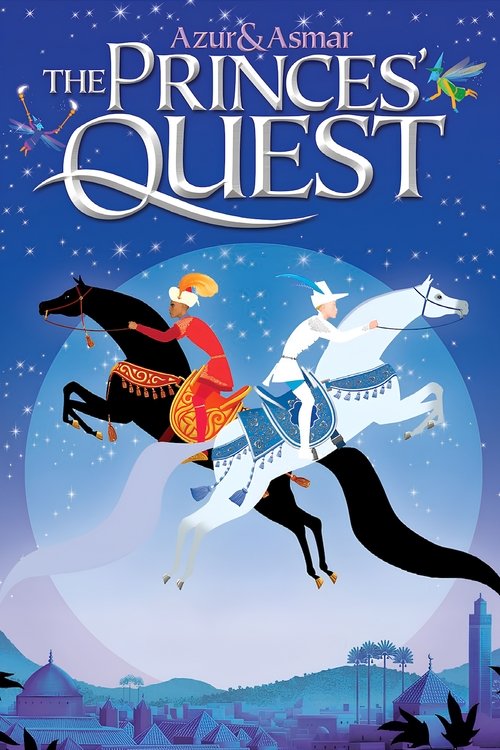
Azur & Asmar: The Princes' Quest
2006 · Michel Ocelot
For a family night or a soothing solo evening when you want pure visual enchantment — a storybook you can fall into. Comfort viewing with real substance.
What it's about
Two boys — Azur, fair-skinned son of a French nobleman, and Asmar, the son of the Maghrebi nurse who raised them both — grow up on lullabies about a captive Djinn Fairy. Years later, separated and changed, each sets out across the sea to find her, and their childhood bond becomes a rivalry that the quest keeps testing. It's a fairy tale built like an argument against bigotry, told through palaces, deserts, and wonders on both shores of the Mediterranean.
The experience
Gentle, gorgeous, and quietly clever — it has the unhurried rhythm of a story being told aloud, with images so ornate you want to pause and stare. Kids get an adventure; adults get the sly design underneath it.
The craft
Michel Ocelot made computer animation look like an illuminated manuscript: softly dimensional faces set against flat, jewel-colored backgrounds drawn from Persian miniatures and Andalusian tile. His boldest stroke is leaving the Arabic dialogue untranslated in the French scenes, so you feel the immigrant's exclusion firsthand — then flipping the imbalance once the story crosses the sea.
Why it matters
A landmark of French animation from the creator of Kirikou, arriving amid heated European debates about immigration and proving CG animation could have a handmade, decorative beauty all its own.
Michel Ocelot, the great fabulist of French animation and creator of Kirikou, made his first computer-animated feature look like nothing else produced with the technology: faces modeled in soft dimension against flat, gem-cut backgrounds drawn from Persian miniatures, Andalusian tile, and illuminated manuscripts, perspective abolished in favor of pattern. The tale is a deliberate mirror-fable — two boys nursed by the same Maghrebi woman, one fair, one dark, grow up to race each other across the sea in pursuit of the Djinn Fairy of their childhood lullabies — and Ocelot builds his argument against bigotry into the film's very grammar. The Arabic spoken in France goes untranslated, so the French viewer feels the immigrant's exclusion firsthand; once the story crosses the Mediterranean, the imbalance reverses. Made amid France's hardening debates over immigration, it insists that the two shores share one civilization of stories. Few films for children trust beauty to carry so much of the moral weight — every frame is composed like a page you could gild.
Reception
A genuine hit in France in 2006 (it premiered at Cannes' Directors' Fortnight) but only a small arthouse release abroad, it has quietly climbed since — now a fixture on 'most gorgeous animated films you haven't seen' lists as Ocelot's international reputation has grown.
How Azur & Asmar: The Princes' Quest was received, from release to now →
Influences: the films it descends from and the films it influenced
- The Adventures of Prince Achmed (1926) — Reiniger's backlit cut-paper silhouette theater staging an Arabian Nights fable is the direct formal ancestor of Ocelot's own silhouette method, which he then recolors into Azur's flat frieze-like figures.
- The Thief and the Cobbler (1993) — Williams built his backgrounds from Persian miniatures and Islamic geometric tiling, using deliberately impossible flat/non-perspectival space—the same miniature-derived decorative flatness Ocelot adopts for Azur's palaces and gardens.
- Sleeping Beauty (1959) — Eyvind Earle's production design rejects atmospheric perspective for gothic-tapestry flatness, stylizing foliage and architecture as decorative pattern—the anti-perspectival compositional grammar Azur inherits.
- The King and the Mockingbird (1980) — The founding work of French auteur animation, whose ornate hand-designed architecture and pictorial care establish the national craft tradition of decorative background-as-authorship that Ocelot continues.
- Kirikou and the Sorceress (1998) — Ocelot's own breakthrough posing figures in profile against flat folk-art-patterned grounds (African here) is the template Azur transposes onto Maghrebi and Persian ornament.
- Princes and Princesses (2000) — These silhouette-theater shorts are the immediate precursor: Azur reworks their two-lovers/quest fable armature and cutout staging in full saturated color and CG-built sets.
- Tales of the Night (2011) — Ocelot returns to pure silhouette against luminous color fields, now digitally composited—extending the cutout method of Azur into an anthology of untranslated-setting fables.
- Dilili in Paris (2018) — Continues Azur's explicit anti-bigotry moral fable and its hybrid of flat figures against elaborately detailed (here photographic) decorative backdrops.
- The Secret of Kells (2009) — Cartoon Saloon builds perspectiveless compositions from illuminated-manuscript interlace and ornament—Ocelot's decorative-pattern staging transposed from Persian miniature to Celtic art.
- Song of the Sea (2014) — Extends the flat folk-art-patterned 2D as a tender moral fable where visual beauty itself carries ethical weight, the same beauty-as-moral-value ethos Ocelot practices.
- Wolfwalkers (2020) — Its dual-protagonist mirror structure—two children from opposed cultures bonded then divided—renders Azur's milk-brother mirror fable in woodcut-flat patterned design.
- The Breadwinner (2017) — A cross-cultural fable set in the Muslim world using nested story-within-story cut-paper interludes, sharing Azur's embedded-tale structure and decorative flat inset panels.
- Kirikou and the Wild Beasts (2005) — Made immediately before Azur, it shares the same flat frontal staging and folk-decorative patterning, marking Ocelot's transition toward the CG-assisted production used on the seed.
- Persepolis (2007) — Contemporaneous French graphic animation that flattens space into high-contrast planar design to tell a cross-cultural fable about bigotry and belonging, a graphic-flatness cousin to Ocelot's decorative flatness.
- The Prince of Egypt (1998) — Its mirror-fable of two boys nursed as brothers who become rivals across a cultural divide is the same narrative device Azur builds on, with the milk-mother bond driving the reconciliation.
- Samurai Jack (2001) — Stages figures against bold flat color-field backgrounds with no atmospheric depth, extending the anti-perspectival decorative composition into a graphic, pattern-forward design language parallel to Ocelot's.
Similar films
- Kirikou and the Sorceress (1998) — influence & lineage · same viewing thread
- Song of the Sea (2014) — influence & lineage · same viewing thread
- The Secret of Kells (2009) — influence & lineage · same viewing thread
- The Adventures of Prince Achmed (1926) — influence & lineage · often watched together
- Princes and Princesses (2000) — influence & lineage
- The King and the Mockingbird (1980) — influence & lineage
- Persepolis (2007) — influence & lineage
- The Breadwinner (2017) — influence & lineage · same viewing thread
All the films related to Azur & Asmar: The Princes' Quest →
Watch it with: curated runs of related films
- Hand-Drawn Myths and Fairy Tales — Watch these as a run of traditional 2D animation that reaches back into folklore — Celtic selkies, Islamicate djinn, West African sorcery, English rabbit-lore — each rendered in a distinct storybook line.