Persepolis
2007 · Vincent Paronnaud
When you want history made personal — a coming-of-age story with real teeth, equal parts comfort and gut-punch, perfect for a night when you want to feel and learn at once.
What it's about
Marjane Satrapi's own girlhood, animated: a bright, punk-loving kid in 1970s Tehran watches her idealistic family celebrate the fall of the Shah, then watches the revolution curdle into a new repression that polices everything from her music to her headscarf. As she grows up, the story follows her into exile in Europe and the strange grief of a homeland that keeps changing shape behind her.
The experience
Funny, fierce, and unexpectedly devastating — it swings from adolescent embarrassment to state violence in the space of a scene and makes both land. You come out having laughed a lot at a story that's fundamentally about loss.
Performances
The French voice cast is superb: Chiara Mastroianni gives Marjane her wit and stubbornness, and Catherine Deneuve and Danielle Darrieux ground the mother and grandmother with warmth and steel.
The craft
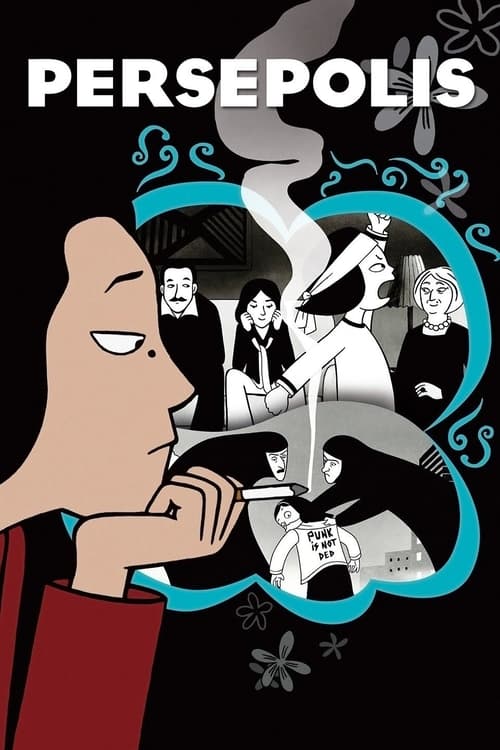
Hand-drawn, mostly black-and-white animation lifted straight from Satrapi's graphic novels, co-directed with comics artist Vincent Paronnaud — flat inky planes and swelling shadows that carry memory better than live action could. The stark style makes the funny scenes pop and the frightening ones loom, and it looks gorgeous on a big screen.
Why it matters
It shared the Jury Prize at Cannes in 2007, drew an official protest from the Iranian government, and became a landmark proof that adult, autobiographical animation could reach a worldwide audience.
Marjane Satrapi's autobiographical graphic novels arrive on screen with their ink intact: hand-drawn, largely black-and-white animation whose flat planes and swelling shadows carry the weight of memory better than any live-action recreation could. Co-directed with comics artist Vincent Paronnaud, the film follows a girl growing up through the Iranian Revolution and its aftermath — punk records smuggled under a chador, exile in Vienna, the ache of a homeland that keeps changing shape behind her. It shared the Jury Prize at Cannes in 2007 and promptly drew a protest from the Iranian government, proof of how sharply a cartoon can cut. Satrapi's genius is tonal: state violence and adolescent embarrassment sit on the same page, each rendered with the same deadpan candor, so the history lesson never smothers the coming-of-age story. The film also stands as a landmark of French animation's grown-up tradition, made largely with traditional cel techniques at a moment when the industry was stampeding toward digital. Its silhouetted crowds — masses of black figures surging across white voids — remain among the most striking images animation has given political cinema.
A Deleuzian reading
Black shapes pour across a white field.
The full Deleuzian reading of Persepolis →
Reception
It arrived already crowned — Jury Prize at Cannes 2007 (over the Iranian government's formal protest) and an Oscar nod for Best Animated Feature — and it has never really dipped; if anything it's grown into the default proof that animation can carry adult political memoir.
How Persepolis was received, from release to now →
Influences: the films it descends from and the films it influenced
- The Triplets of Belleville (2003) — Established the contemporary French hand-drawn feature's caricatural, near-dialogue-free deadpan visual comedy and grotesque silhouette design that Persepolis's droll character stylization and near-silent gag staging inherit.
- Fritz the Cat (1972) — Pioneered adult, politically satirical cel animation for a grown audience, breaking the assumption that hand-drawn features are children's fare — the permission Persepolis needed to animate revolution and repression.
- Maus (as graphic-novel method) (1991) — Codified the black-and-white autobiographical-comics memoir of political catastrophe told through a child's-eye family history, the panel-grammar and tonal register Satrapi's source comic directly descends from.
- Grave of the Fireflies (1988) — Proved hand-drawn animation could deliver serious, tragic, historically-grounded human drama about war and civilian suffering, legitimizing animation as a vehicle for grave autobiographical/historical testimony.
- Ivan the Terrible (1944) — Modeled the expressionist, high-contrast silhouette-and-shadow staging of authoritarian menace that Persepolis's black-and-white compositions of the regime's soldiers and crowds deliberately echo.
- Prince Achmed (The Adventures of Prince Achmed) (1926) — Founded silhouette animation as an expressive form of flat black-shape figures against light, the visual grammar Persepolis draws on in its stark cut-out-like silhouette sequences of crowds and war.
- When the Wind Blows (1986) — Advances the adult 2D animated feature as serious political testimony, using a deliberately stylized flat graphic idiom to carry autobiographical and historical weight.
- The King and the Mockingbird (1980) — French hand-drawn animation deploying stark graphic flatness in service of political allegory and anti-tyranny fable, the tradition Grimault originated.
- Kirikou and the Sorceress (1998) — A French flat high-contrast graphic feature carrying serious non-European folk-memoir material, proving Ocelot's flat-authorial model could hold weight beyond children's fable.
- Barefoot Gen (1983) — Adapts the author's own autobiographical comic into stylized cel animation, inheriting Gen's model of animation as a legitimate vehicle for a child-protagonist's first-person historical testimony.
- American Splendor (2003) — Autobiographical underground-comix adaptation that keeps the source's hand-drawn graphic panel idiom as the film's visual language rather than dissolving it into realism.
- Chico & Rita (2010) — Extends the hand-drawn 2D feature as adult political-historical memoir, using a comic-artist's bold graphic linework (Mariscal) applied to exile and regime repression, following Persepolis's proof that cel animation can carry grown-up autobiographical history.
- Persepolis 2.0 / Tehran-era animated shorts (2009) — Directly repurposes Satrapi's stark black-and-white character iconography to document later Iranian political protest, extending her silhouette-and-flat-shape visual vocabulary as a protest tool.
- Chicken with Plums (2011) — The same directing duo carry forward their storybook-illustration staging, tableau framing, and deadpan-melancholy tone from Persepolis into a live-action/animated hybrid, the direct continuation of their collaborative method.
- Wrinkles (Arrugas) (2011) — Adapts a literary graphic novel into a restrained 2D animated feature about serious adult subject matter, following Persepolis's model of faithful comic-to-cel adaptation retaining the artist's line.
- The Breadwinner (2017) — Deploys 2D hand-drawn animation and a young girl's-eye perspective on Middle Eastern political oppression, using stylized flat imagery for grave subject matter — a direct thematic-formal heir to Persepolis.
- Marona's Fantastic Tale (2019) — European auteur 2D animation using bold graphic-design flatness and a first-person retrospective narration, extending Persepolis's cartoonist-driven, design-forward approach to personal storytelling.
- Little Amélie or the Character of Rain (2025) — Sets the precedent for a first-person autobiographical literary adaptation rendered in stylized 2D, letting an author's memoir voice-over drive childhood-to-consciousness narration.
- Jim Queen and the Quest for Chloroqueer (2026) — Established the French bande-dessinée-line-to-feature pipeline, legitimizing personal, politically charged adult animation drawn in flat graphic-novel line-work.
- In Waves (2026) — The graphic-memoir-to-feature-animation blueprint that preserves the source author's flat, high-contrast ink line as the film's controlling visual identity rather than 'opening it up' into naturalism.
- The Summit of the Gods (2021) — Model for adapting a serious graphic-novel/manga source into feature 2D with fidelity to the original page's high-contrast line, validating the literary-adaptation register Summit occupies.
- Ethel & Ernest (2016) — Model for adapting an autobiographical graphic-novel memoir while preserving the author's own drawn line, using animation to compress decades of family history against political upheaval.
- Ruben Brandt, Collector (2018) — High-contrast flat graphic-novel design proved that a 2D illustrator's aesthetic could carry an adult, literary, festival-scale animated feature.
- Waltz with Bashir (2008) — Animates first-person political-trauma memoir in flat, high-contrast graphic-novel line, using animation's abstraction (rather than reenactment) to render subjective memory of Middle East conflict — the exact autobiographical-animation strategy Persepolis pioneered a year earlier.
- Sita Sings the Blues (2008) — Uses flat 2D graphic-design animation and a personal female voice to interleave autobiography with cultural/mythic history, sharing Persepolis's single-author auteur-cartoonist authorship model.
- The Wind Rises (2013) — Hand-drawn animated biography set against a nation's political history, treating a real individual's life against war and repression with adult seriousness — parallel use of cel animation for historical biography.
- Valse / La Traversée (Florence Miailhe tradition) (2021) — French hand-crafted animation treating exile, displacement and political flight through painterly non-photoreal imagery, sharing Persepolis's mode of French-animation-as-political-memoir.
- Azur & Asmar: The Princes' Quest (2006) — Contemporaneous French graphic animation that flattens space into high-contrast planar design to tell a cross-cultural fable about bigotry and belonging, a graphic-flatness cousin to Ocelot's decorative flatness.
- Mary and Max (2009) — An autobiographical adult animated feature rendered in stark high-contrast monochrome, sharing Mary and Max's marriage of memoir and a deliberately color-drained graphic palette.
- My Life as a Zucchini (2016) — A literary/graphic-novel adaptation using a child's naive-eyed perspective to process trauma in an adult-oriented animated feature — the adaptation model Barras and Sciamma follow.
- Robot Dreams (2023) — A landmark graphic-novel-to-2D-animation adaptation that preserves the source's flat, iconic drawing style rather than smoothing it into house animation — the same fidelity Berger keeps to Sara Varon's line.
- Memoir of a Snail (2024) — A sibling in the animated-biography genre: a first-person life-story arc narrated in dry, deadpan retrospect, proving animation can carry a full melancholic autobiography — the same narrative form Elliot builds in clay.
- Princes and Princesses (2000) — Its high-contrast flat black-and-white graphic staging, with figures reduced to near-silhouette against blank fields, extends the same French auteur silhouette-adjacent minimalism into memoir.
- The Peasants (2023) — Adapts a national literary/graphic source through a single unifying art-historical visual signature, demonstrating that a distinctive drawn style can reinterpret canonical national narrative for arthouse audiences.
- Tower (2016) — Uses graphic, high-contrast 2D animation of first-person memoir to render political violence bearable, abstracting suffering into a stylized visual language as Tower does.
Similar films
- The Breadwinner (2017) — influence & lineage
- Waltz with Bashir (2008) — influence & lineage
- The Color of Pomegranates (1969) — often watched together
- Guillermo del Toro's Pinocchio (2022) — shared sensibility
- In Waves (2026) — shared sensibility
- The President's Cake (2026) — shared sensibility
- Au Revoir les Enfants (1987) — shared sensibility
- The 400 Blows (1959) — shared sensibility
All the films related to Persepolis →