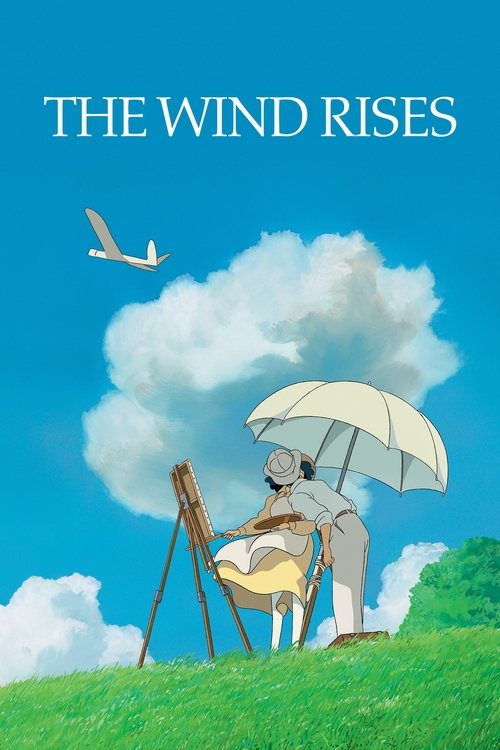
The Wind Rises
2013 · Hayao Miyazaki
The Boy and the Heron's no-marketing release and second Oscar fueled the eternal "final film" watch, while his resurfaced "an insult to life itself" AI clip made him the patron saint of anti-AI-art sentiment. Ghibli-style AI image generation controversies keep him at the center of a fight he never asked to join.
For a contemplative evening when you want beauty with a lump in your throat — a film to sit with, not escape into. It's a comfort watch and a quiet heartbreak at the same time, and it lingers for days.
What it's about
An aviation engineer in interwar Japan spends his life chasing one thing: the perfect airplane. Following Jiro Horikoshi from earthquake-shaken 1920s Tokyo through the Depression and into the years before World War II, it watches a gentle, nearsighted dreamer pour his gift into machines his country will use for war — while he falls in love with a young woman living under the shadow of tuberculosis. Dream sequences with an Italian aviation pioneer keep pulling him back to the question of what his beautiful designs are actually for.
The experience
Slow, tender, and quietly devastating — a hushed film that builds its ache out of wind, paper, and drafting tables rather than drama. The love story is achingly sincere, and the whole thing carries a grown-up melancholy about devoting your life to something the world will misuse.
The craft
Miyazaki's hand-drawn craft at its most refined: trembling earthquakes rendered like a living organism, flight sequences that feel weightless, and famously inventive sound design in which engines and tremors are voiced with human breath and mouth sounds. Joe Hisaishi's score is one of his most tender. It rewards a big screen and a quiet room.
Why it matters
Announced at the time as Miyazaki's farewell feature, it was received as the master's self-portrait — a rare adult, realist drama from the world's most beloved animator, and an Oscar nominee that stirred real debate about art, war, and complicity.
Snapshot
The Wind Rises (Kaze Tachinu) is Hayao Miyazaki's fictionalized biography of Jiro Horikoshi, the aeronautical engineer who designed the Mitsubishi A6M "Zero" fighter, and it stands apart from nearly everything else in his filmography: a hand-drawn, largely realist historical drama for adults, without the fantastical creatures, spirit worlds, or child protagonists that define films from My Neighbor Totoro to Spirited Away. Spanning roughly two decades of interwar Japan — the 1923 Great Kanto earthquake, the Depression, the drift toward militarism, and a tubercular love story — it braids the real Horikoshi with the poet-novelist Tatsuo Hori and threads both through the recurring dream-encounters between Jiro and the Italian aviation pioneer Giovanni Battista Caproni. Announced at the time as Miyazaki's final feature (a retirement he would later reverse with 2023's The Boy and the Heron), it is the most personal and most morally troubled work of his career, an artist's meditation on the beauty of what one makes and the uses to which the world puts it. It was among the most successful Japanese films of its release year and earned an Academy Award nomination for Best Animated Feature.
Industry & production
The film is a Studio Ghibli production, produced by Miyazaki's longtime partner Toshio Suzuki, and it emerged from an unusual origin: a serialized manga Miyazaki drew for the model-hobby magazine Model Graphix, itself a labor of his private aviation obsession. Suzuki has recounted that Miyazaki initially resisted adapting his own manga, and that a decisive push came from within the studio to turn this adult, historically weighty material into a feature. The choice was risky by Ghibli's commercial logic: a two-hour drama about an engineer, with no obvious child audience and a politically charged subject, released into a Japanese market where Ghibli's brand was built on family fantasy.
Ghibli released The Wind Rises domestically in July 2013 — notably the same season Isao Takahata's The Tale of the Princess Kaguya was in production, framing the moment as a twin valediction from the studio's two founding directors. The film performed strongly at the Japanese box office, ranking among the top domestic releases of the year, and traveled the international festival and awards circuit, screening in competition at Venice and securing the Ghibli-standard prestige release abroad through Disney/GKIDS channels in North America. The English-language version assembled a high-profile cast — Joseph Gordon-Levitt as Jiro, Emily Blunt as Naoko, with Werner Herzog, Martin Short, Stanley Tucci, and others — under producer Frank Marshall, part of the long-running practice of star-dubbing Ghibli films for the Anglophone market.
Technology
The Wind Rises was made in Ghibli's mature hybrid pipeline: predominantly hand-drawn 2D animation on paper, scanned and composited digitally, with digital ink-and-paint and selective, restrained CGI integrated to serve rather than dominate the drawn image. Ghibli's house aesthetic deliberately kept computer assistance subordinate to the hand, and the film's most technically demanding passages — crowds fleeing the earthquake, the flexing of an aircraft's fabric-and-metal skin, the churn of a slipstream — are rendered with drawn animation's weight and imperfection rather than simulation. The most discussed technical decision, however, lies in the sound rather than the image (see Sound below): the choice to generate machine and disaster sounds from recorded human voices, an approach that is as much a philosophical statement about representation as a production technique.
Technique
Cinematography
In animation the "camera" is a constructed viewpoint, and Ghibli's longtime director of photography Atsushi Okui oversaw the film's digital compositing and photographic finish. The visual language favors clarity and stillness over spectacle: wide, deep-focus landscapes of green hillsides, telegraph lines, and cloud banks; carefully composed interiors; and a recurring upward gaze toward the sky that motivates the whole film thematically. Miyazaki's staging leans on long, unhurried holds and lateral movement — trains crossing the frame, wind combing through grass — and on a palette of soft, watercolor-adjacent skies against which aircraft read as fragile silhouettes. The dream sequences shift the register subtly toward the luminous and the impossible without abandoning the drawn realism, so that Caproni's fantastical flying machines feel continuous with, not opposed to, the waking world.
Editing
The cutting is patient and elliptical, structured less by conventional plot beats than by the passage of years and the rhyme of recurring motifs — wind, flight, the paper airplane, illness. Transitions frequently move through dreams or through gaps of time, letting the film compress a career and a life into an associative flow. The romance and the engineering plot are interleaved rather than segregated, so that Jiro's professional ascent and Naoko's decline advance in counterpoint. The result is a rhythm closer to a novel or a piece of music than to a biopic's checklist, with several extended set pieces — the earthquake, the test flights — allowed to breathe at length.
Mise-en-scène / staging
This is among Miyazaki's densest films in terms of period texture: 1920s–30s Tokyo streetscapes, provincial sanatoria, resort hotels, Mitsubishi's design halls, drafting tables, slide rules, and the interiors of aircraft. The staging is meticulous about work — the physical business of drawing, calculating, and building — treating engineering as a craft rendered with the same attention Ghibli lavishes on cooking or cleaning in other films. Nature is a constant presence and often an active agent: wind lifts hats and paper and hair, and the earthquake convulses the ground in one of the film's signature sequences. Recurring compositional motifs — the parasol, the paper plane sailing on a breeze, the color of a Nakajima or Mitsubishi prototype against the sky — accrue emotional weight across the runtime.
Sound
The film's most celebrated technical gambit is its sound design. Under Miyazaki's direction, many mechanical and environmental sounds — propeller engines, the rumble that precedes the Great Kanto earthquake, steam and machinery — were produced by human voices rather than conventional foley or recordings. The effect estranges the familiar and underlines the film's central tension: technology voiced by the human throat, machines given a breath. Joe Hisaishi's score, his decades-long collaboration with Miyazaki, is comparatively restrained and lyrical here, favoring period-inflected strings, mandolin and piano textures over sweeping orchestral fantasy, in keeping with the film's grounded, elegiac tone. The closing song draws on Yumi Matsutoya's "Hikōki-gumo" ("Vapor Trails"), a period-evoking pop ballad whose imagery of contrails and mortality dovetails with the film's themes.
Performance
Miyazaki cast Hideaki Anno — the director of Neon Genesis Evangelion, and himself an animator and aviation enthusiast — as the voice of Jiro, a deliberately non-professional, affectless delivery that critics debated at length. Anno's flat, quiet reticence gives Jiro an inward, almost sleepwalking quality suited to a man who lives most fully inside his dreams and drawings. Miori Takimoto voices Naoko with a warmth that carries much of the film's emotional charge, and the supporting vocal cast fills out the period ensemble. The performance style throughout is understated, matching the film's realism; the English dub, by contrast, offers more conventionally polished readings from its star cast.
Narrative & dramatic mode
The film operates as a lyrical bildungsroman and doomed romance rather than a documentary biography. It is openly a fiction: Miyazaki fuses the historical Jiro Horikoshi with the writer Tatsuo Hori — whose novel The Wind Has Risen supplies the tubercular love story and the Valéry-derived title — and adds an invented soulmate, Naoko, and an invented dream-mentor in Caproni. The dramatic mode is elegiac and associative, privileging mood, motif, and moral ambivalence over incident. Dreams function as a structuring device, not decoration: Jiro's recurring meetings with Caproni pose and re-pose the film's central question — whether it is worth building beautiful things that will be used to kill — without ever resolving it into a lesson. The wind of the title is at once literal, erotic, historical, and metaphysical: the current of life that must be lived even as it carries everything toward loss.
Genre & cycle
The Wind Rises sits at the intersection of the historical drama, the artist's biopic, and the melodrama of illness and doomed love, all rendered in animation — a combination rare in any national cinema and singular within Ghibli's catalog. It belongs to a small cycle of Ghibli films aimed squarely at adults and grounded in history rather than fantasy, alongside Takahata's Grave of the Fireflies and The Tale of the Princess Kaguya. Within Miyazaki's own oeuvre it forms a loose thematic cluster with his other flight-obsessed works — Porco Rosso above all, but also Castle in the Sky and Nausicaä — while stripping away their adventure trappings to confront the aircraft-as-weapon directly.
Authorship & method
The film is a near-total authorial statement. Miyazaki wrote the screenplay, directed, and originated the material as his own manga, and the project is saturated with his lifelong preoccupations: the beauty and danger of flight, the ethics of engineering, and his own family's history — the Miyazaki family firm manufactured aircraft parts during the war, a biographical fact that gives the film's guilt an intimate charge. Key collaborators are the constants of his major period: producer Toshio Suzuki, whose advocacy shaped the project; composer Joe Hisaishi, whose restrained, period-tinged score is among his subtlest for Miyazaki; and director of photography Atsushi Okui, overseeing the digital photographic finish of the drawn work. The casting of fellow director Hideaki Anno as Jiro is itself an authorial gesture — an animator directing an animator to voice an engineer — folding the film's meditation on creation back onto the community that made it. Miyazaki paired the release with public anti-war and anti-constitutional-revision statements, making explicit the political convictions that underwrite the film's ambivalence.
Movement / national cinema
The film is a landmark of Japanese animation and of Studio Ghibli's authorial, hand-drawn tradition, which positioned itself against both Disney's model and the increasingly CG-dominated global animation industry. It is also a deeply national work: a reckoning with Japan's interwar and wartime past from within a popular art form, engaging the country's contested memory of its militarist era. That engagement made the film controversial at home — criticized from the nationalist right for Miyazaki's pacifism and for depicting Japan's poverty and folly, and from other quarters for aestheticizing the designer of a war machine. It sits within a broader current of postwar Japanese cinema and literature preoccupied with the moral weight of the war, while remaining unmistakably the product of Ghibli's particular house style.
Era / period
The Wind Rises depicts interwar and prewar Japan — roughly the late 1910s through the 1930s — with the 1923 Great Kanto earthquake, the Shōwa Depression, and the slide toward militarism as its backdrop, and it gestures beyond its own ending toward the war the Zero would fight. Made and released in 2013, it also belongs to a specific moment in Ghibli's history: the twilight of its founding directors, arriving amid Miyazaki's (later reversed) retirement announcement and shortly before the studio's temporary retrenchment of feature production. The film's European literary and cultural touchstones — Paul Valéry's poetry, Thomas Mann (whose The Magic Mountain is echoed in the sanatorium and in the German character Castorp), Italian aviation — place it in dialogue with a cosmopolitan interwar modernism as well as with Japanese history.
Themes
The governing theme is the artist-engineer's moral predicament: the dream of building something beautiful, and the impossibility of controlling its use. Caproni's formulation — that airplanes are beautiful, cursed dreams — frames Jiro's life as a bargain in which creative fulfillment is inseparable from complicity in destruction. Around this cluster related concerns: the tension between dream and reality; mono no aware and the transience of beauty, love, and life, crystallized in Naoko's illness; the wind as the life-force one must try to live within ("Le vent se lève! … il faut tenter de vivre!"); the dignity and absorption of skilled work; and a quiet, unresolved reckoning with national ambition and its costs. The film refuses to exonerate or condemn its protagonist, holding admiration and disquiet in permanent suspension.
Reception, canon & influence
Critically, The Wind Rises was widely acclaimed as a mature, beautiful, and morally serious capstone, with particular praise for its animation, its emotional restraint, and its willingness to sit with ambivalence; the flat vocal performance and the ethics of its sympathetic portrait of the Zero's designer drew the sharpest debate. In Japan the subject was genuinely divisive — attacked from opposing political directions — and Miyazaki's accompanying anti-war statements became part of the film's public reception. It earned major domestic honors and an Academy Award nomination for Best Animated Feature, consolidating its place in the Ghibli and Miyazaki canon as the outlier masterpiece: the adult historical drama in a body of work known for fantasy.
Influences on the film (backward): Tatsuo Hori's novel The Wind Has Risen and Valéry's "Le Cimetière marin" supply title, epigraph, and the romance's contours; Thomas Mann's The Magic Mountain informs the sanatorium and the Castorp figure; the historical record of Jiro Horikoshi and Mitsubishi's aircraft program, and the aviation lore of Caproni and interwar European design, ground the engineering material; and Miyazaki's own decades of flight-obsessed work — most directly Porco Rosso — furnish the thematic soil.
Legacy (forward): Because it was framed as Miyazaki's farewell, the film's most immediate legacy was as a supposed endpoint — a status revised when he returned with The Boy and the Heron, which revisits, in fantastical form, several of the same concerns with creation, guilt, and mortality. More broadly, The Wind Rises stands as a demonstration that mainstream feature animation can carry adult historical and moral weight, a touchstone cited whenever the medium's capacity for serious drama is argued. Its full influence on subsequent filmmakers remains to be seen; what is clear is its secure position as one of the definitive, and most debated, statements of Miyazaki's authorship.
A Deleuzian reading
A hat leaves a head.
The full Deleuzian reading of The Wind Rises →
Reception
Released as Miyazaki's announced 'final film' amid real controversy — nationalists in Japan bristled at his anti-war essays while critics abroad asked if it soft-pedalled the Zero fighter's history. A decade on, it's widely reappraised as his most personal work, a self-portrait of the artist that hits differently now that The Boy and the Heron rewrote the 'farewell' narrative.
How The Wind Rises was received, from release to now →
How to watch The Wind Rises: what to notice on a first viewing
- Listen for engine sounds that are actually human voices. Miyazaki had propellers, steam, and the earthquake's rumble performed by human mouths rather than recorded machinery, so a throat is inside every engine. You can't say exactly where the person is, but a person is somewhere in every machine sound.
- Notice how often something is moved by wind, not a person. Hats lift, paper drifts off a drafting table, hair blows flat across faces, and grass combs itself in waves, all without anyone in the frame causing it. The title tells you in advance: here, the world does the moving, not the people in it.
- Listen to how flat and unhurried Jiro's voice stays. Hideaki Anno, a director rather than a trained actor, delivers every line with the same quiet, almost sleepwalking reticence, no matter what happens around him. He sounds most present exactly when he's drawing or dreaming, not when he's talking to people.
- Notice the drafting tables, slide rules, and engineering tools. The film treats calculating and drawing with the same close attention Ghibli usually gives cooking or cleaning in its other movies. Engineering gets filmed here as a craft, with its own physical labor, not an abstract idea.
The whole guide to watching The Wind Rises, with the keys for a rewatch →
Influences: the films it descends from and the films it influenced
- Porco Rosso (1992) — Establishes the same fetishistic animation of interwar aircraft as designed, hand-drawn objects — banking geometry, prop-wash, wing flex — and the engineer-pilot's melancholy love of flight that The Wind Rises transposes into biography.
- Grave of the Fireflies (1988) — The Ghibli proof that drawn animation can sustain adult wartime tragedy through emotional restraint and elliptical omission rather than melodramatic underscoring, a register Miyazaki adopts for Nahoko's illness.
- Only Yesterday (1991) — Ghibli's first fully non-fantasy adult drama, built on associative memory-and-dream cross-cutting between timelines — the elliptical editing logic Wind Rises uses to slide between Jiro's reality and his Caproni reveries.
- Late Spring (1949) — Codifies mono no aware through withholding: the decisive emotional events (a death, a parting) occur in the cuts and off-screen, teaching the elliptical restraint that governs Wind Rises' handling of loss.
- Pickpocket (1959) — The 'model' method — casting a non-actor to deliver lines in flat, affectless voice as moral distancing — is the precedent for Miyazaki directing Hideaki Anno's deliberately un-actorly vocal performance as Jiro.
- The Human Condition (1959) — Frames a decent Japanese man's complicity in the wartime industrial machine as unresolved moral tragedy — the creation-and-complicity ambivalence Wind Rises refuses to soften into either exoneration or indictment.
- Andrei Rublev (1966) — The episodic artist-biopic structure in which a maker's beautiful creation is inseparable from the violence of his era, pursued as portrait rather than plot — the 'artist and his complicit century' form Miyazaki borrows.
- 8½ (1963) — Uses recurring dream sequences as direct portals into the creator's imagination and a mentor/muse figure who speaks from that dreamspace — the Caproni encounters function exactly as these oneiric framing devices.
- Amadeus (1984) — The template for the artist-biopic-melodrama that stages genius as ethically compromised and doomed, prizing the ambivalence of the creator's gift over hagiography — Wind Rises' genre grammar.
- The Burmese Harp (1956) — Anchors the Japanese anti-war humanist tradition that mourns rather than valorizes, letting a beautiful surface carry grief for the war — the tonal lineage behind Miyazaki's paired anti-war statements and the film's elegiac close.
- Ponyo (2008) — Carries forward Ponyo's late-period commitment to hand-drawn fluid dynamics — its animated earthquake and rippling wind-fields descend from Ponyo's undulating, personified wave-fish surges.
- From Up on Poppy Hill (2011) — Extends Poppy Hill's grounded, historically-minded Shōwa nostalgia and craft-veneration into Hayao's own reflective realist register, hand-drawn and non-fantastical.
- The Boy and the Heron (2023) — Directly revisits the same knot of creation, guilt, and mortality in fantastical form, with a maker-figure (the granduncle's tower) mirroring Jiro/Caproni — Miyazaki re-authoring Wind Rises' concerns after his 'farewell.'
- In This Corner of the World (2016) — Carries forward hand-drawn wartime-Japan drama built on meticulous period-texture craft and quiet domestic ambivalence about complicity, applying Wind Rises' restraint to civilian life.
- Violet Evergarden: The Movie (2020) — Romanticizes interwar technology on the cusp of obsolescence — steamships, aircraft, telephone-era machinery rendered lovingly — the same 'postwar obsolescence' tech-nostalgia Violet builds its world on.
- Look Back (2024) — Miyazaki animates the interior of creative obsession — the maker lost in the act of designing, work as both calling and cost — establishing the register of depicting vocation as physical labor that Look Back applies to the repetitive, hand-cramping act of drawing manga.
- The Tale of the Princess Kaguya (2013) — The concurrent Ghibli statement that adult hand-drawn animation can render mono no aware and mortality through spare, elliptical staging and period-craft texture, extending the same medium-legitimizing project.
- First Man (2018) — An aviation-engineering biopic that fuses a deliberately flat, emotionally withholding protagonist with machine-first sound design foregrounding rivets, engines and vibration — the same alliance of affectless performance and voiced-machine sonic texture.
- Oppenheimer (2023) — Extends the creation-and-complicity biopic: a brilliant designer whose masterwork is a weapon, portrayed with sympathy that refuses to resolve the ethics — the exact moral ambivalence Wind Rises pioneered for the medium.
- Millennium Actress (2001) — Structures a life story as animation sliding seamlessly between reality, memory, and imagined scenes through associative match-cutting — the elliptical, dream-porous biographical editing Wind Rises deploys via Jiro's reveries.
- Persepolis (2007) — Hand-drawn animated biography set against a nation's political history, treating a real individual's life against war and repression with adult seriousness — parallel use of cel animation for historical biography.
- The Summit of the Gods (2021) — A biographical study of an obsessive vocation carried by hand-crafted, near-diegetic sound design and a refusal to sentimentalize the cost of single-minded mastery — Summit's exact register applied to flight instead of altitude.
- Ethel & Ernest (2016) — A hand-drawn biographical chronicle spanning early-twentieth-century history through a life's private moments, dignifying ordinary daily existence within a sweep of national change.
Similar films
- Porco Rosso (1992) — influence & lineage · same viewing thread · often watched together
- Only Yesterday (1991) — influence & lineage · same viewing thread · often watched together
- The Tale of The Princess Kaguya (2013) — influence & lineage · same viewing thread
- The Boy and the Heron (2023) — influence & lineage · often watched together
- Grave of the Fireflies (1988) — influence & lineage
- In This Corner of the World (2016) — influence & lineage
- Spirited Away (2001) — same viewing thread · often watched together
- Princess Mononoke (1997) — same viewing thread · often watched together
All the films related to The Wind Rises →
Watch it with: curated runs of related films
- The Studio Ghibli Canon — A run through the whole hand-drawn shelf of Miyazaki and Takahata — start with the childhood-wonder crowd-pleasers and drift toward the studio's quieter, adult, more elegiac corners.