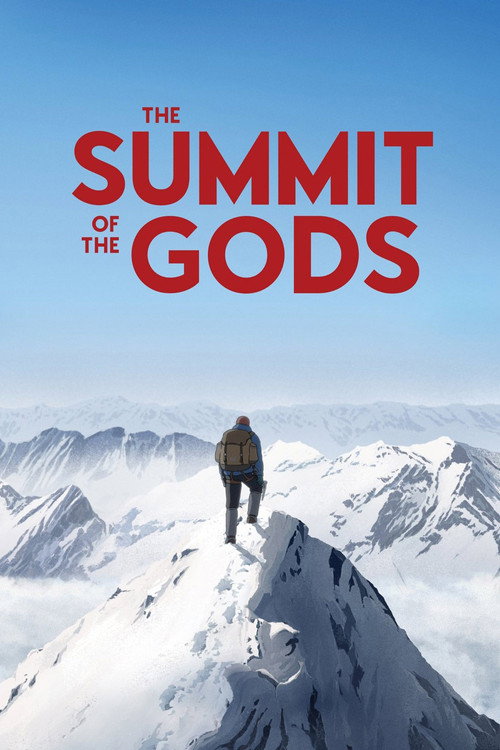
The Summit of the Gods
2021 · Patrick Imbert
For when you want to disappear somewhere vast and cold and come back thinking about obsession — what you'd sacrifice for the one thing you can't let go. A meditative watch for a focused, screens-off kind of evening.
What it's about
A Japanese photojournalist stumbles onto a battered old camera that may have belonged to George Mallory — and could prove whether he reached Everest's summit in 1924, decades before anyone else. The trail leads to Habu Jōji, a legendary climber who vanished from public life, and the reporter's hunt for the man becomes inseparable from the mystery itself. It's a story about the people who give everything to mountains, and the question of why they do it.
The experience
Quiet, absorbing, and vertiginous — long dialogue-sparse stretches of ice, wind, and held breath that build real physical dread. It's contemplative rather than thrilling, and its calm makes the dangerous moments hit harder.
The craft
Hand-drawn 2D animation used with rare restraint: clean lines, enormous silent landscapes, and a sound design of wind and creaking ice that does as much storytelling as the images. It's adult-oriented animation confident enough to be quiet, and it rewards a big screen and good speakers where the mountains can properly loom.
Why it matters
Adapted from Jiro Taniguchi's revered manga, it stood out as proof that European animation could tackle grown-up, novelistic material — a mountaineering drama that won over audiences well beyond animation circles.
Snapshot
The Summit of the Gods (French: Le Sommet des dieux) is a French hand-drawn animated feature adapted from Jiro Taniguchi's manga of the same name, itself drawn from Baku Yumemakura's 1998 novel. It follows Fukamachi, a Japanese photojournalist who stumbles on a battered vest-pocket camera that may have belonged to George Mallory — and thus may hold proof of whether Mallory and Andrew Irvine reached the summit of Everest in 1924, decades before Hillary and Tenzing. The camera is in the possession of Habu Jōji, a legendary, near-mythic alpinist who has vanished from public life, and Fukamachi's pursuit of the man becomes inseparable from his pursuit of the mystery. The film is unusual within contemporary animation: an adult-oriented, largely dialogue-sparse mountaineering drama rendered in restrained 2D, more interested in altitude, endurance, and obsession than in spectacle or comedy. It won the César for Best Animated Film in 2022 and stands as one of the more critically esteemed European animated features of its decade.
Industry & production
The film was produced principally by Folivari, the French company associated with veteran producer Didier Brunner (a figure central to the modern French animation renaissance, previously behind Kirikou and The Triplets of Belleville–era projects), together with Julianne Films and the Luxembourg co-producer Mélusine Productions, with additional partners across France and Luxembourg. This co-production structure — France plus Luxembourg, drawing on regional funding and tax mechanisms — is the standard financing architecture for mid-budget European animated features, which rarely command Hollywood-scale budgets and instead assemble capital across national film funds, broadcasters, and co-production treaties.
The project was a genuine adaptation challenge: Taniguchi's manga runs to five substantial volumes, and the screenplay by Magali Pouzol (with Patrick Imbert and Jean-Charles Ostorero credited in the writing) compresses that sprawl into roughly ninety minutes, necessarily paring subplots to foreground the Fukamachi–Habu axis. Distribution reflected the film's crossover positioning: GKIDS handled North American release, the specialist distributor that has become the primary conduit for auteur and international animation in the United States, while the film also reached international audiences through streaming. It premiered in 2021 in the orbit of the Cannes selection and circulated through the festival circuit before its awards run. Precise budget and box-office figures are not something I can state reliably, and I will not invent them; what is clear is that the film performed as a prestige title rather than a commercial blockbuster, its value measured in critical standing and awards.
Technology
Technologically, The Summit of the Gods is a work of contemporary 2D digital animation that deliberately preserves the character of hand drawing. Rather than pursuing the volumetric CG that dominates commercial animation, the production used digital 2D pipelines to render clean-line figures against painted and digitally composited environments, allowing the mountains to read as vast, textured, and atmospherically deep while the human figures remain graphically economical. The technical ambition lies less in novel rendering techniques than in the disciplined use of relatively conventional tools to sustain a naturalistic, weighty depiction of alpine space — the fall of light on snow, the density of cloud, the scale relationship between a climber and a rock face. Where many animated features signal their technology through surface dazzle, this one directs its craft toward restraint and physical credibility, which is itself a demanding technical achievement in a medium where empty white expanses and subtle gradations of gray and blue offer nowhere to hide.
Technique
Cinematography
The film's "camera" — its virtual staging and framing — is built around verticality and scale. Compositions repeatedly set a small human figure against overwhelming rock and ice, using extreme height differentials to convey both the sublimity and the indifference of the mountain. The animation alternates between these vast establishing vistas and tight, claustrophobic framings of hands on holds, crampons biting ice, and faces rimed with frost, so that the drama oscillates between the cosmic and the intensely tactile. There is a notable willingness to hold on stillness and to let negative space — sheets of snow, blank sky — dominate the frame, a choice that reads as closer to live-action mountain cinema and to the contemplative register of Taniguchi's panels than to the busy visual grammar of mainstream animation.
Editing
Editorially, the film moves between two timelines — Fukamachi's present-tense investigation and the reconstructed history of Habu's climbing career — cutting between the pursuit and the object of pursuit so that the man's biography accretes in fragments. The pacing is patient by the standards of the medium, giving climbs room to unfold in something closer to real duration and trusting silence and process. This measured rhythm is central to the film's effect: obsession is conveyed not through montage acceleration but through the accumulation of detail and the sense of time spent.
Mise-en-scène / staging
The staging is defined by graphic economy in the figures and richness in the environments. Character designs follow a clean, restrained line — faces built from a few decisive strokes — set against meticulously observed alpine settings, from the neon clutter of Kathmandu and Tokyo to the austerity of high camps. The mountaineering itself is staged with evident research: the gear, the rope work, the bivouacs, the bodily mechanics of ascent are rendered with a documentary attentiveness that grounds the more mythic dimensions of the story. This is a film that respects the procedure of climbing, and its mise-en-scène treats equipment and technique as meaningful rather than incidental.
Sound
Sound is among the film's most distinctive elements. Long stretches proceed with minimal or no dialogue, foregrounding wind, the crunch of snow, labored breathing, the ring of an ice axe, and the creak of rope under load. This near-diegetic soundscape does much of the film's emotional work, immersing the viewer in the sensory reality of extreme altitude and isolation. The score, by the Tunisian composer Amine Bouhafa (known for his work on Timbuktu), is used with restraint, entering to lift key passages of ascent and reflection rather than to blanket the film. The result is an unusually quiet animated feature, one whose silences are as expressive as its music.
Performance
Performance here is vocal and gestural rather than photographed, but it is central. In the original French track, the two principal figures are voiced with a controlled intensity suited to men defined by reticence — Fukamachi's watchful, questioning presence and Habu's guarded, monolithic solitude. The animation of performance leans on small, telling gestures and on the eyes, in keeping with the graphic restraint of the character design; there is little of the elastic exaggeration common to the medium. The film asks its voice cast and animators to convey obsession and grief through understatement, and the emotional legibility of two fundamentally taciturn men is a real accomplishment of that combined performance.
Narrative & dramatic mode
The film operates in a mode of investigative quest layered over reconstructed biography — a mystery structure grafted onto a character study. Fukamachi's search functions as the narrative engine, but the true subject is Habu, assembled retrospectively through testimony, memory, and Fukamachi's growing identification with him. The dramatic mode is elegiac and interior: this is a story about why a person does something incomprehensible to others, and the historical Mallory–Irvine enigma serves less as a puzzle to be solved than as a mirror for the film's central question. The Mallory camera is a classic MacGuffin in Hitchcock's sense — the object that sets everyone in motion while mattering less, finally, than what the pursuit reveals about the pursuers. By the end the "answer" to the historical mystery is subordinated to the emotional and philosophical reckoning of the two men.
Genre & cycle
Generically the film sits at an intersection rarely occupied: it is a mountaineering adventure and a mystery told through adult animation. It belongs, on one axis, to the tradition of mountain drama — the lineage of climbing narratives that treat the peak as antagonist, test, and metaphysical proposition. On another axis it belongs to the small but significant cycle of serious, non-family-oriented animated features that European and Asian cinema have advanced as a counterweight to the medium's association with children's entertainment. Within French animation specifically it participates in a wave of literary and graphic-novel adaptations aimed at adult audiences, and within the broader context it can be read alongside other manga and bande dessinée adaptations that carry the sensibility of the printed page into motion.
Authorship & method
Patrick Imbert directs solo here after co-directing The Big Bad Fox and Other Tales (2017) with Benjamin Renner and working extensively as an animator and editor within the French animation industry, including on Ernest & Celestine. That background — hands-on animation and editing craft rather than pure conceptual direction — is legible in the film's disciplined graphic style and its editorial patience. His method as an adapter was one of compression and distillation, honoring Taniguchi's tone while reshaping a multi-volume narrative for the screen.
The key collaborators shape the film decisively. The screenplay adaptation by Magali Pouzol (with Imbert and Jean-Charles Ostorero) performs the essential structural surgery on the source. Composer Amine Bouhafa provides a score notable for its restraint and its refusal to over-sentimentalize. The most important "authorial" presence behind the film, however, is arguably Jiro Taniguchi himself, whose manga supplied not only the story but the visual sensibility — Taniguchi, who died in 2017, was famously admired in France and was himself influenced by European comics, making this adaptation a kind of homecoming.
Movement / national cinema
The film is a flagship of the contemporary French animation renaissance — the sustained wave of ambitious, artisanally 2D, auteur-driven features that has made France one of the world's most important centers for adult and art-house animation. That movement is defined by its rejection of both American CG maximalism and purely commercial imperatives, and by its embrace of graphic-novel aesthetics, literary adaptation, and formal restraint, supported by a robust public-funding ecosystem. The Summit of the Gods also embodies the transnational character of that cinema: a French-Luxembourg production adapting a Japanese manga (from a Japanese novel) about a Japanese climber pursuing a British historical mystery on a Himalayan mountain — a genuinely border-crossing work that nonetheless reads as unmistakably French in its craft and temperament.
Era / period
Released in 2021, the film arrives at a moment when animation's claim to be a medium for adult, serious subject matter had gained substantial critical traction, and when streaming platforms and specialist distributors had expanded the reach of international animation to audiences beyond festivals. It reflects a period-specific confidence in hand-drawn 2D as an aesthetic choice rather than an economic necessity — a deliberate counter-statement in an era dominated by computer-generated features. Its subject matter, meanwhile, reaches back across the twentieth century, threading the 1924 Mallory–Irvine expedition through Habu's mid-to-late-century climbing career into a present-day frame, so that the film carries a strong sense of history as sediment.
Themes
The film's governing theme is obsession — the question, posed explicitly through Mallory's famous retort "because it is there," of why human beings pursue goals that offer no rational reward and considerable likelihood of death. It examines the difference between the doer and the observer: Habu the climber who lives the thing, and Fukamachi the photographer who documents it, and the way the observer is gradually drawn from recording into doing. Related themes run throughout: solitude and the incommunicability of the drive that isolates such men from ordinary life; mortality and the intimacy with death that mountaineering entails; and the sublime — the mountain as an entity indifferent to human meaning, against which people nonetheless insist on inscribing their striving. There is also a quiet meditation on legacy and proof: what it means to have achieved something the world cannot verify, and whether the truth of the summit matters more than the act of reaching for it.
Reception, canon & influence
Critically, the film was warmly received as a mature, visually accomplished work that expanded the expressive range of animation, praised in particular for its immersive rendering of high-altitude environments, its restraint, and its emotional depth. Its most concrete institutional endorsement was the 2022 César Award for Best Animated Film, a significant marker of standing within the French industry; it also circulated prominently through international festivals and specialist release channels. I do not have reliable figures for its commercial performance and will not fabricate them, but its reputation rests securely on critical and awards recognition rather than box office.
The influences on the film run backward through several traditions. Most directly it descends from Taniguchi's manga and Yumemakura's novel, and thus from the broader Japanese literary and graphic engagement with mountaineering. Taniguchi's own cross-pollination with European comics — his affinity with the ligne claire and with artists in the Moebius orbit — means the film's visual lineage loops between France and Japan. It also draws on the real history of Himalayan mountaineering and the enduring Mallory–Irvine mystery, and on the wider tradition of mountain cinema's treatment of the peak as sublime adversary.
Its legacy and forward influence are still crystallizing, as is inevitable for a film only a few years old, and I will not overstate what cannot yet be assessed. What can be said is that it has served as a prominent demonstration case for adult, non-fantastical, hand-drawn animation — a proof that the medium can carry a slow, interior, research-grounded drama for grown audiences. In doing so it strengthened the argument, advanced across the contemporary French animation movement, that 2D animation remains a vital and serious form, and it stands as a reference point for subsequent literary and graphic-novel adaptations that aim for the same register of restraint and gravity.
Reception
It premiered quietly at Cannes 2021 and could have vanished into the Netflix scroll, but word-of-mouth turned it into one of the platform's best-reviewed animated pickups — capped by the César for Best Animated Film in 2022. It's since become a go-to answer to 'underrated Netflix gem'.
How The Summit of the Gods was received, from release to now →
How to watch The Summit of the Gods: what to notice on a first viewing
- Notice how tiny the climbers look against the rock and ice. Imbert repeatedly frames a single figure small against overwhelming rock walls and ice, using extreme height differences to show both beauty and indifference. The mountain never shrinks to match the story. It stays too big for the humans in front of it.
- Listen for wind, crunching snow, and breathing instead of dialogue. Long stretches drop speech entirely, foregrounding wind, snow underfoot, labored breath, and the ring of an ice axe as the primary track. The quiet puts you at the same altitude as the climbers, straining to hear what little there is.
- Follow how the film keeps cutting between two separate timelines. Fukamachi's present-day search and Habu's earlier climbing life are cut against each other, so the older man's story accumulates in fragments. You get to know Habu the way Fukamachi does, piece by piece, instead of all at once.
- Watch how carefully the film shows ropes, gear, and hands at work. The animation renders knots, crampons, bivouacs, and the physical mechanics of climbing with documentary attentiveness, treating equipment as meaningful rather than decoration. The procedure of climbing is treated as its own subject, not just a backdrop for the mystery.
- Notice how few lines draw each face against detailed landscapes. Character faces are built from a handful of decisive strokes, set against richly observed mountains, streets, and camps. The plain faces keep your attention on what the characters do, while the world around them stays vivid.
The whole guide to watching The Summit of the Gods, with the keys for a rewatch →
Influences: the films it descends from and the films it influenced
- Ernest & Celestine (2012) — Imbert cut his teeth here as animator/editor, absorbing the watercolor-soft, unlined hand-drawn surface and the unhurried editorial breathing room he later imposes on Summit's climbs.
- The Big Bad Fox and Other Tales (2017) — Imbert's co-directing debut established his ligne-claire graphic economy — clean contour, sparse fill, staging read in a single legible plane — the exact discipline he carries into Summit's austere rock faces.
- Only Yesterday (1991) — Pioneers the interwoven dual-timeline structure Summit relies on — a present-tense journey continually interrupted by fully-animated flashback — inside non-fantastical, adult 2D drama.
- Grave of the Fireflies (1988) — The founding proof that hand-drawn 2D can sustain a grave, non-fantastical adult tragedy through gestural restraint and withheld emotion rather than caricatured expression.
- The Triplets of Belleville (2003) — Landmark of French adult 2D that proved a near-wordless, graphically economical hand-drawn feature could hold grown audiences — the movement Summit extends into non-comic realism.
- Persepolis (2007) — Model for adapting a serious graphic-novel/manga source into feature 2D with fidelity to the original page's high-contrast line, validating the literary-adaptation register Summit occupies.
- Waltz with Bashir (2008) — Built the adult-animation template of an investigative quest — a first-person narrator reconstructing a buried truth through interviews and testimony — that structures Fukamachi's pursuit of Habu.
- Citizen Kane (1941) — The urtext for Summit's narrative engine: a journalist reconstructs a dead obsessive's life through fragmented secondhand testimony organized around a single unresolved MacGuffin (Rosebud / Mallory's camera).
- I Lost My Body (2019) — Contemporary French adult 2D that drives its narrative with a literal object-MacGuffin and an unusually tactile, near-diegetic soundscape used in place of score-led emotion.
- Touching the Void (2003) — Defines the documentary-mountaineering staging Summit emulates — a survival ordeal reconstructed with procedural precision, the descent itself functioning as the propulsive question.
- The White Hell of Pitz Palü (1929) — Founding Bergfilm that codified the peak as sublime adversary through verticality-and-scale framing — vast walls dwarfing tiny climbing figures in deep vertical space, Summit's core cinematographic grammar.
- A Distant Neighborhood (Quartier Lointain) (2010) — A prior screen adaptation of Jiro Taniguchi that, like Summit, honors his clear-line panel compositions and folds a present-day frame into a reconstructed past via memory-triggered dual timelines.
- The Wind Rises (2013) — A biographical study of an obsessive vocation carried by hand-crafted, near-diegetic sound design and a refusal to sentimentalize the cost of single-minded mastery — Summit's exact register applied to flight instead of altitude.
- Flee (2021) — Same-year adult animated feature reconstructing a life from testimony with documentary restraint, part of the shared argument that 2D can carry research-grounded, interior nonfiction-style drama.
- Josep (2020) — French adult hand-drawn biographical feature whose deliberately sketch-like, sparse line and dual-timeline framing sit squarely in Summit's French-animation-renaissance cohort.
- The Red Turtle (2016) — A dialogue-free French–Japanese co-production leaning on graphic economy and a near-diegetic natural soundscape, treating an indifferent nature as sublime force exactly as Summit treats the peak.
- Free Solo (2018) — Renders climbing obsession through vertiginous verticality-scale compositions that pin a lone body against the void, the documentary counterpart to Summit's rendering of Habu's death-courting drive.
- Arco (2025) — A French hand-drawn feature adapting a comics source with disciplined clean-line draftsmanship, contemporary proof of the BD-to-screen line-preservation Arco practices.
Similar films
- Flee (2021) — influence & lineage
- The Velvet Queen (2021) — shared sensibility
- Society of the Snow (2023) — shared sensibility
- The Eight Mountains (2022) — shared sensibility
- Mad God (2021) — shared sensibility
- Godland (2022) — shared sensibility
- Little Amélie or the Character of Rain (2025) — shared sensibility
- Spirited Away (2001) — shared sensibility