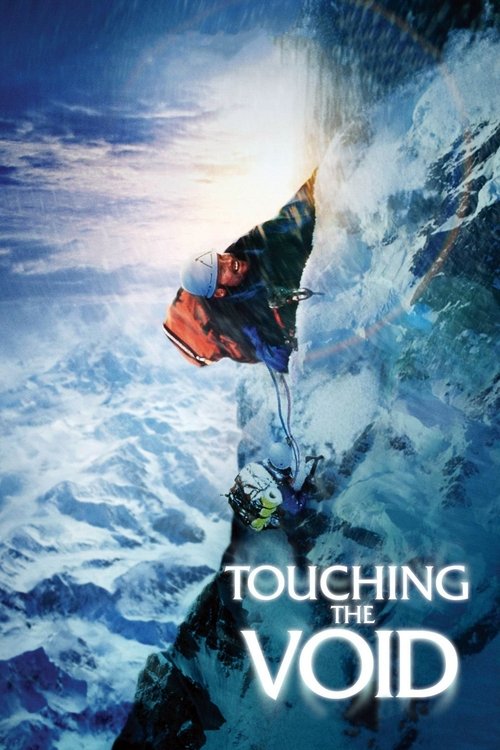
Touching the Void
2003 · Kevin Macdonald
For when you want to be gripped by something real — a white-knuckle survival story that outdoes most thrillers. Choose it when you're ready to be put through the wringer and come out inspired.
What it's about
In 1985, climbers Joe Simpson and Simon Yates attempted the unclimbed West Face of Siula Grande in the Peruvian Andes — and made it to the summit. The descent is where the story lives: a shattered leg, a storm, and a situation that forced one of the most debated decisions in mountaineering history. The film reconstructs what happened through the men's own accounts, told to camera, alongside dramatized climbing sequences shot in punishing conditions.
The experience
One of the most physically stressful films ever made — you feel the cold, the rope, the drop. Even knowing it's a true story told by its participants, the tension is almost unbearable, and it leaves you shaken and strangely elated about what a human body can endure.
The craft
Kevin Macdonald fuses talking-head testimony with full-scale dramatic reconstruction, and the combination is the trick: the real men's voices give the staged climbing sequences documentary weight, while the reconstructions give their words teeth. The mountain photography is stark and beautiful, and the sound of wind, ice, and creaking rope does devastating work. Watch it big and loud if you can.
Why it matters
It became the benchmark for the modern survival documentary, proving reconstruction and testimony could combine into something more gripping than fiction, and it brought Simpson and Yates's story to an audience far beyond climbing.
Snapshot
Touching the Void is a British feature documentary that reconstructs one of the most celebrated survival ordeals in modern mountaineering: the 1985 attempt by Joe Simpson and Simon Yates on the unclimbed West Face of Siula Grande (6,344m) in the Cordillera Huayhuash of the Peruvian Andes. The pair summited, but on the descent Simpson shattered his right leg. Yates lowered him down the mountain in stages until, in a storm at nightfall, he unknowingly paid Simpson out over a cliff. Unable to hold or communicate with his partner and being slowly dragged off the mountain himself, Yates made the decision that would make the story infamous: he cut the rope. Simpson fell into a crevasse, survived, and over three days crawled and hopped some miles back to base camp with no food and a broken leg, arriving hours before the others were due to leave. Adapting Simpson's 1988 memoir, Kevin Macdonald built the film as a hybrid — first-person interviews with the three real participants intercut with high-altitude dramatic reconstruction — and in doing so produced both a landmark of the early-2000s theatrical documentary boom and a template for the modern cinematic docudrama.
Industry & production
The film was produced by Darlow Smithson Productions, with John Smithson as producer, a company rooted in British factual and adventure television. It was developed and financed within the UK theatrical-documentary ecosystem of the early 2000s, with backing associated with FilmFour and the era's public-facing factual-film funding (the precise financing structure is not something I can detail with confidence, and I will not invent figures). Macdonald came to the project having won the Academy Award for Best Documentary Feature for One Day in September (1999); Touching the Void consolidated his standing and served as the bridge from non-fiction into his subsequent fiction career.
The production's central challenge was practical and physical rather than narrative: staging credible high-mountain climbing for the camera. The reconstruction sequences combined location work on Siula Grande itself in the Peruvian Andes with additional climbing footage shot in the Alps, using climbing actors and a specialist mountain crew. The real Joe Simpson and Simon Yates were involved as the on-camera narrators, with the third expedition member, Richard Hawking — who had remained at base camp — completing the trio of interviewees. The film was a notable commercial success by documentary standards, performing strongly in UK cinemas and earning a substantial theatrical release abroad; I'd avoid citing exact grosses without the record in front of me, but its profile was unusually high for a non-fiction feature of its moment.
Technology
Touching the Void sits at the cusp of the digital transition in factual filmmaking. The interview material and much of the dramatized footage were captured on film and high-end video typical of premium documentary production of the period; the demanding altitude and cold of the location work placed a premium on portable, robust camera systems handled by climbing cameramen rather than conventional crews. The technological story here is less about a single innovation than about the logistics of getting professional-grade images at altitude — lightweight rigs, the ability to shoot on near-vertical ice and rock, and the integration of that material with controlled studio-grade interviews. The film predates the GoPro era of helmet-cam ubiquity, so its mountain imagery depended on skilled operators physically present on the faces and in the crevasse environment, which gives the reconstruction its tactile weight.
Technique
Cinematography
The photography divides into two registers. The interviews are shot in a stripped, formal style — the three men set against plain dark backgrounds, isolated in frame, the camera close and still, so that the telling of the story carries the weight. Mike Eley is credited as cinematographer for the dramatic and interview material, while the high-altitude and climbing photography drew on specialist mountain camerawork (Keith Partridge is associated with the climbing cinematography). The mountain footage emphasizes scale and exposure: the smallness of the human figures against the white immensity of the face, the blue interior glow of the crevasse, the disorientation of whiteout. The crevasse sequences are the visual heart of the film — claustrophobic, lit to register ice as both beautiful and lethal — counterpointing the agoraphobic openness of the summit ridge.
Editing
Justine Wright's editing is the film's defining formal achievement, because the entire structure depends on the interlock between recollection and reconstruction. The cut continually moves from a man's face, calmly describing a decision or a moment of terror, to the dramatized event itself, so that voice and image reinforce one another without the actors ever speaking. The editing also manages suspense in a story whose outcome is, in one sense, pre-determined — we know at least one man survives to be interviewed — yet sustains genuine dread, particularly around the rope-cutting and the crawl out. The pacing of the final act, compressing days of delirium and crawling into a propulsive sequence, is a feat of rhythmic control.
Mise-en-scène / staging
The staging operates in two worlds: the bare interview space, deliberately abstracted from any setting, and the fully realized mountain, where every gesture — tying off a rope, the failure of a snow bollard, the dragging weight of an injured man — is reconstructed for legibility and physical truth. The decision to stage the reconstruction with near-silent actors, rather than have them deliver scripted dialogue, keeps the dramatic world subordinate to the testimony; the bodies act, the real men speak. This is the film's governing aesthetic choice and it disciplines everything else.
Sound
Sound is used to dramatize subjective extremity. Wind, the creak and crack of ice, the scrape of a body on rock, and the ringing emptiness of altitude build the sensory world of the climb. The most celebrated sonic detail is diegetic-by-memory: Simpson recounts that, in his delirium during the crawl, the Boney M. song "Brown Girl in the Ring" lodged in his head, and his horror at the prospect of dying to it — a moment of grotesque comedy that the film honors. Alex Heffes's score supplies tension and elegiac weight without overwhelming the interviews, modulating between propulsive anxiety and stillness.
Performance
Performance here is doubled. The dramatic reconstruction is carried physically by Brendan Mackey as Joe Simpson and Nicholas Aaron as Simon Yates (with a further actor portraying Richard Hawking), who perform under genuinely punishing conditions and convey suffering, decision and exhaustion almost entirely through the body. But the film's true performances are the interviews. Simpson is a remarkably articulate, unsparing narrator of his own near-death; Yates speaks with extraordinary candor about cutting the rope, neither defending nor dramatizing himself; Hawking provides the outsider's perspective. The emotional charge of the film comes from these men reliving, in measured speech, events that plainly still mark them.
Narrative & dramatic mode
The film's narrative mode is retrospective first-person testimony dramatized in real time — a documentary that adopts the suspense architecture of a thriller. Its central formal paradox is that the survivors narrate their own potential deaths, which should drain tension but instead deepens it: knowing Simpson lived only sharpens the question of how, and Yates's presence as narrator forces the audience to sit with the moral aftermath of the cut rope. The dramatic mode is essentially existential and procedural, attentive to decisions made under impossible constraints. There is no villain and no rescue; the drama is between a body and a mountain, and between a man and the choice he made to survive.
Genre & cycle
Touching the Void belongs simultaneously to several lineages. As a mountaineering film it descends from a long tradition of expedition and alpine cinema and from the literature of survival; as a survival narrative it is kin to the "ordeal" subgenre in which an individual is stripped to bare endurance. Most consequentially, it belongs to — and helped define — the cycle of theatrically released documentaries that flourished in the early-to-mid 2000s. It is a docudrama in the strict sense: a documentary whose evidentiary spine (the interviews) is fleshed out by dramatic reconstruction, a form it executes with unusual rigor by refusing to let the reconstruction speak over the witnesses.
Authorship & method
Kevin Macdonald's authorial method is visible in the film's central discipline: the refusal to fictionalize the voice. Trained in the British documentary tradition and a writer on film history before he was a director, Macdonald structures the film around testimony and uses reconstruction as illustration rather than substitute. His key collaborators reinforce this. Editor Justine Wright, a frequent Macdonald collaborator, built the interlock of word and image that the film lives or dies by. Composer Alex Heffes — who would go on to score Macdonald's The Last King of Scotland and State of Play — provides a score that serves the testimony rather than competing with it. Cinematographer Mike Eley and the specialist climbing camera team translated the abstraction of the interviews and the physical reality of the mountain into a single coherent visual argument. The source author, Joe Simpson, is in effect a co-author of the film's content, both as memoirist and as on-camera narrator; the film is faithful to the structure and self-questioning of his book. Macdonald moved decisively into fiction afterward, making Touching the Void a hinge work in his filmography.
Movement / national cinema
The film is a product of British factual filmmaking and its distinctive marriage of television-trained rigor with theatrical ambition. It stands in the long shadow of the British documentary movement — the Grierson school's commitment to actuality and the Free Cinema tradition's interest in lived experience — filtered through the Channel 4 / FilmFour culture that nurtured ambitious non-fiction in the 1990s and 2000s. Darlow Smithson's adventure-documentary expertise gave the project its logistical backbone. Within the British film renaissance of the period, Touching the Void was held up as evidence that British documentary could command cinemas, and it was honored as such.
Era / period
Released in 2003, the film arrived at the height of a documentary renaissance in which non-fiction films achieved unprecedented theatrical visibility — a moment that also produced Bowling for Columbine (2002), Spellbound (2002), Capturing the Friedmans (2003) and, soon after, Fahrenheit 9/11 (2004) and March of the Penguins (2005). Touching the Void is the British survival-documentary contribution to that wave. It also reflects an early-2000s appetite for "extreme experience" storytelling and for the docudrama form that broadcast television was simultaneously popularizing, lending it a theatrical legitimacy.
Themes
At its core the film is about decision under extremity and the ethics of survival. Yates's cutting of the rope — an act that mountaineering culture has largely vindicated as the only choice available, and which Simpson himself defends — is the film's moral engine, refusing easy judgment. Other themes thread through: the will to live as a sequence of small, concrete tasks ("to the next landmark") rather than a heroic surge; the indifference of the natural world; the loneliness of suffering, dramatized by the silence of the reconstruction; and the unreliability and persistence of memory, including the absurd intrusion of a pop song into a near-death crawl. The film is notably unsentimental: it treats survival not as triumph but as a grim, almost mechanical persistence.
Reception, canon & influence
Touching the Void was widely and warmly received, praised for the intensity of its testimony and the seamlessness of its hybrid form, and it won the BAFTA for Outstanding British Film (the Alexander Korda Award). It is now regularly cited among the strongest mountaineering films and among the defining theatrical documentaries of its decade.
Looking backward, the film draws on the documentary-with-reconstruction tradition and on the deep literature of mountaineering and survival; its most direct source is Simpson's own acclaimed memoir, which had already established the story's moral and dramatic shape. Looking forward, its influence is most visible in the maturation of the cinematic docudrama: the disciplined interlock of first-person testimony and high-production reconstruction it modeled can be felt in later non-fiction features that married interview to dramatization — James Marsh's Man on Wire (2008), which similarly turned a true ordeal into a suspense narrative and won the documentary Oscar, is the most frequently drawn comparison, and the approach echoes through subsequent reconstruction-driven documentaries. The film also helped cement the commercial case that serious documentaries could fill theaters, and it remains a fixture in discussions of how non-fiction film can generate suspense from outcomes the audience already knows. Where the precise lines of influence are debated rather than settled, that caution should be noted — but the film's status as a touchstone for the reconstruction-driven documentary is not in doubt.
A Deleuzian reading
Start with a man's face in the dark.
The full Deleuzian reading of Touching the Void →
Reception
A hit from day one — rapturous reviews, a surprise box-office success for a documentary, and a BAFTA — and its stock has only risen: two decades on it's still the benchmark every climbing doc (Free Solo included) gets measured against.
How Touching the Void was received, from release to now →
Influences: the films it descends from and the films it influenced
- Nanook of the North (1922) — Originated the docudrama by having real subjects re-perform their own lives for the camera, the staged-reconstruction-as-truth method Touching the Void formalizes by casting actors to mime Simpson and Yates while the real men narrate.
- Housing Problems (1935) — Pioneered ordinary people delivering unscripted, direct-to-camera first-person testimony, the spoken-witness spine that carries the film's entire dramatic structure.
- Night Mail (1936) — The British documentary movement's lyrical interlock of physical labor, landscape, and rhythmic sound design trained the GPO/Grierson tradition Macdonald inherited and applied to the mountain.
- The Conquest of Everest (1953) — Established specialist high-altitude expedition camerawork — hauling rigs into hostile terrain to film climbers in real conditions — the technical lineage of Mike Eley's pre-GoPro altitude photography.
- Shoah (1985) — Reconstructs an ordeal entirely through retrospective first-person testimony and physical return to the site, refusing archival footage — proving voice plus landscape can stage the unfilmable past.
- The Thin Blue Line (1988) — Legitimized stylized re-enactment as illustration of testimony rather than substitute for it, the exact discipline Macdonald cites in using reconstruction only to visualize what the interviews assert.
- One Day in September (1999) — Macdonald's own Oscar-winning doc first married interview testimony to suspense-from-a-known-outcome and selective reconstruction — the authorial template he refined and purified in Touching the Void.
- Man on Wire (2008) — Directly extends the model: a true ordeal restaged as suspense narrative through interview testimony interlocked with high-production reconstruction and silent actor-doubles, winning the documentary Oscar.
- Stranded: I've Come from a Plane That Crashed on the Mountains (2007) — Andes survivors deliver first-person testimony cut against mountain reconstruction, foregrounding the same ethics-of-survival self-questioning Simpson voices over his own doubled body.
- Deep Water (2006) — A reconstruction-driven survival doc generating suspense from an already-known fatal outcome, interlocking witness testimony with dramatized footage of a solitary ordeal at the edge of endurance.
- The Summit (2012) — A K2-disaster doc built on the same testimony-and-reconstruction interlock, manufacturing suspense from a death toll the audience already knows — explicitly the Touching the Void template applied to multiple witnesses.
- The Imposter (2012) — Pushes the reconstruction-driven documentary further, weaving slick dramatization tightly against contradictory first-person testimony to build a thriller's suspense from non-fiction material.
- Meru (2015) — Fuses climbers' retrospective on-camera testimony with self-shot specialist altitude camerawork, descending from both the witness-narration structure and the in-extremis mountain photography.
- Free Solo (2018) — Inherits the specialist mountain-camera apparatus and the generation of unbearable suspense from physical peril, the post-GoPro maturation of the altitude-rig craft Touching the Void pioneered theatrically.
- The Last King of Scotland (2006) — Macdonald's own hybrid documentary-drama method—reconstructed events captured with documentary-style cameras in authentically hostile locations, where uncontrolled environmental incident becomes a stylistic virtue—is carried wholesale into LKOS, including the ethics of treating real suffering as cinematographic material.
- Lone Survivor (2013) — Treats vertical mountain terrain itself as the antagonist, with the tumbling, body-battering descent down rock and scree as the central physical ordeal — the staging logic behind Lone Survivor's cliff falls.
- The Summit of the Gods (2021) — Defines the documentary-mountaineering staging Summit emulates — a survival ordeal reconstructed with procedural precision, the descent itself functioning as the propulsive question.
- Manjummel Boys (2024) — Sets the template of dramatizing a real mountaineering fall-and-rescue with documentary fidelity, sustaining suspense from physical process — how a body is hauled from a crevice — rather than manufactured peril.
- The Cycle of Love (2026) — Solves the foreknown-outcome problem by intercutting survivor testimony shot in neutral space with body-doubles filmed in the actual terrain, so suspense migrates from what happened to how the teller can bear to say it.
- 127 Hours (2010) — The fiction counterpart to the same true survival ordeal: subjective-extremity sound design and a single trapped body, dramatizing the indifference-of-nature crisis the doc renders through testimony.
- Senna (2010) — Builds a suspense narrative toward a fatal outcome the audience already knows, structured wholly around recorded voices — the same suspense-from-known-ending engineering, via archive instead of reconstruction.
- Grizzly Man (2005) — A contemporary survival doc organized around the indifference-of-nature theme and a first-person narrator confronting a hostile wilderness that does not care whether he lives.
- Society of the Snow (2023) — Macdonald's hybrid documentary of Andean high-altitude survival deploys the same altitude-environmental-sound layering and survivor-testimony ethics framework, treating the survivor's own terms for meaning as both formal and ethical constraint.
Similar films
- Grizzly Man (2005) — influence & lineage
- One Day in September (1999) — influence & lineage
- The Thing (1982) — same viewing thread
- The Wages of Fear (1953) — same viewing thread
- Jeremiah Johnson (1972) — same viewing thread
- Society of the Snow (2023) — shared sensibility
- The Descent (2005) — shared sensibility
- Gravity (2013) — shared sensibility
All the films related to Touching the Void →
Watch it with: curated runs of related films
- Into the Heart of Darkness — A run of grueling journeys into hostile country — jungle, ice, desert, occupied forest — where the ordeal strips men down to something primal, hallucinatory, and often unrecoverable.