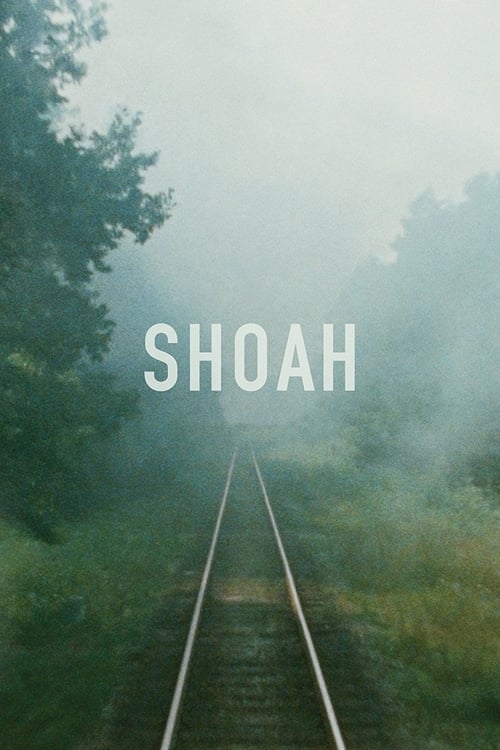
Shoah
1985 · Claude Lanzmann
For when you're ready to give a film real time and full attention — a work you undertake rather than watch, best split across several sittings. This is the far end of challenge, and worth it.
What it's about
A nine-and-a-half-hour documentary about the extermination of European Jewry, built over eleven years and containing not one frame of archival footage. Claude Lanzmann instead films the present: the emptied sites of Treblinka, Chełmno, and Auschwitz, the trains still running the same rails, and long, unflinching interviews with survivors, bystanders, and perpetrators — people made to remember, on camera, in their own words.
The experience
Slow, vast, and quietly overwhelming — the horror arrives through voices, faces, and ordinary landscapes rather than images of atrocity, which somehow cuts deeper. It demands patience and repays it with an experience unlike any other film.
The craft
The founding decision — no archive, only the present — is one of the most consequential formal choices in documentary history: green fields and quiet forests are made to hold what happened in them. Lanzmann's patient, sometimes confrontational interviewing, threaded through multiple languages and translators, turns testimony itself into the film's material.
Why it matters
Widely regarded as one of the greatest documentaries ever made, it permanently changed the debate about how — and whether — atrocity can be represented on film, and stands as the essential counter-argument to using archival horror footage at all.
Snapshot
Shoah is a nine-and-a-half-hour documentary about the extermination of European Jewry, assembled by the French writer and filmmaker Claude Lanzmann over roughly eleven years of research, filming, and editing. Its founding principle is an absolute refusal of archival imagery: there is not a single frame of period photograph or newsreel, no piled corpses, no liberation footage. Instead Lanzmann films the present — emptied camp sites at Chełmno, Treblinka, Auschwitz-Birkenau, and Sobibór, the forests and rail lines of Poland, the faces of those who survived, those who watched, and those who killed. The film is built almost entirely from interviews, conducted in many languages and threaded through Lanzmann's own on-camera questioning, with the landscape standing in for an event that left, by design, almost nothing to photograph. It is at once a work of oral history, a topographical investigation, and a sustained philosophical argument about how the destruction of the Jews can — and cannot — be represented. Widely regarded as one of the most important documentaries ever made, Shoah reframed the ethics of Holocaust representation for every filmmaker who came after.
Industry & production
Shoah was an artisanal undertaking financed across many years and many sources, not a studio product. Lanzmann — a journalist, sometime editor at Les Temps modernes alongside Jean-Paul Sartre and Simone de Beauvoir, and director of the earlier Pourquoi Israël (1973) — was approached in the early 1970s by figures connected to the Israeli government to make a film about the Holocaust "from the standpoint of the Jews." What began with state-related encouragement became a vastly longer and more independent project. By Lanzmann's own repeated account the film took about eleven years and accumulated some 350 hours of footage, of which roughly nine and a half hours were released; the unused material was later deposited and conserved, eventually at the United States Holocaust Memorial Museum, and Lanzmann mined it for several subsequent films (A Visitor from the Living, Sobibór, October 14, 1943, 4 p.m., The Karski Report, The Last of the Unjust).
Financing was patched together over the long gestation, and the production repeatedly ran short of money and time. The most consequential — and most ethically contested — production decisions concerned how Lanzmann obtained testimony from perpetrators. He filmed several former SS men and camp functionaries covertly, using a hidden camera and a concealed transmitter that relayed sound to a van where the image was recorded, paying some of them under false pretenses and a false name. One such filming, of the former Treblinka SS officer Franz Suchomel, is among the film's centerpieces; another covert shoot was physically discovered and Lanzmann was beaten. These methods belong as much to investigative journalism as to documentary convention, and they remain a standing subject of debate about consent, deception, and the limits a filmmaker may cross in pursuit of the historical record.
Technology
Technologically Shoah is deliberately plain; its innovations are ethical and procedural rather than mechanical. It was shot on 16mm color film over many years, which accounts for the visible shifts in stock, weather, and seasons across the finished work. The notable technical apparatus is the clandestine recording rig used for the perpetrators: a small camera hidden in a bag and a radio link feeding a separate recorder, a setup that introduced the grainy, drifting, surveillance-like image that marks those scenes off from the rest of the film. The long passages of Lanzmann walking with witnesses, or riding the rails toward Treblinka, depend on portable sync-sound 16mm equipment, but the film makes no display of technical virtuosity. Its governing technological choice is in fact a refusal: where most Holocaust films are assembled from the photographic and cinematic record left by the perpetrators and liberators, Lanzmann declined that entire archive on the grounds that such images both fail to show the killing and risk turning it into spectacle.
Technique
Cinematography
The cinematography, principally credited to Dominique Chapuis, William Lubtchansky (a major cameraman of the French art cinema), and others across the long shoot, works in two registers. The first is contemplative landscape: slow tracking shots along rail lines into Treblinka, the stone foundations and clearings of Chełmno, the gate and ramp at Birkenau, Polish fields and church squares filmed in flat, undramatic daylight. The camera lingers on these emptied places while a survivor's voice describes what once stood there, so that the image of a peaceful meadow is forced into unbearable tension with the testimony laid over it. The second register is the human face in interview — held in long, patient takes that refuse to cut away from distress. The most famous instance is the barber Abraham Bomba, filmed cutting hair in a Tel Aviv shop as he recounts cutting the hair of women inside the Treblinka gas chamber; the camera stays on him as he breaks down and as Lanzmann presses him to continue.
Editing
Editing, credited to Ziva Postec with Lanzmann, was the labor of years and is arguably the film's primary act of authorship. From hundreds of hours, Postec and Lanzmann constructed a structure that is associative and topographical rather than chronological — organized around places and the movement toward them rather than a timeline of the war. The film is built in two parts ("first era" and "second era"), and it characteristically interweaves testimony with the present-day landscape and with the labor of translation itself: Lanzmann frequently leaves his interpreter's spoken renderings inside the cut, so that the act of carrying language from Polish or Hebrew into French becomes part of the film's rhythm and a constant reminder of mediation. Nothing is summarized; the editing trusts duration to do work that narration would otherwise do.
Mise-en-scène / staging
Because Shoah refuses reenactment in the conventional sense, its "staging" is a subtle and disputed matter. Lanzmann did stage encounters: he arranged for Treblinka survivor Simon Srebnik to return to Chełmno and to a Polish village; he rented a barber shop for Bomba; he hired a locomotive and driver, Henrik Gawkowski, to pull a train toward the Treblinka station sign. These are not dramatizations of the past but provocations in the present, designed to summon memory in the body and the place where it happened. The mise-en-scène is thus a careful orchestration of return — the witness placed back into, or alongside, the site — without ever pretending to depict the killing itself.
Sound
Sound is foundational rather than decorative. The film carries no musical score; its soundtrack is voices, ambient wind, water, birdsong, trains, and the rhythmic overlay of consecutive interpretation. The polyphony of languages — Yiddish, Polish, Hebrew, German, French, English — is preserved rather than smoothed into a single dubbed track, and the labor of translation is audible throughout. The recurring sound of the train, and Srebnik's singing voice returning to the river where as a boy he was forced to sing for the SS, function as the closest thing the film has to motifs.
Performance
There are no actors and no performances in the fictional sense, yet Shoah is acutely concerned with how people speak before the camera. The "performances" are the conduct of witnesses under Lanzmann's questioning: Bomba's collapse, Suchomel's grim technical precision as he diagrams Treblinka and even sings a camp song, the Polish villagers' mixture of pity and antisemitic reflex, the historian Raul Hilberg's measured scholarly exposition. Lanzmann himself is a continuous presence — patient, relentless, sometimes manipulative — and his interviewing is the film's central performative act.
Narrative & dramatic mode
Shoah abandons conventional documentary narration entirely. There is no voice-of-God commentary, no statistics scrolled across the screen, no historical overview to orient the viewer. The dramatic mode is investigative and accretive: meaning is built from the accumulation of testimony, place, and silence over an extreme duration that is itself part of the argument — the film's length is meant to resist the consolations of a tidy two-hour story. Its closest dramatic kinship is to the inquest and to oral history, but Lanzmann inflects both with a near-theatrical sense of confrontation. The film withholds resolution; it ends not with liberation or redemption but with testimony of the Warsaw Ghetto Uprising and a final image of a moving train, refusing catharsis on principle.
Genre & cycle
Formally Shoah is a documentary, but it sits uneasily inside the category and was conceived in opposition to most of what the genre had done with the Holocaust. It belongs to the lineage of the interview-and-oral-history film and to the tradition of cinéma vérité only loosely; Lanzmann rejected the observational pretense of neutrality, intervening constantly. Within the cycle of Holocaust cinema it stands as the great counter-model to compilation documentary — the films built from Nazi and Allied footage — and to dramatized fiction alike. If it founds a cycle, it is the cycle of films that treat the limits of representation as their subject, and that privilege witness, place, and absence over reconstruction.
Authorship & method
Shoah is one of the most thoroughly authored documentaries in the medium's history, and its authorship is inseparable from a method. Lanzmann's governing convictions — articulated in his interviews and writings — were that the extermination must not be "represented" through reconstruction or archival spectacle, that fiction about the gas chambers verges on obscenity, and that the only legitimate path was the present-tense confrontation of witness and site. He divided his subjects into survivors, bystanders, and perpetrators, and he pursued each category with different tactics, including the deceptions used to film former SS men. His on-screen role — questioner, antagonist, patient listener — makes him a true auteur of the encounter.
He did not work alone. The editor Ziva Postec shaped years of footage into the released structure and is essential to any honest account of the film's form. The cinematographers — among them William Lubtchansky and Dominique Chapuis — gave the landscape passages their grave, unhurried quality. The historian Raul Hilberg, author of The Destruction of the European Jews, appears as an on-camera interlocutor and functions as something like the film's intellectual conscience, supplying the bureaucratic and logistical understanding of the genocide that the testimonies dramatize. There is no composer, because there is, by design, no score. The film's writing, such as it is, lives in the questions Lanzmann asks and in the architecture of the cut rather than in any script.
Movement / national cinema
Shoah is a French production by a French author, rooted in the post-war Parisian intellectual milieu of Les Temps modernes, existentialism, and a politically engaged conception of the writer. But it is profoundly transnational in execution — filmed across Poland, Israel, Germany, the United States, and elsewhere, in a half-dozen languages, with a multinational crew. It belongs less to any national-cinema movement than to a postwar European reckoning with memory and atrocity, and it is best understood alongside the French documentary tradition's earlier engagements with the camps, most pointedly Alain Resnais's Night and Fog (1955), against which Lanzmann partly defined himself.
Era / period
The film appeared in 1985, four decades after the liberation of the camps, at a moment when the first generation of witnesses was aging and when public reckoning with the Holocaust was intensifying in France and beyond — the era of the Klaus Barbie proceedings and of sharpening debate over Vichy and over Holocaust denial. Its emergence in the mid-1980s is significant: it was made while direct testimony was still possible to gather but already shadowed by the knowledge that the witnesses would soon be gone. The film's insistence on living voices is inseparable from this twilight timing, and it helped catalyze the broader "era of the witness" in historical culture.
Themes
The film's deepest theme is the problem of representation itself: how, or whether, an event engineered to leave no witnesses and few images can be shown at all. From this flow its other concerns — memory as a bodily, present-tense act rather than a record of the past; the topography of genocide, the way ordinary Polish landscapes and railways were made instruments of murder; and the question of complicity, explored unsparingly through the bystander testimonies of Polish villagers whose recollections mingle compassion with persistent antisemitism. Shoah is preoccupied with the mechanics of extermination — the trains, the timetables, the deception of victims — because Lanzmann believed that understanding the "how" was the only non-trivial way to approach the unimaginable "why." It is equally a meditation on language and translation, on the impossibility and necessity of speech, and on the ethics of looking.
Reception, canon & influence
Shoah was received on release as a landmark, widely hailed by critics as one of the supreme achievements of documentary cinema and as a moral and artistic event that exceeded ordinary film criticism; Simone de Beauvoir, among others, championed it in print. It also drew controversy, particularly in Poland, where its portrait of Polish bystanders provoked official and popular objection, and among ethicists troubled by Lanzmann's deceptive filming of perpetrators. Over the following decades its canonical standing only rose: it appears regularly on critics' lists of the greatest films and is treated as essential viewing and a foundational text in Holocaust studies, documentary theory, and the philosophy of testimony.
Its influences flowing backward are real but selective. Lanzmann worked in conscious tension with Resnais's Night and Fog, accepting its gravity while rejecting its reliance on atrocity footage; he drew on the methods of investigative journalism and on the scholarship of Raul Hilberg; and he absorbed the engaged-intellectual ethos of his Sartrean circle. Forward, its legacy is immense. Shoah effectively rewrote the rules of Holocaust representation, making the refusal of archival spectacle and the privileging of living testimony into a serious ethical position that later documentaries had to answer to. Its influence is visible in the turn toward oral history and "the era of the witness," in debates that shadowed films from Schindler's List to Joshua Oppenheimer's The Act of Killing, and in a wider documentary practice that treats place, duration, and the limits of the image as subjects in their own right. Lanzmann himself extended the project across a series of later films drawn from the same vast body of footage, so that Shoah became not only a finished masterwork but an ongoing archive of witness. Where the historical record on specific production particulars is thin or rests largely on Lanzmann's own often-repeated testimony, that provenance should be kept in mind — but the film's stature and its reorientation of how cinema confronts genocide are not in dispute.
A Deleuzian reading
A field.
The full Deleuzian reading of Shoah →
Reception
Hailed almost instantly as a monument in 1985 — but it was furiously denounced by Poland's communist government, which protested its portrayal of Polish villagers. Four decades on the controversy has faded and it sits near the top of every greatest-documentary poll, ranked #2 in Sight & Sound's 2014 critics' poll of documentaries.
How Shoah was received, from release to now →
Influences: the films it descends from and the films it influenced
- Night and Fog (1956) — Established the present-tense color tracking shot gliding over emptied camp grounds intercut with the past — Lanzmann kept the slow gravity of those landscape glides while explicitly refusing the archival atrocity footage Resnais montaged against them.
- Chronicle of a Summer (1961) — Made the interviewer an on-camera provocateur whose questioning catalyzes rather than records testimony, modeling Lanzmann's role as questioner-antagonist eliciting the witness's present-tense breakdown.
- Hiroshima Mon Amour (1959) — Lanzmann enters into explicit formal argument with Hiroshima by refusing all archival footage of the Holocaust, insisting that present-tense survivor testimony is the only legitimate mode — a counter-position that presupposes and is defined against Resnais's documentary-fiction intercut, making Shoah's method only fully legible in relation to Hiroshima's.
- Muriel, or the Time of Return (1963) — Carries forward the Cayrolian strategy of the absent center, confronting atrocity by refusing to image it and building the work entirely around the unshown victim.
- Passenger (1963) — Its refusal of reenactment and reliance on absence, testimony, and the unsayable extends Passenger's ethic of making the missing visible instead of reconstructing a false wholeness.
- Schindler's List (1993) — Defines itself against Shoah by doing exactly what Lanzmann forbade — dramatic reconstruction of the camps including a gas-chamber scene — making it the descendant that crystallized the representation-vs-refusal debate Shoah set the terms for.
- Waltz with Bashir (2008) — Confronts the limits of representing atrocity by reconstructing repressed eyewitness memory through animation rather than archive, a formal answer to the same archive-refusal problem Lanzmann posed about images of the unspeakable.
- The Act of Killing (2012) — Inverts Lanzmann's perpetrator deceptions by inviting Indonesian killers to stage their own reenactments, letting their self-dramatization expose what direct interrogation could not — a descendant that radicalizes the on-camera confrontation with perpetrators.
- The Voice of Hind Rajab (2025) — Defines the ethic of representing atrocity without ever showing it, refusing archival images in favor of voice and testimony—the principled refusal that governs Hind Rajab's withheld image.
- Our Land (2026) — Interrogates impunity through testimony and physical return to the site of the crime, refusing to re-stage the violent act — the ethics of non-spectacle Our Land adopts toward its killing video.
- One Day in September (1999) — Established sustained perpetrator testimony — including interviews with former SS officers — as a legitimate and formally rigorous strategy in documentary about political violence; Macdonald's extended interview with Jamal Al-Gashey, the surviving gunman, belongs to this post-Shoah tradition of confronting perpetrators without editorial resolution.
- Little Dieter Needs to Fly (1997) — Lanzmann's insistence that survivors perform trauma rather than merely describe it — refusing archival footage and demanding the body re-enter the past through speech and gesture — provides the ethical and formal precedent for Herzog's decision to send Dengler back to the jungle and the door: the irreducible presence of the surviving body as the documentary's primary evidence.
- Son of Saul (2015) — Establishes the genre's prohibition against reconstructing the camps and the reliance on testimony and off-screen reference — Nemes inherits the refusal to depict atrocity directly, keeping the gas chambers and killing in the blurred margins or pure sound.
- The Zone of Interest (2023) — Establishes the prohibition on reenactment — rendering the camps through testimony, absence and present-day landscape rather than depiction, the discipline Glazer extends by withholding the camp from the image entirely.
- The Pianist (2002) — The primacy of first-person survivor testimony over reenacted spectacle as the ethical basis for screening the Holocaust.
- Touching the Void (2003) — Reconstructs an ordeal entirely through retrospective first-person testimony and physical return to the site, refusing archival footage — proving voice plus landscape can stage the unfilmable past.
- Sometimes in April (2005) — Builds atrocity from survivor and perpetrator testimony delivered at the actual locations; Peck imports this evidentiary, place-anchored voice into fiction, letting Kigali's real geography carry the memory.
- The Sorrow and the Pity (1969) — Built history entirely from long, unnarrated face-to-face interviews that let perpetrators, bystanders and resisters incriminate themselves through their own speech — the no-voice-of-god, complicity-of-the-bystander architecture Shoah inherits wholesale.
- Le Joli Mai (1963) — Assembled a polyphonic portrait of a place out of stacked spoken testimony from ordinary people, anticipating Shoah's weave of many voices and its treatment of duration of speech as the film's primary material.
- Hôtel des Invalides (1952) — Turned a commemorative site into an ironic counter-monument by walking the camera through it in the present and undercutting the official memory it enshrines — a precedent for using place itself as hostile witness.
- Hôtel Terminus (1988) — Sibling pursuit of a perpetrator (Klaus Barbie) through patient, accumulating oral-history interrogation and door-to-door confrontation, extending the Ophüls/Lanzmann method of letting evasion and denial play out on camera.
- From the East (D'Est) (1993) — Pushed the durational landscape-tracking shot across post-Soviet Eastern Europe with no narration or score, making the slow lateral survey of unremarkable terrain carry the unspoken weight of catastrophe, as Shoah's roadside and forest glides do.
- The Specialist (1999) — Counter-compilation that re-edits the Eichmann trial's video archive to indict the bureaucratic 'desk murderer,' carrying forward Hilberg's logistical understanding of genocide as administration rather than spectacle.
- Sobibór, Oct. 14, 1943, 4 p.m. (2001) — Lanzmann's own extension drawn from the same body of footage, built on a single survivor's testimony and orchestrated returns to the site, applying the Shoah method to the one uprising it had to set aside.
- S21: The Khmer Rouge Killing Machine (2003) — Brings survivors and guards back to the Tuol Sleng prison and has former perpetrators re-enact their daily routines in situ — the orchestrated return to the place of the crime as the engine of testimony, transposed to Cambodia.
- The Missing Picture (2013) — Answers the absence of images of the Khmer Rouge crimes with hand-made clay figurines, making the missing picture itself the subject — the explicit heir to Shoah's thesis that the event resists archival representation.
- The Look of Silence (2014) — Stages a survivor's brother quietly confronting the still-living perpetrators face to face, restoring the witness-conduct and present-tense ethical encounter at the core of Lanzmann's interview method.
- The Last of the Unjust (2013) — Reactivates 1975 interview footage of Benjamin Murmelstein shot for Shoah but withheld, returning Lanzmann to Theresienstadt's sites decades later and demonstrating the film as an ongoing, self-extending archive of witness.
- Hitler: A Film from Germany (1978) — The exact structural counter-move: Lanzmann also refuses dramatization and uses extreme duration and the frontally recorded speaking witness as his only event, but bans the archival image entirely where Syberberg buries the screen in it — the two films define the poles of the representation debate on technique, not theme.
Similar films
- Schindler's List (1993) — influence & lineage · same viewing thread
- Night and Fog (1956) — influence & lineage
- Waltz with Bashir (2008) — influence & lineage
- The Voice of Hind Rajab (2025) — influence & lineage
- The Act of Killing (2012) — influence & lineage
- Son of Saul (2015) — same viewing thread
- Hitler: A Film from Germany (1978) — same viewing thread
- The Zone of Interest (2023) — same viewing thread
All the films related to Shoah →
Watch it with: curated runs of related films
- In the Shadow of the Reich — A run of films about ordinary people inside the Nazi era — surviving it, resisting it, or trying to reckon with how it happened — that rhyme on conscience, complicity, and who chooses to act.