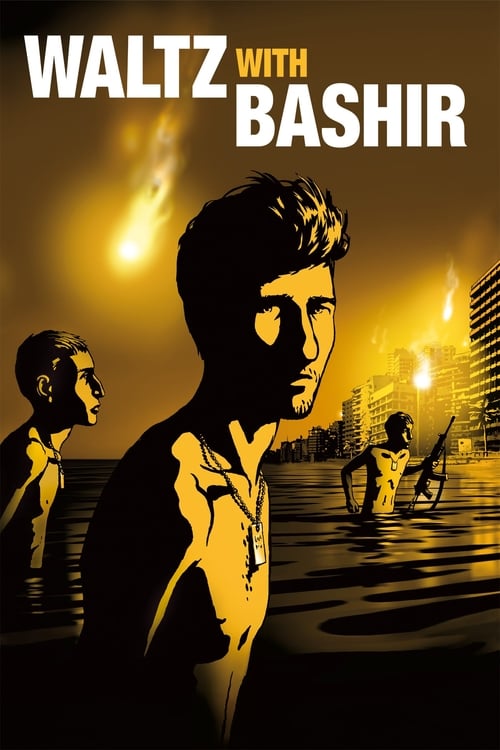
Waltz with Bashir
2008 · Ari Folman
For when you want a serious, haunting film that stays with you for days — a challenge, not comfort viewing, but a genuinely singular one. Reach for it when you're ready to think hard about war and what memory does to survive it.
What it's about
Israeli filmmaker Ari Folman realizes he has almost no memory of his service as a nineteen-year-old soldier in the 1982 Lebanon War — including the nights surrounding the Sabra and Shatila massacre in Beirut. Prompted by a friend's recurring nightmare, he tracks down fellow veterans, a psychologist, and a journalist, and rebuilds his past interview by interview. The whole investigation is rendered in animation, drifting between remembered fact, dream, and hallucination.
The experience
Hypnotic and quietly devastating — it moves like a dream you can't shake, with surreal, gliding imagery set against matter-of-fact conversation. It builds a slow dread as memory comes back into focus, and it lands hard.
The craft
The animation is the whole argument: a stark, heavy-lined style that lets nightmares, hallucinations, and reconstructed memory share one visual language no camera could capture. Max Richter's score threads mourning through it, and the sound design — surf, flares, gunfire, 80s pop — is doing constant work. It rewards a dark room and good speakers.
Why it matters
It essentially defined the animated documentary for modern audiences, won the Golden Globe for foreign-language film and earned an Oscar nomination, and opened a fraught public conversation in Israel about the Lebanon War. Its influence shows up in every documentary since that uses animation to picture the unfilmable.
Snapshot
Waltz with Bashir is an animated documentary in which Israeli director Ari Folman investigates his own amnesia about the 1982 Lebanon War, in which he served as a nineteen-year-old infantryman in the Israeli Defense Forces. Prompted by a friend's recurring nightmare, Folman discovers that he retains almost no concrete memory of his term of service — and, more disturbingly, of his proximity to the Sabra and Shatila massacre, in which Christian Phalangist militiamen slaughtered Palestinian and Lebanese civilians in a Beirut refugee camp while the IDF held the perimeter and lit the night with flares. The film structures itself as a series of interviews Folman conducts with fellow veterans, a psychologist, a trauma expert, and a journalist, each conversation loosening another fragment of buried recollection. What distinguishes it is form: nearly the entire film is animated, including the interview footage, so that documentary testimony and hallucinatory memory occupy the same illustrated surface. It won the Golden Globe for Best Foreign Language Film, was nominated for the Academy Award in the same category, and stands as one of the most formally consequential nonfiction films of its decade — a work that used animation not to soften atrocity but to dramatize the unreliability of the mind that survives it.
Industry & production
The film was an international co-production, financed across Israel, France, and Germany, with backing that included Israeli public funds, France's ARTE, and German regional support — a structure typical of an ambitious auteur documentary that could not have been carried by the small Israeli market alone. Folman had a substantial prior career in Israeli television and film, including work on the acclaimed series BeTipul (later remade internationally as In Treatment), which gave him standing to mount a project of this technical scale. The production was notably long and labor-intensive: the animation was produced over roughly four years by a comparatively small studio team in Israel. The methodology inverted the usual order of animated filmmaking. Folman first conducted and recorded real interviews with the actual veterans and shot live-action reference material — a video "script" — which was then translated into animation, so the drawn film had a documentary substrate underneath it. Two of the interviewees reportedly asked not to appear as themselves; in those cases the testimony was preserved but the figure and voice were altered, a disclosure the film's makers have acknowledged and which sits honestly within a project about the instability of first-person truth.
Technology
The film's technique has often been loosely described as rotoscoping, but the production consistently stated it was not conventionally rotoscoped. Rather, the live-action reference and a large body of illustrated storyboards were combined and animated using a mixture of Adobe Flash cutout animation, classic hand animation, and 3-D — a hybrid pipeline the studio developed to give the drawn figures their characteristic weight and stiffness. The result is deliberately not the fluid, traced naturalism of rotoscope: bodies move with a slightly heavy, marionette-like quality that reads as memory rather than as filmed life. The palette leans on deep blacks, sulfurous yellows, and a recurring cold sea-blue, achievable through digital compositing that could hold a limited, poster-like color scheme across the whole film. This technological approach — assembling animation from live reference without literally tracing it — was central to the film's argument, because it let interview and dream, present testimony and reconstructed past, be rendered in one continuous visual grammar that photography could never have unified.
Technique
Cinematography
Because the film is animated, "cinematography" is a matter of designed camera behavior rather than captured light, and the film exploits this freedom. Virtual camera moves glide through spaces no real camera could hold — a slow track across an airport terminal packed with returning soldiers, an aerial drift over the sea, a descent into water. The framing frequently favors the iconic and frontal: single figures held in stillness, silhouettes against flarelight, wide compositions where a lone soldier is dwarfed by architecture or landscape. The lighting is expressionistic, built on hard contrasts and unnatural color casts. The film's most reproduced image — a naked man rising from the sea at night under the orange glare of falling flares — exemplifies the approach: a composition that is dreamlike precisely because its light obeys emotional rather than physical logic.
Editing
The editing organizes the film as an investigation, cross-cutting between the present-tense interviews and the recovered or imagined past they summon. Nora Ben Zvi and the editorial work structure a braided chronology in which each testimony triggers a flashback, and flashbacks are sometimes revised or contradicted as new accounts accumulate — the cut itself dramatizes memory's revision. Music-video-like passages (most famously a firefight staged to a driving rock track) sit against long, quiet interview stretches, and the rhythm modulates between hallucination and interrogation. The film withholds its terminus: the massacre is circled, approached, and deferred until the final movement, so the editing builds a structure of dread rather than revelation.
Mise-en-scène / staging
Every element of the frame is authored, which gives the staging an unusual density of intention. Interiors — a bar, an apartment, a psychologist's office — are rendered with flat, graphic-novel clarity, while the war scenes are staged as tableaux: soldiers frozen in impossible poses, a tank crew silhouetted on a ridge, the titular "waltz" in which a soldier fires wildly with a machine gun in the middle of a Beirut street beneath a torn poster of the assassinated president-elect Bashir Gemayel, spinning as if dancing. The recurring motifs — the sea, flares, feral dogs, the airport — are staged as returning images rather than plot points, functioning like the fixed symbols of a recurring dream.
Sound
Sound is one of the film's most powerful registers precisely because the image is drawn and therefore weightless; the soundtrack supplies the physical world. Max Richter's score is central — brooding, minimal, elegiac — and the film also deploys period and pastiche pop and rock to ironic and unsettling effect. Ambient sound, gunfire, the wash of the sea, and the recorded interview voices ground the animation in something bodily and real. The interviews use the veterans' actual recorded testimony (with the noted exceptions), so the documentary authenticity lives largely in the voice track while the image floats above it.
Performance
"Performance" is doubled. On the voice track are the real interviewees delivering genuine recollection, their hesitations and flatness carrying the affect of trauma; on the image track are animated avatars whose restrained, heavy movement resists conventional expressiveness. The deliberate stiffness of the figures becomes a kind of performance choice — faces that hold rather than emote, bodies that move like people underwater — which suits a film about numbness, dissociation, and men who have detached from their own histories.
Narrative & dramatic mode
The film's dramatic engine is the detective story turned inward: Folman is both investigator and suspect, reconstructing a crime scene in which his own culpability is the mystery. It adopts the structure of psychoanalysis — a symptom (the friend's nightmare, Folman's blank), a hunt through associations and witnesses, and a movement toward a repressed core. This is memoir as forensic procedure. The mode is confessional and essayistic, but it resists the tidy catharsis of recovered-memory narratives; the "solution" is not absolution but the return of an unbearable image. The animation sustains a productive ambiguity between what happened, what was dreamed, and what was reconstructed after the fact, so the narrative never fully stabilizes into settled fact — which is the point.
Genre & cycle
Waltz with Bashir sits at the intersection of the war film, the documentary, and animation, and it belongs to a broader turn-of-the-decade cycle of animated nonfiction that pushed documentary beyond its photographic base. It is also part of a distinct wave of Israeli films reckoning with the 1982 Lebanon War and its moral aftermath, a cluster that includes Beaufort (2007) and, two years later, Lebanon (2009). Within the war genre it is an anti-heroic, trauma-centered entry, closer to the tradition of films skeptical of their own nations' conduct than to combat spectacle. Its hybridity — the animated documentary of witness — was novel enough that it was frequently discussed as sui generis, even as it drew on longstanding traditions of animation addressing atrocity.
Authorship & method
The film is unmistakably Folman's authored act of reckoning: he is director, writer, on-screen investigator, and the biographical subject, a convergence that makes authorship and confession inseparable. His method — recording real testimony, shooting live reference, then rebuilding it as animation — was the decisive creative decision, and it flowed from a conviction that only drawing could hold memory, dream, and testimony in a single frame. His central collaborator on the visual identity was art director and illustrator David Polonsky, whose graphic-novel style defined the film's look and who, with Folman, later adapted the material into a companion graphic novel. The score by Max Richter is the other authorial signature, giving the film its mournful gravity; Richter's contribution is substantial enough that the music functions as co-narrator. The editing was handled by Nora Ben Zvi, and the film's sound and animation direction were the product of a sustained studio effort in Israel. The collaboration between Folman's investigative structure and Polonsky's image-making is what gives the film its unified voice.
Movement / national cinema
The film is a landmark of the resurgent Israeli cinema of the 2000s, a period in which Israeli filmmakers produced an internationally visible body of work that turned a critical, self-examining eye on the country's wars and occupations. Within that new wave, Waltz with Bashir is among the most formally daring and internationally decorated. Its willingness to place an Israeli soldier's complicity — specifically the IDF's role at the perimeter of Sabra and Shatila — at the center of a first-person account made it a significant, and domestically debated, act of national self-scrutiny. Notably, despite its subject, the film was reportedly banned from public screening in Lebanon, a fact that underscores how thoroughly its national provenance shaped its reception across the region.
Era / period
Made across the mid-to-late 2000s and released in 2008, the film belongs to a moment when digital animation tools had matured enough to make a feature-length, small-studio animated documentary economically and technically feasible, and when documentary itself was expanding aggressively beyond observational realism. It arrived amid a wider international appetite for nonfiction that formally interrogated memory and testimony. Its historical subject, however, is 1982 — the Israeli invasion of Lebanon and the Sabra and Shatila massacre — so the film is structurally a work of the 2000s looking back a quarter-century, and its emotional register is that of a generation confronting, in middle age, what it did as teenagers.
Themes
The film's governing theme is memory and its failure: the mind's capacity to erase what it cannot bear, and the moral hazard of that erasure. Repression is figured not as absence but as an active screen — Folman's invented or displaced memories stand in for the truth until testimony dislodges them. Closely bound to this is complicity and the question of the bystander: the film's moral center is not the pulling of a trigger but the standing at a perimeter, the lighting of flares, the watching. It interrogates the guilt of proximity and the diffusion of responsibility. War is rendered as absurd, disorienting, and dreamlike — the "waltz" of the title is madness mistaken for grace. Trauma, youth, and the numbing of feeling recur, as does an implicit historical echo, made explicit in the film's engagement with the Holocaust as a shadow over the second generation. The film's final gesture — a sudden shift out of animation into live-action documentary footage of the massacre's aftermath — insists that beyond the drawn image lies an unrepresentable real, and that art's stylization must finally give way to the photographic fact of the dead.
Reception, canon & influence
Waltz with Bashir was received as a major critical event. It premiered in competition at Cannes in 2008, won the Golden Globe for Best Foreign Language Film, was nominated for the Academy Award for Best Foreign Language Film, and collected numerous critics' and national awards; it was widely cited on year-end best lists. Critical discourse centered on its formal audacity — the proposition that animation could be a legitimate, even superior, vehicle for documentary truth about trauma — and on the ethical weight of its final live-action turn, which some read as a necessary rupture and others debated. There was also principled discussion of the limits of its self-scrutiny: whether a film centered on Israeli guilt and Israeli memory could adequately hold the Palestinian dead who are, until the last minutes, largely off-screen.
Looking backward, the film draws on a lineage of memory-and-testimony cinema and of animation used for serious historical subject matter, as well as on the confessional first-person documentary; its psychoanalytic structure and its music-driven war sequences show an absorption of both art cinema and popular idiom. Looking forward, its influence has been considerable. It became the reference point for the animated documentary as a recognized form, cited in critical and academic discussion whenever later works — such as Tower (2016) or other hybrid nonfiction — use animation to render testimony, memory, or events beyond the camera's reach. It helped legitimize animation as a tool for adult, politically serious documentary, and it consolidated the international standing of the 2000s Israeli new wave. Folman and Polonsky's own subsequent trajectory — including the graphic-novel adaptation and Folman's later animated work engaging the Holocaust — extends the film's method. Within the canon of nonfiction cinema, Waltz with Bashir is now routinely named among the defining documentaries of its century's first decade, valued less as a report on a war than as a rigorous, formally original inquiry into how the people who fight wars survive by forgetting them.
A Deleuzian reading
A naked man walks out of a black sea at night.
The full Deleuzian reading of Waltz with Bashir →
Reception
A Cannes-competition sensation in 2008 and instant critical darling, it won the Golden Globe only to lose the Foreign Language Oscar to Departures — still cited as one of the category's great upsets. Nearly two decades on it remains the benchmark 'animated documentary,' though it's now debated as much as it's admired.
How Waltz with Bashir was received, from release to now →
How to watch Waltz with Bashir: what to notice on a first viewing
- Notice interviews and remembered scenes drawn in the same style. Every image in the film, real testimony and imagined memory alike, is built from the same flat lines, weight, and narrow palette of black, yellow, and blue. You cannot tell testimony from imagination by how it looks, only by what the voice track tells you.
- Listen for the veterans' real, hesitant recorded voices. Beneath the drawn images the soundtrack keeps actual interview audio, unscripted pauses and flatness included, while Max Richter's brooding, minimal score sits underneath. The truth of the film lives mostly in what you hear, while the picture stays open to doubt.
- Watch how stiffly and heavily the animated figures move. Bodies hold poses rather than flow between them, faces stay fixed more than they emote, and characters walk as if pushing through water. The stiffness becomes its own kind of acting, suited to men who have gone numb to their own past.
- Notice camera moves no real camera could make. The animated camera glides through packed terminals, drifts over the sea, and descends into water, while wide shots repeatedly dwarf a lone soldier in landscape or architecture. Scale and impossible movement keep reminding you that everything on screen was built, not filmed.
- Follow how each interview summons a specific flashback. Every conversation Folman has with a fellow veteran calls up a remembered or imagined scene, tied to what that person just told him. The structure turns the film into an investigation, each witness unlocking one more piece of what happened.
The whole guide to watching Waltz with Bashir, with the keys for a rewatch →
Influences: the films it descends from and the films it influenced
- Night and Fog (1955) — Its slow tracking camera gliding over emptied atrocity sites, married to a mournful poetic-musical voice and withholding moral confrontation until the end, models Bashir's deferred climax and its documentary gaze at the vacated scene of horror.
- Hiroshima mon amour (1959) — Its braided cutting between present-tense testimony and involuntary traumatic flashback — memory intruding as sudden image over spoken recollection — is the editing grammar Folman rebuilds for his interviews.
- Sans Soleil (1983) — Establishes the first-person essay-documentary voice that reconstructs and interrogates its own memory as unreliable image-archive, the reflexive investigative structure Folman turns inward on himself.
- Shoah (1985) — Builds an atrocity documentary entirely from recorded interview testimony while refusing archival footage of the event itself, the testimony-as-architecture method Folman records first and only then re-embodies as drawing.
- The Thin Blue Line (1988) — Treats documentary reenactment as frankly subjective — repeating a contested event in stylized, Philip Glass–scored restagings — the precedent for Folman's music-driven, admittedly reconstructed memory sequences.
- Apocalypse Now (1979) — Choreographs combat to music as operatic hallucination (the Wagner helicopter assault), the direct model for staging the title firefight as a lethal dance — a soldier waltzing with a machine gun under Bashir's poster.
- Grave of the Fireflies (1988) — Uses hand-drawn animation to render wartime death with unflinching documentary gravity rather than fantasy, legitimizing the medium as a vehicle for serious atrocity that Folman then claims for nonfiction.
- Waking Life (2001) — Shoots live-action reference and animates over it to render dream and memory as an unstable, floating visual field, the live-shot-then-redrawn workflow Folman adapts (pointedly without true rotoscope).
- Munich (2005) — Folman's animated documentary deploys trauma-intercutting — fragmented recovered memories erupting into present-tense scenes — as its central formal device, and culminates by cutting from animation into actual archival news footage of the Sabra and Shatila massacre, enacting Munich's archival-integration strategy in reverse: from subjective reconstruction into documentary reality, forcing the same ethical rupture Munich achieves with its cross-cut climax.
- Sometimes in April (2005) — Carries forward the aftermath-and-complicity form — a participant reconstructing a massacre years later through fractured memory and testimony — pushing Peck's survivor-recollection frame into animated first-person inquiry.
- When the Wind Blows (1986) — Extends animation-as-grief into war trauma and state complicity, vindicating the film's core argument that the medium can bear political seriousness and mourning.
- Pink Floyd: The Wall (1982) — Uses expressionist animation as emotional shorthand for war trauma and repressed memory, the Scarfe strategy of drawing what live action cannot show applied to a father's-war reckoning.
- The Missing Picture (2013) — Substitutes handcrafted clay figures in dioramas for the footage the Khmer Rouge never let exist, extending Bashir's principle that animation can testify to atrocity the camera failed to record.
- The Congress (2013) — Folman's own live-action-to-animation hybrid that inverts Bashir's structure — rupturing from photographed reality into drawn hallucination rather than the reverse — carrying his medium-switch as dramatic device forward.
- Tower (2016) — Rotoscopes survivor interviews into animated reenactment to reconstruct a mass shooting from inside participants' remembered experience, the canonical citation of Bashir's animated-testimony form.
- Another Day of Life (2018) — Adapts a war correspondent's memoir as animated documentary punctuated by live-action interview inserts, replicating Bashir's animation-with-live-action-rupture architecture for a different conflict.
- Where Is Anne Frank (2021) — Folman and Polonsky reunite to apply the same drawn-testimony method to Holocaust memory, the direct continuation of their studio collaboration and graphic-novel visual identity.
- Flee (2021) — Uses animation to hold and protect a refugee's spoken testimony, rendering memory and its gaps as drawing while reserving live-action archival breaks — an explicitly Folman-derived animated-documentary method.
- The Breadwinner (2017) — Demonstrated animation as a vehicle for grave recent-history testimony from a war zone, using stylization to render trauma otherwise unfilmable.
- Jim Queen and the Quest for Chloroqueer (2026) — Proved the adult animated feature could sustain grave allegorical and documentary weight for grown audiences, expanding what the medium was allowed to say.
- In Waves (2026) — Animated first-person memoir built from recorded interviews, using non-linear, dreamlike editing to reconstruct suppressed traumatic memory — the ethical interview-led method Nguyen adopts with Dungo and Kristen's family.
- The Summit of the Gods (2021) — Built the adult-animation template of an investigative quest — a first-person narrator reconstructing a buried truth through interviews and testimony — that structures Fukamachi's pursuit of Habu.
- Rio 2096: A Story of Love and Fury (2013) — Establishes the first-person voiceover guiding stylized 2D animation through traumatic national history — the confessional-witness mode Rio 2096's immortal narrator inherits.
- Won't You Be My Neighbor? (2018) — Legitimizes animation inside nonfiction as a window into a subject's interior life, the exact function of the film's Daniel Tiger sequences rendering Rogers's inner world.
- Persepolis (2007) — A graphic-novel author-illustrator adapting her own politically charged autobiography into stark, high-contrast 2D animation — the same author/illustrator division of labor Folman shares with Polonsky, released a year earlier.
- Chicago 10 (2007) — Contemporaneously animates real courtroom transcript testimony as motion-captured reenactment, extending nonfiction into animation to dramatize documented speech beyond surviving footage.
- My Best Fiend (1999) — Folman constructs an essay-documentary around a filmmaker's investigation of his own selective, self-protective memory — the 'memory and myth-making' formal problem that also structures My Best Fiend — ending with archival footage that shatters the reconstructed myth.
- Little Dieter Needs to Fly (1997) — Folman applies the double-temporality and narration-image gap to animated form — recovered war trauma reenacted as drawn image — where the visible gap between animation and testimony marks the inaccessibility of traumatic memory in the same register that Herzog's location-reenactment marks what the jungle cannot return to Dengler.
- The Kid Stays in the Picture (2002) — Animated documentary that visualizes the unreliability of first-person recollection, dramatizing memory as a reconstructed, possibly false image rather than recorded fact.
- The Voice of Hind Rajab (2025) — Reconstructs an unwitnessable massacre through mediated, stylized form before puncturing it with real footage—dramatizing the gap between authentic record and reconstruction that Hind Rajab holds in tension.
- Mary and Max (2009) — A contemporaneous autobiographical adult animated feature that trusts animation to carry heavy, real memory and trauma, part of the same late-2000s wave legitimizing animation as a vehicle for grown-up personal nonfiction.
- Incendies (2010) — Lebanese civil-war memory recovered as a present-tense investigation, climaxing in the Sabra and Shatila massacre — the same buried-atrocity-as-inquiry procedural Incendies stages.
- It's Such a Beautiful Day (2012) — Folman uses animation as the medium for fractured memory and trauma, shifting visual textures to depict dissociation and unreliable recall — the same formal argument that only animation can show a mind coming apart.
- Quo Vadis, Aida? (2021) — Interrogates the culpability of the onlooker at a massacre (Sabra and Shatila), weighing the moral cost of standing by and looking — Aida's theme of complicit witness.
- Memoir of a Snail (2024) — An animated first-person memoir organized as recovered life-narrative through voiceover testimony — sibling in the animated-biography lineage that legitimizes animation as a vehicle for a single narrator's remembered grief.
- The Look of Silence (2014) — Sibling built on the refusal of catharsis and the excavation of massacre memory through subjective reconstruction, arriving at complicity rather than resolution.
Similar films
- Flee (2021) — influence & lineage
- Hiroshima Mon Amour (1959) — influence & lineage
- Persepolis (2007) — influence & lineage
- Grave of the Fireflies (1988) — influence & lineage
- Shoah (1985) — influence & lineage
- Leila and the Wolves (1986) — shared sensibility
- Beanpole (2019) — shared sensibility
- No Other Land (2024) — shared sensibility