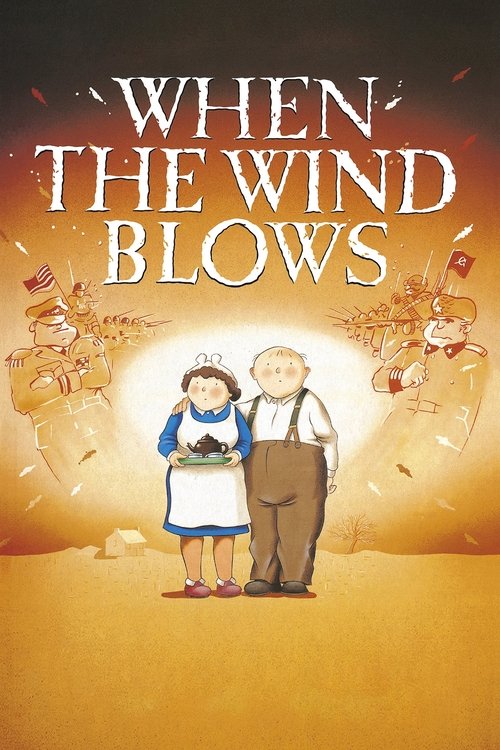
When the Wind Blows
1986 · Jimmy T. Murakami
For when you're ready to be wrecked by something — not a horror-movie scare but a slow, humane heartbreak you'll carry for days. Emphatically not a light animated watch, despite its storybook look.
What it's about
Jim and Hilda Bloggs are a sweet, ordinary retired couple in the English countryside who hear that nuclear war may be coming. Trusting as ever, they follow the government's civil-defence pamphlets to the letter — leaning doors against the wall, stocking the cupboard, reminiscing about how everyone pulled together in the last war. Their cheerful diligence collides with a kind of war their memories never prepared them for.
The experience
Devastating in the gentlest possible register: it plays like a cozy domestic comedy about a bickering, devoted old couple while dread accumulates underneath, and the tenderness is exactly what makes it hurt. Few films are this quiet and this shattering at once.
Performances
John Mills and Peggy Ashcroft voice Jim and Hilda with such lived-in warmth and mundane affection that the couple feels like your own grandparents.
The craft
Adapted by Raymond Briggs from his own graphic novel, it lays hand-drawn 2D characters over real three-dimensional miniature sets, so the soft cartoon couple inhabit an eerily solid, photographable world. The soundtrack features Roger Waters, with David Bowie singing the title song, and the sound design makes the pastoral quiet feel increasingly fragile.
Why it matters
A landmark of British animation for adults and a defining work of the mid-1980s wave of nuclear-anxiety art, it showed that animation's innocence could be the sharpest possible weapon against complacency.
Snapshot
When the Wind Blows is a British animated feature adapted by Raymond Briggs from his own 1982 graphic novel, directed by the Japanese-American animator Jimmy T. Murakami and produced by John Coates for TVC London. It follows Jim and Hilda Bloggs, a retired couple in rural Sussex, as they dutifully prepare for a nuclear attack by following government civil-defence leaflets, survive the initial blast, and then die slowly and uncomprehendingly of radiation sickness in the ruin of their cottage. The film is celebrated for the almost unbearable tension between its gentle, cozy domestic register and the annihilation it depicts, and for its formal experiment in overlaying hand-drawn 2D characters onto three-dimensional physical miniature sets. It belongs squarely to the mid-1980s wave of British nuclear-anxiety art — the same cultural moment that produced the BBC's Threads (1984) — and remains one of the most emotionally punishing works ever made in the medium of animation, precisely because it never raises its voice.
Industry & production
The film emerged from a specific corner of British animation. Producer John Coates and his studio TVC London (TV Cartoons) had scored an international success with the wordless half-hour The Snowman (1982), also adapted from a Raymond Briggs picture book. When the Wind Blows was in effect the follow-up collaboration between the same producer and author, but pitched at an entirely different tonal and thematic register — a feature-length adult drama rather than a children's seasonal perennial. Financing and distribution involved British backers; the film received a UK theatrical release in 1986. Precise budget and box-office figures are not something I can state reliably, and the public record on its commercial performance is thin — it is generally understood to have been a critical rather than a commercial event, reaching much of its lasting audience through television and home video rather than cinemas.
The project's viability rested partly on the marketability of Briggs's name and partly on an unusually starry roster of musical contributors (discussed under Sound and Authorship). It is a comparatively modest production by feature-animation standards — a small studio, a two-hander of a story, largely confined to a single interior — which is part of its power: the constraints match the domestic claustrophobia of the material.
Technology
The most distinctive technological feature is the film's hybrid image-making. Rather than animating the Bloggses' cottage as flat painted backgrounds, the production built the interior as physical three-dimensional miniature sets — model rooms with real depth, furniture, and props — and then composited the traditionally cel-animated, hand-drawn characters into those spaces. This allowed the camera to appear to move through a real environment, pushing in, tracking, and craning around the couple in ways that flat cel backgrounds cannot easily support, and it lends the domestic world a tactile solidity that makes its eventual destruction more visceral. The technique predates digital compositing, so the integration was achieved photographically and through careful staging; the exact rig-by-rig methods are not something I can detail with confidence beyond the well-attested combination of 2D characters and 3D model sets. The film also incorporates other media — collage, archival-style imagery, and mixed textures — particularly around the bomb sequence, where the register deliberately fractures.
Technique
Cinematography
Because the world is a built miniature, the "camera" behaves more like live-action photography than conventional animation. The film favours a roving, dimensional eye that drifts through the cottage's rooms, establishing the geography of kitchen, parlor, and the makeshift shelter, so that when radiation, decay, and disorientation set in, we already feel the space as a lived-in home. The framing is patient and often eye-level with the couple, keeping us inside their scale and their comfort. The great cinematographic rupture is the blast itself, rendered not through the domestic idiom but through a violent shift in imagery and color — a formal shock that mirrors the narrative shock.
Editing
The cutting is unhurried and rhythmically domestic for most of the running time, built around routines: tea, chores, reading the leaflets, going to bed. This slowness is a strategy — it naturalizes the couple's denial and lets dread accumulate. Editorially, the film is organized as a slow decline curve: preparation, the flash, false relief, and then the long attrition. The pacing tightens emotionally even as it stays outwardly gentle, and the contrast between the leisurely everyday and the irreversible biological countdown is where much of the film's horror is generated.
Mise-en-scène / staging
Staging is the film's heart. The single-cottage setting, dense with mid-century British domestic detail — crockery, wallpaper, the range, the garden — is a portrait of an entire way of life and a class sensibility. Jim's construction of the "inner core or refuge," leaning doors against a wall at the prescribed angle per the pamphlets, is staged with poignant literalism: the couple physically enact the government's instructions, and the inadequacy of those instructions is written into the flimsy geometry of what they build. As the film proceeds, the mise-en-scène decays in step with the bodies — dust, disorder, and physical deterioration overtaking the once-tidy home.
Sound
Sound is central to the film's reputation, and it operates on two levels. First, the intimate diegetic soundscape of the cottage and the two voices. Second, a curated body of popular and composed music: David Bowie performed the title song "When the Wind Blows," and Roger Waters (with his Bleeding Heart Band) provided the incidental score, while the associated soundtrack drew in other well-known contemporary artists. The songs sit in ironic or elegiac relation to the images — modern, adult, apocalyptic music framing a story about two people whose frame of reference is the Second World War. The juxtaposition of contemporary rock with the couple's antiquated worldview is itself a thematic statement about how the times have moved past them.
Performance
The vocal performances by Sir John Mills as Jim and Dame Peggy Ashcroft as Hilda are the film's soul. Both were among the most distinguished actors of their British generation, and they bring a lived-in, naturalistic warmth and specificity to the couple — the bickering affection, the routines, the small vanities. Crucially, they play the roles straight and tender, never for satire, so that the characters' cheerful obtuseness reads as heartbreaking rather than foolish. Ashcroft's Hilda, fretting about mess and propriety even as her body fails, and Mills's Jim, clinging to his faith in "the authorities," anchor the film's argument in fully human terms.
Narrative & dramatic mode
The dramatic mode is domestic realism collapsing into tragedy. There is almost no plot in the conventional sense: the "action" is a couple doing chores and waiting, then dying. The engine is dramatic irony — the audience understands what the Bloggses cannot, that their WWII-era faith in preparation, stoicism, and government will not save them from a thermonuclear weapon. Their persistent misapprehension (treating the coming attack as a repeat of the Blitz, expecting rescue and normality to resume) is the tragic flaw, but it is a flaw of innocence and trust rather than of character, which makes it merciless. The film withholds any redemptive turn; it moves inexorably toward an ending of quiet, prayerful extinction. This is tragedy in a minor, domestic key — closer to a two-hander chamber drama than to spectacle.
Genre & cycle
The film sits at the intersection of adult animation, war/anti-war film, and the specifically 1980s cycle of nuclear-holocaust dramas. That cycle, driven by renewed Cold War tension and the deployment debates of the early-to-mid decade, produced The Day After (US, 1983), Threads (UK, 1984), and Briggs's book and film, among others; it can be traced back to Peter Watkins's suppressed The War Game (1965). Within animation, When the Wind Blows helped assert that the medium could carry serious, despairing adult subject matter — a lineage that includes anti-war animation such as Grave of the Fireflies (Japan, 1988) and Barefoot Gen. Its use of a cozy domestic idiom to deliver political horror is a defining generic gesture: it weaponizes the reassurance of both animation and English domesticity.
Authorship & method
Authorship here is genuinely shared. Raymond Briggs is the originating author — creator of the 1982 graphic novel and writer of the film — and the work bears his signature fusion of tender, everyday English observation with bleak subject matter, already visible across his career (the melancholy beneath The Snowman, the acid politics of Fungus the Bogeyman and The Tin-Pot Foreign General). Jimmy T. Murakami directed; a Japanese-American who, as a child, experienced the wartime internment of Japanese-Americans, he brought to the material a personal proximity to the civilian experience of catastrophe, and he had earlier directed live-action genre films (Battle Beyond the Stars, 1980). John Coates produced, extending the TVC/Briggs partnership from The Snowman. On the music side, David Bowie contributed the title song and Roger Waters the score, giving the film two of the most significant figures in British rock. The visual method — 2D characters on 3D model sets — is itself an authorial choice that unifies the collaborators' realist-yet-stylised sensibility. Where individual craft credits (editor, specific art directors) are concerned, I would not want to assign roles I cannot verify precisely.
Movement / national cinema
This is a distinctly British work in idiom and politics. It draws on a native tradition of socially conscious realism and on the particular texture of English lower-middle-class life, and it responds directly to a British institutional artifact — the government's civil-defence public-information campaign of the era (the "Protect and Survive" material), which the film treats as tragically inadequate. It also belongs to a strong British animation tradition centered on studios like TVC and on picture-book adaptation. Its critique is aimed at a specifically British complacency: the myth of the Blitz spirit, of "keeping calm and carrying on," repurposed and shown to be lethal in the nuclear age.
Era / period
The film is inseparable from the early-to-mid 1980s, the last acute phase of the Cold War, when intermediate-range missile deployments in Europe, protest movements, and a genuine public fear of nuclear exchange were at their height. The Bloggses themselves are of an earlier era — their reference points are the 1939–45 war — and the film's central historical argument is precisely about the gap between two periods: the couple apply the survival logic of one epoch to the utterly different reality of another, "unaware that times and the nature of war have changed." The film is thus doubly period-marked: a mid-80s text about the persistence of mid-century assumptions.
Themes
The governing theme is the fatal inadequacy of ordinary human decency and preparation against nuclear weapons — the idea that no amount of pluck, tidiness, or obedience can survive them. Braided through this are: denial and trust in authority, dramatized in Jim's touching faith that "the powers that be" have matters in hand; nostalgia as blindness, the Blitz-era memory that romanticizes war; class and Englishness, the specific manners and modesty of the Bloggses; marriage and companionship, the enduring tenderness between two people whose love is the only thing the film treats as unironically real; and the failure of the state toward its citizens, an anti-establishment critique delivered not through polemic but through the spectacle of two trusting people abandoned. The film's power lies in fusing these into a single, quiet, domestic decline.
Reception, canon & influence
Critically, When the Wind Blows was and remains highly regarded, praised especially for its emotional devastation, the Mills–Ashcroft performances, and its formal ambition in mixing 2D and 3D imagery; it is frequently cited as proof of animation's capacity for serious adult tragedy. (Specific contemporary reviews and any awards I would not want to quote or attribute without the record in front of me.)
Influences on the film (backward): most directly, Briggs's own 1982 graphic novel and his broader body of work; the British public-information/civil-defence campaigns of the period, which supply both the film's plot mechanics and its target of critique; and the wider cultural lineage of nuclear-fear cinema running from Watkins's The War Game (1965) through the 1980s cycle. Its domestic realism draws on native British traditions of everyday-life drama, and its production DNA descends from TVC's The Snowman.
Legacy (forward): the film has become a canonical entry in the 1980s nuclear-anxiety corpus, routinely discussed alongside Threads and The Day After as a defining artistic response to the era's fears, and it is a landmark in the argument that animation can be a vehicle for grief and political seriousness — a case later cinephiles make in the same breath as Takahata's Grave of the Fireflies. Its reputation has, if anything, grown through home video and streaming, sustained by the ongoing cultural interest in Raymond Briggs and by the enduring, terrible relevance of its subject. Within animation history it stands as an important demonstration of hybrid 2D/3D staging and of the feature-length adult animated tragedy, a template more often praised than attempted.
A Deleuzian reading
Jim takes the doors off their hinges and leans them against the wall at the angle the pamphlet prescribes.
The full Deleuzian reading of When the Wind Blows →
Reception
Released into the thick of 1980s nuclear dread alongside Threads and The Day After, it was respectfully received as the 'animated one' of the bunch — now it's climbed into the canon of most-devastating films ever, a fixture on 'movies that broke me' lists.
How When the Wind Blows was received, from release to now →
How to watch When the Wind Blows: what to notice on a first viewing
- Watch Jim follow the government leaflet's instructions exactly. He leans the removed doors against a wall at the precise angle the pamphlet prescribes, executing the government's advice with total literalism. The procedure gets followed perfectly, with nothing real behind it to make it actually work.
- Notice the camera drift through rooms like a real house. Because the sets are physical miniatures with real depth, the camera can push in, track, and drift through kitchen and parlor the way a live-action camera would. The house feels solidly real, which makes the drawn people inside it feel more fragile by comparison.
- Listen for how modern the music sounds against them. David Bowie's title song and Roger Waters's score are contemporary and apocalyptic, laid over two people whose entire frame of reference stopped in 1945. The soundtrack already knows something the couple doesn't, and it never lets you forget that gap.
- Watch how much period detail fills the cottage. Crockery, wallpaper, the range, and the garden are rendered with dense mid-century specificity, a whole way of life built into the set. The home itself becomes a portrait of who these two people are before either says a word.
- Watch the small bickering affection between Jim and Hilda. Mills and Ashcroft play the couple's routines, small vanities, and gentle sniping straight and tender, never once for satire. Their ordinariness is what makes their small routines feel tender.
The whole guide to watching When the Wind Blows, with the keys for a rewatch →
Influences: the films it descends from and the films it influenced
- The Snowman (1982) — The direct production DNA — same TVC studio, producer John Coates, and Raymond Briggs source — supplying the soft colored-pencil cel texture and the roving dimensional camera that glides through hand-drawn domestic interiors.
- The War Game (1965) — Established the technique of dramatizing nuclear attack through mundane British domestic detail while quoting and mocking real civil-defence advice, the exact 'Protect and Survive' irony When the Wind Blows weaponizes.
- Dr. Strangelove (1964) — Its close on Vera Lynn's 'We'll Meet Again' over mushroom clouds is the template for scoring apocalypse with cheerful nostalgic pop — the sound/ironic-music-juxtaposition device.
- Watership Down (1978) — Proved the feature-length British adult animated tragedy was viable, pairing gentle watercolor naturalism with an unflinching, death-facing register that licensed Briggs's grief.
- The Plague Dogs (1982) — Extended that model with hand-painted English landscape backgrounds and a relentlessly downbeat decline curve refusing consolation, prefiguring the film's slow-decline structure.
- Yellow Submarine (1968) — Founded the British TVC feature-animation house style of flat graphic characters set against constructed depth, the graphic-vs-dimensional tension Murakami literalizes as 2D figures on 3D model sets.
- Bambi (1942) — Disney's multiplane camera created true dimensional parallax within 2D drawing — the ancestor of the roving-dimensional-camera effect — while introducing off-screen death and grief into animation.
- Kes (1969) — Models the British social-realist attention to working-class domestic texture, regional speech, and small ordinary routines that Jim and Hilda's chatter and household rituals inherit.
- Threads (1984) — Contemporaneous British nuclear drama tracking the apocalypse through one ordinary Sheffield household's slow physical and social disintegration, the same domestic-scale decline curve.
- Grave of the Fireflies (1988) — The canonical successor in animated civilian war tragedy, built on the same opening-declared dramatic irony (we know the protagonists are already doomed) and domestic-chamber intimacy.
- Ethel & Ernest (2016) — A direct continuation of the Briggs/TVC partnership — hand-drawn cel, an ordinary aging English couple, the same tender everyday-domestic register — adapting Briggs's own memoir of Jim and Ethel's real counterparts.
- Persepolis (2007) — Advances the adult 2D animated feature as serious political testimony, using a deliberately stylized flat graphic idiom to carry autobiographical and historical weight.
- Waltz with Bashir (2008) — Extends animation-as-grief into war trauma and state complicity, vindicating the film's core argument that the medium can bear political seriousness and mourning.
- The Day After (1983) — The American counterpart rendering nuclear war at the scale of ordinary families and a failing state apparatus, part of the same 1983–86 nuclear-anxiety cycle.
- Testament (1983) — A domestic chamber tragedy confining nuclear catastrophe to a single family's quiet radiation decline, choosing intimacy and dramatic irony over spectacle exactly as Briggs does.
- Barefoot Gen (1983) — Animated depiction of the bomb's effect on civilians, using the disarming softness of cartoon drawing against unflinching bodily horror to make atrocity legible.
Similar films
- Barefoot Gen (1983) — influence & lineage · often watched together
- Ethel & Ernest (2016) — influence & lineage
- Grave of the Fireflies (1988) — influence & lineage
- Watership Down (1978) — influence & lineage
- The Plague Dogs (1982) — influence & lineage
- Testament (1983) — influence & lineage
- Threads (1985) — same viewing thread
- Tokyo Story (1953) — often watched together
All the films related to When the Wind Blows →
Watch it with: curated runs of related films
- The Shadow of the Bomb — Watch these when you want the Cold War's dread the way it actually landed — not in war rooms but at kitchen tables — the same annihilation refracted from pulp sci-fi to a submarine standoff to a retired couple brewing tea as the fallout arrives.