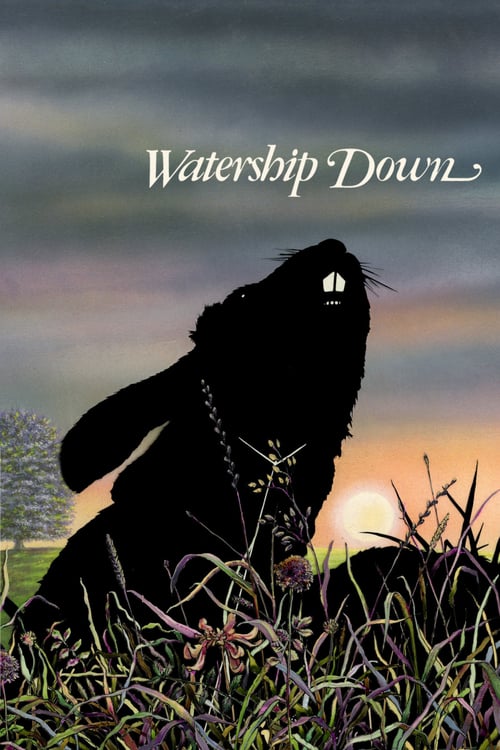
Watership Down
1978 · Martin Rosen
For when you want animation with actual stakes — a mythic survival story that will move you and may shake you. Not a cozy family pick for the very young; a haunting, rewarding one for everyone else.
What it's about
A young rabbit is seized by a terrifying premonition that his warren will be destroyed, and a small band of believers — the steady Hazel, the bruiser Bigwig, the clever Blackberry — slips away to search for a new home across the English countryside. Their exodus runs through rivers, roads, snares, predators, and other rabbit societies with their own chilling ways of surviving.
The experience
Beautiful and genuinely harrowing by turns — soft watercolour landscapes and closely observed animal movement, interrupted by prophecy, blood, and real terror. It looks like a children's film and behaves like a war film, and that tension is exactly its power.
Performances
John Hurt's warm, careworn voice makes Hazel the film's moral center, and Zero Mostel brings raucous comic relief as the seagull Kehaar.
The craft
Hand-drawn animation sets naturalistic rabbits against watercolour Hampshire downland, with stylized, dreamlike sequences for the rabbits' own creation myths. The violence, when it comes, is sudden and unsoftened — a deliberate refusal to talk down to the audience — and Art Garfunkel's 'Bright Eyes' gives the film its famous, aching musical signature.
Why it matters
It became a permanent fixture of British cultural memory — beloved and notorious as the cartoon that traumatized a generation, so contested that the ratings board revisited its all-ages classification more than four decades later — and it stands as proof animation could carry adult weight.
Snapshot
A hand-drawn British animated feature that treats a rabbit warren's flight from destruction as national epic — exodus, founding, and war — and refuses to soften any of it. Adapted by producer-turned-director Martin Rosen from Richard Adams's 1972 novel, the film sets naturalistic, closely observed animal movement and watercolour Hampshire downland against sudden eruptions of blood, suffocation, and prophecy. Its reputation rests on a single unresolved tension: it looks and sounds like a children's film, and it behaves like a war film. That tension made it a durable object of British cultural memory — beloved, notorious, and repeatedly relitigated, including by the BBFC itself, which in 2022 reclassified the film from U to PG some forty-four years after passing it for all ages.
Industry & production
The film's production history is unusual and, in one respect, tragic. Martin Rosen, an American producer working in Britain (his earlier credits include production work on Ken Russell's Women in Love), acquired the rights to Adams's novel shortly after its success and set up Nepenthe Productions to make it. There was no standing British feature-animation industry to absorb such a project; the film had to be built from scratch, assembling a London crew drawn substantially from the country's commercials and short-film sector and from veterans of earlier one-off features.
Rosen initially engaged John Hubley to direct. Hubley was a figure of enormous prestige — a UPA founder, co-creator of Mr. Magoo, an Academy Award winner for independent shorts made with Faith Hubley, and the most credible art-cinema animator working in English. He developed the film for roughly a year before departing the production in 1976 amid disagreements over approach, schedule and cost; he died in February 1977. Rosen took over as director, having also written the screenplay, and retained sole directing credit. What survives of Hubley's conception is generally understood to be the prologue: the Frith creation myth, rendered in a flat, friezelike, ochre-and-black stylization closer to cave painting or folk art than to anything else in the film. It functions as a signature of the road not taken — the more radical, graphically abstracted Watership Down that might have existed.
The remainder was executed in a naturalistic register by a British animation crew whose senior figures carried lineage back to Halas & Batchelor's Animal Farm (1954), Britain's first animated feature and its only prior attempt at serious literary animation for a non-juvenile audience. The credited animation direction and key animation staff — among them Arthur Humberstone and Tony Guy — represent that continuity directly. The film was released in Britain in autumn 1978 and in the United States shortly after through Avco Embassy. Reported budget and grosses vary between sources and are not reliably documented; what is clear is that the film performed strongly in the UK and had a long afterlife in television and home video rather than a blockbuster theatrical run.
Technology
Technologically the film is conservative by design: traditional cel animation, hand-inked and hand-painted, photographed on a rostrum camera, with painted backgrounds in watercolour and gouache. There is no attempt at the optical spectacle Disney had pioneered decades earlier — no elaborate multiplane virtuosity, no rotoscope-driven human figures. The technical ambition is directed elsewhere, into two areas.
The first is landscape rendering. The backgrounds are built from observation of the actual Hampshire chalk downland around Watership Down itself, and they carry the tonal vocabulary of English watercolour — wet washes, soft horizons, chalk-white and grass-green under changeable light. They are painted to a level of atmospheric detail that the flatter character cels cannot match, and the resulting register mismatch is one of the film's most-discussed formal features. It reads to some viewers as a limitation; it reads to others as a deliberate ontology, in which the land is more solid and more permanent than anything living on it.
The second is optical and effects work in service of Fiver's visions and the film's moments of terror. Superimposition, color suffusion, dissolves, and abstracting distortion carry the field-of-blood premonition, the gassing of the Sandleford warren, and the death-vision sequences. These are old techniques, but deployed with unusual severity: the red does not stylize violence, it saturates the frame.
Technique
Cinematography
The film's "camera" is conceived along live-action lines and, crucially, at rabbit height. Much of the staging sits low in the grass, with sightlines blocked by stems and root-tangle, so that predators and machines enter frame the way they would enter a rabbit's perception — abruptly, from above or from the periphery. Against this, the film repeatedly cuts to high, wide landscape views that reduce the protagonists to specks moving across the downs. The oscillation between these two scales is the film's central visual argument: an epic seen from ground level.
The rostrum work simulates handheld unsteadiness during flight and combat, uses pans that lag behind their subject as a live-action operator's would, and stages depth through hedgerow and treeline recession rather than through animation-specific tricks. Aerial perspective arrives with Kehaar, whose flight sequences motivate the film's only genuinely liberated camera. In credit terms the photography is assigned to a camera department rather than to a single authorial director of photography, which is standard for cel animation of the period and worth noting rather than glossing.
Editing
Terry Rawlings cut the film, and the work is more consequential than its context suggests. The editing gives Watership Down an unusually tight, live-action rhythm: short shots in the violence, abrupt cutaways at the point of impact, and a willingness to hold on aftermath — a body, a stillness — longer than an animated feature normally would. The Sandleford destruction sequence and the Efrafa raid are built on collision cutting rather than on the sustained, performance-driven takes typical of character animation, which is partly a virtue of necessity (it economizes animation) and partly a genuine stylistic choice. Rawlings went on immediately to Alien (1979) for Ridley Scott and to a substantial career in British and international features; Watership Down is generally cited as the credit that opened that door.
Mise-en-scène / staging
The film organizes itself around a sequence of contrasting habitats, each with its own visual logic: the open, sunlit warren at Sandleford; Cowslip's warren, all indolent shadow and unspoken wrongness; the exposed heath crossings; Efrafa, drawn as a dark, over-populated burrow system whose crowding is expressed spatially; and Watership Down itself, a high, airy, defensible home. Nuthanger Farm introduces human scale as pure threat — a dog, a cat, a shotgun, a hutch.
Within scenes, staging depends on group composition. Rabbits are almost always drawn in clusters, and the film reads its politics off those clusters: Hazel positioned within the group rather than above it, Woundwort framed frontally and alone, Cowslip's rabbits arranged in a stillness that signals something has been traded away. The design of the rabbits themselves is naturalistic to a fault — no clothing, no anthropomorphic hands, minimal facial caricature, differentiation by coloring, scarring and posture. This restraint is what allows the violence to land: these are animals, and they bleed like animals.
Sound
The soundtrack is one of the film's strongest departments. Angela Morley composed the bulk of the score; the main prologue theme is credited to Malcolm Williamson, then Master of the Queen's Music, who did not complete the assignment. The score is orchestral, pastoral in the English tradition, and used sparingly — long stretches run on ambience alone: birdsong, wind across chalk grass, water, distant road noise. That restraint makes the intrusions unbearable by contrast: earth-moving machinery, the hiss of gas, a dog's bark, a shotgun.
Michael Hordern narrates the prologue and voices Frith, giving the mythology a liturgical weight. The film retains Adams's Lapine vocabulary — silflay, hraka, hrududu, the Black Rabbit of Inlé — without a glossary, trusting context, which does more world-building than any exposition could.
Mike Batt's song "Bright Eyes," performed by Art Garfunkel, sits over the death and vision material. It became a UK number one single in 1979 and one of the year's biggest sellers, and it has arguably done more than the film itself to fix Watership Down in British memory. It is also the film's most contested element: its pop-ballad idiom sits at an angle to the score's austerity, and Adams was reportedly unenthusiastic about it.
Performance
The voice cast is drawn from the front rank of the British stage and screen, and directed toward underplaying. John Hurt's Hazel is quiet, tired, and pragmatic — a leader who persuades rather than commands. Richard Briers gives Fiver a fragile, distracted quality that keeps the prophecy from becoming portentous. Michael Graham Cox's Bigwig supplies bluster with real fear underneath. Ralph Richardson lends the Threarah an establishment complacency in a handful of lines; Denholm Elliott makes Cowslip's courtesy quietly obscene; Harry Andrews gives Woundwort a flat, administrative brutality rather than villainous relish. Nigel Hawthorne, Roy Kinnear, Hannah Gordon, Joss Ackland and Simon Cadell fill out the ensemble. Zero Mostel's Kehaar — broad, comic, mid-European — is the film's one licensed piece of vocal caricature and its only sustained comic relief; it was his final screen role, recorded before his death in 1977.
Narrative & dramatic mode
The structure is an odyssey followed by a founding and then a siege. Fiver's vision drives an exodus; the journey is episodic and picaresque, each stop a test with a distinct moral character; arrival is followed by the discovery that a warren without does cannot survive, which motivates the Efrafa expedition and the war with Woundwort. Critics have long read Adams's novel against the Aeneid — flight from a destroyed home, a divinely warned leader, a new polity founded in a foreign land — and the film preserves that shape while stripping most of the novel's classical epigraphs and much of its embedded lore.
The dramatic mode is essentially tragic-heroic rather than sentimental. Deaths are not reversed, and consequences accumulate. The film's most distinctive structural device is the mythological frame: the prologue establishes El-ahrairah and the Black Rabbit as the culture's founding narratives, and the film then returns to them at intervals, so that the plot is continually being read through the rabbits' own storytelling. Woundwort's disappearance rather than confirmed death, and his subsequent survival as legend, closes that loop. The coda — Hazel, aged, leaving with the Black Rabbit — resolves the film not in triumph but in acceptance, a remarkably unhurried ending for a feature of this length.
Genre & cycle
Nominally a talking-animal fable, the film belongs more accurately to a small cycle of serious literary animation, and it sits at the head of a late-1970s/1980s wave of animated features that assume an adult or at least an unprotected audience. Its immediate British ancestor is Animal Farm (1954). Its immediate descendants include Rosen's own The Plague Dogs (1982), also from Adams and considerably bleaker; Don Bluth's The Secret of NIMH (1982) in the United States; Jimmy Murakami's When the Wind Blows (1986); and, in a different national tradition entirely, Isao Takahata's Grave of the Fireflies (1988). Common to all is the conviction that hand-drawn animation is a medium, not a genre, and that its association with childhood is a distribution accident rather than an aesthetic law.
The film also participates in a specifically British 1970s mode — the children's culture of genuine dread, alongside public information films and the era's unsettling children's television — in which frightening young audiences was understood as pedagogically legitimate.
Authorship & method
Authorship here is genuinely divided, and honest accounting should say so. Rosen is the film's controlling intelligence: he acquired the property, adapted it himself, assembled the production, took over direction mid-stream and finished it. The adaptation's choices are his — the compression of Adams's mythology into a prologue and a few interpolations, the excision of substantial episodes, the retention of Lapine, the decision to keep the blood. His subsequent The Plague Dogs confirms these as authorial preferences rather than accidents.
But the film's most formally distinctive passage — the prologue — carries Hubley's conception, and its animation execution belongs to a British crew whose naturalistic house style Rosen inherited rather than invented. Morley's score and Batt's song supply the film's emotional register; Rawlings's cutting supplies its pace and its shock; the background painters supply the landscape that most viewers actually remember. It is a producer's film in the best sense: coherent because one person held the through-line, distinctive because several others were allowed to be very good in their own departments.
Movement / national cinema
Watership Down is a British film in an unusually thick sense. Its landscape is a specific and identifiable stretch of Hampshire chalk downland; its pastoral is the pastoral of English watercolour and of a literary tradition running from Hardy's Wessex through Kenneth Grahame; its anxiety — bulldozers, a sign advertising development, the gassed warren — is the anxiety of postwar British suburban expansion into the countryside. The voice cast is a roll-call of the national theater tradition.
Industrially, however, it exemplifies British animation's structural problem: the country has repeatedly produced remarkable one-off features — Animal Farm, Yellow Submarine, Watership Down, When the Wind Blows — without sustaining a studio system capable of retaining the crews assembled to make them. Each is built, then dispersed. The durable British animation institutions that followed (Aardman most conspicuously) grew from shorts and commercials rather than from this feature lineage.
Era / period
1978 is close to the low point of Western feature animation. Disney was in its weakest sustained period, between The Rescuers (1977) and The Fox and the Hound (1981), with the Bluth walkout still to come and the studio's renaissance more than a decade away. That vacuum is part of why Watership Down registered so strongly: there was very little else in the medium making serious claims.
Its themes land squarely in their moment. Post-Silent Spring ecological consciousness, anxiety about development and motorway building, and a broader 1970s pessimism about institutions all find expression in the film. The Efrafa material — surveillance, mark systems, controlled movement, a security apparatus — is legible against Cold War totalitarianism, and Cowslip's warren, where the rabbits are fed and safe and have agreed not to ask where the missing go, reads as a critique of comfortable complicity that was very much in the air.
Themes
Home and its loss are the film's foundation: the entire narrative is generated by the destruction of a dwelling place and the labor of building another. Around this cluster several arguments.
Political forms. The film stages three polities and judges them. Sandleford is complacent hierarchy that cannot hear warning. Cowslip's warren is the bargain of safety for truth — a society that has agreed to a lie in exchange for food, and has produced art and mannerly poetry as its compensation. Efrafa is the security state, in which survival is purchased with total control. Against these, Hazel's warren is improvisational and consultative, built on the recognition that a rabbit who is good at digging, or thinking, or flying, should be listened to.
Prophecy and reason. Fiver's visions are true, and the film never rationalizes them, but they are useless without Hazel's willingness to act and Blackberry's capacity to reason. Intuition and intelligence are treated as complementary rather than opposed.
Death. Watership Down is unusually direct about mortality for a film in this form. Death is depicted, mourned, and finally personified — not as a monster but as a courteous companion. The closing sequence reframes everything preceding it as a life rather than an adventure.
Myth as social technology. The El-ahrairah stories are shown doing work: consoling, instructing, and finally absorbing Woundwort into legend. The film argues that a culture is constituted by the stories it can tell about itself.
Human beings as a natural disaster. Humans are never characterized, only encountered — as machinery, gas, snare wire, a shotgun. The film's most sustained cruelty is presented as ordinary land management.
Reception, canon & influence
Contemporary reviews were broadly respectful and frequently divided along a consistent line: near-universal praise for the landscape work, the score, the vocal performances and the seriousness of purpose; recurring reservations about character animation that some found flat or insufficiently expressive beside those backgrounds, and about the compression of Adams's dense mythology into a prologue. The novel's readers noted the excisions; general audiences noted the blood.
The lasting reception story, though, is the certificate. The BBFC passed the film U in 1978, and generations of British children encountered it accordingly, frequently on television at Easter. The resulting cycle — broadcast, complaints, press coverage, a fresh round of adult reminiscence about childhood distress — has recurred for decades, and complaints following a Channel 4 Easter broadcast in 2016 drew regulatory attention. In 2022 the BBFC reclassified the film to PG. Few films have had their reception so thoroughly organized around a question of audience protection, and the recurring debate is itself evidence of how effectively the film does what it set out to do.
Backward. The film's ancestry runs through Disney's Bambi (1942), which established both the naturalistic animal-animation idiom and the precedent for a devastating maternal death in a children's animated feature; through Animal Farm (1954) for the British literary-animation model and for much of the actual crew lineage; through the English landscape watercolour tradition for its backgrounds; and through the 1970s wildlife documentary's unsentimental predation for its violence. Adams's novel supplies the rest, itself deeply indebted to classical epic structure and to R. M. Lockley's naturalist study The Private Life of the Rabbit, which grounds the film's behavioral accuracy.
Forward. Rosen's The Plague Dogs (1982) is the direct sequel-in-spirit, extending the method to a subject with no consolation available; John Hurt appears in both. More broadly, Watership Down is a standing reference point in the recurring argument that animation is not a children's medium — invoked by advocates of serious animation for four decades, and a formative memory for many working animators and directors who saw it young. The property itself has been readapted twice, as a British-Canadian television series (1999–2001) and as a BBC/Netflix miniseries (2018) with Nicholas Hoult, James McAvoy and Ben Kingsley, whose visibly gentler handling of the violence is best understood as a response to the 1978 film rather than to the novel.
Its most peculiar legacy is cultural rather than cinematic: in Britain, Watership Down functions as a shared generational shorthand for the moment a children's story turned out to be telling the truth. "Bright Eyes" carries much of that freight. The film's actual achievement — the marriage of an unglamorous, observational animal naturalism to an epic about founding a society and then having to defend it — is admired more narrowly, and deserves the wider audience.
A Deleuzian reading
Fiver stops on a rise above the Sandleford warren in the evening light, and the field in front of him fills with blood.
The full Deleuzian reading of Watership Down →
Reception
A genuine hit in Britain in 1978 — and a chart-topping soundtrack single to boot — it spent decades filed under 'the cartoon that traumatized a generation' before being reclaimed as a masterpiece of British animation, unsoftened and all the better for it.
How Watership Down was received, from release to now →
How to watch Watership Down: what to notice on a first viewing
- Watch how low the camera sits in the grass. Much of the film stays down at rabbit height, sightlines blocked by stems, so danger enters the frame abruptly from above or the edge, the way a rabbit would see it. The low camera puts you inside a rabbit's field of vision instead of a human observer's.
- Notice the film cut from ground level to wide landscapes. The film keeps alternating between close, grass-level shots and high, wide views where the rabbits shrink to specks moving across the downs. The scale keeps swinging between a single rabbit's danger and the size of the whole land around it.
- Compare how open or cramped each warren looks. Each new warren the rabbits reach has its own visual logic. Some are sunlit and open, some are shadowed and crowded, and the design alone tells you whether it is safe. You can read how dangerous a place is before any character says a word about it.
- Listen for long stretches with only birdsong and wind. Morley's score stays sparse, letting birdsong, wind, and water carry most scenes, so any mechanical sound like an engine or a gunshot lands hard by contrast. The quiet makes the human world's noise feel like an invasion every time it arrives.
- Watch Hazel lead by suggestion, not by giving orders. Hurt plays Hazel quiet and persuasive rather than commanding, always proposing rather than ordering the other rabbits. His style of leadership tells you what kind of warren the group is trying to build.
The whole guide to watching Watership Down, with the keys for a rewatch →
Influences: the films it descends from and the films it influenced
- Bambi (1942) — Established the naturalistic animal-animation idiom Rosen's British crew inherited — weight-bearing quadruped locomotion drawn from live studio specimens rather than caricatured bipedal acting, staged at eye-level on the ground plane so the horizon sits at animal height, with a mass off-screen death (fire/hunters) as the film's structural hinge exactly as the warren gassing is here.
- Fantasia (1940) — The 'Night on Bald Mountain' segment's multiple-exposure translucent apparitions over painted art is the optical-printer technique Watership Down reuses for Fiver's field-of-blood visions and the Black Rabbit — a superimposed ghost layer of differing density laid over an otherwise flat cel/background composite.
- The Living Desert (1953) — Disney's True-Life format licensed the unsentimental depiction of predation to a family audience and, crucially, its low-slung telephoto burrow-mouth camera position — the documentary grammar Rosen adopts wholesale, letting the fox, the cat and Woundwort kill the way a wildlife unit would film it rather than the way a cartoon would stage it.
- Animal Farm (1954) — The British model of a feature-length animated adaptation of a serious literary-political text, and the direct crew lineage — Halas & Batchelor's London pool supplied animators to Rosen's unit — including the convention of playing animals as a polity without clothing, props or anthropomorphic hands.
- Of Stars and Men (1964) — Hubley's feature-length mythic-cosmological exposition in flat, textured, limited-animation panels — color fields breathing under crayon and wash rather than line-and-fill cels — is precisely the graphic register he brought to the Frith creation prologue before Rosen replaced him, and why that prologue reads as a different film's visual language grafted on.
- The Producers (1967) — Zero Mostel's broad Yiddish-theater attack — the barked consonants, the elongated vowels, the comic tempo built for a house of 1,200 — is imported intact as Kehaar's vocal performance, deliberately unassimilated to the underplayed British stage ensemble around him so the gull registers as a foreign body in the warren.
- The Graduate (1967) — Nichols's use of Art Garfunkel's unadorned high tenor as a floating non-diegetic elegist commenting over montage, rather than as any character's song, is the exact deployment of 'Bright Eyes' — Batt's ballad functions as a narrator the film's naturalism otherwise forbids.
- Yellow Submarine (1968) — TVC's London operation trained and dispersed the animators, rostrum operators and optical department Rosen hired, and normalized the rostrum-camera repertoire — traveling multi-pass moves, dissolves and hold-frames on a static camera — that Watership Down leans on for its simulated-handheld tracking and abrupt scale oscillations.
- Fantastic Planet (1973) — Proved a European animated feature could carry an adult political allegory about a hunted species to theatrical release, and modeled the economy that made it affordable — elaborate painted landscape backgrounds carrying the image while figure animation is held to spare, unglamorous movement.
- Scott of the Antarctic (1948) — Vaughan Williams's modal, wordless-chorus pastoral-symphonic scoring against landscape founded the English film idiom Angela Morley writes in — the downland cues here use the same open-fifth string writing and folk-inflected woodwind to make weather and terrain, not character, the subject of the music.
- The Plague Dogs (1982) — Rosen's direct method extension — the same watercolour Lake District backgrounds, the same refusal of anthropomorphic facial performance in favour of behaviorally accurate canine posture, the same John Hurt — applied to material offering no consolation, confirming the naturalism as authorial choice rather than house style.
- The Secret of NIMH (1982) — Bluth's post-Watership case for full animation in a dark animal feature: naturalistic rodent locomotion and scale-accurate staging combined with heavy backlit/optical effects work and on-screen blood, made in explicit opposition to the flattened Disney house product of the period.
- When the Wind Blows (1986) — The clearest British inheritance — a literary adaptation animated for adults in watercolour-and-crayon textures laid over cel, produced out of the same London TVC world, and carrying a chart pop title song used, as 'Bright Eyes' is, to deliver the emotional verdict the film's observational surface withholds.
- Grave of the Fireflies (1988) — Takahata builds from the same premise — non-elastic, observationally weighted character animation against location-researched watercolour backgrounds — and adopts the Watership structure of announcing the death in a prologue so the film becomes an account of how it happens rather than whether.
- Pom Poko (1994) — The habitat-destruction-and-migration plot of an animal polity debating its own governance, staged with deliberate oscillation between naturalistic four-legged design and stylized registers — a systematized version of Watership Down's scale and design shifts between the warren-council scenes and Fiver's visions.
- Fantastic Mr. Fox (2009) — Anderson's English-countryside animal society under mechanized human assault is staged on the same two axes: cross-sectional burrow tableaux that read the warren as architecture and politics, and a ground-level camera height that makes tractors and diggers legible as apocalyptic scale rather than machinery.
- Watership Down (2018) — The CG miniseries retains Rosen's rabbit-height staging and Adams's Lapine while systematically dismantling Rawlings's collision cutting — violence held in continuous, legible coverage and drained of blood — which makes it readable as a direct rebuttal to the 1978 edit rather than a fresh reading of the novel.
- The Wild Robot (2024) — Impressionistic, painterly rendering of the natural world married to unsentimental animal predation and death — the tonal license for the film's real-stakes wilderness.
- Flow (2024) — Treats animals with genuine mortal stakes and observed field behavior rather than cute anthropomorphism, the naturalistic characterization Flow extends by removing speech entirely.
- Ethel & Ernest (2016) — Founded the British tradition of feature-length hand-drawn animation for serious adult subject matter, using naturalistic English landscape watercolour backgrounds rather than cartoon abstraction.
- Hoppers (2026) — Rendered a burrow as a polity with its own offices, oratory and juridical procedure, shot from rabbit height with naturalist landscape backgrounds — the direct staging precedent for the beaver lodge treated as a court rather than a den.
- The Lord of the Rings (1978) — Released the same year with the same structural solution to an unfilmably dense literary mythology: a stylized, non-representational prologue in a wholly different graphic register (silhouette and solarised color there, Hubley's flat panels here) compressing the backstory before the naturalistic body of the film begins.
- Alien (1979) — Terry Rawlings carried his Watership Down method straight over — violence assembled from fragments too brief to read fully, the collision cut on impact and the cutaway before the wound resolves, so the Bigwig/Woundwort fight and the chestburster are constructed on the same principle of withheld continuity.
Similar films
- The Plague Dogs (1982) — influence & lineage
- The Secret of NIMH (1982) — influence & lineage
- When the Wind Blows (1986) — influence & lineage
- Grave of the Fireflies (1988) — influence & lineage
- Fantastic Mr. Fox (2009) — influence & lineage
- Fantasia (1940) — influence & lineage · often watched together
- Wolfwalkers (2020) — same viewing thread
- Song of the Sea (2014) — same viewing thread
All the films related to Watership Down →
Watch it with: curated runs of related films
- Hand-Drawn Myths and Fairy Tales — Watch these as a run of traditional 2D animation that reaches back into folklore — Celtic selkies, Islamicate djinn, West African sorcery, English rabbit-lore — each rendered in a distinct storybook line.