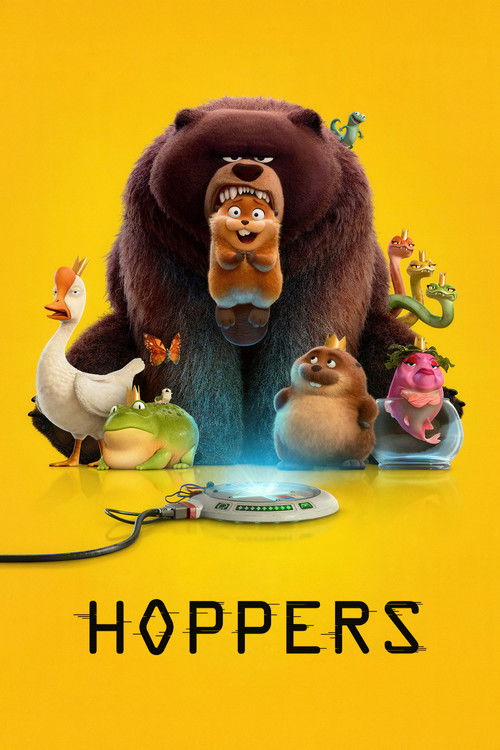
Hoppers
2026 · Daniel Chong
For a family movie night when you want real imagination, not just noise — funny enough for kids, with a body-swap sci-fi hook that gives adults something to chew on. Comfort viewing with a curious streak.
What it's about
Scientists have figured out how to "hop" a human mind into a lifelike robotic animal, letting people walk into the wild and talk to creatures as one of them. Mabel, a devoted animal lover, jumps at the chance and wakes up in the body of a beaver — only to find the animal world holds secrets, politics, and mysteries far stranger than anything she expected. What starts as a communication experiment becomes an undercover adventure in a hidden society.
The experience
Bright, quick, and mischievous — a caper energy runs under the wonder, with spy-movie beats folded into a nature story. It's playful on the surface but keeps nudging you toward a bigger question: what would it actually mean to live inside another creature's skin?
The craft
Pixar animation put to an unusually tactile task: rendering both a robotic beaver convincing enough to fool other beavers and the wet, woody Oregon wilderness it has to survive in. The 3D animation rewards a big screen, and it comes from a first-time feature director, Daniel Chong, who brings a deadpan TV-comedy rhythm — honed on We Bare Bears — into the studio's house style. Stay through the credits.
Why it matters
Pixar's thirtieth feature and a notable changing of the guard: the studio handing a feature to a creator recruited from television rather than raised in its own story department, betting on a new comic voice.
Snapshot
Pixar's thirtieth feature is also its most conceptually literal-minded film about empathy, and the first directed by someone the studio recruited from television rather than promoted from its own story department. Hoppers opened in North America on 6 March 2026, runs 104 minutes, and is Daniel Chong's feature debut — Chong being best known as the creator of Cartoon Network's We Bare Bears (2015–2019), a series built from a webcomic and a deadpan, internet-native comic rhythm that has almost nothing in common with the Emeryville house voice.
The premise is a machine for producing a very old kind of story out of a very new kind of device. Scientists have learned to "hop" a human consciousness into a lifelike robotic animal; Mabel, an animal-loving girl, takes the opportunity and wakes up in the body of a beaver. What follows is not a disguise plot but a translation plot — the robot bodies do not conceal her so much as give her access to a language, and the film's real subject is what she then overhears. The setting is Oregon, and the tagged material of the film — beaver, spy, human-vs-nature, transhumanism — describes the shape accurately: a girl in a borrowed body infiltrates an animal polity, meets its king, and discovers the human development plan that the animals already know about and she did not.
Commercially the film performed as the studio needed it to. Reported as the strongest opening for an original animated feature since 2017, it arrived three months before Toy Story 5 and functioned, inside Disney, as the counter-argument to the lesson Elio had taught the previous June. Audience measures split in the way that usually indicates a film better liked by enthusiasts than by the general ticket-buyer: 8.2 on TMDB across roughly two thousand votes against 7.2 on IMDb across some seventy-six thousand.
Industry & production
Hoppers was greenlit and made inside the most unstable five-year stretch of Pixar's history, and its release date was a thesis statement. The studio had sent Soul, Luca and Turning Red to Disney+ between 2020 and 2022 — a decision executives have since publicly described as a mistake that trained families out of theatrical habit — then absorbed a roughly fourteen-percent staff reduction in 2024, then watched Inside Out 2 become an enormous stabilizing hit and Elio close as one of its weakest theatrical performers ever. Pete Docter's stated corrective was a return to originals with broader initial legibility: films whose premise can be understood from a poster.
Hoppers is exactly that film. It was announced at CinemaCon in April 2024 with concept art rather than footage, and the concept did the work — a girl inside a beaver, explained in a sentence. Nicole Paradis Grindle produces, bringing the institutional continuity (Sanjay's Super Team, Incredibles 2, Toy Story 4) that Pixar typically pairs with a first-time director.
Chong's hire is the genuinely notable industrial fact. Pixar has historically made directors from within, and almost always out of the story department: Docter, Andrew Stanton, Bob Peterson, Peter Sohn, Domee Shi. Chong worked in feature story departments before television, which makes him legible to the system, but We Bare Bears is a creator-owned series in the Cartoon Network mold — episodic, low-stakes, comically flat, emotionally sincere without being architected. Bringing that sensibility inside a studio whose central authorship mechanism is the Braintrust and the iterated story reel is a bet on grafting, and the seams of that graft are the most interesting thing to watch for in the finished film.
The competitive field mattered too. The Wild Robot (2024) had already put a machine intelligence into a forest and made animal language its central problem; Flow (2024) had won the Academy Award with a wordless animal film; Zootopia 2 had saturated the anthropomorphic-animal market in November 2025. Hoppers entered a crowded lane four months later and had to justify its own conceit against three recent, well-liked answers to adjacent questions.
Technology
A complete technical account of the production is not yet in the public record, and it would be easy to invent one; what can be said rests on the studio's known pipeline and on one documented tool.
Pixar's animation runs on Presto, its rendering on RenderMan, its asset interchange on Universal Scene Description — the open standard the studio released in 2016 and which has since become industry infrastructure. Hoppers is the first deployment of Luna, an extension to Presto that lets lighting artists work across multiple shots at once rather than proceeding shot by shot; it was expanded on Toy Story 5 later the same year. That is a workflow tool rather than an image tool, but the choice of film to debut it on is suggestive: a picture set almost entirely in one continuous forest-and-river environment, where consistency of light across long stretches of adjacent shots is the governing problem, is precisely where multi-shot lighting pays.
The harder craft problem is the hoppers themselves. The film needs two categories of animal to coexist in frame and remain instantly distinguishable — organic animals and robotic replicas of them — without the replicas reading as toys. That is a grooming and shading problem before it is an animation problem: fur that behaves correctly over a substrate that is not muscle, eyes that are legible as performing instruments while remaining manufactured. Pixar's hair and cloth simulation lineage runs from Monsters, Inc. through the strand system built for Brave, and a film with a large mammalian cast plus water — beavers, a river, a dam — sits on top of two of the most expensive simulation categories the studio has. Absent published papers, the honest statement is that the specific solutions have not been documented in the sources available here.
Technique
Cinematography
Pixar splits cinematography between a director of photography for camera and one for lighting, a division in place since the mid-2000s and a reminder that the term names two crafts in this cinema. Hoppers poses both of them the same question: height. The film moves between a human world photographed at human scale and an animal world photographed from roughly eighteen inches off the ground, and the second regime is where its images have to earn their keep. The ancestry is specific — A Bug's Life's macro understorey, the rat's-eye passages of Ratatouille, and most recently The Wild Robot's forest floor — and the risk is equally specific: a low camera that becomes a gimmick rather than a point of view.
Lighting inherits an Oregon palette, which is a real constraint and a gift. The Pacific Northwest gives diffuse overcast, canopy-filtered shafts, and wet surfaces — conditions that flatter volumetric rendering and that read as regionally specific rather than as generic forest. Where the film's development-versus-wilderness argument becomes visual, it will be in the difference between that light and the flat, even, municipal illumination of the human town.
Editing
Pixar edits before it animates: sequences are cut as boards, screened internally, and rebuilt many times, so the editor functions closer to a co-writer than a finisher. The interesting variable here is Chong's television timing. We Bare Bears ran eleven-minute segments built on flat comic beats and abrupt tonal drops — a rhythm that resists the long escalating set piece Pixar features are usually cut around. At 104 minutes the film is short by 2020s tentpole standards, which is consistent with a comic sensibility that prefers compression. The film carries both a mid-credits and a post-credits stinger, a convention Pixar has used sparingly and which here signals a comic rather than elegiac exit.
Mise-en-scène / staging
The film's design problem is that it needs an animal society that is neither a human city in fur — the Zootopia solution — nor a documentary naturalism that cannot support dialogue scenes. The beaver lodge is the obvious hinge: a real animal structure that is genuinely architecture, genuinely engineered, and therefore stageable as a court without anthropomorphising it into a town hall. Placing a king inside it lets the film borrow the blocking grammar of political scenes while keeping the built environment zoologically true, which is a more disciplined choice than the genre usually makes.
Against that sits the human Oregon town and the development it intends. The staging argument of the film is a boundary — where the surveyed land stops and the unsurveyed begins — and the degree to which that line is composed into frames rather than merely spoken about is the measure of the film's seriousness.
Sound
Sound is not a department here; it is the premise. A film whose subject is hearing animals as speech has to solve, in its first reel, the transition from noise to language — and every prior solution is a known quantity. Babe (1995) simply granted speech and asked the audience to accept it. Dr. Dolittle made it a gag. The Wild Robot dramatized acquisition, making the learning of animal language a sequence in itself. Hoppers has a technological alibi its predecessors lacked: the hop is a device, so the shift can be motivated rather than assumed, and the film can put a threshold in the mix — the moment Mabel's ears become someone else's.
The second sound problem is the bodies. A robotic beaver that sounds mechanical is a joke; one that sounds organic wastes its own concept. The design has to hold a small, constant residue of manufacture underneath a naturalistic animal. Pixar's post work has run through Skywalker Sound since 1995, and that Marin lineage is the relevant house tradition. Composer and sound-department credits are not reliably established in the sources available for this entry, and are better left unnamed than guessed.
Performance
The announced principal cast — Piper Curda as Mabel, with Bobby Moynihan and Jon Hamm in the animal and municipal camps respectively — describes the film's two comic registers: a young lead playing sincerity, and character comedians playing institutional absurdity. Curda's task is the classic body-swap acting problem, doubled. She must play a girl who is aware of being in a beaver, so the performance carries a running commentary on its own embodiment, while the animators supply a physicality she is not producing. Vocal performance in this medium is always co-authored; here the co-authorship is the subject, since the character herself is operating a body she did not grow.
Narrative & dramatic mode
Structurally Hoppers fuses two well-established engines. The first is the body-swap comedy, whose grammar runs from Freaky Friday through Big and whose rule is that the borrowed body teaches what argument could not. The second is the undercover-infiltration plot, and the "spy" framing is the film's sharper move: Mabel does not merely visit the animal world, she enters it under a false identity, which converts a fable about empathy into a story about deception with a deadline.
That fusion places the film in the going-native tradition — Dances with Wolves, FernGully, Pocahontas, Avatar — and inherits its hazard, which critics have named for thirty years: the outsider who joins the threatened community and becomes its indispensable champion. The dramatic question is whether the film gives the animals agency independent of Mabel's arrival. The synopsis's phrasing — that she uncovers mysteries "beyond anything she could have imagined" — suggests a mystery structure in which the animals already possess the knowledge and the human is the last to learn it. That inversion, if sustained, is the film's escape route from the trap.
Genre & cycle
Three cycles intersect. The talking-animal fable is the oldest, running from Bambi through The Jungle Book, Watership Down, Babe and Zootopia, and its perennial tension is between animals as moral proxies for humans and animals as themselves. The consciousness-transfer strand belongs to science fiction — Being John Malkovich, Avatar, and a wider 2010s–2020s substrate of uploaded-mind narratives — and supplies the film's transhumanist vocabulary. The third is the development-versus-wilderness fable: FernGully, Over the Hedge, and, in a far more unsentimental register, Takahata's Pom Poko and Miyazaki's Princess Mononoke, both of which refuse the tidy victory that American versions of the story tend to grant.
The atlas's own similarity graph places Hoppers nearest to Zootopia and Zootopia 2, Bong Joon Ho's Okja, The Mitchells vs. the Machines, Big Hero 6, Wallace & Gromit: Vengeance Most Fowl, and the European animal-transformation films Oink and Miss Minoes — a cluster that captures the film's position precisely: mainstream American animal comedy with a science-fictional device and a corporate-antagonist spine.
Authorship & method
The authorship question is the graft. Chong's television work is characterized by flat affect, comic patience, an affection for social awkwardness, and a refusal of the escalating emotional climax; Pixar's method is a three-act architecture pressure-tested by the Braintrust and rebuilt through repeated story-reel screenings until the emotional mechanism is load-bearing. Neither is a natural fit for the other, and a first-time feature director working inside that system does not typically win the disagreements. Where Hoppers is most itself, one would expect to find Chong's rhythm in scene-level comic business; where it is most Pixar, in the shape of the third act.
Grindle produces, and her credit history is one of institutional stewardship — the producer Pixar assigns to guide new directors through the system. Beyond the director and producer, the key craft credits — cinematography, editing, score, screenplay attribution — are not reliably established in the sources available for this entry, and inventing them would be worse than the omission.
Movement / national cinema
This is a product of the Emeryville school: the studio descended from Lucasfilm's computer division, with a house commitment to physically plausible virtual cinematography, story-reel iteration as the primary authorship mechanism, and an American domestic register of feeling. By 2026 that school's monopoly on the form has broken — the Spider-Verse films and their successors legitimized non-photoreal stylization, and Pixar's own recent work (Turning Red, Elemental, Luca) has drifted toward the illustrative.
The film also belongs to Pixar's late-period regionalism. Where the studio once set films in generic suburbs, its recent output has been aggressively place-specific — Toronto, Liguria, Mexico — and Hoppers' Oregon is part of that turn. Pacific Northwest specificity in mainstream American animation is rare, and it carries real content: this is a region whose economic history is a two-century argument about timber, rivers and land use, which is the film's plot.
Era / period
Hoppers sits inside three mid-2020s conversations. The first is transhumanist: brain-computer interfaces moved from speculation to trial in the decade preceding the film, and a children's movie whose device is consciousness transfer is drawing on a live public vocabulary rather than a purely science-fictional one. The second is ecological — a period of both documentary saturation and documented loss, in which the moral status of animals is unusually available as popular subject matter. The third is industrial: animation's labor anxiety about generative AI, negotiated through the Animation Guild's mid-decade contract fight, in a period when a studio's insistence on visible human craft is itself a positioning statement.
Reception, canon & influence
The detailed critical record for Hoppers is not securely established in the sources underlying this entry, and no quotations, scores or attributed judgments will be manufactured to fill the gap. What can be stated is narrower and firmer. The film opened strongly for an original animated feature — reportedly the best such opening since 2017 — and that result functioned inside Disney as evidence in the slate argument that Elio had opened the previous year, immediately preceding a summer in which Toy Story 5 nonetheless made the opposite case at far greater scale. Audience aggregates show the enthusiast-versus-general split described above, and the film has entered this atlas's Top 250 Animated Films and Top 250 Science Fiction Films sets at a modest position.
Backward, the lines of influence are legible. Bambi supplies the founding grammar of the animal-perspective feature and the forest as moral space. Babe established that a talking-animal film could be simultaneously comic and serious about husbandry and death. Pom Poko and Princess Mononoke stand behind any development-versus-wilderness story that refuses an easy win. Zootopia is the immediate commercial predecessor for animal society as political allegory, and The Wild Robot, only sixteen months earlier, is the unavoidable comparison — a machine in a forest learning to speak animal, which makes Hoppers' inversion (an animal-shaped machine carrying a human) look like a deliberate answer rather than an accident. Behind the device itself sits the body-swap comedy and, more distantly, Avatar's remote-piloted body as a vehicle for crossing between species.
Forward, honesty requires a limit. The film is five months old at the time of writing, and its artistic legacy cannot yet be assessed; anything asserted would be prediction dressed as scholarship. Two things are safely observable. Luna, the multi-shot lighting extension the film debuted, has already propagated within Pixar and belongs to a toolchain licensed well beyond it. And Hoppers is now a data point that studio executives will cite for years — the original that opened, in a year when the sequel opened larger — which is a form of influence that has nothing to do with what is on the screen and everything to do with what gets made next.
Reception
Opened No. 1 in March 2026 with the biggest launch for an original animated film since Coco, then rode a 94% Tomatometer past $500M worldwide — instantly adopted as the proof-point that Pixar originals can still open in the sequel era.
How Hoppers was received, from release to now →
How to watch Hoppers: what to notice on a first viewing
- Notice the camera drop to about knee height outdoors. The film shifts between a human world shot at human scale and an animal world shot from roughly eighteen inches off the ground. The low camera isn't just a gimmick, it's how you're meant to feel the size difference.
- Watch for soft, overcast, canopy-filtered light outdoors. The forest scenes use a diffuse Pacific Northwest light, wet surfaces and filtered canopy shafts, distinct from the flatter light of the human town. The two worlds are lit differently enough that you can feel which one is more alive.
- Notice the beaver lodge staged like a royal court. The animals' meeting place is a real, engineered beaver structure rather than a cartoon town hall, and the film blocks it like a political chamber anyway. The architecture stays true to an actual beaver home even while it's doing courtroom work.
- Listen for the exact moment Mabel starts hearing speech. Because the hop is presented as a device, the film can mark a specific threshold, the instant her ears stop hearing noise and start hearing language. You get to notice the switch happen, instead of just being told to accept it.
- Watch Mabel's reactions to being inside an unfamiliar body. Her performance carries a running awareness of operating a body she didn't grow, so her comic timing is partly about the beaver itself. She's not just playing a beaver, she's playing a girl noticing she's a beaver.
The whole guide to watching Hoppers, with the keys for a rewatch →
Influences: the films it descends from and the films it influenced
- Bambi (1942) — Established the animal-perspective feature's camera contract — eye-level and below, staged in multiplane forest depth so undergrowth passes in front of the lens, with humans present only as offscreen sound and never as faces, the exact grammar Hoppers uses for its low-angle animal POV.
- Watership Down (1978) — Rendered a burrow as a polity with its own offices, oratory and juridical procedure, shot from rabbit height with naturalist landscape backgrounds — the direct staging precedent for the beaver lodge treated as a court rather than a den.
- Never Cry Wolf (1983) — Ballard's ground-level lenses and Alan Splet's sound design built animal presence from breath, fur-rustle and off-frame movement rather than score, inside a going-native structure where the embedded observer's field notes decay into identification — the live-action template for Hoppers' infiltration arc.
- Pom Poko (1994) — Staged animal assemblies as parliamentary sessions with factions, motions and rhetoric, then let the development plot end in partial defeat — the procedural model for a lodge scene playing as deliberation instead of comic chaos.
- Babe (1995) — Codified the animal-speech threshold as a formal rule: speech is fully audible on the animal acoustic plane and inaudible across the human one, with lip movement engineered to sit just under photoreal — the convention Hoppers inherits and complicates by putting a human consciousness on the animal side of that line.
- Princess Mononoke (1997) — Gave animal clans distinct vocal registers and physical scale to make them political actors, and structured the development conflict so neither the forest nor the works can be granted a clean win — the refusal Hoppers' third act is measured against.
- Being John Malkovich (1999) — Fixed the consciousness-transfer film's core device — a sustained first-person pass shot from inside the occupied body, with the host's motor control and the rider's intention visibly out of phase — which is the shot logic of Hoppers' piloting sequences.
- Monsters, Inc. (2001) — Pixar's first production-scale fur simulation (Fizt on Sulley's coat) turned hair into a secondary-motion performance channel; Hoppers' beaver grooms and their behavior in and out of water descend from that solver lineage.
- Ratatouille (2007) — Animated a body driven by an occupant from outside its own nervous system — Remy steering Linguini by tufts of hair — which is Hoppers' premise run in reverse, and the same animation problem of two intentions competing for one set of limbs.
- WALL-E (2008) — Ben Burtt's Skywalker Sound method of building character voice from processed mechanical and organic recordings, so servo grain and breath occupy one throat, is the direct precedent for Hoppers' robotic-organic hybrid vocal design.
- Fantastic Mr. Fox (2009) — Proved that flat-affect, deadpan line delivery and comic patience survive on animal characters — dialogue cut on the beat after the laugh, not on it — the scene-level rhythm Chong's television grammar brings into Pixar's architecture.
- Avatar (2009) — Built the remote-piloted body as a machine for interspecies crossing, including the link-in/link-out ritual and the recurring cut between the operator's slack body and the avatar's waking eye — a transition structure Hoppers reuses at the lodge.
- First Cow (2019) — Shot the Pacific Northwest in flat overcast with no key-light modeling and a patient, low, unmoving camera in the beaver-trapping frontier — the same diffuse-light and extraction-economy palette Hoppers' lighting reference draws on.
- Soul (2020) — Pixar's own consciousness-transfer solution: a lead voice performance carried inside an animal body, with the animation team keying the animal's natural locomotion against imported human gesture so the mismatch reads as comedy before it reads as pathos.
- Turning Red (2022) — The nearest test case for Hoppers' authorship graft — a television-inflected comic idiom and a fur-heavy transformation body surviving the Braintrust's story-reel rebuild, with the director's rhythm intact at scene level and the studio's shape governing the third act.
- Flow (2024) — Sustained a floating, animal-height virtual camera through water simulation with no dialogue at all, forcing narrative onto animal behavior and fur-water interaction — the maximalist version of the wordless-observation passages Hoppers uses between its speech scenes.
Similar films
- Zootopia (2016) — influence & lineage
- The Wild Robot (2024) — influence & lineage
- Flow (2024) — influence & lineage
- Remarkably Bright Creatures (2026) — often watched together
- Zootopia 2 (2025) — shared sensibility
- Toy Story 5 (2026) — shared sensibility
- Hundreds of Beavers (2024) — shared sensibility
- Spider-Man: Across the Spider-Verse (2023) — shared sensibility