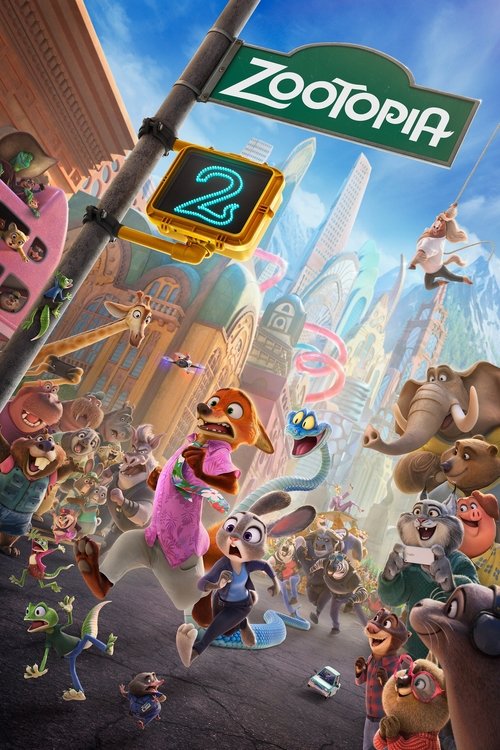
Zootopia 2
2025 · Jared Bush
For family movie night when you want everyone actually laughing, or when you're in the mood for a detective story you can watch with a bowl of popcorn and zero stress. Pure comfort with a brain.
What it's about
Rookie cops Judy Hopps and Nick Wilde — a by-the-book bunny and a reformed fox hustler — are riding high after cracking Zootopia's biggest case when a snake named Gary slithers into a metropolis that has only ever known mammals. Chasing the mystery he brings with him, the partners go undercover into corners of the city they've never seen, and the case starts testing the partnership itself.
The experience
A quick, jokey, visually busy buddy-cop caper that keeps the banter flying while sneaking in questions about who a city is built for. Playful on top, a little pointed underneath.
The craft
Disney Animation builds out whole new districts of the city for the undercover plot, and the density of background gags and species-scaled sight jokes rewards a second viewing. The animation of Gary alone — expressive, limbless, oddly charming — is a small technical showcase.
Why it matters
A decade-later sequel to an Oscar-winning billion-dollar original, and a statement release for Disney Animation's new creative leadership under Jared Bush.
Snapshot
Zootopia 2 is Walt Disney Animation Studios' feature-length sequel to the studio's 2016 Academy Award winner, arriving in theaters over the U.S. Thanksgiving corridor in November 2025 — nearly a decade after the original, an unusually long gap for a property of its commercial standing. It returns rabbit officer Judy Hopps and fox con-artist-turned-cop Nick Wilde to the mammalian metropolis of Zootopia, this time drawn into a mystery precipitated by the arrival of a reptile, Gary De'Snake, in a city conspicuously (and, in the first film, pointedly) populated only by mammals. The film is a Disney Animation tentpole in the fullest institutional sense: a sequel to a billion-dollar original, released by a studio whose creative leadership had shifted such that co-director Jared Bush now sits at the top of the animation division. Read against the franchise's origins, Zootopia 2 is both a continuation of a buddy-cop mystery format and an expansion of the original's central allegory about prejudice, difference, and the anxieties of a diverse civic order.
Industry & production
The original Zootopia (2016) is the load-bearing fact of this production. That film grossed over one billion dollars worldwide and won the Academy Award for Best Animated Feature, establishing an original, non-fairytale property as a franchise-grade asset for Disney Animation — a studio whose modern reputation rests more heavily on Frozen and its sequels. A sequel was therefore commercially overdetermined; the notable industrial story is the delay. Nearly nine years separate the two films, a gap during which the property was extended through a Zootopia+ short-form series on Disney+ (2022) and a theme-park land, keeping the world commercially warm while the feature developed.
The production also sits inside a leadership transition. Jared Bush — co-director and co-writer of the original — rose to become Chief Creative Officer of Walt Disney Animation Studios in the mid-2020s, succeeding the era defined by Jennifer Lee. Zootopia 2 is thus directed by a figure who is simultaneously the studio's top creative executive, an arrangement that concentrates authorship in a way worth flagging. The established record credits the sequel to Bush directing alongside Byron Howard, who co-directed the original; the brief here names only Bush, but Howard's co-directing role is part of the documented lineage and should not be elided. Ginnifer Goodwin (Judy Hopps) and Jason Bateman (Nick Wilde) return in the lead voice roles. The new antagonist-or-catalyst figure, Gary De'Snake, was cast with Ke Huy Quan — a piece of casting freighted with his mid-2020s career resurgence. Beyond these top-line facts, the granular below-the-line record for the sequel is thin at the time of writing, and this dossier flags rather than fabricates where that is so.
Technology
Disney Animation's technical identity in this period is defined by its proprietary path-tracing renderer, Hyperion, first deployed on Big Hero 6 (2014) and central to the original Zootopia's look. The 2016 film was a genuine technical milestone for the studio in two areas that any sequel inherits and extends. First, fur and hair: Zootopia required believable, physically distinct pelts across dozens of species — the sheen of an otter, the coarse coat of a buffalo, the density of a rabbit — and the studio developed grooming and shading tooling (widely reported under the name iGroom) to author fur at scale. Second, crowds: populating a functioning city with animals of radically different sizes and gaits demanded a crowd system (reported as "Nitro") capable of generating large, heterogeneous background populations rather than repeated humanoid extras.
Zootopia 2 almost certainly builds on this same technical spine — Hyperion rendering, mature fur pipelines, evolved crowd tools — now nearly a decade more advanced. The introduction of a reptile, Gary De'Snake, is the film's most conspicuous technical proposition: scales, a limbless body plan, and serpentine locomotion sit entirely outside the mammalian rigging and grooming problems the first film solved, and would have required fresh rigging, shading, and animation-simulation work. Any specific claim about how the studio achieved this should await the published technical record; what can be stated confidently is that the character's very existence represents a deliberate expansion of the world's — and the pipeline's — biological vocabulary.
Technique
Cinematography
In a fully computer-animated feature, "cinematography" names the layout and lighting departments — the authored virtual camera and the lighting design — rather than a photographed image. The original Zootopia used its virtual camera to sell scale contrasts as both comedy and worldview: the vertiginous drop into Little Rodentia, the towering architecture of Savanna Central, the compression of the DMV gag. Its lighting was district-coded — the hard desert key of Sahara Square against the diffuse overcast of Tundratown — using illumination as a mapping device for a city of climates. Zootopia 2's synopsis promises "unexpected new parts of town," which implies new lighting and layout problems: fresh districts are, for this studio, fresh cinematographic environments. Specific camera and lighting credits for the sequel are not established here and are left unstated rather than invented.
Editing
The original film's editing served a buddy-cop mystery: it cross-cut investigation and banter, timed comic reversals, and managed a plot that pivots on a mid-film twist. A sequel foregrounding "a great mystery" and undercover work inherits the same editorial burden — sustaining suspense and revelation while protecting the character comedy that is the franchise's commercial engine. Editorial personnel for Zootopia 2 are not part of the reliably established record here, and are not asserted.
Mise-en-scène / staging
Production design is arguably the original Zootopia's signature achievement: a city organized into biome-districts, each an environment engineered for a class of animal, with running sight-gags about scale, signage, and infrastructure designed for multiple body plans. The staging is the theme — a metropolis whose architecture literalizes coexistence and its frictions. The sequel's move into new neighborhoods extends this world-as-argument logic; introducing a reptilian character raises the pointed design question of where, in a mammal-built city, a snake fits — a staging problem that is inseparable from the film's allegory.
Sound
The original's sound design leaned on register and scale — the acoustic difference between a mouse-sized district and a buffalo chief's office — and on Michael Giacchino's score. Giacchino's original music, together with Shakira's pop anchor "Try Everything," gave the first film a bright, propulsive identity. Whether the sequel reunites the same musical team should be confirmed against the credits rather than assumed; the natural expectation is continuity with Giacchino's established palette, but this dossier does not assert the sequel's composer as fact.
Performance
Voice performance is where the franchise's chemistry lives. Goodwin's Judy is earnest, fast, and morally strenuous; Bateman's Nick is dry, deflecting, and defensively witty — a comic contrast the first film converted into genuine partnership. The synopsis's promise that "their growing partnership is tested like never before" signals that the sequel stakes its emotional register on that same vocal interplay, now with the two established as full partners rather than reluctant collaborators. Ke Huy Quan's Gary De'Snake introduces a new vocal texture into an ensemble long defined by mammalian voices; the casting invites — though the film's own handling must confirm — a performance that plays on the snake's status as the city's conspicuous outsider.
Narrative & dramatic mode
Zootopia has always operated in a detective/mystery mode dressed in family-comedy clothing — a noir-inflected procedural about a mismatched pair uncovering a conspiracy, with the mystery's solution doubling as a lesson about bias. The sequel preserves this structure: a new arrival, a "twisting trail," undercover assignments, a partnership under strain. Dramatically, the franchise's engine is the buddy dynamic — two characters whose differences (predator/prey, idealist/cynic) map onto the film's social themes — and the sequel appears to advance that relationship into a more mature, tested phase. The undercover conceit is a classic device for putting a stable partnership under pressure by forcing each character into an assumed identity, a move that literalizes the series' recurring interest in the gap between how animals are seen and who they are.
Genre & cycle
The film sits at the intersection of the contemporary CG family-animation tentpole and the anthropomorphic-animal comedy, a lineage running from Disney's own Robin Hood through Chicken Little and beyond, and from the wider funny-animal tradition. More specifically, it belongs to the buddy-cop cycle — the 48 Hrs./Lethal Weapon mismatched-partners format — refracted for a family audience, a hybrid the original made distinctive. As a sequel, it also participates in Disney Animation's late-2010s-into-2020s turn toward franchising original properties (following the Frozen and Ralph sequels), a cycle in which the studio, historically resistant to theatrical sequels, increasingly extended its own hits.
Authorship & method
The controlling authorial signature is Jared Bush. Bush co-wrote and co-directed the original Zootopia, co-wrote Moana, and co-directed and co-wrote Encanto (2021), before ascending to Chief Creative Officer of Walt Disney Animation Studios. His body of work is marked by socially engaged premises delivered through tightly structured, emotionally legible screenplays — Encanto's intergenerational trauma, Zootopia's bias allegory — and by a facility for ensemble and world-building. His dual role on this film as both director and studio creative head makes Zootopia 2 an unusually direct expression of a single authorial-institutional vision.
The established collaborative record for the sequel is, as noted, partial. Byron Howard — a veteran Disney director (Bolt, Tangled, Zootopia, Encanto) — is part of the film's documented directing lineage. The original's musical author was Michael Giacchino; its writing was a Bush–Phil Johnston collaboration. For the sequel, specific cinematography, editing, and composing credits are not reliably fixed in this account, and are therefore described by function and inheritance rather than named — a deliberate hedge against invention.
Movement / national cinema
This is mainstream American studio animation at its most institutionally central: a Walt Disney Animation Studios production, made within the Burbank studio system's proprietary-pipeline model. It belongs to the post-Frozen Disney Animation identity — technically maximalist, thematically earnest, globally distributed — and to the broader Hollywood animation ecosystem in which Disney, Pixar, DreamWorks, and Illumination compete for the family tentpole calendar. It is a national cinema of a specific kind: an American cultural export whose civic allegory about a diverse metropolis reads, deliberately, as a parable of the contemporary United States.
Era / period
Zootopia 2 is a mid-2020s release, and its moment inflects it in several ways. Industrially, it lands in a period of anxiety about theatrical animation's health after the pandemic-era rise of streaming, making a proven billion-dollar franchise a rational bet. The nine-year gap means the sequel addresses a partly grown-up original audience while onboarding new children. Culturally, its allegory of difference and belonging arrives in a period of intensified debate over pluralism and division — the same soil that made the 2016 film feel timely, now further evolved. The film is also a product of Disney Animation's leadership-transition era, carrying the imprint of new creative stewardship.
Themes
The franchise's master theme is prejudice and the social construction of difference: the first film built its predator/prey binary as an allegory for racial and social bias, complicating easy readings by having its idealist heroine harbor her own unexamined assumptions. Zootopia 2 extends this through the figure of a reptile in a mammal city — Gary De'Snake as the newly visible outsider whose very presence "turns the metropolis upside down." That premise sharpens the original's argument: the first film critiqued bias within a shared mammalian in-group; a snake introduces a more absolute category of otherness, a body the city was not built to accommodate. Secondary themes are partnership and trust — the tested Judy–Nick relationship as a model of difference bridged through work — and the perennial Zootopia interest in appearance versus identity, foregrounded here by the undercover conceit. Any reading of the film's specific thematic conclusions should defer to the finished film; what is grounded is the direction of travel from the original's established concerns.
Reception, canon & influence
Backward (influences on the film): Zootopia 2 stands atop a clear genealogy. Most immediately, it inherits the original Zootopia whole — its world, tone, allegory, and format. Behind that lie the mismatched-partner buddy-cop films of the 1980s and the detective/noir tradition the first film knowingly quoted (its overt homage to The Godfather in the Mr. Big sequence being the clearest signature). It also draws on Disney's own anthropomorphic-animal heritage and on the studio's post-Big Hero 6 technical lineage. The casting of Ke Huy Quan connects the film to the broader mid-2020s cultural moment of his career revival.
Reception: As a sequel to an Oscar-winning billion-dollar property released on a prime holiday date, Zootopia 2 was positioned as a major commercial event. Detailed, verifiable critical and box-office specifics for the film are outside what this dossier can responsibly assert without inventing figures or quotations, and are therefore left to the confirmed public record rather than stated here.
Forward (what it may shape): The original Zootopia has already demonstrated influence — validating original (non-fairytale) animated properties as franchise material, advancing fur and crowd technology later reused across the studio, and modeling the socially allegorical family film. A successful sequel would reinforce Disney Animation's turn toward extending its own originals and would further entrench Zootopia as a durable, multi-platform franchise. Its most legible legacy claim, made under Bush's combined authorial and executive role, is as a statement of Disney Animation's mid-2020s creative direction: technically ambitious, thematically earnest, and committed to civic allegory in family-film form.
A Deleuzian reading
The camera steps off a ledge and drops into Little Rodentia, and a city block the size of a coffee table comes up to meet it.
The full Deleuzian reading of Zootopia 2 →
Reception
Opened Thanksgiving 2025 to warm-if-unstartled reviews and a record-smashing debut — then the story became China, where its months-long run turned a 'fine Disney sequel' into a full-blown box office legend.
How Zootopia 2 was received, from release to now →
How to watch Zootopia 2: what to notice on a first viewing
- Watch the doorways, counters, and signage built for different body sizes. The city is organized into biome districts, each engineered for a class of animal, with running gags about scale, transit, and infrastructure. The architecture carries the argument. Which bodies fit and which do not gets settled by the buildings before anybody in the film discusses it.
- Watch the light change as the camera enters a new district. Sahara Square runs on a hard desert key and Tundratown on flat overcast. New neighborhoods bring new lighting, so illumination works as a map of a city of climates. You can place yourself by the light alone, which is how a wholly built world keeps its geography legible.
- Watch how Gary moves compared with every other animal onscreen. Scales, no limbs, and serpentine locomotion sit outside the fur grooming and mammal rigging this world was built on. He moves differently because nothing here was designed for him. The animation problem and the story problem are the same problem: a body the city never planned for.
- Listen to how Goodwin's pace runs against Bateman's dryness. Judy is earnest, fast, and morally strenuous. Nick deflects and jokes. This time the two start as full partners rather than reluctant collaborators. The partnership is what the film puts under strain, and you can hear it in the timing before the plot names it.
- Watch how the pair poke at the city instead of confronting it. Each move they make turns up another piece of a situation nobody can see whole. The case advances by small disclosures rather than by one decisive act. The shape of the case is the shape of the city, and both arrive one fragment at a time.
The whole guide to watching Zootopia 2, with the keys for a rewatch →
Influences: the films it descends from and the films it influenced
- Zootopia (2016) — Supplies the entire inherited pipeline — biome-district city design, layered fur-shading and crowd-simulation systems, and the undercover buddy-cop mystery armature — which the sequel reprises and extends to reptile rigging.
- 48 Hrs. (1982) — Codifies the mismatched-partner buddy-cop template — a rules-bound lawman paired with a fast-talking hustler working a case together — the exact dynamic Judy and Nick re-enact.
- The Godfather (1972) — The first film's Mr. Big scene is a shot-for-shot blocking-and-lighting homage (the shadowed don, the hand-kiss supplication), importing that crime-noir staging grammar the sequel keeps.
- Chinatown (1974) — Provides the detective-unearths-a-civic-conspiracy noir plot skeleton, where the mystery's real subject is how the city itself is rigged — the structural mold of Zootopia's whodunit.
- Who Framed Roger Rabbit (1988) — Establishes the fusion of hard-boiled detective noir with a cartoon-animal cast, the tonal and generic precedent for playing anthropomorphic characters straight inside a crime plot.
- Robin Hood (1973) — Disney's precedent for an all-anthropomorphic-mammal ensemble with no humans present, each species cast for characterological shorthand — the studio heritage Zootopia's mammal metropolis systematizes.
- Big Hero 6 (2014) — Debuts Disney's Hyperion renderer, whose global-illumination path-tracing architecture is the direct technical ancestor of Zootopia 2's lighting pipeline.
- Tangled (2010) — Byron Howard's earlier feature where Disney built its CG hair-simulation and non-photoreal virtual-camera systems, the R&D that matures into the fur-and-hair simulation seen here.
- The Incredibles (2004) — Michael Giacchino's brass-and-jazz, spy-caper orchestral idiom originates here and is the scoring voice he carried into the Zootopia franchise's detective register.
- The Lion King (1994) — Pioneers Disney's animal-fur rendering and its landmark early crowd-simulation (the wildebeest stampede), the direct forebear of the studio's mammal-fur and stampeding-crowd techniques.
- Ralph Breaks the Internet (2018) — Extends Disney's model of sequelizing its own original IP with escalated crowd-simulation set pieces, sharing Zootopia's writer-director bloodline (Moore, Johnston).
- The Bad Guys (2022) — Extends the crime-genre-rendered-in-anthropomorphic-animals craft into a stylized heist-buddy comedy, carrying forward Zootopia's proof that noir/caper structure works with animal casts.
- Zootopia+ (2022) — Directly reuses the sequel's world assets, district-design language, and character rigs in episodic form, expanding minor players from the mystery into standalone shorts.
- Encanto (2021) — Shares Bush and Howard's authorial method — a socially engaged premise delivered through a tightly structured, emotionally legible ensemble screenplay built on dense world-building.
- Moana (2016) — Bush co-wrote it, and its effects-simulation breakthroughs (character-acted water) run parallel to the fur and crowd simulation, both products of the same mid-2010s Disney FX push.
- Frozen II (2019) — The template for Disney Animation extending a billion-dollar original property into a sequel via markedly escalated effects and environment simulation — the strategic and technical playbook Zootopia 2 follows.
Similar films
- Zootopia (2016) — influence & lineage · same viewing thread
- Hoppers (2026) — shared sensibility
- Ne Zha 2 (2025) — shared sensibility
- The Sheep Detectives (2026) — shared sensibility
- Toy Story 5 (2026) — shared sensibility
- Coyote vs. Acme (2026) — shared sensibility
- Puss in Boots: The Last Wish (2022) — shared sensibility
- Shrek 2 (2004) — shared sensibility
All the films related to Zootopia 2 →
Watch it with: curated runs of related films
- Genre as Trojan Horse — Watch these together when you want the pleasures of a genre picture — a buddy-cop case, a heist crew, a monster in the sky — that turns out to be secretly arguing about who America polices, prices, and erases.