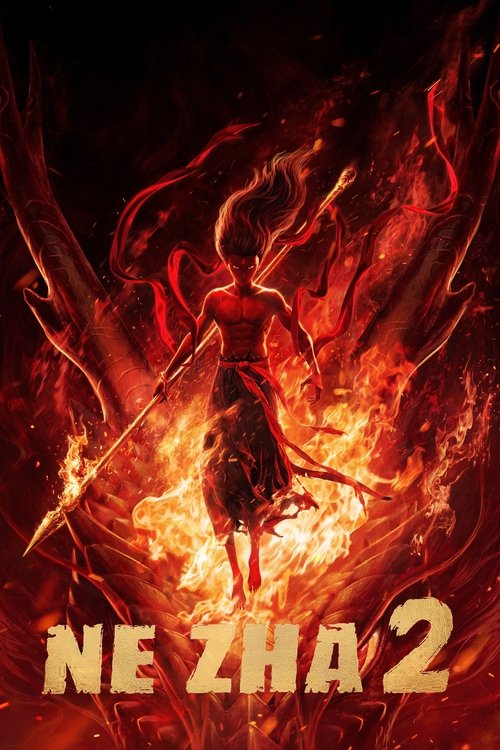
Ne Zha 2
2025 · Jiao Zi
Became the highest-grossing animated film in history (~$2B) almost entirely inside China — the box-office story that forced the "Hollywood doesn't need China / China doesn't need Hollywood" conversation to flip.
For when you want pure spectacle — an evening of maximalist animated action that also sneaks up on your feelings. A crowd-pleaser, not a challenge; great with family or friends who love big fantasy.
What it's about
The boy-demon Ne Zha and the dragon prince Ao Bing, their bodies destroyed by heavenly lightning, are granted a fragile second chance at life — and immediately pressed into a gauntlet of perilous trials. Around them, tensions between the dragon clans and the celestial powers boil toward open war, and the two friends find their bond, their identities, and the fate of mortals and immortals alike hanging on what they do next. It's a big mythological fantasy drawn from Chinese legend, told at blockbuster scale.
The experience
It's a torrent — dazzling, loud, emotionally big, swinging between slapstick comedy, tearjerker sincerity, and battle sequences of staggering scale. At 144 minutes it's a genuine epic, and it moves like one: exhausting in the best way.
The craft
The 3D animation pushes Chinese studio production to a new ceiling: vast armies, elemental magic, ocean and sky rendered at overwhelming density, with character comedy animated as nimbly as the destruction. This is exactly the kind of film that rewards the biggest screen and loudest speakers you can find.
Why it matters
It became a box-office phenomenon of historic proportions in China and the flagship of an emerging animated universe built from the classic novel Investiture of the Gods, announcing Chinese animation as a global commercial force.
Snapshot
Ne Zha 2 is a Chinese computer-animated fantasy-adventure directed and written by Jiao Zi (the pen name of Yang Yu), released into the Spring Festival corridor on January 29, 2025. It is the direct sequel to Ne Zha (2019) and the flagship entry in Enlight Pictures' emerging "Fengshen Universe," an animated cycle built from Investiture of the Gods (Fengshen Yanyi), the sixteenth-century vernacular novel attributed to Xu Zhonglin. The film picks up from the first installment's cliffhanger: the boy-demon Ne Zha and the dragon prince Ao Bing, their bodies destroyed by heavenly lightning, are granted a fragile reincarnation and pressed into a sequence of trials that entangle them in a widening war between the dragon clans and the celestial bureaucracy. At 144 minutes it is unusually long for mainstream animation, and its scale — reportedly some 138 animation studios and thousands of workers over roughly five years — made it, by the accounts in circulation, the most expensive Chinese animated film to that point. Its commercial performance was without precedent: it became the highest-grossing animated film ever made and the first animated film to cross the two-billion-dollar mark worldwide, the overwhelming majority of that earned in a single domestic market. It is, in short, both an artisanal spectacle and an event in the economic history of cinema.
Industry & production
The production is the clearest case yet of China's animation sector operating at Hollywood tentpole scale while retaining a distinctly domestic industrial shape. The credited production companies cluster around Jiao Zi's Chengdu base and Enlight's Beijing apparatus — Chengdu Coco Cartoon, Chengdu Zizai Jingjie Culture Media, Beijing Enlight Media, Beijing Enlight Pictures, and Beijing Coloroom Technology. Rather than a single vertically integrated studio in the Pixar or DreamWorks mold, the film was assembled through a vast subcontracting network: reporting consistently cites on the order of 138 animation houses and more than 4,000 people, against roughly 1,600 on the 2019 film. A budget of about 80 million U.S. dollars (some 600 million yuan) is widely reported, breaking the prior domestic record held by Deep Sea (2023). The five-year gestation — the same span the original required — became part of the film's public narrative, and the long delay between announcement and release was framed in coverage as evidence of perfectionism rather than trouble, though the internal specifics of that schedule are not well documented in accessible sources.
Distribution followed the now-standard playbook for a Chinese New Year "blockbuster season" release, with a saturation domestic rollout across premium formats. International release was handled piecemeal by territory — Trinity CineAsia acquired dozens of markets across the U.K. and Europe, and an English-dubbed version was prepared for later Western release. The overseas footprint, while historically large for a Chinese film, remained a small fraction of the domestic take, which is the crux of what the box office actually demonstrates: the maturation and sheer size of China's home market rather than a genuine global crossover.
Technology
Ne Zha 2 is a 3D CG production finished for an exceptional range of exhibition formats — 2D, 3D, IMAX, the Chinese premium large formats CINITY and CGS China Giant Screen, Dolby Cinema, and 4DX. Its technological signature is density: reporting points to more than 2,400 shots, of which upwards of 1,900 are visual-effects shots, an extraordinary ratio that reflects a film in which fluid simulation, crowd systems, and destruction effects dominate nearly every sequence. The most demanding set pieces — oceanic dragon armies, a churning furnace-of-souls, mass battles of celestial troops — depend on large-scale particle, fluid, and cloth simulation, and the film's willingness to stage thousands of discrete figures in motion is its most conspicuous technical flex. Precise details of the pipeline, render infrastructure, and proprietary tooling are not laid out in the English-language record, so claims about specific software or bespoke solvers should be treated cautiously; what is verifiable is the finished result's simulation-heavy character and its calibration for the largest premium screens.
Technique
Cinematography
Credited to Shi Chaoqun, the "cinematography" here is virtual — the design and choreography of a camera unconstrained by physics. The film's visual grammar favors sweeping, weightless moves: plunging descents through cloud strata, whip-fast orbits around combatants, and elastic scale shifts from the intimate to the cosmic. This is consistent with a contemporary Chinese fantasy-animation house style that prizes kinetic legibility in crowded frames, keeping a clear read on the protagonist amid visual chaos. Detailed shot-by-shot analysis of Shi's choices is not available in secondary literature, but the governing tendency is toward maximalism — a camera that rarely rests and that treats vertiginous verticality as a default expressive register.
Editing
Lin Qiuying is credited with the edit. At 144 minutes the film is long by the standards of family animation, and it carries a dense, incident-packed structure: a rapid cross-cutting between comic domestic beats and escalating action, with set pieces stacked toward a prolonged climax. The rhythm alternates broad slapstick — a mode inherited directly from the first film — with tonal pivots into pathos and large-scale warfare. The risk of such a structure is exhaustion, and the editing's task is pacing the accumulation so the spectacle crests rather than plateaus; the film's popular reception suggests that balance was largely achieved, though the length drew some critical note.
Mise-en-scène / staging
The staging fuses classical Chinese iconography — celestial palaces, dragon-clan undersea realms, Taoist talismanic magic — with a rounded, caricatural character design descended from the 2019 film. Ne Zha remains a snaggle-toothed, smirking imp, a deliberate anti-cute design that anchors the film's irreverence. Environments are built for density and verticality, layering foreground gags against enormous architectural and geological backdrops. The production leans on the visual vocabulary of Fengshen mythology — lotus imagery, cloud-scrolls, the aesthetics of Chinese ink and temple statuary — reworked into a plastic, kinetic 3D idiom rather than a painterly one.
Sound
The score is credited to Wan Pin Chu, Rui Yang, and Roc Chen, with orchestral recording reported at the Vienna Synchron Stage. Its defining strategy is hybridization: a Western symphonic backbone interwoven with Chinese traditional instrumentation — pipa, erhu, suona — and, notably, Dong ethnic-minority polyphonic throat singing. This grafting of a globalized orchestral idiom onto specifically Chinese timbres mirrors the film's larger cultural project of presenting national mythology in a form legible as world-scale blockbuster. The sound design more broadly serves the simulation-heavy imagery, with the weight and impact of mass combat carried substantially in the mix.
Performance
As an animated film, performance operates on two planes: voice and animator. The Mandarin voice cast reprises the register established in 2019 — a brash, comic Ne Zha against more measured celestial and dragon-clan figures — and the film's humor depends heavily on vocal timing. The animated "performance," meanwhile, is broad and exaggerated by design, privileging clear physical comedy and legible emotional beats over naturalism. Specific casting credits are documented, but critical writing in English has said little about individual vocal performances, so granular assessment of them rests on thin ground.
Narrative & dramatic mode
The film's dramatic mode is the mythological hero's-trial narrative bent toward a modern sensibility about identity and prejudice. Ne Zha, born of a "demon" essence and fated to be feared, and Ao Bing, heir to a maligned dragon clan, are doubled protagonists whose shared predicament — destroyed bodies, borrowed second life, contested nature — literalizes a theme of self-definition against inherited destiny. The narrative escalates from the domestic and comic into a cosmological war between the dragon clans and the heavenly order, introducing an original antagonist, Wuliang, not derived directly from the source novel. This willingness to invent within a canonical framework is characteristic of the Fengshen Universe approach: the myth supplies the scaffolding and the moral archetypes, while the screenplay reshapes causality and antagonism to a contemporary dramatic arc about loyalty, coded difference, and defiance of a corrupt authority. The tonal mode is deliberately volatile — swinging between lowbrow comedy, sincere melodrama, and grand tragic spectacle — which is both the film's populist strength and the target of its sharper critics.
Genre & cycle
Ne Zha 2 sits at the confluence of the mythological-fantasy epic and the family action-adventure, and it is best understood as the second beat of a deliberate franchise cycle. Enlight's Fengshen Universe is the animated counterpart to a broader Chinese trend of mining Investiture of the Gods and the Journey to the West corpus for cinematic universes — a strategy visible across both animation and live action in the 2010s and 2020s. Within animation specifically, the film belongs to the post-2015 wave of Chinese "guochan donghua" theatrical features — following Monkey King: Hero Is Back (2015), White Snake (2019), Deep Sea (2023), and Jiao Zi's own Ne Zha — that reclaimed domestic myth for a home audience after decades in which imported animation dominated. Ne Zha 2 is the point at which that cycle achieved not merely commercial viability but market supremacy.
Authorship & method
Jiao Zi is the film's decisive author, and his biography has become inseparable from its reception. Trained in pharmacology at Sichuan University, he taught himself animation and drew notice with an early independent short before spending years developing Ne Zha (2019). His method, as far as the public record supports, is that of a hands-on writer-director-designer who exercises unusually tight control over story and visual conception while marshaling an enormous distributed production — a model closer to an auteur presiding over a workshop network than to the committee authorship of large Western studios. He takes sole screenplay credit, which reinforces the reading of the Ne Zha films as a personal reworking of national myth rather than a corporate assembly. His key collaborators on this installment include cinematographer Shi Chaoqun, editor Lin Qiuying, and the composing team of Wan Pin Chu, Rui Yang, and Roc Chen; beyond these credits, the internal division of creative labor across the vast studio network is not well documented, and it would be inventing detail to claim more precision than the record supports.
Movement / national cinema
The film is a landmark of contemporary Chinese national cinema and specifically of the state-and-market-backed effort to build indigenous animation capable of competing with Hollywood on its own terms. It embodies a cultural-policy ambition — the promotion of Chinese stories, aesthetics, and "cultural confidence" — that has run through the sector's revival, while also being a genuinely popular, bottom-up phenomenon rather than a purely top-down product. Its reliance on domestic myth, traditional instrumentation and craft motifs, and a distributed national supply chain of studios makes it a showcase for the depth of China's animation labor pool. At the same time, the film's near-total dependence on the domestic box office marks the limit of the movement's current reach: it is a triumph of a national cinema for its own vast audience more than a demonstration of transnational appeal.
Era / period
Ne Zha 2 is a defining artifact of the mid-2020s, a period in which the Chinese theatrical market's scale and the maturation of its animation industry converged. It arrived after several years of pandemic disruption to global exhibition, and its record-setting Spring Festival run functioned partly as a reassertion of the theatrical event in an era of streaming. Technologically it reflects the state of the art in large-scale simulation-driven CG animation calibrated for premium large-format screens. Culturally it belongs to a moment of ascendant nationalist confidence in Chinese popular media, in which the recovery of classical mythology for mass entertainment carries evident ideological as well as commercial weight.
Themes
The film's central theme is the contest between imposed fate and self-authored identity: Ne Zha and Ao Bing are both defined at birth by a "nature" others fear, and the drama turns on their refusal to accept that inheritance. From this flow the film's related concerns — prejudice against the marginalized "demon" and the maligned dragon clans reads as a fable about coded difference and social exclusion; loyalty and chosen kinship set against clan and cosmic hierarchy; and the corruption or unaccountability of nominally righteous authority, embodied in the celestial order. Bound up with these is a theme of transformation and rebirth, literalized in the protagonists' borrowed second life and their trials of the body. The film delivers these ideas in a broadly populist register — defiance, friendship, filial feeling — but the anti-authoritarian coloring of its portrait of the heavens has invited more pointed interpretation.
Reception, canon & influence
Critically, the film was received warmly in China and with respectful curiosity abroad, where reviewers tended to admire its technical density and energy while noting its considerable length and tonal whiplash; detailed English-language critical literature remains comparatively thin, a reflection of its late and limited Western release. Its economic reception, however, is a matter of record and of history: it became the highest-grossing animated film ever made — surpassing Inside Out 2 — and the first animated film to pass two billion dollars worldwide, with global figures reported in the region of $2.2 billion and rising toward the all-time top tier of films. Crucially, this was achieved overwhelmingly in one domestic market, making it also the highest-grossing film ever in a single territory and a benchmark case in the study of the Chinese box office.
Looking backward, the film's influences are layered: the Fengshen Yanyi source and the deep well of Chinese folk depictions of Nezha; the immediate precedent of Jiao Zi's own 2019 film and the broader guochan donghua revival that Monkey King: Hero Is Back and White Snake helped ignite; and, at the level of craft, the global lexicon of CG feature animation and blockbuster action spectacle. Looking forward, its legacy is still forming but already substantial: it validated the Fengshen Universe as a franchise and, more consequentially, reset expectations for what Chinese animation can achieve commercially and industrially. It stands as a proof of concept for the distributed, large-studio-network production model and as an argument, closely watched across the global industry, that a national-myth animated tentpole can out-earn every Hollywood equivalent. Whether that success proves exportable or remains a domestic phenomenon is the open question its record leaves for the films that follow it.
Sources: Variety — box office ramifications, CGTN — $2.18 billion, Wikipedia — Ne Zha 2, Deadline — European distribution, The Copenhagen Post — the phenomenon explained
Reception
It went from a Chinese New Year 2025 opener to a full-blown phenomenon in about three weeks, smashing past Inside Out 2 to become the highest-grossing animated film ever — while the rest of the world mostly caught up later, via IMAX runs and A24's English-dub release.
How Ne Zha 2 was received, from release to now →
How to watch Ne Zha 2: what to notice on a first viewing
- Watch the camera plunge through clouds without cutting away. The film favors long, weightless camera moves, diving through cloud layers and whipping around fighters in ways no physical camera could hold steady. The movement itself feels unbound by gravity, which is part of the spectacle.
- Notice Ne Zha's snaggle teeth and smirking expression. The character design keeps him scruffy and irreverent rather than conventionally adorable, the same grinning, gap-toothed look carried over from the first film. His design argues against cuteness before he says a single line.
- Listen for pipa and erhu inside the orchestra. The score layers a full Western orchestral sound with traditional Chinese instruments and, in places, ethnic-minority throat singing, so two very different musical traditions play at once. You are hearing two musical worlds sit inside the same cue, not one borrowing from the other.
- Count how quickly a joke turns into a battle. The editing cuts fast between broad domestic comedy and escalating combat, stacking set pieces on top of each other rather than spacing them out. The tonal whiplash is built into the pacing, not an accident of a long runtime.
- Watch the scale jump from tiny figures to vast realms. Environments stack celestial palaces, undersea dragon kingdoms, and towering architecture, with the camera repeatedly shifting from an intimate close view to an enormous cosmic one. The size of the world keeps changing under you, scene to scene.
The whole guide to watching Ne Zha 2, with the keys for a rewatch →
Influences: the films it descends from and the films it influenced
- Ne Zha (2019) — The direct predecessor established the anti-cute, smoky-eyed dark-circled Nezha design and the exaggerated vocal-comedy performance register, plus the distributed multi-studio production pipeline this sequel simply scaled up.
- Nezha Conquers the Dragon King (1979) — Shanghai Animation Film Studio's canonical Nezha imagery and its self-disembowelment/rebirth-from-lotus beat are the iconographic template the film reworks as its mythological hero's trial.
- Havoc in Heaven (1964) — Codified the folk-opera visual grammar of Chinese myth — flame and cloud-scroll motifs, opera-derived stylized movement, deity iconography — that the film's fengshen staging directly descends from.
- Monkey King: Hero Is Back (2015) — Proved a guochan-donghua CG feature could stage kinetic feature-scale martial-arts spectacle and turn a profit, igniting the myth-tentpole revival Jiao Zi's films extend.
- White Snake (2019) — Light Chaser Animation's fusion of CG fluid, hair and cloth simulation with Chinese-myth material set the simulation-heavy technical bar for the guochan fantasy the film pushes further.
- Kung Fu Panda (2008) — DreamWorks' template of exaggerated, cartoon-timed martial-arts choreography paired with broad comic-relief vocal performance is the blockbuster-animation grammar mapped here onto Chinese motifs.
- How to Train Your Dragon (2010) — Pioneered the swooping, weight-aware virtual-camera flight sequence (with Roger Deakins consulting on lighting) that the film's aerial battle choreography borrows wholesale.
- Crouching Tiger, Hidden Dragon (2000) — Yuen Woo-ping's wire-fu grammar of weightless, gravity-defying combat and mid-air rooftop duels is the live-action fight vocabulary the film translates into unbound CG camera moves.
- Hero (2002) — Its color-coded, painterly maximalism — massed arrows, leaves and banners saturating the frame — is the spectacle logic behind the film's kinetic cinematographic density.
- The Lord of the Rings: The Return of the King (2003) — Weta's Massive crowd-simulation software for autonomous armies is the underlying technique enabling the film's enormous multi-thousand-unit battle sequences.
- Legend of Deification (Jiang Ziya) (2020) — The first co-branded Fengshen Universe installment, sharing the same Fengshen Yanyi source world and the Beijing Enlight / Coloroom production network that the Ne Zha films anchor.
- New Gods: Nezha Reborn (2021) — A rival cyberpunk reimagining of the identical Nezha myth that extends the anti-cute, rebel-teen redesign of the god as a defiant anti-authoritarian figure.
- New Gods: Yang Jian (2022) — Light Chaser's Fengshen-derived hero film advancing simulation-heavy CG spectacle and shared deification-myth iconography on a parallel franchise track.
- Deep Sea (2023) — Pushed a bespoke 'particle-ink' rendering pipeline to maximalist swirling density, a distinctly Chinese-CG stylization running parallel to the film's simulation-heavy effects maximalism.
- Big Fish & Begonia (2016) — Rendered Chinese folk-cosmology and Shanhaijing/Fengshen creature iconography as a feature-length CG-assisted fantasy, part of the same guochan-donghua revival cohort.
Similar films
- Kung Fu Panda (2008) — influence & lineage
- How to Train Your Dragon (2010) — influence & lineage
- The Legend of Hei 2 (2025) — same viewing thread
- Demon Slayer: Kimetsu no Yaiba Infinity Castle (2025) — same viewing thread
- KPop Demon Hunters (2025) — same viewing thread
- Nimona (2023) — same viewing thread
- Resurrection (2025) — often watched together
- Zootopia 2 (2025) — shared sensibility
All the films related to Ne Zha 2 →
Watch it with: curated runs of related films
- Sympathy for the Demon — A run of the 2025 animation wave where the line between demon-hunter and demon keeps blurring — outcast heroes carrying monstrous power, and monsters worth rooting for.