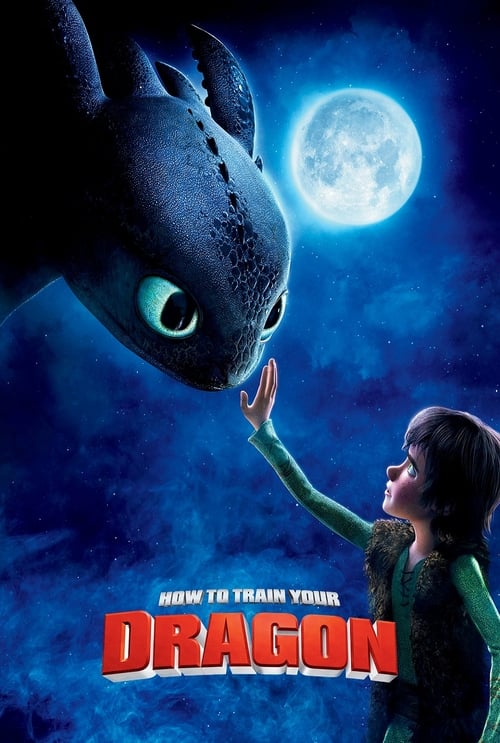
How to Train Your Dragon
2010 · Chris Sanders
For a feel-good night when you want genuine soaring joy — one of the safest crowd-pleasers there is, equally right for kids, dates, or anyone who needs their spirits lifted.
What it's about
On a Viking island where killing dragons is the family business, scrawny Hiccup — the chieftain's disappointing son — finally downs the most feared dragon in the archipelago. Face to face with the wounded creature, he can't finish the job, and instead secretly befriends it, putting him on a collision course with everything his father and village believe.
The experience
Pure uplift: funny and warm on the ground, then breathtaking in the air, with flying sequences that hit a physical rush few animated films ever manage. It's paced like a bottle rocket but takes its emotions — a boy who can't please his father — seriously.
The craft
Roger Deakins served as visual consultant, lending painterly discipline to the fog, firelight, and shadow of the Norse island world, and John Powell's Oscar-nominated Celtic-inflected score turns the flight scenes into pure exhilaration. This one genuinely demands a big screen and good speakers — the airborne sequences are the reason.
Why it matters
The film that made DreamWorks Animation an artistic contender rather than Pixar's snarky rival, launching one of modern animation's most beloved franchises.
Dean DeBlois and Chris Sanders, the team behind Lilo & Stitch, were brought in barely a year from release to rebuild a faltering adaptation of Cressida Cowell's books — and delivered the film that made DreamWorks Animation an artistic contender rather than Pixar's snarky rival. The story is the oldest one in the boy-and-his-animal tradition: a Viking runt who wounds the most feared dragon in the archipelago and, unable to finish the job, befriends it instead. What elevates it is flight. The airborne sequences, scored to John Powell's soaring, Oscar-nominated Celtic-inflected music, are among the purest passages of kinetic joy in modern animation, and the studio hired Roger Deakins as visual consultant to bring his painterly discipline of fog, firelight and shadow to the Norse island world. The dragon Toothless — part cat, part salamander, part fighter jet — became an instant classic of character design. DeBlois went on to direct the two sequels alone, completing one of animation's rare genuinely novelistic trilogies, then remade this film himself in live action in 2025.
A Deleuzian reading
A boy stands over a pinned dragon with a knife, and his arm doesn't come down.
The full Deleuzian reading of How to Train Your Dragon →
Reception
A hit with critics from day one (it lost the Animated Feature Oscar to Toy Story 3), but its stature has only grown — it's now routinely called the moment DreamWorks stopped chasing Shrek-style gags and made its masterpiece.
How How to Train Your Dragon was received, from release to now →
Influences: the films it descends from and the films it influenced
- The Black Stallion (1979) — The wordless cove taming — trust built through gesture, glance, and firelight with no dialogue — descends directly from Ballard and Deschanel's dialogue-free beach sequence where a boy and an animal learn each other in pure image.
- E.T. the Extra-Terrestrial (1982) — The friendship-across-fear architecture — a child conceals a feared creature from a militarized adult world, shot at kid's-eye low angles that render the 'monster' tender — is Spielberg's blueprint.
- Nausicaä of the Valley of the Wind (1984) — The gliding flight sequences staged as weightless balletic joy rather than combat, plus a protagonist who reconciles her people with a demonized winged species, are lifted from Miyazaki's aerial grammar.
- My Neighbor Totoro (1988) — Toothless's cat-like, purely non-verbal expressiveness — communicating character through ear-flicks, pupil dilation, and posture with zero speech — extends Totoro's model of animal charisma without language.
- The Iron Giant (1999) — The 'it is not a weapon' reversal — a creature built/feared as an instrument of war revealed as a gentle friend, indicting the adults who see only a threat — is Bird's exact moral engine.
- Lilo & Stitch (2002) — The directors' own template: an ostracized misfit bonds with a dangerous 'monster' redesigned into something adorable via Sanders' signature rounded, teardrop-and-curve character design.
- Braveheart (1995) — John Powell's Celtic-inflected idiom — soaring orchestral swells threaded with pennywhistle and bodhrán against Nordic-Gaelic settings — descends from James Horner's Braveheart scoring palette.
- Kung Fu Panda (2008) — The 'DreamWorks elevation' — sincerity and sweep replacing pop-culture snark — plus Powell's method of pairing percussive kinetic cues with a lyrical emotional theme, feeds straight into HTTYD.
- Dragonslayer (1981) — Its go-motion Vermithrax established dragon flight physics as weighty, membrane-and-bone reptilian aeronautics — the tactile, believable wing mechanics HTTYD's rigging chases rather than cartoon flapping.
- Monsters, Inc. (2001) — Extends Monsters' central craft of a wordless, expressive giant creature bonding with a small human through pantomime animation rather than dialogue.
- Mulan (1998) — Sanders again translates Mulan's craft—expressive character animation and a mismatched hero/creature bond—into a large-scale action-fantasy, now in CG.
- Spirit: Stallion of the Cimarron (2002) — Builds its central bond on a non-speaking creature whose entire performance is carried through pantomime body-acting and eye animation, the wordless-animal-actor craft Spirit wagered on.
- How to Train Your Dragon 2 (2014) — Extends the novelistic-trilogy arc and pushes the Deakins-consulted volumetric lighting further — fog banks, firelight rim-light, and ice caverns rendered as photographable atmosphere.
- Klaus (2019) — Its hand-painted-look pipeline with hard directional firelight and cast shadow advances the same project HTTYD began — bringing live-action cinematographic lighting logic into stylized animation.
- Raya and the Last Dragon (2021) — Re-centers a human-and-dragon partnership built through earned trust, and stages aerial bonding on the HTTYD template of a skeptical rider learning to ride.
- Puss in Boots: The Last Wish (2022) — Furthers DreamWorks' visual elevation with painterly, brushstroke-visible rendering and unironic emotional stakes — the sincerity-over-snark ethos HTTYD proved viable at the studio.
- The Wild Robot (2024) — Sanders reapplies impressionistic, painterly lighting and a cross-species friendship-across-fear bond, treating the creature relationship as the film's whole emotional and formal center.
- How to Train Your Dragon (2025) — DeBlois transposes his own fog-firelight-shadow staging and flight choreography shot-for-shot into live-action/photoreal CG, testing whether the animated blocking survives photographic literalism.
- Nimona (2023) — Built a reluctant-duo bond between a misfit and a feared creature almost wordlessly, through incremental trust-building body-language animation — the emotional-choreography model for Nimona and Ballister.
- Big Hero 6 (2014) — Sets the template for the exhilarating 'test flight' sequence staged with a naturalistic, weight-aware virtual camera swooping alongside rider and creature — the language Hiro and Baymax's first flight over the city reproduces beat for beat.
- Ne Zha 2 (2025) — Pioneered the swooping, weight-aware virtual-camera flight sequence (with Roger Deakins consulting on lighting) that the film's aerial battle choreography borrows wholesale.
- Kung Fu Panda 2 (2011) — Established the DreamWorks 'live-action-informed' virtual cinematography (with Roger Deakins consulting) of long lenses, shallow focus, and lens flare that KFP2 adopts wholesale for its shot design.
- Rise of the Guardians (2012) — The film that brought Deakins into DreamWorks as visual consultant and installed the method Guardians runs on: single motivated key light, honest falloff, and a virtual camera operated with handheld imperfection and real lens behavior during flight.
- How to Train Your Dragon: The Hidden World (2019) — Establishes the film's two founding methods: Deakins' consultancy imposing motivated single-source lighting and real lens behavior on a CG feature, and the 'Forbidden Friendship' sequence's observational holds — long, cut-sparse takes in which a creature approaches, retreats and re-approaches with no dialogue to carry the beat.
- WALL·E (2008) — Roger Deakins consulted on both films, importing photographic realism into CG — atmospheric haze, real lens characteristics, shallow rack-focus, and motivated lens flares standing in for hand-held camera imperfection.
- Avatar (2009) — Released months earlier, it runs the same beat in parallel: taming a flying mount and the first-flight bonding sequence as the emotional hinge, with performance-driven creature emotion.
- The Lorax (2012) — John Powell's soaring, uplift-driven animation scoring method here is the template for the score-and-songs spine he writes for the Lorax to carry both comedy and emotional swell.
- Frozen II (2019) — Established the emotive creature-flight sequence built with a Deakins-consulted virtual camera and naturalistic light, the craft Frozen II reprises in Elsa's ride across the Dark Sea on the Nokk.
- Transformers One (2024) — Dramatizes friendship across a hostile ideological divide through a single bonded pair, the DreamWorks character-first blockbuster architecture that centers a relationship over the world's spectacle.
Similar films
- How to Train Your Dragon (2025) — influence & lineage · same viewing thread
- Kung Fu Panda (2008) — influence & lineage · same viewing thread
- Puss in Boots: The Last Wish (2022) — influence & lineage · same viewing thread
- How to Train Your Dragon 2 (2014) — influence & lineage
- Lilo & Stitch (2002) — influence & lineage
- The Wild Robot (2024) — influence & lineage
- How to Train Your Dragon: The Hidden World (2019) — same viewing thread
- Spirit: Stallion of the Cimarron (2002) — same viewing thread
All the films related to How to Train Your Dragon →
Watch it with: curated runs of related films
- The DreamWorks Fable — A run of DreamWorks' own canon — the studio that answered Disney with ogres, pandas, Vikings and swashbuckling cats — half fairy-tale satire, half genuine heart.