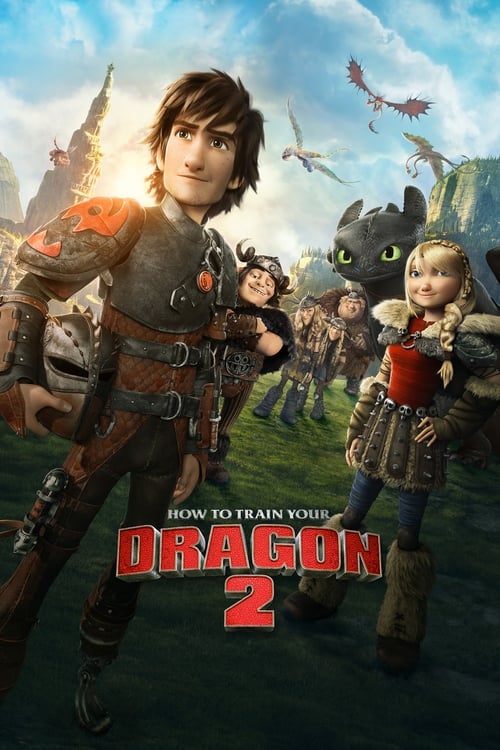
How to Train Your Dragon 2
2014 · Dean DeBlois
For when you want adventure with genuine heart — big-screen wonder for a family night, but with enough emotional weight and melancholy to move adults just as hard. Comfort that isn't afraid to hurt a little.
What it's about
Five years after Vikings and dragons made peace, Hiccup and Toothless spend their days mapping the world beyond Berk — until they find a hidden sanctuary of wild dragons, a mysterious masked rider with a stunning connection to Hiccup's past, and a warlord named Drago building a dragon army. Hiccup, being pressed to grow up and lead, believes he can talk anyone around. Drago is about to test that belief.
The experience
Sweeping and surprisingly emotional for a family film — the flying sequences are pure exhilaration, but the story goes to darker, more grown-up places about loss and responsibility than you expect. It earns real tears alongside the spectacle.
The craft
Dean DeBlois deliberately aged his hero and darkened the palette, treating a family sequel like the middle chapter of a mythic trilogy. The aerial cinematography — advised by the great Roger Deakins — gives the flight scenes real sky-and-cloud grandeur, and John Powell's soaring score is one of the best in modern animation. This one demands the biggest screen and best speakers you have.
Why it matters
Widely hailed as the rare sequel that deepens rather than repeats, it won the Golden Globe for animated feature and raised the bar for how emotionally serious mainstream family animation could be.
Snapshot
How to Train Your Dragon 2 is the second installment of DreamWorks Animation's most critically respected franchise, and the first film in the series directed solely by Dean DeBlois, who had co-directed the 2010 original with Chris Sanders. Conceived by DeBlois from the outset as the middle chapter of a planned trilogy, the film performs an unusual gambit for a mainstream family animation: it ages its protagonist five years, darkens its palette and its stakes, kills a beloved parent, and stages a mythic conflict about leadership, pacifism, and the seductions of power. Loosely descended from Cressida Cowell's children's book series but by this point largely independent of it, the film pairs sweeping aerial spectacle with an emotionally serious coming-of-age narrative. It was widely acclaimed on release, won the Golden Globe for Best Animated Feature, and earned an Academy Award nomination in the same category. It stands as one of the clearest arguments for the artistic ambition of studio computer animation in the 2010s.
Industry & production
The film was produced by DreamWorks Animation and distributed by Twentieth Century Fox under the studios' distribution arrangement of the period. Bonnie Arnold produced, as she had on the first film. The original How to Train Your Dragon had been a substantial commercial and critical success in 2010 and had spawned television and short-form spinoffs, making a sequel a strategic certainty; what is notable is how much creative latitude DreamWorks extended to DeBlois. He returned only on the condition that he could shape a trilogy with genuine tonal progression rather than a formulaic follow-up, and the studio's willingness to let a family franchise turn on the death of a father figure is a meaningful marker of DreamWorks' bid for prestige in this era.
Commercially, the film grossed well over half a billion dollars worldwide, a strong result though widely reported as somewhat below the studio's internal expectations for a sequel to a beloved property; precise figures should be checked against a reliable box-office database rather than taken from memory. It premiered out of competition at the Cannes Film Festival in May 2014 before its summer release, a placement that signaled the studio's framing of the film as a work of animation art as much as a commercial tentpole.
Technology
How to Train Your Dragon 2 arrived during a significant overhaul of DreamWorks Animation's production pipeline. The film is generally cited as an early showcase for the studio's new proprietary animation and lighting toolset, developed to give artists more direct, sculptural control over characters and light. The animation software commonly associated with this transition is the studio's "Premo" system, which replaced the older EMO toolset and allowed animators to push and pose characters more intuitively; the lighting and rendering overhaul of the same period aimed at richer global illumination and more physically plausible light behavior. The exact version and feature set deployed on this specific title should be verified against DreamWorks' technical documentation, as studio pipelines evolved rapidly across concurrent productions and the record in popular sources is imprecise.
What is not in doubt is the visible result: the sequel's imagery is markedly more expansive and atmospheric than the first film's, with vast skies, volumetric cloud and mist, snow and ice environments, and a climactic sequence involving enormous "Alpha" dragons whose scale demanded advances in crowd, effects, and lighting technology. The move toward a larger, more naturalistic world was as much a technological achievement as an aesthetic one.
Technique
Cinematography
As with the first film, the production engaged cinematographer Roger Deakins as a visual consultant — a now-celebrated collaboration in which a live-action master of light advised DreamWorks' lighting and layout teams. Deakins' influence is legible in the film's restrained, motivated lighting, its preference for natural-seeming key sources, and its willingness to let sequences sit in dusk, overcast, and firelight rather than the flat, over-lit brightness common to family animation. The "camera" work — designed by the layout department under the film's head of layout and cinematography — leans into a genuinely cinematic vocabulary: long lenses that compress dragon and rider against distant terrain, sweeping aerial moves that treat flight as choreography, and a widescreen sense of scale that recalls the epic. DeBlois has spoken of aspiring to the grandeur of David Lean and to the darker register of a middle chapter such as The Empire Strikes Back; the film's visual design bears this out in its horizon-filling compositions and its comfort with shadow.
Editing
Edited by John K. Carr, the film balances two rhythms: the buoyant, kinetic momentum of the flight sequences and the slower, dialogue-driven scenes of family reunion and moral crisis. The cutting during aerial action is fluid and continuous, favoring sustained camera moves over rapid fragmentation, which preserves the legibility and physical joy of flight. The film's most affecting passages — the reunion of Hiccup's parents, the funeral sequence — are cut with patience and restraint, allowing performance and music to carry the emotion rather than forcing pace.
Mise-en-scène / staging
Production design (led by Pierre-Olivier Vincent) expands the world outward from the single island of Berk into an atlas of new geographies: hidden ice nests, sea stacks, Drago's armada. The staging repeatedly contrasts spaces of sanctuary (the glowing dragon sanctuary presided over by Valka) with spaces of conquest (Drago's fleet and trap-laden ship). Character design ages the ensemble convincingly — Hiccup's leaner frame, prosthetic leg, and new flight suit externalize his growth — while the dragons retain the tactile, animal-like expressiveness that distinguished the first film. Toothless in particular is staged with the body language of a cat or dog, a deliberate design choice that grounds the fantasy in recognizable animal behavior.
Sound
The sound design gives weight and specificity to wind, wingbeat, fire, and ice, and the film's action depends heavily on the aural sense of air and altitude. Above all, the film is carried by John Powell's returning score (discussed below), which functions almost as a second narrative voice.
Performance
The voice cast returns and deepens. Jay Baruchel voices Hiccup with a nervy sincerity that matures across the film; Gerard Butler's Stoick and Craig Ferguson's Gobber supply gruff warmth and comic relief; America Ferrera's Astrid anchors the peer group. The sequel's decisive additions are Cate Blanchett as Valka, Hiccup's long-lost mother, whose vocal performance carries the film's most tender and most sorrowful notes, and Djimon Hounsou as the antagonist Drago Bludvist, whose gravity gives the villain menace. Kit Harington joins as the dragon trapper Eret. The animation of facial performance — a beneficiary of the new toolset — allows unusually subtle acting, particularly in the wordless exchanges between Hiccup and Toothless.
Narrative & dramatic mode
The film operates in the register of the mythic coming-of-age epic. Five years after the first film's reconciliation of Vikings and dragons, Hiccup faces the question of what kind of man and leader he will become. The plot braids three strands: the discovery of his presumed-dead mother Valka and the restoration of a family; the rise of the conqueror Drago, who commands dragons through fear; and Hiccup's reluctance to inherit his father's role as chief. The dramatic mode is tragic in structure — Hiccup's idealistic belief that he can reason with Drago leads, catastrophically, to his father's death, when Stoick sacrifices himself to save his son from a mind-controlled Toothless. This is a genuine tragedy of good intentions, and the film refuses to soften it: Stoick stays dead, and Hiccup must earn his leadership through grief rather than triumph. The narrative thus inverts the usual family-film arc, moving from reunion to loss to hard-won maturity.
Genre & cycle
The film sits at the intersection of the fantasy adventure, the animated family film, and the coming-of-age drama, with strong inflections of the war film and the mythic quest. Within the cycle of 2010s American computer-animated features, it belongs to a wave of DreamWorks titles — Kung Fu Panda 2, Rise of the Guardians, and others of the period — that pursued visual sophistication and emotional weight in explicit contrast to earlier, gag-driven studio product. As a sequel, it participates in the middle-chapter tradition of franchise storytelling, consciously darker and more open-ended than its predecessor. Its willingness to stage genuine loss aligns it with a broader tendency in the period's best animation to treat mortality and grief seriously for young audiences.
Authorship & method
Dean DeBlois is the film's clear author. Having co-directed and co-written the first film, he took sole directing and writing credit here and shaped the material as a personal, trilogy-scale project with a defined thematic through-line about identity, leadership, and the cost of idealism. His method emphasized emotional continuity and long-form character arc over episodic incident, and his stated ambition to make the film "grow up" alongside its audience is central to its design.
His key collaborators form a notably stable creative unit. Composer John Powell returned to build on his acclaimed first-film score, expanding its Celtic-inflected orchestral themes; his music for the series is among the most celebrated in modern animation, and the sequel's soundtrack includes the song "Where No One Goes," co-written and performed with Jónsi of Sigur Rós, reprising the original film's collaboration. Cinematographer Roger Deakins returned as visual consultant, lending the lighting its restraint and realism. Editor John K. Carr shaped the film's rhythm. Production designer Pierre-Olivier Vincent and the head of character animation Simon Otto — a long-serving steward of the dragons' design and movement across the series — gave the world its tactile consistency. The continuity of this team across the trilogy is itself a form of authorship, uncommon in studio animation.
Movement / national cinema
The film is a product of American studio computer animation, and specifically of DreamWorks Animation's distinctive position as the principal challenger to Disney/Pixar's dominance. Where DreamWorks had built its early identity on irreverent, pop-culture-laden comedy (the Shrek films), the How to Train Your Dragon series represents the studio's turn toward sincerity, visual craft, and dramatic weight — a bid to be taken seriously as an artistic peer rather than a commercial foil. The film's engagement of a live-action cinematographer of Deakins' stature is emblematic of this convergence between animation and the prestige aesthetics of live-action cinema in the period.
Era / period
Released in 2014, the film belongs to a high-water period for computer-animated features, when rendering, lighting, and simulation technology had matured to the point that photorealistic environments and subtle character acting were within reach, while stylization remained a deliberate choice rather than a limitation. It also reflects an industry moment defined by franchise thinking, in which sequels were expected to expand worlds and extend across trilogies. The film's tonal seriousness participates in a broader 2010s trend of family entertainment addressing loss, grief, and moral complexity for young viewers.
Themes
The film's central theme is leadership as moral responsibility — the question of what one owes to community, and the recognition that idealism untempered by wisdom can cause catastrophe. Bound to this is a meditation on pacifism and its limits: Hiccup believes every conflict can be resolved through understanding, and the film both honors that conviction and forces him to reckon with its failure against a genuine tyrant. Family and inheritance run throughout — the restoration and immediate re-loss of a mother, the death of a father, and the passing of a mantle from one generation to the next. The dragons themselves dramatize a theme of loyalty and free will versus control, most painfully in the sequence where Toothless, mind-controlled, is turned against those he loves. Underlying all of it is a coming-of-age arc in which maturity is defined not by power but by the acceptance of loss and duty.
Reception, canon & influence
Critical reception was strongly positive. Reviewers praised the film's visual grandeur, John Powell's score, the maturity of its storytelling, and its willingness to take emotional risks unusual for the genre; the death of Stoick was frequently singled out as a bold and earned narrative choice. The film won the Golden Globe for Best Animated Feature and was nominated for the Academy Award for Best Animated Feature (an award it did not win, losing to Big Hero 6). It is widely regarded as one of the strongest animated sequels of its era and, by some critics, as equal or superior to the original.
Influences on the film (backward): The trilogy design draws on the darker, more expansive middle-chapter model exemplified by The Empire Strikes Back, and DeBlois has cited the sweep of David Lean's epics as an aspiration for the film's scale and landscape photography. The naturalistic lighting philosophy descends directly from the influence of live-action cinematography via Deakins. The animal-behavior grounding of the dragons draws on close observation of domestic animals rather than reptilian fantasy convention. The source books by Cressida Cowell remain the franchise's origin point, though by the sequel the films had diverged substantially from their plots.
Legacy (forward): The film cemented How to Train Your Dragon as DreamWorks' flagship prestige franchise and set up How to Train Your Dragon: The Hidden World (2019), which completed DeBlois's trilogy. It reinforced the industry case that animated sequels could deepen rather than dilute their originals, and its serious treatment of grief contributed to a broader normalization of emotional weight in family animation. Its technical achievements in flight, scale, and atmospheric lighting influenced the ambitions of subsequent studio productions. The property's enduring cultural standing is further evidenced by DreamWorks and Universal's later live-action adaptation of the series, a testament to the world's lasting resonance.
Reception
Acclaimed on release — Cannes premiere, Golden Globe win, the trilogy's biggest box office — and it's only grown in stature since, now routinely called the franchise's darkest and most ambitious chapter, with its Oscar loss to Big Hero 6 increasingly remembered as a snub.
How How to Train Your Dragon 2 was received, from release to now →
How to watch How to Train Your Dragon 2: what to notice on a first viewing
- Watch how much of the film sits in dusk and overcast. Roger Deakins consulted on the lighting and it shows. Key light comes from believable sources: low sun, fire, ice glow, gray sky. Family animation is usually lit flat and bright. This is not. The lighting tells you the tone before the plot does. Shadow is allowed here, and it does real work.
- Look at how far away the horizon is during flight. The layout team uses long lenses that squash dragon and rider against distant terrain, and moves the camera in long sweeps. Flight is staged as choreography, in widescreen, with real landscape behind it. DeBlois was aiming at David Lean, and the compositions say so. The scale is the point of this sequel.
- Watch how Toothless moves like a cat or dog. Head tilts, ear flaps, the way he settles, stretches and pounces. Simon Otto's animation team grounds the dragon in behavior you have watched in a real animal. Nothing about him is designed as a mascot. You believe the friendship because you recognize the animal. The fantasy rests on observed behavior.
- Count how few cuts a flight sequence uses. John K. Carr holds the camera move rather than chopping the action into pieces. You can follow where a dragon is and where it is heading. The quiet scenes are cut just as patiently. Legibility is what makes flying feel physical. The joy comes from following a body through space.
- Look at how many new places the film visits. The first film had one island. Pierre-Olivier Vincent opens the map: ice nests, sea stacks, trapper ships, an armada. Sanctuaries glow and warm. Conquest spaces are dark, iron and trap-laden. The design sorts the world into shelter and conquest, and you can tell which you are in at a glance.
The whole guide to watching How to Train Your Dragon 2, with the keys for a rewatch →
Influences: the films it descends from and the films it influenced
- How to Train Your Dragon (2010) — Established the flight rig and long-lens aerial camera language — Toothless-and-Hiccup bonding staged through wordless facial acting and Deakins-consulted motivated lighting — that the sequel inherits and scales up.
- The Empire Strikes Back (1980) — Supplies the middle-chapter template DeBlois cited: darken the palette, introduce a lost parent/mentor revelation, and end on defeat rather than triumph, deferring resolution to a third film.
- Lawrence of Arabia (1962) — DeBlois's stated model for scale — landscape-as-character shot on long lenses, tiny figures against vast terrain, and patient epic pacing repurposed for the sanctuary and glacier vistas.
- The Assassination of Jesse James by the Coward Robert Ford (2007) — Deakins's own long-lens, low-key naturalistic photography here is the live-action grammar he then imported as visual consultant — restrained, source-motivated light replacing animation's usual even key.
- WALL-E (2008) — Also a Deakins-consulted CG film, it pioneered treating virtual light with cinematographic restraint and carrying long stretches of story through wordless facial performance rather than dialogue.
- Nausicaä of the Valley of the Wind (1984) — Origin of the girl-and-flying-beast bond and the reverent, ecological dragon-sanctuary sublime that Valka's hidden nest and the Bewilderbeast directly echo.
- Bambi (1942) — The template for animal movement built on close observation of real creatures rather than caricature, and for staging a parent's death as the emotional axis of a family film.
- The Lion King (1994) — Codified the animated coming-of-age epic where a young heir loses a father-leader and must accept the burden of rule — the leadership-and-grief arc Hiccup inherits after Stoick.
- Kung Fu Panda 2 (2011) — Contemporary DreamWorks sequel scored by John Powell that likewise deepens rather than dilutes its original, adding a genuine trauma-and-parentage backstory to a comedy franchise.
- How to Train Your Dragon: The Hidden World (2019) — Completes DeBlois's trilogy with the same stable unit (Powell, Deakins consulting, Otto's dragon animation), extending the aerial-flight cutting and naturalistic lighting to a bittersweet separation ending.
- Coco (2017) — Inherits the normalization of real grief and death in family animation that Stoick's funeral helped legitimize, staging mortality and remembrance as the film's emotional core.
- Puss in Boots: The Last Wish (2022) — Carries DreamWorks' prestige-sequel ambition forward, marrying expressive painterly rendering to a mortality-haunted maturation arc for a character audiences knew only as comic relief.
- The Wild Robot (2024) — HTTYD co-creator Sanders reunites naturalistic light, wordless creature performance, and John Powell's orchestral scoring in a painterly frame that treats parenthood and loss with the same earned emotional weight.
- How to Train Your Dragon (2025) — Established the franchise's aerial-flight camera grammar — banking POV, wind-and-scale cues — that Pope translates into live-action lensing.
- Rise of the Guardians (2012) — Another Deakins-consulted DreamWorks production applying the same motivated-naturalistic lighting philosophy and sweeping aerial camerawork to a mythic family adventure.
- Big Hero 6 (2014) — Its head-to-head Oscar rival built on the same then-new global-illumination push, using physically accurate light bounce and grief-driven story to raise the technical and emotional bar for studio animation.
- Kubo and the Two Strings (2016) — Extends the mythic coming-of-age epic on a grand landscape scale, pairing a young hero's journey with the loss of parents and a somber, elegiac tone rare in family animation.
- Avatar (2009) — Parallel innovation in the aerial-flight bonding sequence — rider and winged beast filmed with continuous long-lens virtual camera moves through vast atmospheric skyscapes as an emotional set piece.
- Finding Dory (2016) — Centered a physical disability (Hiccup's amputation, Toothless's prosthetic fin) as character fact rather than narrative obstacle — the same representational craft Dory applies to cognitive difference.
Similar films
- How to Train Your Dragon: The Hidden World (2019) — influence & lineage
- How to Train Your Dragon (2010) — influence & lineage
- Kung Fu Panda 2 (2011) — influence & lineage
- The Wild Robot (2024) — influence & lineage
- Puss in Boots: The Last Wish (2022) — influence & lineage
- Rise of the Guardians (2012) — influence & lineage
- Big Hero 6 (2014) — influence & lineage
- Kubo and the Two Strings (2016) — influence & lineage