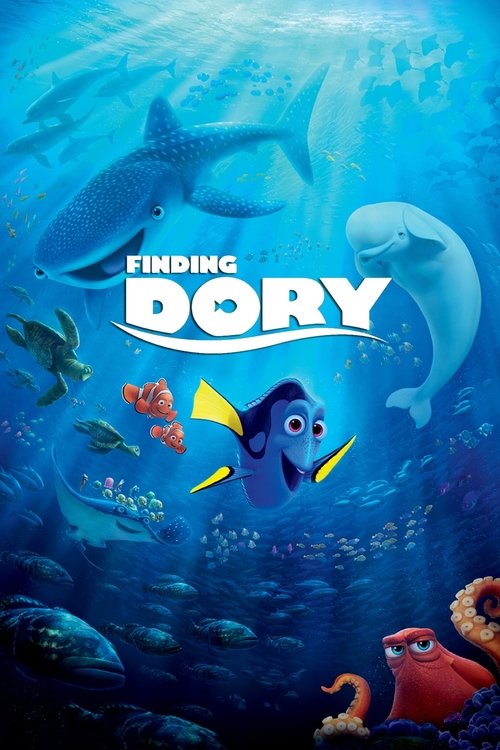
Finding Dory
2016 · Andrew Stanton
For family movie night, or when you need a good cry that ends in a hug — pure comfort viewing with more heart than it strictly needed to have. Great with kids, quietly affecting without them.
What it's about
Dory, the endlessly cheerful blue tang with no short-term memory, is jolted by a sudden flash of her childhood — and sets off with Nemo and Marlin to find the parents she forgot she had. The search leads to a sprawling California marine institute, part rescue hospital, part aquarium, where getting in is easy and getting around requires help from some very unlikely locals, including a cranky seven-armed octopus. It's a family adventure about what it means to find your way home when your own mind keeps losing the map.
The experience
Bright, fast, and very funny, with escape-room ingenuity to its set pieces — and then it sneaks up on you emotionally, because underneath the gags is a tender story about living with a disability and the people who love you anyway. Bring tissues; it earns them honestly.
Performances
Ellen DeGeneres turns what was a comic-relief voice into a full lead performance, making Dory's forgetfulness by turns hilarious and heartbreaking, and Ed O'Neill's grumpy octopus Hank is the film's great scene-stealer.
The craft
Pixar's underwater light — murky kelp forests, glowing tanks, sun through shallow water — is some of the studio's most beautiful rendering, and the octopus Hank is a small animation miracle, camouflaging and squeezing through the institute like a one-fish heist crew. The film swaps the open-ocean road trip of its predecessor for tight, clever spatial puzzles that keep the energy up.
Why it matters
A massive worldwide hit that proved a comic sidekick could carry her own story, it's also become a touchstone example of mainstream family animation treating disability with warmth and without condescension.
Snapshot
Finding Dory is Pixar Animation Studios' thirteen-years-later sequel to Finding Nemo (2003), directed by Andrew Stanton with co-director Angus MacLane and released by Walt Disney Pictures in June 2016. Where the original was a father's odyssey to recover a lost son, Finding Dory inverts the premise: the blue tang Dory (Ellen DeGeneres), defined since the first film by her short-term memory loss, becomes the protagonist of her own quest to recover the family and origins she has forgotten. The film relocates much of its action from the open Pacific to the Marine Life Institute, a California rehabilitation-and-aquarium complex, trading the first film's voyage structure for a contained, escape-room-like geography. It is at once a crowd-pleasing family adventure and, beneath its comedy, an unusually sustained meditation on disability, caregiving, and the dignity of a mind that works differently. Commercially it was one of Pixar's largest successes; critically it was received as a warm, well-crafted, if inevitably less revelatory, return to a beloved world.
Industry & production
Finding Dory arrived at a particular moment in both Pixar's and Stanton's careers. Stanton had left feature animation after WALL·E (2008) to direct Disney's live-action John Carter (2012), a production widely reported as one of the largest financial write-downs in the studio's history. His return to Pixar and to the Finding Nemo universe was, in industry terms, a homecoming to safer creative ground, and it coincided with Disney-era Pixar's broader pivot toward sequels and franchise extensions (Cars 2, Monsters University, the Toy Story and Incredibles continuations) alongside its originals.
The decision to make a Nemo sequel was, by Stanton's own later accounts in press interviews, driven less by commercial mandate than by a worry that Dory's condition left her perpetually vulnerable — a character who could be lost and never find her way back. That anxiety became the story's engine. Pixar's standard long development cycle applied: the film was announced publicly in 2013 for a date that was ultimately moved, settling on a June 2016 release. As with all Pixar features of the period, the production passed through the studio's "Braintrust" review process, in which directors screen works-in-progress to senior colleagues for candid story notes.
The film was a major box-office performer, opening to one of the strongest debuts ever recorded for an animated film in North America and going on to gross over a billion dollars worldwide; it became, for a time, the highest-grossing animated release domestically. (Precise figures vary by source and currency conversion, so I cite the orders of magnitude rather than exact totals.) Theatrically it was paired with the Pixar short Piper, a photorealistic study of a sandpiper chick on a beach that itself became a showcase for the studio's rendering advances.
Technology
Finding Dory sits inside Pixar's significant mid-2010s overhaul of its rendering pipeline. The studio had been transitioning its in-house RenderMan from the older REYES architecture toward RIS, a physically based path-tracing system that computes global illumination more directly. Films of this window — Finding Dory among them — benefited from more physically accurate light transport, which mattered enormously for an underwater feature where light behaves as a sculpted, scattering medium: caustics dancing on a reef floor, shafts angling down through depth, the soft murk of distance.
Water was the film's defining technical problem, as it had been for the original, but the toolset had advanced by more than a decade. The production had to render multiple distinct water "environments" — open ocean, kelp forest, touch pools, aquarium tanks, the institute's pipes and rehabilitation enclosures — each with its own clarity, color, and particulate quality. Surface interaction (the meniscus, splashes, the look of an object crossing from water into air) and the rendering of wet versus dry surfaces were areas of focused work.
The most discussed technical character was Hank, the "septopus" octopus voiced by Ed O'Neill. Octopus anatomy — boneless, infinitely deformable, capable of squeezing through tiny gaps and changing color and texture to camouflage — made him, by the filmmakers' repeated public testimony, among the most complex characters Pixar had then rigged and animated. The combination of arm articulation, suckers, skin-color shifts, and shape-changing camouflage required custom rigging and simulation tools beyond ordinary character setup. I'd flag that specific named-software claims about Hank's rig are best treated cautiously unless sourced to Pixar's own technical talks; the general difficulty, however, is thoroughly attested.
Technique
Cinematography
Pixar separates the photographic role into camera and lighting departments; Finding Dory credits Jeremy Lasky as director of photography for camera and Ian Megibben for lighting, both Pixar veterans. The "camera" work translates live-action grammar into a virtual underwater space: the film uses lensing, depth of field, and handheld-style movement to ground a fully synthetic environment in cinematic convention. The undersea setting licenses unusual freedom of movement — the camera can travel vertically and rotate in ways a terrestrial camera cannot — but the film generally restrains this, favoring legible coverage over showy floating.
Lighting carries much of the emotional and locational signature. The open ocean is rendered in cool, deep blues with directional shafts; the Marine Life Institute interiors shift to the greener, more clinical, fluorescent-tinged palette of an institutional aquarium; the touch-pool and child-visitor sequences brighten toward overexposed daylight. The flashbacks to Dory's childhood are softened and warmed, a standard but effective coding of memory.
Editing
Edited by Axel Geddes, the film departs structurally from the linear journey of Finding Nemo. Its present-tense action is intercut with fragmentary flashbacks — Dory's sudden, involuntary recollections of her parents and her childhood. The editing has to dramatize memory itself: a stray cue in the present (a phrase, an object, the gravel-bed path her parents laid) triggers a cut to the past. This associative cutting is the film's most distinctive formal gesture, mirroring its protagonist's cognition, where the audience reconstructs the backstory in the same broken order Dory does. The Institute setting also produces a denser, more farcical chase rhythm in the third act than the original's open-water pacing.
Mise-en-scène / staging
The shift from ocean to aquarium reorganizes the film's spatial logic. Finding Nemo was built on the vastness and danger of open water; Finding Dory is built on enclosure — tanks, pipes, quarantine, the touch pool, and ultimately a transport truck. The Marine Life Institute is a layered, navigable architecture that the characters must traverse from the inside, which makes the staging more about routes, obstacles, and confinement than about distance. Hank's camouflage and shape-shifting are exploited as staging devices, letting characters hide in plain sight and move through human spaces.
Sound
Sound design must continuously sell submersion — the muffling of water, the change in acoustic character between open ocean and a glass tank, the abrupt clarity of air. The film also uses sound as comedy and as plot mechanism: Destiny the whale shark and Bailey the beluga turn echolocation into a navigation gag with genuine narrative payoff, and Dory's celebrated ability to "speak whale" is a sonic running joke carried over from the original.
Performance
Vocal performance anchors the film. Ellen DeGeneres returns as Dory and shoulders a far heavier dramatic load than in the original, where Dory was largely comic relief; here the same chipper, deflecting energy must also register genuine fear, grief, and the loneliness of forgetting. Albert Brooks returns as the anxious clownfish Marlin. Hayden Rolence voices Nemo, replacing Alexander Gould, who had aged out of the role since 2003 (Gould has a vocal cameo as a truck passenger). The ensemble is notably deep: Ed O'Neill as Hank, Kaitlin Olson as the near-sighted Destiny, Ty Burrell as the insecure Bailey, Diane Keaton and Eugene Levy as Dory's parents Jenny and Charlie, Idris Elba and Dominic West as the territorial sea lions Fluke and Rudder, and Sigourney Weaver heard as the disembodied institutional voice of the Marine Life Institute — a casting joke that plays on her own star recognition.
Narrative & dramatic mode
The film operates in the mode of the quest-adventure crossed with the recovery-of-the-past melodrama. Its central formal innovation is to make memory loss not merely a character trait but the architecture of the storytelling: the audience learns who Dory is and where she comes from only as she does, in disordered flashes. This produces real dramatic irony and pathos — the viewer often retains information Dory cannot, and the film mines genuine fear from the possibility that she will forget her own purpose mid-quest. The dramatic stakes are internal and relational rather than survival-based, and the resolution turns on Dory learning to trust her own improvisational instincts ("What would Dory do?") rather than overcoming her condition.
Genre & cycle
Finding Dory belongs to the family-adventure animated feature, and more specifically to the Pixar sequel cycle of the early-to-mid 2010s. As a sequel it follows the familiar pattern of shifting focus to a beloved supporting character, but it distinguishes itself within that cycle by anchoring its comedy in disability rather than novelty. It also sits within the long animation tradition of anthropomorphic-animal storytelling and the more specific subgenre of the aquatic adventure that the original Finding Nemo had effectively defined for modern computer animation.
Authorship & method
Andrew Stanton is among Pixar's founding creative voices — writer-director of Finding Nemo and WALL·E, co-writer on the Toy Story films and other early features — and his sensibility recurs here: high-concept emotional premises, protagonists defined by a single profound limitation (loneliness, obsolescence, memory), and comedy that never fully insulates the audience from melancholy. He shares directing credit with Angus MacLane, a longtime Pixar animator and director, and the screenplay is credited to Stanton with Victoria Strouse (story credits also involve MacLane and Bob Peterson, per the film's billing).
Among key collaborators, composer Thomas Newman returns from Finding Nemo, lending continuity through his distinctive textural, lightly percussive orchestral idiom; reusing and varying the original's musical world is part of how the sequel signals kinship. Editor Axel Geddes shapes the associative flashback structure described above. Cinematographers Jeremy Lasky (camera) and Ian Megibben (lighting) carry the photographic translation of an undersea world. The collaborative, iterative Braintrust method of Pixar story development applies throughout, meaning authorship here is genuinely distributed even as Stanton's thematic fingerprint is clear.
Movement / national cinema
The film is a product of American studio computer animation as practiced by Pixar in Emeryville, California, under Disney ownership. It is not part of an avant-garde or art-cinema movement; rather it belongs to the dominant commercial tradition of CGI family features that Pixar itself did much to establish in the late 1990s and 2000s. Its setting — explicitly a California marine institute modeled on the kind of public aquarium-and-research facility found on the Central Coast — gives it a recognizably American regional texture.
Era / period
Finding Dory is a mid-2010s film, made in a period when the animated-feature market was crowded and franchise-driven, when path-traced rendering was becoming the industry norm, and when Pixar was balancing sequels against originals (Inside Out had been released the prior year). It also lands in a cultural moment of increasing attention to representation and disability in mainstream entertainment, which sharpened the film's reception around its portrayal of memory loss and other conditions among its cast of characters.
Themes
The film's governing theme is living with a disability without being defined by deficit. Dory's short-term memory loss is treated not as a problem to be cured but as a way of being that carries its own gifts — improvisation, openness, an absence of the fear that paralyzes the more "able" Marlin. The flashbacks reveal parents who taught Dory coping strategies out of love rather than shame, framing the film as much about caregiving and the fear of losing a vulnerable child as about Dory herself. Secondary characters extend the motif: Destiny's poor eyesight, Bailey's doubted echolocation, Hank's missing limb and desire to hide. Surrounding all of this are Pixar's perennial themes of family — found and biological — and self-acceptance. A quieter ecological note runs through the Marine Life Institute setting, with its rhetoric of "rescue, rehabilitation, and release."
Reception, canon & influence
Critically, Finding Dory was received warmly as a polished, emotionally generous sequel — praised for DeGeneres's expanded performance, for its handling of disability with humor and tenderness, and for its technical accomplishment, while a recurring reservation held that it could not recapture the originality of Finding Nemo and at times leaned on formula. It was broadly judged a strong entry in Pixar's catalog rather than a top-tier landmark.
Looking backward, the film's most obvious influence is Finding Nemo itself — its world, characters, musical voice, and the undersea-adventure template it inherited and refined. More deeply, it draws on Pixar's house principle, articulated across Stanton's career, that comedy and grief belong together, and on a long tradition of animated animal fables. The flashback-driven treatment of memory has antecedents across cinema's many films about amnesia and recollection, though Finding Dory domesticates that lineage for a young audience.
Looking forward, the film's clearest legacy is commercial: as one of the highest-grossing animated films of its era, it reinforced the studio-economics logic that drove the late-2010s wave of animated sequels. Its technical work — particularly the rendering of varied water environments and the much-discussed octopus animation — fed Pixar's accumulating expertise in simulating difficult, deformable, light-interacting subjects. Culturally, it is frequently cited in discussions of disability representation in children's media as a comparatively thoughtful example. Its most direct narrative offspring is arguably the continued willingness of mainstream animation to build family features around protagonists whose cognitive or physical difference is the heart of the story rather than its obstacle. The longer-term critical placement of Finding Dory within the Pixar canon remains, reasonably, that of an accomplished and beloved sequel rather than a foundational work — a verdict the record supports without overstatement.
A Deleuzian reading
Picture a trail of shells laid across the sea floor, leading home.
The full Deleuzian reading of Finding Dory →
Reception
Landed in 2016 to warm reviews and a record-smashing box office (the biggest domestic opening ever for an animated film at the time), but it's since settled into 'solid, second-tier Pixar' status — routinely cited in the mid-2010s Pixar-sequel-fatigue conversation rather than alongside the studio's classics.
How Finding Dory was received, from release to now →
Influences: the films it descends from and the films it influenced
- Finding Nemo (2003) — Direct parent whose reef-lighting and caustics pipeline, undersea camera grammar, and Thomas Newman score are recycled and varied — the sequel signals kinship by re-orchestrating the original's textural, lightly percussive musical world.
- WALL·E (2008) — Established Stanton's virtual camera that fakes live-action photographic flaws — lens flare, rack focus, shallow depth-of-field, anamorphic distortion — a photographic translation carried directly into Dory's underwater cinematography.
- Toy Story (1995) — Originated Pixar's articulated character-rigging and deformation pipeline from which Hank the septopus's boneless, seven-arm, surface-mimicking rig is a direct technical descendant.
- The Silent World (1956) — Codified the submersion aesthetic — color-graded depth falloff, drifting particulate, weightless framing — that Pixar's aquatic-adventure idiom and submersion sound design imitate.
- Memento (2000) — Built nonlinear architecture in which a memory disorder dictates the editing logic itself, the structural precedent for letting Dory's short-term memory loss govern associative cutting.
- Eternal Sunshine of the Spotless Mind (2004) — Modeled the subjective, dissolving associative flashback — recollection triggered by sensory cue and shading into the present tense — that Axel Geddes shapes into Dory's memory editing.
- Bambi (1942) — Set the animated-animal-fable template structured around parent-child separation and grief, the emotional architecture Pixar inherited and Stanton domesticates for a young audience.
- Aladdin (1992) — Pioneered the star-comedian voice performance (Williams) as a film's improvisational comic engine, the voice-acting lineage behind DeGeneres's expanded, riff-driven Dory.
- Coco (2017) — Extended Pixar's path-traced rendering toward massed translucent, self-luminous environments, building on the deformable-and-light-interacting subject expertise Finding Dory accumulated.
- Lightyear (2022) — Co-director MacLane's solo feature continuing the hard-surface staging and enclosure-driven blocking he co-directed here into a full directorial sensibility.
- Luca (2021) — Carried forward the submersion-design sound and the enclosure-to-open-water staging transition, building family drama on aquatic concealment and surfacing as its core formal device.
- Monsters University (2013) — Marked Pixar's move to global-illumination/path-traced RenderMan (RIS) rendering, the same lighting transition Finding Dory exploits to render varied, light-interacting water environments.
- Inside Out (2015) — Companion Pixar 'mind' film using associative flashback as load-bearing structure and dramatic irony about a protagonist's cognition — the audience grasping inner mechanics the character cannot.
- The Good Dinosaur (2015) — Pushed Pixar's photoreal fluid and environment simulation — rushing rivers and landscape rendering — on the same water/light pipeline Finding Dory advanced for its varied tanks and open ocean.
- Moana (2016) — Contemporaneous leap in character-interactive, deformable water simulation, extending the same craft problem — animating a sentient, light-transmitting fluid as a performing element.
- How to Train Your Dragon 2 (2014) — Centered a physical disability (Hiccup's amputation, Toothless's prosthetic fin) as character fact rather than narrative obstacle — the same representational craft Dory applies to cognitive difference.
Similar films
- Finding Nemo (2003) — influence & lineage
- Inside Out (2015) — influence & lineage
- Moana (2016) — influence & lineage
- Toy Story (1995) — influence & lineage
- WALL·E (2008) — influence & lineage
- Remarkably Bright Creatures (2026) — shared sensibility
- Toy Story 5 (2026) — shared sensibility
- Big Hero 6 (2014) — shared sensibility