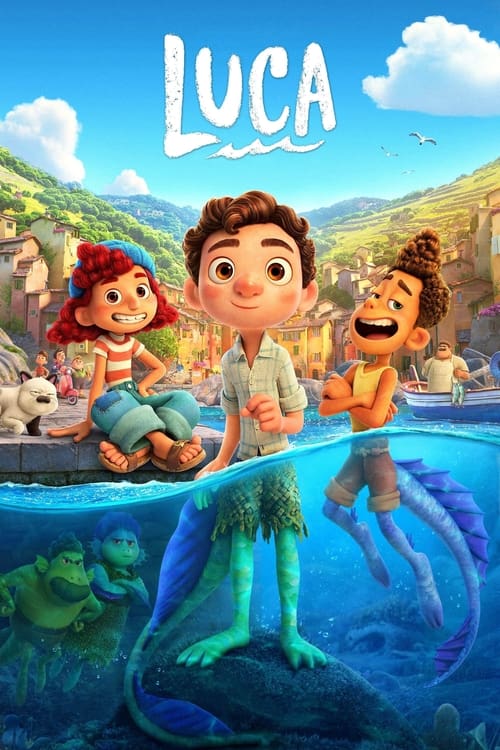
Luca
2021 · Enrico Casarosa
For when you want pure warmth — a family movie night, a rainy-day pick-me-up, or a nostalgia bath in summer light. One of the coziest comfort watches in modern animation.
What it's about
Luca is a young sea monster who discovers that his kind turn human the moment they dry off on land. With his daring new friend Alberto, he sneaks ashore to the little Italian Riviera town of Portorosso in the 1950s, where the boys befriend the spirited outsider Giulia and enter the town triathlon to win a Vespa — their ticket to freedom. The only catch: one splash of water reveals what they really are, in a town that fears sea monsters.
The experience
Sun-warmed and gentle, like a childhood summer remembered — low stakes by design, big on friendship, gelato, and the ache of growing apart from someone you love. It's funny and light on its feet, with a soft undertow of melancholy about hiding who you are.
The craft
Enrico Casarosa steers Pixar away from photorealism toward a looser, hand-drawn-feeling style inspired by Italian and Japanese animation, and the result is gorgeous: watercolor seas, pesto-green hillsides, light that feels like August. The Italian pop soundtrack and seaside sound design complete the postcard.
Why it matters
A memory-piece drawn from Casarosa's own Ligurian childhood, it marked Pixar embracing smaller, more personal, stylized storytelling — and it grew a devoted following as one of the studio's most rewatchable comfort films.
Snapshot
Luca is Pixar Animation Studios' twenty-fourth feature and the directorial debut of Enrico Casarosa, previously known for the Oscar-nominated short La Luna (2011). A sun-drenched coming-of-age fable set on the fictional Italian Riviera town of Portorosso, it follows Luca Paguro, a young sea monster who discovers that his kind take human form the moment they step out of the water and dry off. With his emboldening new friend Alberto, Luca ventures onto land, befriends the bookish outsider Giulia, and enters a small-town triathlon to win the Vespa that represents freedom beyond the boundaries of his life. The film is notable less for narrative ambition than for tone and texture: it is deliberately small in scale, warm, and stylized, a memory-piece steeped in Casarosa's Ligurian childhood and his affection for Italian and Japanese cinema. It is also historically significant as one of the tentpole Pixar features released directly to Disney+ during the COVID-19 pandemic, bypassing wide theatrical distribution in most markets.
Industry & production
Luca was produced by Pixar Animation Studios and distributed by Walt Disney Studios. Andrea Warren served as producer; the project grew out of a pitch Casarosa developed after La Luna, drawing on his own boyhood in Genoa and a formative friendship with a bolder childhood companion. Development proceeded through Pixar's standard iterative story process, and much of the later production coincided with the pandemic, meaning significant portions of the film were completed by artists working remotely — a notable operational challenge for a studio whose pipeline had been built around co-located, highly collaborative crews.
The film's release strategy is the defining industrial fact of its history. On July 18, 2021, Disney released Luca directly to Disney+ at no additional cost to subscribers in most territories, with only limited theatrical engagements. This decision, made amid ongoing pandemic disruption to cinemas, placed Luca alongside Soul (2020) as a major Pixar work that reached audiences primarily through streaming rather than theaters. Because it was not given a conventional wide theatrical rollout, Luca has no comparable global box-office figure to earlier Pixar releases, and any attempt to rank it commercially against theatrically released peers would be misleading; the record here is genuinely different in kind rather than merely thin.
Technology
Luca was made with Pixar's proprietary toolset — the Presto animation system and the RenderMan renderer — within a production pipeline increasingly organized around Universal Scene Description (USD), the interchange framework Pixar had developed and open-sourced in the prior decade. The technically interesting story of Luca, however, is not a new tool but a deliberate turn away from photorealism. Where much of Pixar's late-2010s work pushed toward physically accurate light, hair, cloth, and water, Luca's filmmakers pursued a more illustrative, caricatured, hand-crafted look, which required steering the studio's realism-tuned technology toward a stylized end.
That meant shaping simplified, appealing character forms, painterly skies and water, and gently exaggerated proportions rather than the dense micro-detail Pixar renderers are capable of producing. The transformation effect — sea monster to human and back, triggered by water and dryness — is one of the film's few true technical set-pieces, requiring the animation and effects teams to sell a fluid, believable morph between two very different body designs. The underwater sequences likewise called for a stylized treatment of light scatter and buoyancy that reads as storybook rather than documentary. Beyond these, Luca did not foreground a signature technological breakthrough, and it would be inaccurate to claim one.
Technique
Cinematography
As is standard at Pixar, photography was divided between a director of photography for camera and one for lighting — credited to David Juan Bianchi (camera) and Kim White (lighting). The virtual camerawork favors clarity, warmth, and intimacy over spectacle: eye-level framings that keep the two boys close, wide establishing views of the harbor and hills that function as postcards of remembered place, and a golden, high-key palette evoking the glare of a Mediterranean summer. Lighting leans into saturated blues and warm ochres, with a softness that reinforces the film's memory-tinted register. The camera is rarely showy; its restraint is a stylistic choice consistent with the film's modest, personal scale.
Editing
The film was edited by Catherine Apple. The cutting is unhurried, built around the rhythm of a single summer, and prioritizes the emotional beats of friendship and small humiliations over incident. The triathlon climax provides the film's most kinetic sequence — cross-cutting between swimming, cycling, and pasta-eating — but even there the editing keeps the stakes human-scaled rather than escalating toward the large action climaxes typical of many contemporary animated features.
Mise-en-scène / staging
Production design, led by Daniela Strijleva, is the film's most distinctive craft achievement. Portorosso is an invented composite of the Cinque Terre and the Ligurian coast: stacked pastel houses, a working harbor, cobbled piazzas, café awnings, and Vespas. The staging is warm and lived-in, and the whole world is tuned to a slightly heightened, illustrative key — a place recalled from childhood rather than photographed. Character design, with art direction associated with Deanna Marsigliese, embraces caricature: rounded, appealing silhouettes that read instantly and depart from photoreal proportion. The recurring iconography — the Vespa, the sea, books and telescopes, food and the family table — organizes the staging around the film's themes of escape, difference, and belonging.
Sound
The sound design contrasts the muffled, resonant world beneath the water with the bright clatter of the town above, dramatizing the film's central threshold between two lives. Dan Romer's score blends orchestral warmth with Italian-inflected melody, and the film leans heavily on licensed period Italian pop — including recordings associated with artists such as Edoardo Bennato and Rita Pavone, plus a nod to Italian operatic tradition — to place the viewer firmly in a mid-century Mediterranean soundscape. Music functions less as underscore-for-tension than as atmosphere and nostalgia, reinforcing the sense of a summer preserved in memory.
Performance
The voice cast anchors the film's intimacy. Jacob Tremblay voices Luca as tentative and wondering; Jack Dylan Grazer plays Alberto with a swaggering bravado that masks loneliness; and Emma Berman's Giulia brings a fierce, generous energy as the human friend who widens both boys' world. Supporting turns include Maya Rudolph and Jim Gaffigan as Luca's parents, Marco Barricelli as the preening bully Ercole, Sacha Baron Cohen, and Sandy Martin as the grandmother. The performances favor naturalism and youthful spontaneity over broad comic exaggeration, consistent with the film's grounded emotional aims.
Narrative & dramatic mode
Luca operates in the coming-of-age mode: a bounded, seasonal story of a first friendship that opens a sheltered protagonist to a larger life, and of the small betrayal and reconciliation through which he learns to stand on his own. Its dramatic engine is concealment — the sea-monster secret that could be exposed by a single splash of water — which supplies both comedy and low-key suspense without ever escalating into high-stakes peril. The structure is classical and legible: an established order (Luca's confined undersea life), a disruptive friendship, a journey into the forbidden world, a widening rift as Luca is drawn toward Giulia and away from Alberto, a crisis of exposure, and a resolution that affirms difference and lets the boys part having changed each other. Casarosa has framed the film's recurring mantra, "Silenzio Bruno!" — the command to silence the inner voice of fear — as its thematic through-line. The register is gentle and comic-nostalgic rather than tragic, and the film's deliberate refusal of a bombastic climax is central to its identity.
Genre & cycle
The film sits at the intersection of family animation, fantasy, and the coming-of-age comedy-drama, with clear affinities to the "summer that changed everything" tradition of boyhood friendship stories. Within Pixar's own output it belongs to a cycle of more personal, smaller-scaled, director-driven features of the late 2010s and early 2020s that trade world-saving stakes for intimate emotional questions. It also participates in a broader contemporary current of animated films that foreground otherness and acceptance through fantastical premises. Its most idiosyncratic generic move is to graft a monster-transformation fantasy onto an essentially neorealist-adjacent story of small-town Italian life, so that the "monster" conceit works primarily as metaphor rather than as a source of genre thrills.
Authorship & method
Luca is unusually legible as a personal work. Casarosa has been open that the film is rooted in his Genoese childhood and in a real, formative friendship, and that the fear of being found out — of not belonging — is drawn from lived feeling. His method as a director carries over from his background as a story artist and from La Luna: an emphasis on hand-drawn appeal, gesture, and stylization over Pixar-house realism, pursued here at feature length. The screenplay is credited to Jesse Andrews and Mike Jones, with the story credited to Casarosa, Andrews, and Simon Stephenson. Key collaborators shaping the film's voice include composer Dan Romer, editor Catherine Apple, production designer Daniela Strijleva, the camera and lighting directors of photography David Juan Bianchi and Kim White, and producer Andrea Warren. The consistency between Casarosa's stated intentions — a memory of an Italian summer, rendered like an illustrated storybook — and the finished film's look and tone marks Luca as strongly author-driven within a large studio system.
Movement / national cinema
Though a product of an American studio, Luca wears its Italian and Japanese cinephile influences openly. Casarosa has repeatedly cited Federico Fellini — the autobiographical seaside nostalgia of Amarcord and the aimless small-town youth of I Vitelloni — and the textures of Italian neorealism as touchstones, and the film's evocation of place, food, and provincial ritual reflects that lineage. Equally important is the influence of Hayao Miyazaki and Studio Ghibli: the very name Portorosso is a transparent homage to Miyazaki's Porco Rosso, and the film's stylized, hand-crafted aesthetic and its unhurried attention to small physical pleasures are consciously Ghibli-inflected. Luca thus reads as an American animation studio's affectionate act of cross-cultural homage rather than as part of any Italian film movement proper.
Era / period
The story is set in a mid-twentieth-century Italy — an unspecified but clearly evoked 1950s-into-1960s moment, signaled by the Vespa, the fashions, the period pop songs, and the pre-mass-tourism intimacy of the coastal town. This period setting is essential to the film's nostalgic, memory-piece character. In terms of its own production era, Luca is a document of the pandemic period in Hollywood animation: made partly under remote-work conditions and released into the streaming-first distribution landscape that COVID-19 accelerated, it belongs to the small group of Pixar features whose first audiences met them at home rather than in theaters.
Themes
The film's central theme is acceptance of difference — the fear of being seen as a "monster" and the liberation of being embraced as one is. Around this cluster friendship and its growing pains, the courage to quiet one's own fear ("Silenzio Bruno!"), the pull between safety and the wider world, and the bittersweet recognition that formative friendships can change us even as we outgrow them. The sea-monster premise has invited multiple allegorical readings: many viewers and critics have read the boys' hidden nature and their fear of exposure as a metaphor for queer adolescence, while others read it in terms of immigration and xenophobia, or simply as the universal childhood experience of hiding a self one fears is unacceptable. Casarosa has described his primary intention as capturing pre-romantic boyhood friendship; it is fair to note that the film's openness to these competing readings is itself part of its cultural footprint, and that the metaphor is deliberately capacious rather than fixed.
Reception, canon & influence
Critical reception was generally positive. Reviewers praised the film's warmth, charm, visual beauty, and the sincerity of its central friendship, while a recurring line of criticism held that Luca was "minor" Pixar — lower in stakes, thematic ambition, and emotional complexity than the studio's most celebrated work. That framing, of a lovely and modest film rather than a landmark one, has largely defined its critical standing. The film was nominated for the Academy Award for Best Animated Feature but did not win; the category that year went to Encanto.
Its influences run backward to the sources Casarosa has named: Fellini's autobiographical and small-town films, Italian neorealism's sense of place, and Miyazaki and Studio Ghibli's hand-crafted stylization and attention to the textures of ordinary life. Within Pixar, it extends the studio's trend toward personal, director-specific, stylized projects. Forward influence is harder to assess so soon and should be stated cautiously: Luca's most durable legacy so far is arguably as a marker in Pixar's turn toward more openly caricatured, illustrative aesthetics and toward smaller, intimate stories, and as a case study — alongside Soul and Turning Red — in the streaming-first release decisions that reshaped how Pixar films reached audiences during and after the pandemic. Claims beyond that would outrun the current record.
A Deleuzian reading
Water hits a boy's arm in a sunlit piazza and the skin goes to scales.
The full Deleuzian reading of Luca →
Reception
Dropped straight to Disney+ in June 2021 and widely shrugged off as 'minor Pixar' — charming but slight. Five years on it's been thoroughly reappraised as one of the studio's warmest recent films, a summer comfort-watch staple whose low-stakes hangout energy now reads as a feature, not a bug.
How Luca was received, from release to now →
How to watch Luca: what to notice on a first viewing
- Watch every time water touches Luca's or Alberto's skin. Casarosa turns the most ordinary substance on the Riviera into the one thing every scene tracks with anxiety. An ordinary object becomes a constant source of tension the moment it can expose the boys.
- Watch how Alberto holds his shoulders and chin when he talks big. Jack Dylan Grazer's swagger never wavers even when Alberto is clearly scared or alone, a posture worn like armor. The bravado is the loneliness, carried on the outside of the body instead of hidden inside it.
- Look at how blue and orange split every shot of Portorosso. Kim White's lighting keeps deep saturated blues against warm ochre almost everywhere, softer than any real coastline. The softness is how a remembered summer looks, not how any actual coast looks.
- Listen for how sound changes the instant a body leaves the water. Underwater scenes stay muffled and resonant; the moment a character surfaces, the soundtrack turns bright and clattering. The sound design draws the line between two lives before any line of dialogue does.
The whole guide to watching Luca, with the keys for a rewatch →
Influences: the films it descends from and the films it influenced
- I Vitelloni (1953) — The episodic, autobiographical portrait of aimless young men loafing in a small Adriatic seaside town is the provincial-youth structure Casarosa explicitly cites.
- Amarcord (1973) — Childhood rendered as warm memory of a coastal Italian town populated by affectionately caricatured townsfolk — the storybook-memory register and exaggerated-locals staging Luca adopts.
- Porco Rosso (1992) — Sun-bleached Ligurian/Adriatic Mediterranean palette and seaside-town architecture supply the Italian-coast Ghibli look behind the Portorosso composite.
- Ponyo (2008) — Hand-drawn anti-photorealist stylization paired with a sea creature morphing into a human child to live on land — the direct transformation-morph template.
- Kiki's Delivery Service (1989) — European seaside-town coming-of-age built from the unhurried textures of ordinary daily life that define Luca's summer rhythm.
- Bicycle Thieves (1948) — Neorealism's grounding of story in a specific, lived Italian place is the sense-of-location inheritance behind the invented-yet-authentic Portorosso.
- La Luna (2011) — Casarosa's own short prototyped the hand-drawn, gesture-first appeal and stylization-over-Pixar-realism he then scaled to feature length.
- Splash (1984) — The concealment engine of a water-creature passing as human on land, whose true form is exposed by contact with water, is Luca's core reveal mechanic.
- The Little Mermaid (1989) — A sea-creature protagonist who transforms and hides their nature to belong in the human world above — the yearning-outsider-crosses-the-surface structure.
- Finding Dory (2016) — Carried forward the submersion-design sound and the enclosure-to-open-water staging transition, building family drama on aquatic concealment and surfacing as its core formal device.
- Finding Nemo (2003) — Extends Pixar's seaside/undersea worldbuilding with refined subsurface light and sea-creature-to-human transformation, building on Nemo's reef-light rendering foundation.
- The Red Turtle (2016) — Ghibli-produced wordless naturalism and a human/sea-creature transformation rendered in flat, illustrative stylization rather than photoreal detail.
- Song of the Sea (2014) — Hand-crafted illustrative flatness carrying a selkie (seal-human) transformation myth about belonging, a parallel anti-photorealist folk-fantasy approach.
- Turning Red (2022) — Pixar's director-specific caricatured aesthetic deploying involuntary bodily transformation as a concealed-difference coming-of-age metaphor.
- Soul (2020) — Part of Pixar's turn to personal, stylized, streaming-first features — a Disney+ debut cohort with Luca that reshaped how these films reached audiences.
- Spider-Man: Into the Spider-Verse (2018) — Landmark of the industry-wide move to openly illustrative, anti-photorealist animation that licensed Luca's caricatured, storybook rendering.
- Call Me by Your Name (2017) — Sun-drenched northern-Italian summer coming-of-age whose warm high-key light and queer-allegory reading Luca closely parallels.
- Bao (2018) — Pixar short using a stylized fantasy metaphor for intimate personal feeling, part of the studio's move toward director-driven, caricatured storytelling.
- Coco (2017) — Sibling in Pixar's turn toward place-specific cultural texture — an intensely localized regional setting (Ligurian coast) treated with the same lived-in specificity Coco brings to small-town Mexico.
Similar films
- Call Me by Your Name (2017) — influence & lineage
- Ponyo (2008) — influence & lineage
- Amarcord (1973) — influence & lineage
- Kiki's Delivery Service (1989) — influence & lineage
- Fireworks (2023) — shared sensibility
- Guillermo del Toro's Pinocchio (2022) — shared sensibility
- My Life as a Zucchini (2016) — shared sensibility
- Arco (2025) — shared sensibility