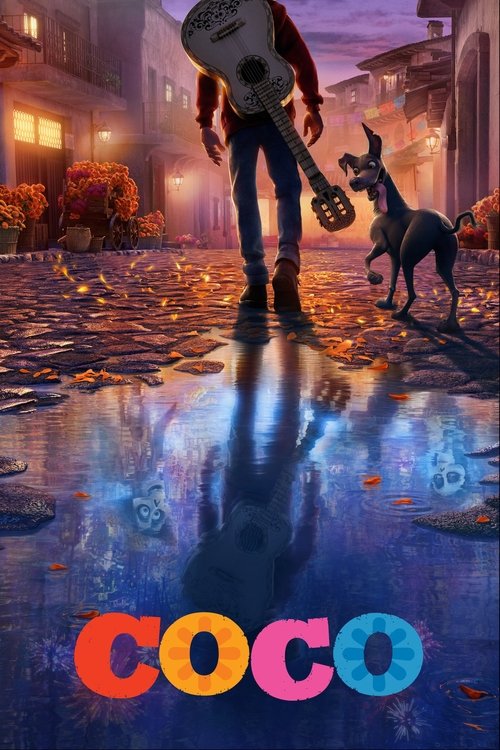
Coco
2017 · Lee Unkrich
For when you need a good cry disguised as a family adventure — a comfort watch about grief and remembrance that leaves you wanting to call your grandmother. Bring tissues, genuinely.
What it's about
Miguel, a boy from a Mexican shoemaking family that banned music generations ago, dreams of playing guitar like his idol, the legendary Ernesto de la Cruz. On Día de los Muertos — the one night the border between worlds is thin — he finds himself in the Land of the Dead, a glowing metropolis of stacked towers, where with a charming trickster named Héctor he must untangle his family's oldest secret to get home.
The experience
Dazzling and big-hearted, it moves like an adventure but lands like a memory — the kind of film that has the whole room laughing for an hour and quietly weeping by the end. Its emotional payoff is famous for a reason.
The craft
Built on years of research trips into Mexican tradition, the Land of the Dead is one of animation's great environments — a vertiginous neon city reached across a bridge of marigold petals that rewards the biggest, brightest screen available. The papel picado prologue is a master class in compressed storytelling, and the Oscar-winning song 'Remember Me' does real narrative work rather than just decorating the film.
Why it matters
A landmark of cultural specificity in mainstream animation — cast with Latino actors in its principal roles and treating Día de los Muertos with real seriousness — and one of Pixar's most beloved late-era triumphs.
Pixar's plunge into Mexico's Día de los Muertos, directed by Toy Story 3's Lee Unkrich with co-director Adrian Molina, and built on years of research trips that show in every frame: a Land of the Dead imagined as a vertiginous, glowing metropolis of stacked colonial towers, reached across a bridge of marigold petals. Miguel, a boy from a shoemaking family that has banned music for generations, crosses over on the one night the border between worlds is thin, and the film becomes a detective story about memory itself — who gets remembered, who does the remembering, and what is owed to the dead. The prologue, narrated over animated papel picado banners, is a small master class in compressed storytelling. Cast entirely with Latino actors in its principal roles and anchored by the Oscar-winning song 'Remember Me,' it treats its cosmology with a seriousness rare in family animation: death here is not the end but forgetting is. In Mexico it became, for a time, the highest-grossing film in the country's history.
A Deleuzian reading
A bridge made of flower petals.
The full Deleuzian reading of Coco →
Reception
An instant hit in 2017 — two Oscars, rapturous reviews — but its stature has only grown: it's now the consensus pick for Pixar's best film of the sequel-heavy late 2010s, and in Mexico it became the highest-grossing film in the country's history.
How Coco was received, from release to now →
Influences: the films it descends from and the films it influenced
- Toy Story 3 (2010) — Unkrich's own prior feature perfects the cross-cut, brink-of-oblivion climax (the incinerator) whose editorial rhythm Coco reuses in Miguel racing to sing before Coco forgets — the same 'push the audience to grief, then release' catharsis machine.
- Up (2009) — The wordless 'Married Life' montage models Coco's compressed prologue technique: decades of family history and loss delivered as image-and-music economy before the plot proper begins.
- Ratatouille (2007) — Establishes Pixar's research-driven sensory authenticity plus the 'artist defying family expectation' engine — Remy's cooking-vs-clan is directly rhymed by Miguel's music-vs-shoemaking family ban.
- Ratatouille (2007) — Also seeds the 'mystery of lineage' twist structure — the revered idol (Gusteau / Ernesto de la Cruz) is exposed as fraud, redirecting the hero's admiration to true kin.
- Finding Dory (2016) — Extended Pixar's path-traced rendering toward massed translucent, self-luminous environments, building on the deformable-and-light-interacting subject expertise Finding Dory accumulated.
- How to Train Your Dragon 2 (2014) — Inherits the normalization of real grief and death in family animation that Stoick's funeral helped legitimize, staging mortality and remembrance as the film's emotional core.
- Macario (1960) — Its marigold-lit land of the dead and towers of glowing souls descend from Macario's emblematic cavern of candle-lives and its Day-of-the-Dead iconography.
- The Book of Life (2014) — Sibling that arrives first with the same Día de los Muertos visual grammar — marigold-petal bridges, sugar-skull character design, and a tiered Land of the Remembered — establishing the iconography Coco refines in CG.
- Spirited Away (2001) — The template for a child crossing a threshold into a densely populated spirit-world with its own bureaucracy, currency, and rules — Coco's Land of the Dead border-crossing and photo-passport gag descend directly from Chihiro's bathhouse.
- Corpse Bride (2005) — Inverts the palette so the afterlife is the vibrant, saturated realm and the living world is drab — the exact color logic Coco uses to make the Land of the Dead its most luminous environment.
- Beetlejuice (1988) — Originates the afterlife-as-bureaucracy comedy — waiting rooms, caseworkers, and paperwork for the dead — which Coco stages as border-control desks and 'family reunion' clearances.
- What Dreams May Come (1998) — Pioneers the painterly, hyper-saturated afterlife as an expressionist landscape built from light and color — a live-action ancestor to Coco's glowing vertiginous Land of the Dead.
- Metropolis (1927) — Source of the vertiginous stacked-city cinematography — the vertical, terraced megastructure shot from dizzying angles — that Coco quotes in its towering, tiered City of the Dead.
- Frozen (2013) — Robert Lopez and Kristen Anderson-Lopez's plot-load-bearing ballad model ('Let It Go') is the direct precedent for 'Remember Me' — a song that is simultaneously theme, emotional key, and narrative device.
- Soul (2020) — Descendant that extends Coco's method of rendering a metaphysical realm in CG and binding it to a musical idiom — jazz for the soul-world as mariachi is for the dead.
- Encanto (2021) — Extends Coco's culturally-specific, research-driven Latin American family epic — a multigenerational house, ancestral trauma, and heritage-as-inheritance rendered through a saturated regional palette.
- Onward (2020) — Carries forward Pixar's grief-quest structure — a son journeying to reconnect with a dead father across a fantastical threshold before a hard time limit expires.
- Turning Red (2022) — Extends Coco's engine of culturally-specific family obligation versus individual identity, staging the same generational-expectation conflict through a particular diaspora's textures.
- Luca (2021) — Sibling in Pixar's turn toward place-specific cultural texture — an intensely localized regional setting (Ligurian coast) treated with the same lived-in specificity Coco brings to small-town Mexico.
Similar films
- Ratatouille (2007) — influence & lineage
- Soul (2020) — influence & lineage
- Toy Story 3 (2010) — influence & lineage
- Up (2009) — influence & lineage
- Spirited Away (2001) — influence & lineage
- The Boy and the Heron (2023) — same viewing thread
- Tótem (2023) — same viewing thread
- Guillermo del Toro's Pinocchio (2022) — same viewing thread
All the films related to Coco →
Watch it with: curated runs of related films
- Where Children Meet the Dead — Watch these together and Coco's candlelit sweetness darkens by degrees into a run of folk fables where the dead won't stay buried and children bargain with mortality under the shadow of war and fascism.