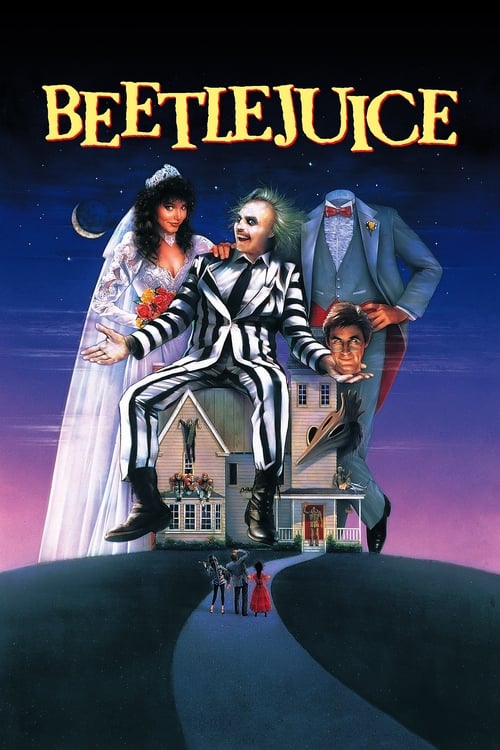
Beetlejuice
1988 · Tim Burton
Perfect Halloween-adjacent comfort viewing — when you want laughs with a skeleton grin, something imaginative and a little ghoulish that the whole room can enjoy. Pure fun, zero homework.
What it's about
A sweet young couple die suddenly and find themselves haunting their own beloved New England farmhouse — just as an insufferably trendy New York family moves in and starts renovating. Too gentle to scare anyone off themselves, the ghosts turn to a self-styled 'bio-exorcist,' a leering, motor-mouthed demon named Beetlejuice, whose help is far worse than the problem. It's a haunted-house story flipped inside out: the dead are the nice ones, and the living are the pests.
The experience
Fast, loud, gleefully weird fun — a joke-a-minute farce that keeps topping itself with grotesque sight gags and bursts of the genuinely macabre. It's the rare movie that's spooky and silly in the same breath, and it never stops moving.
Performances
Michael Keaton is a hurricane as Beetlejuice — a largely improvised, filthy-carnival-barker performance so combustible it steals the film with surprisingly little screen time. Geena Davis and Alec Baldwin ground it as the mildest, most decent ghosts imaginable.
The craft
Tim Burton's handmade sensibility is everywhere: stop-motion monsters, warped model landscapes, practical creature effects with real texture and personality, all scored to Danny Elfman's careening carnival music. The Harry Belafonte calypso set piece alone is worth the price of admission — this one rewards good speakers and a crowd.
Why it matters
A surprise hit that made Tim Burton a brand-name director on the way to Batman, and a cornerstone of the spooky-funny family aesthetic — its afterlife bureaucracy and striped-suit ghost are permanent pop-culture furniture.
Snapshot
Beetlejuice is Tim Burton's second feature, a delirious afterlife comedy that arrived between the modest cult success of Pee-wee's Big Adventure (1985) and the studio juggernaut of Batman (1989). Produced by The Geffen Film Company and released by Warner Bros., it transformed a grim, sometimes macabre script into a Day-Glo haunted-house farce whose imagination ran in the opposite direction from convention: here the dead are the sympathetic protagonists and the living are the intruders. Built around Michael Keaton's volcanic, largely improvised turn as the title "bio-exorcist," and anchored by Geena Davis and Alec Baldwin as a newly deceased couple too decent to be frightening, the film fused handmade stop-motion grotesquerie, Danny Elfman's carnivalesque score, and a now-iconic Harry Belafonte calypso set piece. It was a commercial hit that crystallized Burton's authorial signature — a gothic-suburban sensibility, sympathy for outsiders, and a craftsman's love of visible artifice — and it won the Academy Award for Best Makeup. Few late-1980s studio comedies have proved so durable, spawning an Emmy-winning animated series, a long-gestating Broadway musical, and a 2024 legacy sequel.
Industry & production
Beetlejuice emerged from a spec script by Michael McDowell, a Southern gothic novelist known for horror paperbacks. The original draft was reportedly far darker and more violent than the finished film. Producers David Geffen, Larry Wilson, and Richard Hashimoto shepherded the project, with Warren Skaaren receiving co-screenplay credit for a substantial rewrite that lightened the tone and sharpened the comedy. Burton came aboard after Pee-wee's Big Adventure had demonstrated he could deliver a distinctive vision on a contained budget; the studio's confidence in him was real but bounded, and Beetlejuice was made economically — its modest budget is frequently cited in the low-to-mid eight figures, though exact internal figures vary across sources and should be treated with caution.
The casting reflects a film assembled before its director was a brand name. Michael Keaton, then known chiefly as a comic actor from Mr. Mom and Night Shift, was not Burton's obvious first choice on paper but proved transformative; his collaboration here directly preceded his controversial casting as Batman, a decision Burton fought for partly on the strength of this work. Geena Davis and Alec Baldwin were cast as the Maitlands, with Catherine O'Hara and Jeffrey Jones as the gentrifying Deetz family and a teenaged Winona Ryder as the death-fixated Lydia, a role that helped define her early persona. Sylvia Sidney, a star of 1930s Hollywood, lent old-studio gravity to the chain-smoking caseworker Juno.
The title itself became a marketing flashpoint: the studio was wary of "Beetlejuice" and reportedly floated alternatives — the much-repeated anecdote is that Burton joked the film should be called Scared Sheetless, only to be alarmed when the studio took it seriously. The film opened in the spring of 1988 and substantially outperformed expectations, becoming one of the year's surprise successes and establishing Burton as a bankable director on the eve of Batman.
Technology
Beetlejuice is a near-textbook case of pre-digital effects ingenuity, and its visual identity is inseparable from its deliberate refusal of seamlessness. The production used a battery of practical and optical techniques: stop-motion animation, prosthetic makeup, forced-perspective miniatures, hand-built creatures, replacement animation, and optical compositing. The decision to make the effects look handmade was aesthetic as much as budgetary — Burton and his team embraced the seams rather than hiding them.
The most celebrated technical set piece is the model town in the Maitlands' attic, a miniature New England village that becomes a stage for the afterlife's surreal incursions, including the sandworms of the desert-like "Saturn" netherworld. The face-stretching gags, the spinning heads, the shrunken-headed hunter in the afterlife waiting room, and the sculptural distortions of the Maitlands' self-mutilating attempts to scare were achieved through prosthetics, puppetry, and stop-motion rather than any photochemical trickery that aspired to realism. The film received the Academy Award for Best Makeup, recognizing the work of Ve Neill, Steve La Porte, and Robert Short. The effect of all this is a film whose technology is openly theatrical — closer to a haunted carnival attraction than to the photoreal effects pipelines that would dominate the following decade.
Technique
Cinematography
Thomas E. Ackerman shot the film, and the cinematography serves the production design's tonal split between the mundane and the supernatural. The Maitlands' pre-renovation Connecticut farmhouse is photographed warmly and conventionally; the afterlife bureaucracy and the netherworld are rendered with high-contrast, expressionistic lighting and saturated, artificial color. The camera is mobile and frequently playful — pushing into the model town, swooping through the house, treating space as elastic and unstable once the supernatural intrudes. The visual grammar deliberately telegraphs artifice, with compositions that frame the action like a proscenium and lighting that flatters the handmade quality of the effects rather than disguising it.
Editing
Jane Kurson edited the film, and the cutting is central to its comic and tonal control. Beetlejuice runs short and brisk, and its humor depends on timing — the snap between a sincere domestic beat and an eruption of grotesque spectacle. The film's structure is episodic and accelerating, accumulating gags and set pieces rather than building a tight causal plot, and the editing manages a tone that lurches deliberately between sentiment, horror, and slapstick. The famous dinner-party possession sequence, in which the Deetzes and their guests are seized into a lip-synced rendition of Belafonte's "Day-O (The Banana Boat Song)," is a model of comic timing achieved in the cut.
Mise-en-scène / staging
Production designer Bo Welch — who would become a recurring Burton collaborator — is arguably the film's most important visual author after Burton himself. The staging contrasts two worlds: the Maitlands' cozy, handcrafted domesticity and the Deetzes' aggressively modernist renovation, a satire of urbane art-world pretension in which the home is gutted into angular, sterile sculpture. The afterlife is conceived as a grimy, overcrowded waiting room — a bureaucracy of the dead, complete with caseworkers, handbooks, and a numbered queue — a comic deflation of the sublime that became one of the film's most influential conceits. Welch's designs give the netherworld a hand-built, slightly shabby quality that reinforces the film's anti-grandiose vision of death.
Sound
Danny Elfman's score is foundational to the film's identity, a manic, waltzing, circus-gothic suite that established the template for his decades-long partnership with Burton. The music swings between mock-romantic lushness and frenetic carnival menace, mirroring the film's tonal instability. The diegetic use of Harry Belafonte's calypso recordings — "Day-O" at the dinner party and "Jump in the Line (Shake, Senora)" at the climax — provides the film's two most memorable musical moments and supplies an incongruous, sunny counterpoint to the macabre material. Sound design contributes heavily to the comic-grotesque texture: the squelches, pops, and mechanical groans of the practical effects are foregrounded, reinforcing the handmade aesthetic.
Performance
The performances operate in deliberately mismatched registers, which is part of the film's design. Keaton's Betelgeuse is a tornado of vulgar, fast-talking improvisation — a genuinely unsettling figure beneath the comedy, on screen for a surprisingly small portion of the runtime yet dominating the film's memory. Davis and Baldwin play the Maitlands with earnest, deadpan sincerity, their very niceness the engine of the joke that they cannot manage to be frightening. Catherine O'Hara's Delia Deetz is a comic creation of brittle pretension, while Winona Ryder's Lydia provides the film's melancholic center, a lonely goth teenager who feels more kinship with the dead than the living. Sylvia Sidney's weary Juno grounds the afterlife scenes with old-Hollywood authority.
Narrative & dramatic mode
The film's dramatic mode is comic-gothic fantasy with a strong satirical undercurrent. Its boldest structural choice is the inversion of the haunted-house formula: the audience is aligned with the ghosts, who want their home back, while the living family are the unwelcome occupiers. This reversal turns standard horror affect inside out and converts dread into farce. The narrative is loosely constructed, accumulating incident and set piece rather than tightening a plot, and it tolerates abrupt tonal shifts between domestic sentiment, supernatural spectacle, and outright menace — most pointedly in the late, uneasy plot turn in which Betelgeuse attempts to force a marriage to the teenaged Lydia, a darkness the film holds in tension with its comedy. The resolution is notably warm: the dead and the living reach an unlikely domestic coexistence, an ending that affirms found family across the boundary of mortality.
Genre & cycle
Beetlejuice sits at the intersection of the supernatural comedy and the gothic fantasy, part of a late-1980s wave of effects-driven genre hybrids. It can be read alongside the studio ghost-comedy lineage that Ghostbusters (1984) had recently revitalized, but its sensibility is closer to the macabre whimsy of Charles Addams and the fairy-tale gothic than to that film's blockbuster sleekness. Within Burton's own filmography it inaugurates the suburban-gothic cycle he would refine in Edward Scissorhands (1990), films that set the strange and the sincere against the conformist American suburb. It also belongs to a broader tradition of afterlife comedies that domesticate death by rendering it bureaucratic and banal.
Authorship & method
Beetlejuice is where Burton's authorial identity consolidated, and it did so through a set of collaborations he would sustain for decades. As director he favored handmade effects, theatrical artifice, sympathetic monsters, and outsider protagonists, all visible here in mature form. The film established or cemented several of his key creative partnerships: composer Danny Elfman, whose score launched one of the most consistent director-composer relationships in modern American cinema; production designer Bo Welch, who would return for Edward Scissorhands and Batman Returns; and actors Michael Keaton, Catherine O'Hara, and Winona Ryder, all of whom recur across Burton's work. Cinematographer Thomas E. Ackerman and editor Jane Kurson were less permanent collaborators but executed the film's tonal balancing act with precision.
On the writing side, authorship is genuinely shared and somewhat contested: Michael McDowell's original conception supplied the macabre architecture and the darker sensibility, while Warren Skaaren's rewrite (with Larry Wilson contributing to the story) reoriented it toward comedy. The finished film is best understood as Burton imposing a unifying visual and tonal sensibility on material that several hands had reshaped — a method of authorship through design, casting, and tone rather than through screenwriting control.
Movement / national cinema
Beetlejuice is a product of mainstream American studio filmmaking, but it draws on traditions that sit askew from Hollywood realism. Its expressionist lighting, theatrical artifice, and grotesque-comic imagination connect it to a lineage running through German Expressionism, Universal horror, the macabre Americana of Charles Addams and Edward Gorey, and the stop-motion craft tradition of animators like Ray Harryhausen, whose influence Burton has repeatedly acknowledged. It is not part of any organized movement; rather it represents the assertion of a personal, illustrator's sensibility — Burton trained as an animator at Disney — within the commercial American studio system, a move that helped legitimize idiosyncratic auteur visibility inside the late-1980s blockbuster economy.
Era / period
The film is firmly a late-1980s artifact, both in its production technology and its cultural satire. Made on the cusp of the digital-effects revolution, it represents a high point of the practical-effects craft tradition just before computer imaging began to displace it. Its comedy is also of its moment: the Deetzes embody a specifically 1980s satire of the yuppie art world and the gentrifying transformation of rural property into urbane real estate, while Lydia's gothic alienation prefigures the alternative youth subcultures that would flourish in the following decade. The film's visual maximalism and its embrace of artifice are continuous with the decade's pop aesthetics, even as its sympathies lie with the marginal and the morbid.
Themes
At its core, Beetlejuice is about home, belonging, and the construction of family across difference. The Maitlands' attachment to their house, the Deetzes' colonizing renovation, and the eventual blended household of the living and the dead together form a sustained meditation on domestic space as identity. Death is treated not as terror but as bureaucratic banality — a satire of institutional life that defuses mortal dread by imagining the afterlife as an under-resourced government office. The film is equally a study of the outsider: Lydia's loneliness, the Maitlands' gentle squareness, and Betelgeuse's anarchic vulgarity are all forms of not-belonging, and the film's emotional resolution rewards those who accept the strange. Beneath the comedy runs a genuine current of menace, embodied in Betelgeuse's predatory designs on Lydia, which keeps the film's whimsy from curdling into mere cuteness.
Reception, canon & influence
Beetlejuice was both a critical and commercial success, praised in particular for Keaton's performance, Elfman's score, and its inventive visual design, and it won the Academy Award for Best Makeup. While some contemporary critics noted the looseness of its plotting and the abruptness of its tonal shifts, the consensus recognized a distinctive and confident comic imagination. Specific contemporary box-office and review figures vary across sources, and precise numbers should be verified against primary records rather than asserted here.
The influences on the film run backward through the gothic-comic tradition: the cartoons of Charles Addams, the pen-and-ink macabre of Edward Gorey, Universal horror, German Expressionist lighting, and the stop-motion legacy of Ray Harryhausen, all filtered through Burton's animation training. Its forward influence has been substantial and durable. It immediately validated Burton as a major studio director, directly enabling Batman. It generated an Emmy Award–winning animated television series (1989–1991) that ran for four seasons; a stage musical adaptation that reached Broadway in 2019; and a long-awaited legacy sequel, Beetlejuice Beetlejuice, released in 2024 with Keaton, Ryder, and O'Hara reprising their roles — a testament to the original's grip on popular memory. More diffusely, its conception of a bureaucratic, mundane afterlife became a widely imitated comic template, and its fusion of the morbid and the whimsical helped license a broader cultural space — visible across animation, music video, and youth subculture — for the gothic-cute sensibility that Burton himself would continue to define in Edward Scissorhands, The Nightmare Before Christmas, and beyond.
A Deleuzian reading
Up in the attic of a Connecticut farmhouse sits a model town: a little New England village of balsa and paint, with a covered bridge and a main street, built by hand by a dead man named Adam Maitland.
The full Deleuzian reading of Beetlejuice →
Reception
A surprise hit in 1988 that critics didn't quite know what to do with — it opened to mixed reviews but big box office, won the Oscar for Best Makeup, and has since settled comfortably into 'stone-cold classic' status as the purest distillation of early Burton.
How Beetlejuice was received, from release to now →
Influences: the films it descends from and the films it influenced
- The Cabinet of Dr. Caligari (1920) — Its painted, geometrically warped sets and hard chiaroscuro supply the canted angles and distorted scale Burton stylizes in the model afterlife and waiting-room interiors.
- Bride of Frankenstein (1935) — Whale's fusion of Universal-horror macabre with arch comic theatricality and a sympathetic, misunderstood monster is the tonal blueprint for Beetlejuice's morbid-whimsical balance.
- Topper (1937) — Establishes the screwball ghost-comedy template of a recently-dead couple learning to manifest and meddle with the living that the Maitlands directly reprise.
- A Matter of Life and Death (1946) — Its administrative, tribunal-and-waiting-room conception of the hereafter is the direct precursor to the DMV-like afterlife bureaucracy and caseworker Juno.
- Jason and the Argonauts (1963) — Harryhausen's stop-motion creature animation is the technique Burton revives for the lurching sandworms and shape-shifting bodily gags.
- Vincent (1982) — Burton's own stop-motion short codifies the Edward Gorey / Expressionist monochrome gothic-child aesthetic he scales up here.
- Pee-wee's Big Adventure (1985) — Launched the Burton–Elfman director-composer partnership and the cartoon-logic, hyperkinetic mobile camera carried straight into Beetlejuice.
- Willy Wonka & the Chocolate Factory (1971) — Keaton self-designs Beetlejuice outside the script's authority — pre-specifying tics, costume, and a vaudevillian rhythm the narrative cannot fully contain — directly inheriting Wilder's condition that the self-designed character must signal to the audience he operates by his own untranslatable internal rules.
- Harvey (1950) — Extends the Topper–Harvey benign-supernatural comedy where the living and unseen dead share domestic space for laughs, mining the gap between who perceives the spirit and who doesn't for staging gags.
- Ghostbusters (1984) — Extends the institutionalization of the afterlife into full bureaucracy — caseworkers, waiting rooms, a handbook — and pushes the stop-motion/puppet hybrid further by making the effects grotesque-comic in themselves, the one line Ghostbusters refused to cross.
- Batman (1989) — Greenlit on Beetlejuice's success, it extends Elfman's gothic orchestral scoring and the expressionist, miniature-built production-design approach into a studio tentpole.
- Edward Scissorhands (1990) — Reunites Bo Welch's pastel-suburb-meets-gothic design and Elfman to extend the sympathetic-outsider monster framed against a stylized model town.
- The Nightmare Before Christmas (1993) — Realizes the gothic-cute afterlife world fully in stop-motion with Elfman songcraft, the handmade-macabre sensibility Beetlejuice licensed.
- Death Becomes Her (1992) — Plays mutilated, reanimated undead bodies as showcase practical/visual-effects slapstick, the same comic grotesquerie of the corpse played for laughs.
- The Frighteners (1996) — Builds on the freelance 'bio-exorcist' conceit — a huckster working the ghost/living boundary — with comic spectral set pieces.
- Corpse Bride (2005) — Inverts a drab living world against a vibrant, jazzy land of the dead, extending the 'afterlife livelier than life' gag and the diegetic musical-number device.
- Coraline (2009) — Stop-motion gothic-cute uncanny-parallel-world craft that carries the handmade Selick/Burton macabre forward a generation.
- ParaNorman (2012) — Laika stop-motion that fuses kid-protagonist ghost comedy with affectionate horror pastiche, a direct heir to the morbid-whimsical template.
- Beetlejuice Beetlejuice (2024) — Legacy sequel that deliberately reprises the practical-effects, miniature, and stop-motion handmade aesthetic over digital spectacle.
- The Mask (1994) — An anarchic, disinhibited trickster rendered through elastic makeup and stop-motion morph gags within a comic-noir palette — the tonal precedent for the Mask's stylized transformations.
- Miss Peregrine's Home for Peculiar Children (2016) — Its sight-gag grotesquerie and cabinet-of-curiosities set dressing of deformed bodies prefigure the peculiars' anatomies as staged spectacle.
- Eternity (2025) — Renders afterlife bureaucracy — handbooks for the recently deceased, waiting rooms, exasperated caseworkers — through tactile practical production design instead of VFX, the restrained-worldbuilding approach Eternity favors.
- Defending Your Life (1991) — Extends the bureaucratic-afterlife comedy, processing the newly dead through institutional procedure, paperwork, and waiting rooms.
- Coco (2017) — Originates the afterlife-as-bureaucracy comedy — waiting rooms, caseworkers, and paperwork for the dead — which Coco stages as border-control desks and 'family reunion' clearances.
- Lisa Frankenstein (2024) — Sets the candied-horror framing and camp-supporting-cast idiom — the macabre treated as gaudy suburban farce — that Williams adopts for tone and production-design palette.
- The Lost Boys (1987) — Bo Welch's next design applies the same principle as the Santa Carla cave and Sam's bedroom: vertical, stacked, prop-dense spaces where the set is a climbing frame for staging, and decor is written as character biography rather than backdrop.
Similar films
- Beetlejuice Beetlejuice (2024) — influence & lineage
- Corpse Bride (2005) — influence & lineage
- The Nightmare Before Christmas (1993) — influence & lineage
- Edward Scissorhands (1990) — influence & lineage
- Pee-wee's Big Adventure (1985) — influence & lineage
- Bride of Frankenstein (1935) — influence & lineage
- Coraline (2009) — influence & lineage
- Little Shop of Horrors (1986) — shared sensibility