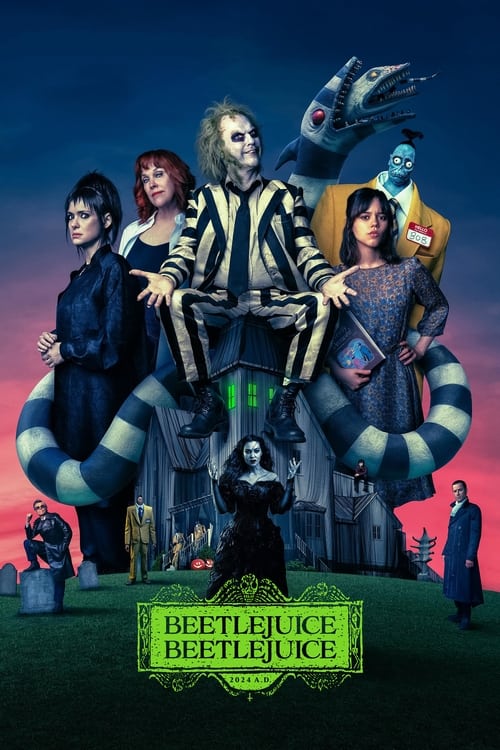
Beetlejuice Beetlejuice
2024 · Tim Burton
For a spooky-season night when you want laughs with your ghosts, not scares — ideal family-with-teens viewing or a comfort rewatch for anyone who grew up on the original. Zero challenge, maximum Halloween.
What it's about
Three generations of the Deetz family come home to Winter River after a death in the family: Lydia, now a haunted paranormal-TV host; her sharp, skeptical teenage daughter Astrid; and art-world matriarch Delia. When Astrid accidentally opens a portal to the Afterlife, the gleefully repulsive bio-exorcist Betelgeuse — who has been waiting decades for another shot at Lydia — comes crawling back into their lives.
The experience
A carnival ride through Tim Burton's afterlife — fast, gaudy, joke-dense, and stuffed with handmade ghouls and sight gags. It's macabre the way a Halloween party is macabre: death played as vaudeville, with just enough family feeling underneath to give it a pulse.
Performances
Michael Keaton slides back into Betelgeuse's moldy pinstripes without missing a beat — motor-mouthed, repellent, and irresistible — while Catherine O'Hara steals scenes as the magnificently self-absorbed Delia and Winona Ryder gives Lydia's return a genuine melancholy.
The craft
Burton leans hard into practical effects — puppets, prosthetics, stop-motion, handcrafted afterlife bureaucracy — giving the film a tactile, toybox quality that's become rare in studio fantasy. The production design of the waiting-room underworld is the star attraction, and it pops on a big screen.
Why it matters
A thirty-six-years-later sequel that became one of the biggest hits of the 2020s legacy-reboot wave, and a late-career reaffirmation of Burton's original handmade-gothic sensibility.
Horror · Horror comedy & camp · Haunted house & ghost story · Gothic. A gaudy, joke-packed carnival of handmade ghouls and afterlife sight gags, played for laughs; Halloween fun for families with teens.
Snapshot
Beetlejuice Beetlejuice is Tim Burton's thirty-six-years-later sequel to his 1988 breakout Beetlejuice, reuniting Michael Keaton, Winona Ryder, and Catherine O'Hara with the director who launched them into the film's peculiar afterlife. The premise folds a new generation into the original's household comedy: after the death of patriarch Charles Deetz, Lydia (Ryder) — now a paranormal-television host still traumatized by her adolescent brush with the undead — returns to Winter River with her estranged teenage daughter Astrid (Jenna Ortega) and stepmother-turned-conceptual-artist Delia (O'Hara). Astrid's accidental opening of a portal to the Afterlife draws the "bio-exorcist" Betelgeuse back into the family's orbit. The film is best understood as a legacy sequel arriving at the crest of the 2020s nostalgia-reboot cycle, but one made distinctive by Burton's deliberate return to handmade, analog craft after a stretch of more digitally saturated studio work. It premiered as the opening film of the Venice Film Festival before its wide theatrical release, and functioned commercially as a major late-summer 2024 event picture; specific grosses are outside the scope of this dossier, but its performance was widely characterized as a substantial success.
Industry & production
The film emerged from Warner Bros., the studio that held the original, and was shepherded in part through Burton's renewed creative partnership with writer-producers Alfred Gough and Miles Millar, with whom he had just enjoyed an outsized hit on the Netflix series Wednesday — a collaboration that also brought Jenna Ortega into Burton's world and, in effect, supplied the casting logic for Astrid. A Beetlejuice sequel had been a perennial development rumor for decades (various scripts and concepts, including a much-discussed "Beetlejuice Goes Hawaiian" premise attached to the original era, circulated over the years without materializing), so the 2024 film is the survivor of an unusually long gestation. The production benefited from the return of key above-the-line originators — Keaton, Ryder, O'Hara, and composer Danny Elfman — which gave the picture both marketing continuity and a genuine tonal through-line rather than a mere brand revival.
Production notably fell across the 2023 industry landscape shaped by the WGA and SAG-AFTRA strikes; the film shot in a window that required navigating that disruption, and Burton has spoken publicly in this period about a renewed skepticism toward AI and a desire to return to tactile filmmaking, which informed the production's methods. One sensitive real-world constraint shaped the narrative: Jeffrey Jones, who played Charles Deetz in 1988, did not return, and the sequel writes the character's death into its opening — handling his figure through stylized, non-photoreal means rather than recasting. The record on the exact contractual and creative reasoning is one better left uncharacterized here beyond the visible on-screen solution.
Technology
The most salient technological story of Beetlejuice Beetlejuice is a deliberate refusal of the era's default tools. Burton foregrounded practical and analog techniques: stop-motion animation, miniatures, puppetry, prosthetic and creature make-up, forced perspective, and in-camera trickery, with digital effects positioned as a supplement rather than the primary image-making engine. The sandworms of Saturn, the shrunken-head henchman Bob and his cohort, and the decapitated/reassembled bodies of the Afterlife bureaucracy are the kind of gags that reward a handmade approach, and the film leans into the seams and textures that photoreal CGI tends to sand away. This is consistent with the original's aesthetic, which was itself a showcase for practical creature and stop-motion work at the end of the 1980s, before the digital transition.
The choice is also a period statement. Made as generative AI anxieties peaked across Hollywood, the film's insistence on visible craft reads as an authorial position about where value and charm reside in fantasy imagery. Where exactly the production drew the line between practical and digital on any given shot is not fully documented in the public record, and it would be a mistake to claim the film is entirely CGI-free — modern compositing and clean-up are effectively unavoidable — but the guiding intention toward the tangible is clear and was central to how the film presented itself.
Technique
Cinematography
The film was photographed by Haris Zambarloukos, a cinematographer most associated with Kenneth Branagh's features, marking a new pairing rather than a continuation of Burton's earlier collaborations with Bruno Delbonnel or the late work of others. The visual grammar honors the original's storybook Gothic: saturated, slightly artificial color in the world of the living contrasted against the sickly greens, purples, and fluorescent bureaucratic palette of the Afterlife. Burton and Zambarloukos favor compositions that read as illustration — symmetrical framing, theatrical staging within the frame, and a willingness to let sets look like sets — which supports the practical-effects strategy by keeping the camera complicit in the artifice rather than straining for realism. Certain sequences, particularly a black-and-white flashback rendered in the manner of vintage Italian horror, function as explicit stylistic homage embedded in the cinematography itself.
Editing
Cut by Jay Prychidny — an editor who worked with Burton and the Gough–Millar team on Wednesday — the film's editorial rhythm juggles multiple plot strands (Lydia and Astrid's mother-daughter fracture, Betelgeuse's pursuit by his soul-sucking ex-wife Delores, Delia's grief-as-performance-art, and a young-romance subplot) and periodically detaches from linear storytelling for set-piece flights of fancy. The most conspicuous editorial mode is the musical/montage interlude, including a stylized origin flashback and a climactic wedding sequence built around a well-known pop song; these operate as self-contained numbers whose pacing departs from the surrounding comedy. The looseness is characteristic of the property — the 1988 film was itself famously episodic and gag-driven rather than tightly plotted — and the sequel embraces that structural permissiveness.
Mise-en-scène / staging
Production design returns to the twin-world architecture of the original: the peaked, gingerbread-Gothic Deetz house and Winter River town square on the side of the living, and the waiting-room-from-hell civil service of the dead, with its case-workers, corridors, and clerical undeath. Burton's signature — a collision of German Expressionist angles, Charles Addams cartooning, and midcentury Americana — governs the staging. The Afterlife is again imagined as an absurd bureaucracy, an idea that remains one of the property's richest comic engines. Practical sets, miniatures, and forced perspective allow the staging to feel continuous with 1988 rather than a glossy digital reinvention, and recurring visual motifs (stripes, the sandworm desert, model-town aesthetics) are consciously reprised.
Sound
Danny Elfman's return is the film's most important sonic decision. His original Beetlejuice score is among the defining works of the Burton–Elfman partnership, and the sequel both quotes and extends that language — the manic, carnivalesque orchestration with choral flourishes that fuses horror and comedy in a single gesture. Equally central is the property's tradition of using pre-existing songs as diegetic set pieces: the 1988 film made Harry Belafonte's calypso recordings ("Day-O," "Jump in the Line") into iconic sequences, and the sequel continues this strategy of pop-song showstoppers, most memorably in its wedding climax. Sound design leans on the wet, mechanical, cartoon-grotesque texture appropriate to bodies that come apart and reassemble.
Performance
Michael Keaton's Betelgeuse is the film's animating force and the clearest proof of continuity: his performance restores the character's improvisatory, vaudevillian menace — a fast-talking, leering trickster whose limited screen time (a deliberate inheritance from the original, where the title character appears far less than the marketing implies) concentrates his impact. Winona Ryder deepens Lydia from goth adolescent into a haunted, media-savvy adult, and Catherine O'Hara's Delia remains a comic highlight, her artistic pretensions now channeled through grief. Jenna Ortega imports the deadpan, watchful quality familiar from Wednesday as Astrid, effectively the new audience-surrogate outsider. The supporting ensemble — Monica Bellucci as Betelgeuse's vengeful, self-stapling ex-wife Delores, Willem Dafoe as a B-movie-actor-turned-afterlife-detective, and Justin Theroux as Lydia's oleaginous manager-boyfriend — extends the film's mode of broad, arch caricature. The register throughout is heightened and theatrical, in keeping with the source.
Narrative & dramatic mode
Structurally the film is a comedy of remarriage-and-reconciliation grafted onto a haunted-house farce. Its dramatic engine is generational: Lydia, once the child who could see the dead, is now a mother failing to see her own living daughter, and Astrid's skepticism recapitulates and inverts her mother's adolescent alienation. The Afterlife functions, as in 1988, less as a horror space than as a bureaucratic mirror of the world above, where death is paperwork and unfinished emotional business. The narrative mode is deliberately anti-tidy — a cluster of parallel subplots that periodically pause for spectacle — privileging tone, gag, and set piece over airtight causality. This is a legible authorial choice rather than a flaw: the property's identity is anarchic revue comedy in Gothic dress.
Genre & cycle
The film sits at the intersection of horror-comedy and fantasy, and within two overlapping industry cycles. First, it is a paradigmatic legacy sequel — the 2010s–2020s wave of decades-later continuations that return original stars to beloved properties (Blade Runner 2049, Top Gun: Maverick, Ghostbusters: Afterlife, and others), trading on generational memory while introducing a younger successor character. Second, it belongs to the durable lineage of American Gothic comedy that Burton has done as much as anyone to define, descending from the Addams-and-Munsters tradition of domesticated macabre. Its horror is affectionate and cartoonish rather than frightening, using the iconography of death — corpses, exorcists, the underworld — as a playground for slapstick and design.
Authorship & method
Beetlejuice Beetlejuice is a strong instance of Burton-as-auteur returning to his native idiom after a period of larger, more effects-heavy studio assignments (Alice in Wonderland, Dumbo). The reunion with Danny Elfman (composer) is the single most defining authorial signature, the pair's collaboration being one of the most consequential director-composer partnerships in modern American cinema. On the page, Alfred Gough and Miles Millar (screenplay; with story contributions connected to Beetlejuice franchise development, including Seth Grahame-Smith's involvement in the project's earlier phases) supply a structure attuned to Burton's tonal instincts, fresh from Wednesday. Haris Zambarloukos (cinematographer) and Jay Prychidny (editor) are comparatively newer collaborators, situating the film within Burton's evolving rather than fixed crew. The authorial method on display — practical effects, star loyalty, tonal fidelity to a 1980s original — amounts to a self-conscious act of curatorship, Burton returning to and preserving his own myth. Where specific attributions of story credit are contested or thinly documented in the public record, they should be treated with corresponding caution.
Movement / national cinema
The film is firmly within mainstream American studio filmmaking, but Burton is best read against the grain of that context: he is a Hollywood insider whose sensibility is essentially that of an outsider illustrator and animator, steeped in stop-motion, Universal-horror iconography, and a European Expressionist inheritance. There is no "movement" in the avant-garde sense here, but the film's black-and-white horror pastiche and its Italian-horror allusions (evoked through casting and a stylized flashback) gesture knowingly toward European genre traditions, and the practical-effects ethos aligns Burton with a craft lineage — Ray Harryhausen, the stop-motion tradition, classic monster make-up — that runs alongside rather than through the digital American blockbuster.
Era / period
Released in 2024, the film is a document of a specific mid-2020s moment: the maturation of the nostalgia economy, the strike-shadowed reckoning over labor and technology in Hollywood, and an emergent backlash against generative AI in creative industries. Its analog craft strategy is inseparable from that context, functioning as both aesthetic preference and cultural statement. It also reflects the streaming era's feedback loop — Burton's theatrical revival was materially enabled by the success of his Netflix series and its associated talent — showing how television and film pipelines had become continuous by the mid-2020s.
Themes
The film's central theme is generational inheritance and the transmission of grief — how a parent's unresolved trauma shapes, and estranges, a child. Death is treated, characteristically for Burton, as continuous with life: bureaucratic, mundane, negotiable, and above all not an ending but an ongoing set of obligations. Related motifs include the persistence of the past (literalized in Betelgeuse's inability to stay dead and buried), performance and inauthenticity (Lydia's ghost-hunting TV show, Delia's grief-art, Betelgeuse himself as pure showman), and the family as a haunted, reconstituted unit — the blended, multigenerational Deetz household extended into a fourth character generation. Beneath the comedy runs a sincere current about seeing and being seen: the recurring conceit that only certain people perceive the dead becomes a metaphor for parental attention and recognition.
Reception, canon & influence
Critical reception was broadly warm rather than rapturous: reviewers tended to praise Keaton, O'Hara, and the tactile design while noting the diffuse, subplot-heavy structure — a mixed-to-positive consensus consistent with well-received legacy sequels. (Precise aggregate scores and figures are outside this dossier's remit and should be verified against current sources.) Commercially it registered as a significant hit, confirming enduring affection for the property.
The influences on the film run backward to Burton's own 1988 original and its make-up/stop-motion craft; to the Addams-family tradition of Gothic domestic comedy; to Harryhausen-era practical fantasy; and, in its stylistic asides, to European horror. Its influence forward is still emerging and should not be overstated so soon after release, but two throughlines are already legible: it strengthened the commercial case for star-reunited legacy sequels made with theatrical event ambitions, and it stands as a high-profile argument for practical, handmade fantasy at precisely the moment the industry was debating AI and synthetic imagery. Whether it seeds a fuller franchise revival or influences a broader return to analog effects is, as of this writing, genuinely undetermined — a claim the historical record cannot yet support.
A Deleuzian reading
A woman in pieces puts herself back together with a staple gun.
The full Deleuzian reading of Beetlejuice Beetlejuice →
Reception
Landed in September 2024 as a genuine event — a $100M+ opening and instant 'Burton is back' narrative after a decade of misses. Two years on it's settled into fond-but-clear-eyed territory: a warm hangout sequel that most agree is more a collection of great bits than a great whole.
How Beetlejuice Beetlejuice was received, from release to now →
How to watch Beetlejuice Beetlejuice: what to notice on a first viewing
- Look for visible seams: puppet joints, staples, sets that look like sets. Burton builds with stop-motion, miniatures, prosthetics, and forced perspective, and he lets you see the joins. Digital work is demoted to cleanup. The shrunken heads and the reassembled office staff were made by hands. In 2024 a studio could have rendered all of this without a join. Seeing the seam is the film's position.
- Watch for rooms washed in a single hard red or green. The world of the living runs saturated and storybook. The Afterlife turns sickly green, purple, fluorescent. In the Italian-horror asides the color stops describing the room and swallows it, the way Bava lit. Color tells you which world you are in before anyone speaks, and which older horror film the room was borrowed from.
- Watch the Afterlife corridors: canted angles, stripes, geometry that never lines up. The dead run a civil service of case-workers, waiting rooms, and paperwork. Burton draws the architecture out of The Cabinet of Dr. Caligari, where perspective was painted onto flats. Objects there move and want on their own. Death in this film is an office, and the office is drawn by a silent German horror movie. Both jokes run at once.
- Count how few minutes Keaton is actually on screen. Betelgeuse talks fast, leers, and changes his pitch to fit whoever is listening. He hands out business cards for a profession he invented. Keaton plays him as a vaudeville act dropped into someone else's house. He is not a character with a goal. He is an appetite, and the film keeps him scarce so the appetite stays loud.
- Listen for Elfman's carnival orchestra and the choir riding over it. Danny Elfman scored the 1988 film and returns here, quoting his own music. The orchestration is manic and circus-like, with choral flourishes that make a scare and a gag land in the same gesture. The score tells you how to take each scene. Horror and comedy arrive on the same note instead of taking turns.
The whole guide to watching Beetlejuice Beetlejuice, with the keys for a rewatch →
Influences: the films it descends from and the films it influenced
- Beetlejuice (1988) — The direct source text: Ve Neill's latex prosthetic makeup and in-camera stop-motion gags (the shrunken heads, the sandworm, the elongating faces) plus Elfman's calliope-and-organ cue vocabulary, all of which the sequel deliberately reprises rather than reinvents.
- A Matter of Life and Death (1946) — Its celestial administration — a monumental processing hall and stairway where the dead are logged by clerks — is the template for staging the afterlife as a deadpan civil-service bureaucracy rather than a spiritual void.
- The Cabinet of Dr. Caligari (1920) — German Expressionist painted-perspective flats and canted, non-Euclidean architecture supply the grammar for the Netherworld's striped, angular waiting rooms and impossible corridors.
- Jason and the Argonauts (1963) — Ray Harryhausen's Dynamation armature puppetry is the handmade-monster idiom Burton openly cites, animating the afterlife's shrunken-head denizens as tactile stop-motion creatures instead of CGI.
- Suspiria (1977) — Saturated primary-color gel lighting inherited from Bava — hard reds and greens washing whole rooms — is quoted directly in the film's Italian-horror stylistic asides.
- 8½ (1963) — The closing carnivalesque procession — an ensemble revue that resolves emotion through spectacle rather than plot — is the grammar behind the anti-tidy 'MacArthur Park' showstopper finale.
- Wednesday (2022) — Gough & Millar's episodic macabre-comedy structure and Burton's gothic visual grammar carry directly into the sequel's screenplay — the writers arrived on it fresh from the series.
- The Nightmare Before Christmas (1993) — Burton-produced, Elfman-scored: its carnival-waltz songcraft and armature-performance stop-motion establish the puppet-driven macabre-musical mode the sequel's Netherworld extends.
- Edward Scissorhands (1990) — The Burton-Elfman storybook-gothic dialectic — pastel suburbia set against a looming gothic manor, scored with a music-box celesta motif — is the authorial signature the sequel returns to after Burton's larger studio assignments.
- Corpse Bride (2005) — Its two-tiered cosmology, where the land of the dead is livelier and more musical than the living world, plus Elfman's danse-macabre songwriting, prefigures the sequel's afterlife-as-revue staging.
- The Addams Family (1991) — The Gothic-domestic-comedy deadpan — a macabre household played with straight-faced bourgeois normalcy — is the comic register the O'Hara/Ryder family scenes operate in.
- Guillermo del Toro's Pinocchio (2022) — A high-profile argument for hand-built stop-motion armature fantasy as an explicit aesthetic refusal of synthetic/AI imagery — the same analog-craft stance the sequel stakes out.
- Poor Things (2023) — Practical storybook-gothic sets shot with forced perspective and fisheye lensing that make artifice legibly handmade, sharing the sequel's commitment to visible, tactile fabrication over seamless digital worlds.
- Ghostbusters: Afterlife (2021) — The star-reunion legacy-sequel template — returning original cast, practical creature/ectoplasm effects, theatrical-event framing — is the commercial and formal playbook the film runs.
- Coraline (2009) — Stop-motion Other-world built from tactile, handmade uncanny interiors, extending the Selick/Burton puppet lineage the sequel draws on for its underworld inhabitants.
- Frankenweenie (2012) — Burton's monochrome stop-motion homage to Universal/Whale horror demonstrates the same self-curatorial method — reviving his own 1980s short in handmade puppet form — that drives the sequel's return to native idiom.
Similar films
- Beetlejuice (1988) — influence & lineage
- Corpse Bride (2005) — influence & lineage
- Coraline (2009) — influence & lineage
- Edward Scissorhands (1990) — influence & lineage
- The Nightmare Before Christmas (1993) — influence & lineage
- Suspiria (1977) — influence & lineage · often watched together
- Lisa Frankenstein (2024) — often watched together
- Miss Peregrine's Home for Peculiar Children (2016) — shared sensibility
All the films related to Beetlejuice Beetlejuice →
Watch it with: curated runs of related films
- Horror That's In on the Joke — A run of horror comedies that know the rules — the slasher's final girl, the cabin in the woods, the zombie survival list, the deadly family tradition — and have a blast bending them, so watching them together turns each one's genre jokes into a running conversation.