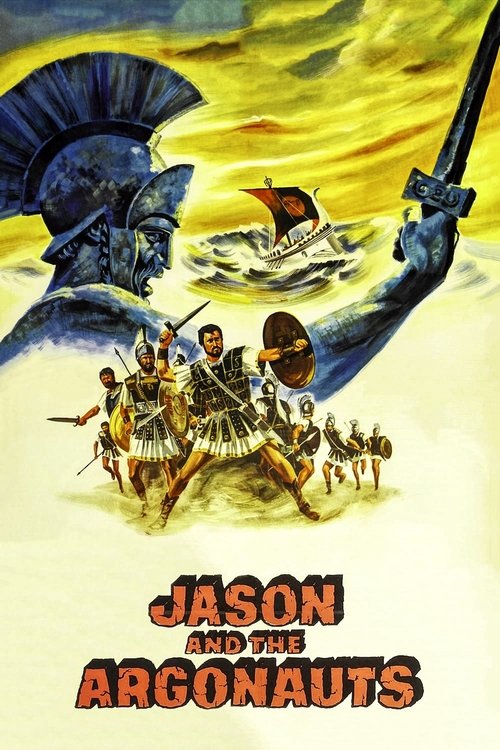
Jason and the Argonauts
1963 · Don Chaffey
For family movie night or when you want uncomplicated wonder — swords, monsters, and myth with zero cynicism; comfort viewing with a genuine sense of awe.
What it's about
To claim his rightful throne, the hero Jason must sail to the edge of the known world and bring back the Golden Fleece. He gathers a crew of champions aboard the Argo and runs a gauntlet of wonders — a bronze giant, shrieking harpies, clashing rocks, and worse — while the gods on Olympus move him across the board like a piece in their game.
The experience
A pure Saturday-matinee thrill that still delivers: brisk, colorful, and paced from marvel to marvel, with monster sequences that carry real menace and strange, handmade beauty. It's the kind of adventure that makes adults feel ten years old again.
The craft
This is Ray Harryhausen's stop-motion masterwork — every creature animated by hand, frame by frame, culminating in a skeleton swordfight against living actors that remains one of the most astonishing effects sequences ever committed to film. Bernard Herrmann's thunderous score drives it all, and the Mediterranean locations give the fantasy real sunlight and stone; it rewards the biggest screen you can find.
Why it matters
The pinnacle of Harryhausen's career and a foundational text for the effects artists and fantasy filmmakers who followed — generations of directors cite the skeleton fight as the moment they fell in love with movies.
Snapshot
Jason and the Argonauts is the film in which Ray Harryhausen's stop-motion animation stopped being a novelty attraction and became, briefly and completely, the reason cinema exists. Nominally a Columbia adventure picture directed by the British journeyman Don Chaffey, it is in practice a Harryhausen film — conceived around his key drawings, shot to accommodate his composites, and remembered almost entirely for four sequences: the bronze giant Talos turning his head on a groaning axis; the harpies harried into a net among the temples of Paestum; the sea god Triton shouldering apart the Clashing Rocks; and seven skeletons rising out of the earth to fence with three live men. It condenses Apollonius of Rhodes into a string of marvels, frames the whole with Zeus and Hera moving mortals across a board on Olympus, and ends without ending, on the promise of a sequel that never came. Commercially it was not the hit its makers wanted. Sixty years on it is routinely named the high-water mark of pre-digital fantasy filmmaking, and its skeleton duel remains the most-cited effects sequence of the analog era.
Industry & production
The film was produced by Charles H. Schneer through Morningside Productions for release by Columbia Pictures — the fifth and most ambitious entry in the Schneer–Harryhausen partnership that had already produced It Came from Beneath the Sea (1955), 20 Million Miles to Earth (1957), The 7th Voyage of Sinbad (1958), The 3 Worlds of Gulliver (1960) and Mysterious Island (1961). The economic model is the point: these were mid-budget pictures whose production values were manufactured in an animation room rather than bought on a soundstage. A giant, a hydra and a god of the sea cost model-making time, not extras and construction.
Shooting took place largely in Italy — the Palinuro coast, the Amalfi coastline, and the Greek temples at Paestum standing in for the Aegean world — with effects photography and animation completed under Harryhausen's control in Britain. Italy in 1962–63 offered cheap sunlight, standing classical architecture, crews experienced from the peplum boom, and favourable costs; the same calculus was drawing runaway American and British production south throughout the period. The picture was shot in Eastmancolor and released flat rather than in anamorphic widescreen, a technical decision with aesthetic consequences discussed below.
The screenplay is credited to Jan Read and Beverley Cross, the latter of whom would become the franchise's house mythographer, returning for Sinbad and the Eye of the Tiger (1977) and Clash of the Titans (1981). The project carried the working title Jason and the Golden Fleece before release. Detailed production documentation is comparatively thin for a film of this stature — much of what circulates derives from Harryhausen's own later accounts and interviews, and precise budget and grosses are not reliably established in the published record. What is consistently reported is that the film disappointed on first release relative to The 7th Voyage of Sinbad, and that its reputation was built afterwards, through television screenings and then home video.
Technology
The film's engine is Dynamation, Harryhausen's trade name for a split-screen travelling-matte compositing method built around rear projection. Live-action plates were shot on location with the actors playing to empty air. In the animation room, the plate was rear-projected a frame at a time onto a small screen; a matte blocked off the foreground portion of the image; the model was animated in front of the screen and photographed frame by frame. The film was then rewound and re-exposed with a counter-matte, printing the foreground element back in. The result is a "sandwich": background plate, animated puppet, foreground plane. A skeleton can appear to walk behind a rock and in front of a hillside within one shot, and a bronze colossus can straddle a real cove.
This is why the picture was not shot in CinemaScope. Anamorphic optics compounded the generation loss and grain of rear-projected plates and complicated the geometry of the whole process; Harryhausen's films stayed flat. He compensated by shooting in hard, bright Mediterranean sunlight, which held detail through the duplication stages and gave the composites the saturated, slightly hardened look that is now inseparable from the house style.
The creatures themselves were ball-and-socket metal armatures, built up with latex, foam and modeled surfaces, sculpted and finished by Harryhausen. Their scale is deliberately small — the illusion of size is manufactured by camera angle, by the reactions of actors, and above all by weight and tempo of movement rather than by physical bulk.
Technique
Cinematography
Wilkie Cooper, Harryhausen's regular collaborator across The 7th Voyage of Sinbad, The 3 Worlds of Gulliver, Mysterious Island and later First Men in the Moon, shot the picture. His job was unusual: much of his framing was dictated in advance by Harryhausen's key drawings, which specified camera position, lens height and the exact area of frame the creature would occupy. Cooper's contribution is the discipline of it — flat, clean, high-key exteriors with deep focus and minimal camera movement, because a moving camera in the live-action plate must be matched by a moving animation stand, and every added complication multiplies weeks of work.
The most expressive photographic choice is the low angle used for Talos. The camera sits at the level of men on a beach and cranes its gaze upward at nothing; the Argonauts are photographed small in the frame with sky above them, so that when the animated giant is composited into that empty upper register, he inherits the geography of the shot. It is a lesson in the effects shot as a photographic problem rather than a post-production one.
Editing
Maurice Rootes cut the film, but the significant editorial decisions were made before a frame was exposed. Harryhausen storyboarded the set-pieces as sequences of finished drawings that functioned as the film's real blueprint; because each composite was individually and expensively fabricated, coverage in the conventional sense did not exist for the creature scenes. The effects sequences are therefore edited at the level of conception, and they cut with a precision the surrounding dramatic scenes lack.
The dividing line is audible in the rhythm. Dialogue scenes are plainly, sometimes flatly assembled. The set-pieces accelerate systematically: the skeleton duel opens on wide, legible master compositions establishing the impossible co-presence of men and bones, then tightens as the fight goes on into shorter, closer, more fragmentary cuts — which both raises the tempo and, usefully, shortens the individual animated shots.
Mise-en-scène / staging
The staging problem of the film is that the actors are performing with partners who do not exist. Every creature scene had to be pre-choreographed to a plan and executed to counts, with eyelines given to marks and sightlines rehearsed so that a man's parry lands where a skeleton's sword will later be. The three-against-seven duel was rehearsed at length with fencing instruction so that the human half of the choreography could be filmed as a complete, internally coherent performance, against which Harryhausen then animated the opposing half.
Location work carries much of the film's texture: real stone, real sea, real ruins. The temples at Paestum give the harpy sequence a genuine antiquity that no set could buy, and the Argo is a physical ship on real water. The Olympus scenes take the opposite approach — a stylized, abstracted space with a pool that functions as a scrying surface and mortals rendered as figures on a board. The film keeps two visual registers, the tangible and the artificial, and its subject is the traffic between them.
Sound
Bernard Herrmann's score is the fourth and last of his Harryhausen collaborations, and the most severe. There is virtually no conventional romantic writing; Herrmann builds instead from massed brass, low woodwind and an unusually prominent percussion battery. Talos is announced by weight — heavy, slow, brazen sonorities that give the animated figure the mass its physical model does not have. The skeleton duel is scored on a percussion-dominant palette whose dry, clattering attack is doing characterization: the sound of bone. It is one of the clearest demonstrations in the medium of music supplying the physics that the image cannot.
The rest of the track is post-synchronised throughout, as international co-productions of the period generally were, and both leads were dubbed by British actors — a decision that flattens the performances and gives the film a faintly hermetic, storybook acoustic. Creature sound effects — the metallic groan of Talos turning his head, the shriek of the harpies — do as much work as the animation in persuading the ear that the eye is not being deceived.
Performance
Todd Armstrong's Jason is stolid and, being dubbed, doubly distanced; he is a function of the plot rather than a character in it, and the film is honest about this. The picture is carried by its supporting bench of British character actors. Niall MacGinnis's Zeus is the great performance — not thunderous but genial, worldly and faintly bored, a supreme being with the manner of a senior civil servant who has seen every case file before. Honor Blackman, filming while she was Cathy Gale on The Avengers and a year before Goldfinger, plays Hera as clipped, partisan and constrained; Nigel Green's Hercules supplies bluff physical authority and the film's one genuine moment of grief; Laurence Naismith's Argus is its craftsman-conscience; Patrick Troughton, three years from Doctor Who, makes a memorably ragged Phineas. Nancy Kovack's Medea, also dubbed, arrives too late in the structure to become the figure the myth requires.
Collectively these performances constitute an early, high-difficulty case study in acting against absent partners — the discipline that would become standard practice decades later in bluescreen and motion-capture production.
Narrative & dramatic mode
The film is quest-romance in its purest episodic form, inherited from Apollonius' Argonautica: a voyage strung as beads, each landfall producing a self-contained marvel. This is structurally risky — episodes do not accumulate dramatic pressure the way causally-linked scenes do — and the screenplay's solution is the Olympian frame. Zeus and Hera watch from above, wagering over Jason, with Hera permitted to intervene on his behalf a strictly limited number of times. That constraint converts a picaresque into something with a ticking mechanism: every rescue spends a finite resource, and the audience is counting.
The mode is frankly presentational. Characters state intentions, obstacles arrive on schedule, and the emotional register stays broad enough for a family matinee. The film's most interesting formal decision is its refusal of closure: it stops at the moment of triumph, with Zeus observing, in paraphrase, that the lovers may enjoy their calm sea for now — he has not finished with Jason. A sequel was clearly intended and never made, so the film permanently withholds the myth's dark second half: Corinth, betrayal, Medea's revenge. What survives is a fragment that behaves like a whole, and the omission arguably improves it.
Genre & cycle
Jason sits at the intersection of three cycles. It is adjacent to the Italian peplum boom detonated by Pietro Francisci's Hercules (1958), whose infrastructure and locations it borrows — but it is not a peplum, since its interest is in the marvelous rather than the muscular, and it declines the strongman iconography almost entirely. It belongs squarely to the Schneer–Harryhausen fantasy cycle, standing between the Sinbad films as the moment the formula turns from Arabian Nights orientalism to classical myth. And it is a product of the early-1960s family-adventure market, aimed at holiday and matinee audiences at a point when television had claimed the domestic audience and cinema was competing on spectacle.
Within Harryhausen's own filmography it is the pivot: The 7th Voyage of Sinbad established the model with a single animated skeleton; Jason multiplies that to seven and effectively exhausts the possibilities of the technique in one sequence. Everything after — through The Golden Voyage of Sinbad (1973) to Clash of the Titans (1981) — is variation.
Authorship & method
Authorship here is genuinely divided, and pretending otherwise misreads the film. Don Chaffey, credited director, was a capable British professional — Greyfriars Bobby (1961) and The Three Lives of Thomasina (1963) for Disney, Hammer's One Million Years B.C. (1966), later Pete's Dragon (1977), plus substantial television including The Prisoner and The Avengers. He directed the actors, the locations and the dramatic scenes competently and without signature.
The film's conceptual authorship belongs to Harryhausen, credited as associate producer and creator of the special visual effects. He designed the creatures, drew the key frames that fixed the shots, determined the film's set-piece architecture, and animated every figure himself. Schneer supplied the production frame and the commercial discipline. Beverley Cross and Jan Read built the mythological scaffolding, with Cross's Olympian wager the single most valuable dramaturgical contribution.
Among the department heads, Herrmann and Cooper are the decisive collaborators, both fluent in the peculiar demands of the format. Herrmann's departure after Jason — this was his last score for the unit — marks the end of the cycle's musical seriousness as clearly as the skeleton duel marks the peak of its visual ambition.
Movement / national cinema
The picture is a British-based, American-financed international production shot in Italy: a precise snapshot of how mid-budget genre cinema was organized in the early 1960s. British craft labor and animation facilities, Hollywood distribution, Mediterranean locations, and a multinational cast post-synchronised into a single language track. It belongs to the same industrial moment as the early Bond films — British-made, Eastmancolor, exotic-location, internationally financed — and shares their instinct that spectacle plus locations could compete with both television and the collapsing Hollywood roadshow epic.
It is not, in any useful sense, part of a movement. Its aesthetic lineage runs not through the national cinemas but through a technical craft tradition: Willis O'Brien's The Lost World (1925) and King Kong (1933), on which Harryhausen's entire practice is a direct filial elaboration.
Era / period
1963 is the year of Cleopatra's near-catastrophe, the visible end of the classical studio system, the ascent of the Bond franchise, and a marketplace splitting between adult art cinema and youth-and-family spectacle. Jason is a rational response to that landscape: a film whose production values are demonstrably impossible on television, made for a fraction of an epic's budget by manufacturing wonder in a small room. It also arrives at the last moment before the fantasy genre's center of gravity shifts — a decade and a half before Star Wars (1977) industrialized effects work and made the artisanal, single-animator model economically untenable.
Themes
The film's governing idea is that the gods are spectators. Zeus and Hera preside over a board of mortal pieces, intervene by whim within self-imposed rules, and treat a human life as a diversion of moderate interest. This is not solemnly tragic — MacGinnis plays it with charm — but it is genuinely bleak, and it gives the picture an intellectual spine that its dialogue scenes lack. Jason's counterpoint is a stubborn secular claim: that men should manage their own affairs and build their own ships. Argus the shipwright embodies that faith in craft, and the film quietly endorses it, since salvation arrives repeatedly through construction, seamanship and nerve.
A second thread concerns animation itself. Every major creature is an inanimate thing given motion: bronze made to walk, stone made to move, bone made to fight. The film is preoccupied with the uncanniness of the object that lives — which is, of course, exactly what Harryhausen was doing at his animation stand, one frame at a time. The Talos sequence, in which a statue's head grinds around to look at the men who robbed it, is the purest expression of that idea in the cycle.
Reception, canon & influence
Backward. The film descends from Willis O'Brien — Harryhausen's mentor and the animator of King Kong — and beyond him from the tradition of trick-film illusionism reaching back to Méliès. Its literary source is Apollonius of Rhodes, freely adapted: Talos is redesigned as bronze colossus with a heel-plug, the dragon's teeth of the Cadmus myth are transferred to the hydra, and the whole Corinthian aftermath is dropped. Its industrial context is the Italian peplum cycle; its narrative manners come from the Saturday-matinee serial.
Contemporary reception. Reviews on release were broadly appreciative of the effects and dismissive of the drama — a pattern that would follow Harryhausen's work for the rest of his career. Commercially the film is consistently described as underperforming expectations; specific figures are not reliably documented and should not be asserted. Its audience was assembled slowly, through television broadcast and later video, and by the 1980s it had become a canonical work of childhood cinephilia for a generation of filmmakers.
Forward. The skeleton duel is among the most influential three minutes in effects history. Sam Raimi's Army of Darkness (1992) is an extended homage; the animated skeleton warrior became a permanent fixture of fantasy film, comics and games, and the digital skeleton crews of later blockbusters are its descendants by other means. Harryhausen's influence on a generation is well documented in their own testimony — Peter Jackson, Tim Burton, Guillermo del Toro, John Landis, Nick Park, Phil Tippett and Dennis Muren among them — and Pixar's Monsters, Inc. (2001) named a restaurant "Harryhausen's" in tribute. Within the cycle, Clash of the Titans (1981), also written by Beverley Cross, is Jason's direct successor and Harryhausen's farewell.
The film's institutional standing was ratified when Harryhausen received the Academy's Gordon E. Sawyer Award in 1992; Tom Hanks, presenting, is widely reported to have joked that while others nominate Citizen Kane or Casablanca as the greatest film ever made, his choice was Jason and the Argonauts. Harryhausen himself repeatedly named it his own favorite of his films and the skeleton fight his finest work. That judgment has largely become the consensus one: not the best-directed film of its year, but the fullest realization of a craft that no longer exists in the form he practiced it.
A Deleuzian reading
The head turns first.
The full Deleuzian reading of Jason and the Argonauts →
Reception
In 1963 it played as well-made matinee fare and did only modest business, with Harryhausen himself lamenting it never got the recognition it deserved on release. Decades of TV reruns and filmmaker worship later, it's routinely called the crown jewel of Ray Harryhausen's career.
How Jason and the Argonauts was received, from release to now →
How to watch Jason and the Argonauts: what to notice on a first viewing
- Watch the empty sky above the men on the beach. Cooper frames the Argonauts small and low with a great deal of blank sky above them before Talos is ever composited into that space. The empty frame is reserved ground, built so the giant inherits real light and a real horizon.
- Listen for the low brass announcing Talos before he moves. Herrmann writes slow, heavy, brazen music that gives the small physical model a mass and menace the image alone cannot supply. The music is telling your ear what your eyes are being tricked into believing.
- Notice the actors' swords land exactly where nothing stands. Every fencer was rehearsed to counts, with eyelines given to marks, so a parry lands precisely where an animated blade will later be drawn in. The human performers are already acting the whole scene before a single creature exists.
- Notice how different Olympus looks from the rest of the film. Real ruins, real sea, and real stone carry the mortal scenes, while Zeus and Hera watch from a stylized, abstracted set with a scrying pool. The film keeps two separate worlds, one tangible and one artificial, and keeps crossing between them.
- Watch how long it takes the giant's head to turn. Talos grinds his head around slowly, with a groan, before he does anything else, long before any attack begins. That slow turn is the whole trick: a machine given a visible moment to notice you.
The whole guide to watching Jason and the Argonauts, with the keys for a rewatch →
Influences: the films it descends from and the films it influenced
- The Lost World (1925) — Willis O'Brien's ball-and-socket armature puppets combined with live-action plates via double exposure, glass shots and split-screen mattes established the frame-by-frame creature-inside-a-photographed-world grammar Harryhausen inherited whole from his mentor.
- King Kong (1933) — O'Brien's miniature rear-projection — animating the puppet one frame at a time in front of a back-projected plate of live actors, then re-photographing — is the precise technique the Schneer unit industrialized and rebranded as Dynamation.
- Mighty Joe Young (1949) — Harryhausen animated the majority of the gorilla himself under O'Brien, learning there the eyeline-matching and contact-shadow discipline that makes Talos's foot appear to land on the same ground the actors are standing on.
- The Beast from 20,000 Fathoms (1953) — Harryhausen's first solo feature, where he cheapened O'Brien's method by splitting a single live plate into foreground and background elements so the animated creature could pass behind real objects — the two-element sandwich later marketed as Dynamation.
- The 7th Voyage of Sinbad (1958) — The direct prototype: first Schneer–Harryhausen Dynamation feature in color, first Herrmann score for the unit, and the single animated skeleton dueling a live swordsman that Jason multiplies by seven.
- The 3 Worlds of Gulliver (1960) — An entire feature built on scale illusion — low camera, matched eyelines, split-screen compositing — which drilled the unit in directing actors to play against partners marked out on an empty set and inserted months later.
- Journey to the Center of the Earth (1959) — Herrmann's strings-less orchestration (five organs, massed brass, low woodwind) is the same timbre-as-character strategy he brings to Talos, where the creature is scored by brass and percussion blocks rather than by melody.
- Hercules (1958) — Supplies the peplum production template Jason works inside: Mediterranean location exteriors shot flat and high-key in deep focus, a multinational cast wholly post-synchronised, and mythological episodes structured as discrete physical trials.
- The Golden Voyage of Sinbad (1973) — The six-armed Kali sword dance is the skeleton duel restaged — multiple animated blades converging on one live actor, cut to the same accelerating shot rhythm that shortens as the fight closes.
- Clash of the Titans (1981) — Beverley Cross returns and rebuilds his key dramaturgical invention from Jason — a second Olympian register in which gods move mortal figures on a board, motivating each creature set piece rather than merely introducing it.
- The Empire Strikes Back (1980) — Phil Tippett's AT-AT and tauntaun animation is Harryhausen's armature puppetry with go-motion blur added to defeat strobing, still married to live plates by the same foreground/background matte split.
- The Terminator (1984) — Gene Warren Jr.'s stop-motion metal endoskeleton advancing on live actors fuses Talos and the skeletons: an inorganic humanoid whose menace comes from stiff, weightless, frame-stepped articulation rather than from mass.
- Army of Darkness (1992) — An avowed feature-length extension of the skeleton duel, mixing stop-motion, replacement animation and wire-rigged doubles to scale Harryhausen's choreography-to-absent-partners from three combatants to an army.
- Jurassic Park (1993) — Tippett's stop-motion animators keyframed the CG dinosaurs through an armature-based Dinosaur Input Device, preserving Harryhausen's pose-to-pose performance instinct at the exact moment the photographic technique that carried it died.
- Pirates of the Caribbean: The Curse of the Black Pearl (2003) — The moonlit skeleton crew is Jason's set piece executed digitally, and it retains the tell — actors fencing and reacting to sightlines against nothing, with the animated opponent composited to those pre-fixed eyelines afterwards.
- King Kong (2005) — Harryhausen's Dynamation choreography integrating animated creatures with live actors in the same frame — the technical-aesthetic tradition Kong's digital animation explicitly honors and supersedes.
- Return of the Jedi (1983) — Harryhausen's Dynamation stop-motion creature animation is the direct craft line to Phil Tippett's go-motion rancor and AT-ST work in Jedi.
- Beetlejuice (1988) — Harryhausen's stop-motion creature animation is the technique Burton revives for the lurching sandworms and shape-shifting bodily gags.
- The Lord of the Rings: The Two Towers (2002) — Ray Harryhausen's Dynamation established how an articulated synthetic creature can hold eyelines and trade blows convincingly with actors in the same shot — the staging logic Weta digitized for Gollum and the Uruk-hai.
- The Lord of the Rings: The Fellowship of the Ring (2001) — Ray Harryhausen's stop-motion creature choreography (the skeleton-army duel) is the artisanal-monster lineage WETA modernized into the cave-troll and Moria set pieces, prioritizing tactile creature weight over slick CG.
- Mysterious Island (1961) — Same unit, same method — Harryhausen built the giant crab around a real crab carapace and Herrmann scored each creature encounter as a self-contained symphonic movement, the set-piece-as-suite architecture Jason perfects.
- First Men in the Moon (1964) — The immediate successor made by the same storyboard-first process, where Harryhausen's key drawings fix the shot list before shooting; Herrmann's absence from the podium exposes how much of Jason's weight was carried by scoring rather than animation.
- One Million Years B.C. (1966) — Chaffey again directing performers to react to nothing on location while Harryhausen supplies the antagonist months later — the allosaurus attack repeats Jason's blocking principle of arranging human bodies around an empty axis that will be filled in animation.
Similar films
- King Kong (1933) — influence & lineage
- Jurassic Park (1993) — influence & lineage
- Pirates of the Caribbean: The Curse of the Black Pearl (2003) — influence & lineage · same viewing thread
- The Odyssey (2026) — same viewing thread
- The Lord of the Rings: The Return of the King (2003) — same viewing thread
- Indiana Jones and the Last Crusade (1989) — same viewing thread
- Harry Potter and the Deathly Hallows: Part 2 (2011) — same viewing thread
- Fantasia (1940) — often watched together
All the films related to Jason and the Argonauts →
Watch it with: curated runs of related films
- Studio-Sized Mythmaking — A run of blockbuster quest epics — fellowships forged, dark lords faced, and long roads home — that rhyme on scale, world-building, and the pull of a saga you can lose a weekend inside.